Tenth of December

Almost a year ago, for the month of June, I read and wrote about a short story every day, for the entire month. I’m collecting online stories again this year (already close to the requisite thirty) – though I haven’t decided whether to do the same thing again.

Any suggestions or feedback would be greatly appreciated. Si o No.

On Day 7 of last year I read and wrote about the story Sea Oak, by George Saunders. It made me want to read more. I have just finished a long, interesting, but somewhat repetitive tome and wanted something shorter and lighter. So I picked up a book of George Saunders short stories in a digital loan from my library. It was the collection Tenth of December – and has been almost universally praised, often listed as one of the best books of last year.

And it did not disappoint.

First of all, though, the negative. George Saunders has a great skill – an innovative way – with words. Sometimes it feels as if he is showing off. Unusual forms, unexpected voices, mannered style – it’s all here and may be layered a little thick. I can see why the jaded literati have are so enamored – he can be challenging. In a few places I wanted to tell him to simply get on with it.

But, still, the stories had heart. The true judge of a work is whether or not you care about the characters and in these stories you do. They will break you in unexpected places and in an unanticipated fashion.

Back to the style. One technique that he uses to devastating effect is to tell a story from several points of view – from characters that are about to intersect in surprising ways. He uses this technique to illustrate how completely different the world is seen by different people. He exposes the little lies everyone tells themselves… simply to get through the day.

The first story in the collection uses this technique in triplicate. A popular girl, an unpopular boy, and a meter reader with bad intentions all tell their own stories in their own voices, observing each other under harrowing circumstances. A delicate structure, but one of great strength.

Another story – this one available online from the New Yorker, Puppy – uses the same technique for two women. They observe and are observed by each other and both found lacking – though they both are doing the best they can.

The title story – also available online, Tenth of December – has a young boy living in a fantasy world inside his head and an older man with a big problem intersecting on a freezing mountainside. Each has no idea of the others plight but are able to arrive at an understanding in the end.

Arguably the oddest, and possible the most powerful story, the The Semplica-Girl DiariesRead it here, too, courtesy of the New Yorker – is written as a diary from a father to future generations. The jarring language and constant use of abbreviations makes it a hard read (I was halfway through before I figured out what “SG” meant) but by the end you realize it is worth the effort. A devastating comment on consumer culture, international capitalism, and exploitation of third world workers – all disguised as a diary of a father trying to have a nice birthday party for his little girl.

So, there are three stories you can read online. If you like them, get the book – it’s worth it.
And those are three more stories I can’t use for my month of short stories in June, if I decide to do that.

Don’t worry, there are more where those came from.

Dallas Noir

Dallas-Noir

About a year and a half ago, I read a book called New Orleans Noir – which I enjoyed a lot. It was a collection of DARK short stories all set in a city I love very much… and a city, despite all its frivolity and fun, that has plenty of opportunities for that side of the human spirit.

The book was part of a series of noir short stories tied to individual cities. After reading it, I had a thought, “I wish they would do one of these on Dallas – but they never will.” I was wrong.

I missed it when the book was published or I would have gone to some of the events. I didn’t find out about the book until it made the rounds on social media. When the publication of Dallas Noir popped up in my facebook feed I was really excited. And in this day of ebooks and instant gratification, fifteen seconds later I was looking at the table of contents.

What was even cooler is that I have personally met two of the authors – I read their stories first.

David Haynes is an Associate Professor and Director of Creative Writing at SMU. About a decade ago I took a couple of classes in fiction writing from him through the Writer’s Garrett. I’ve always been amazed at how much more I learned from these than from my college writing classes (which set my writing back over a quarter-century – it’s my college writing classes that are responsible for me being a chemist).

His story, “Big Things Happening Here,” Oak Lawn, was more than excellent. Unique, subtle, very “literary” – it tells the story of two men that witness someone being abducted in a tony suburb and are drawn into a vast conspiracy… or maybe not. A thought provoking tale of the possibility of a secret undercurrent of modern life – an illustration of the adage, “Simply because you are paranoid doesn’t mean they are not out to get you.”

Next I read a story by Catherine Cuellar, “Dog Sitter,” Love Field. I have met her a number of times at events in the Arts District and bike rides. Her contribution was on the more civilized edge of the noir genre – a story of a domestic worker that kills a passerby by accident. It’s a finely characterized tale which captures the delicate and difficult life led by those right under our noses, yet right outside of the mainstream of society.

After those two I cranked through the collection in order. I was familiar with many of the writers – I’ve been reading Ben Fountain and Harry Hunsiker for a while. There was a wide variety in all the stories – which made it as enjoyable as a box of chocolates – but the locations were all familiar. They did a good enough job of inserting locations and people that any Dallasite will recognize to give me the creeps as I ride/drive/move around town and see things that remind me of the stories.

The last story was by Jonathan Woods, “Swingers Anonymous,” M Streets. I enjoyed his collection, Bad Juju & Other Tales of Madness and Mayhem – driving down to the Pearl Cup on Henderson to hear him read one night. I’ve always admired his writing – because he doesn’t fuck around. He writes like a truck wreck… the story comes at you two hundred proof and on fire. True to form, his story in Dallas Noir has a classic “grab your attention” opening line:

We all went over to Pauline’s to admire her breasts.

How can you not finish a story that starts like that?

Dallas Jail complex with the Margaret Hunt Hill bridge in the background. (click to enlarge)

Dallas Jail complex with the Margaret Hunt Hill bridge in the background.
(click to enlarge)

Life After High School

I read a lot of short stories. A lot.

All my life I have read voraciously and read short stories particularly. After the advent of the ebook and the portable reader I have been able to kick it up a notch. My Kindle goes with me everywhere and I’m able to read in the small nooks of time that I can scare up. The short story is particularly good to gobble up in these little snips and sips. I usually read one at lunch and another before I go to sleep. That’s two short stories a day… and over a few years… over a handful of decades… they add up.

Kindle

Call Me Ishmael

Forty years ago, I had an English professor ask me about my reading habits. I told him I had gone to high school in another country and life there consisted of days of boredom sandwiched between moments of stark terror. I had picked up the habit of reading whenever I could.

“But it is mostly junk,” I said, “Cheap Science Fiction and stuff like that.”

“Your sense of story is very strong.” the professor said, “Talking to students over the years, I think that the important thing is to read and it doesn’t really matter what you read, as long as you read a lot.”

Not too long ago, on this very blog, I did my Month of Short Stories entries – where I wrote about a short story each day. I enjoyed doing that and promised to write more about particular works that caught my fancy.

The other day I finished a large collection of Joyce Carol Oates short stories called High Lonesome. It brings together her own favorites over forty years – from 1966 to 2006. Oates is a very prolific writer and it was good to peruse this sampling.

Alice Munro recently won the Noble Prize for her short stories and I like to compare the two writers. Munro is the unassailable master of the form – but on the whole, I prefer reading Oates. Munro’s writing concerns the life she has led and the people she has known and the wisdom she has acquired. Wonderful stuff and I am so happy she deservedly won the prize. However, Oates goes one step beyond – she kicks it up a notch. Oates writes about the void… the beyond… the horror that lies right on the other side of the tender membrane that divides our world from the realm of madness.

That is something I am interested in.

There are a lot of great and interesting stories in the collection, including the classic “Where are you going, Where Have You Been?” and the amazing “Heat” – which I wrote about before. Today, I want to talk about one of the later stories in the collection, “Life After High School.”

Spoilers will be written, so please, surprise everyone and read the story first. I found a PDF of it here.

“Life After High School” seems to be a popular story for school essay assignments – there is a lot written about it on this interweb thing. I looked at more than a few – and everybody seems to completely miss the point of the story.

You see… it’s really three stories in one. The first two are tricks played on the reader – then she hits you with the hammer, the third.

The first three quarters of the story is the tragic tale of unrequited love where Zachary Graff, the intelligent but socially awkward teenager falls in love with Sunny Burhman, the attractive and popular girl that everyone likes. He eventually, Senior Year, works up the nerve to propose to her and she, of course, says no. He is so heartbroken he kills himself by running his car in a closed garage. This devastates Miss Burhman, and she is “Sunny” no more.

So far, so good. An oft-told tale, one that every reader, especially a young person, will recognize and understand.

But Oates throws a twist. The story isn’t “High School” – it’s “Life After…” and, decades later a middle-aged Sunny Burhman contacts another student, Tobias Shanks, from those days. They meet for lunch and Sunny discovers that the two boys were gay lovers and that Zachary went to see him after she had rejected Zachary and, moreover, Zachary had left him a suicide note.

So now the story has morphed into one of a sensitive young man destroyed by society’s disapproval and Zachary’s proposal to Sunny was his last, futile attempt to “fit in.”

And that is where most people that read it leave the story. It is where I was ready to leave it… but not everything fit.

For example, the description that Oates provides of Zachary was a little odd. She said that most people were afraid of him. That doesn’t fit with the usual view of an odd, awkward, gay loser.

Also, Sunny says to him, “Zachary, it’s a free world.” But his response is, “Oh no it isn’t, Sunny. For some of us, it isn’t” A foreboding answer for a young person. There are plenty of other incongruities – I’ll leave some for you to find – enough to make my point clear on a second reading.

But finally, there was a detailed list of items that were found in his car at his death, it was said to be oddly littered. There was a Bible, some pizza crusts, textbooks, size eleven gym shoes, a ten foot piece of clothesline in the glove compartment, and the engagement ring in the car. (italics mine)

What was that all about? Why tell us all this? Chekhov’s gun says there has to be a reason… a good one.

So I was a little suspicious of the story. And then, I came to the last line… and the whole story changed. You see you think the story is one thing, then you think it’s another – and with the simple, final sentence it all changes, radically, for the last time.

After they have talked and read the suicide note, Sunny, almost as an afterthought, says:

“What do you think Zachary planned to do with the clothesline?”

And there it is.

Zachary wasn’t simply an awkward, misunderstood teenager… he was a killer. He didn’t propose to Sunny because he loved her (though he certainly did) – he was trying to get her into his car so he could kill her. When he failed, he went to see Tobias Shanks, his other love, and tried the same thing with him. Only then, with his homicidal needs frustrated, did he then off himself.

And the girl knew it. Sunny didn’t change her life after high school because of guilt over her rejection of Zachary. She was devastated because of the realization of how close she came to evil, how near she was to being an innocent murder victim, how thin that membrane that protects us really is.

Now… that is a story.

The funny thing is, reading what other folks thought about the tale, nobody else seemed to get it.

Here’s an analysis that is confused by the clothesline and the final line – the most important part of the story.

The clothesline is a symbol whose meaning is up for interpretation because the story does not give it a definite role. It could have been used to force Tobias or Sunny into coming with Zachary or Zachary could have planned to use it to kill himself

Here’s one that only notices the coldness of the final question (in my opinion, her detachment is her armor against the horror that lies beyond)…

Barbara Burhman’s final question in the story, “Life After High School” by Joyce Carol Oates was an appropiate closure because it is a reflection and direct unfolding of one of Barbara’s defining core characteristics and how she really truly feels about Zachary: cold-hearted indifference.

and finally, this one, simply says,

In the extract it was mentioned that Zachary had a clothesline in the glove compartment when the police found him dead in his car. It shows us that if the carbon monoxide did not work to kill him, he would have used the clothesline. It is an appropriate closure to the story because it shows Barbara and Tobias that there was nothing that they could do to save him. Zachary was determined to kill himself. I guess it shows some relief that he would have committed suicide sooner or later, if they might have saved him from the car.

Yeah, right. That’s a pretty slim reason to put that sentence in there for a writer of Oates’ skill. It’s like Chekhov included a gun so that the protagonist could have something to clean.

Am I off base here? Am I reading something into that last question that isn’t there? Is this really a tale of teenage angst, society’s rejection, and doomed love? Am I nuts to read into it a brilliant subtext of homicide and madness?

I don’t think so.

What do you think? – That’s assuming you do.

What I learned this week, November 22, 2013


5 city bikes that roll you through town in style
The latest in steel-framed, fender-clad, and leather-saddled bikes at a variety of price points.

Some of the ones that caught my eye:

Shinola Runwell

Purefix Bourbon

Public V7

If I could afford a new bike – this is what I would buy right now:
Xootr Swift


I love reading (and writing) short stories. Apparently, I’m not alone.

2013: The Year of the Short Story


In Dallas, a deafening slurping noise as the town goes crazy for Asian noodles


I’m going to have to go visit Sulphur Springs and use the public restrooms.


The Ten Sexiest Riffs in Music


You’ve probably already seen this – but it is the coolest music video I’ve ever seen. Be sure and check out all the channels.

Bob Dylan – Like a Rolling Stone – Official Video

For some reason, I really like “The Price is Right” channel… maybe it’s just Drew Carey lip-syncing Dylan.


A cow-orker is retiring at the end of the year (an awful lot are) and he stopped by my office for my help on getting his replacement up and going. I asked the innocent question, “Do you have any plans for retirement.”

He got all excited and launched into a long lecture on kayak fishing and, especially, about the particular kayak he is getting ready to buy – the Hobie Mirage Pro Angler 14. I have to admit – the thing is pretty cool.

The most amazing (to me) feature are the foot powered propulsion fins. Two flexible extensions underwater are moved by pedals to propel the kayak forward. Pretty cool… but not cheap.

Short Story Day Thirty-One – Carnation, Lily, Lily, Rose

31. Carnation, Lily, Lily, Rose
Kelly Link
http://www.fenceportal.org/?page_id=2327

This is day Thirty-One of my Month of Short Stories – the last day – a story a day for June (and one day in July).

Carnation, Lily, Lily, Rose - by John Singer Sargent

Carnation, Lily, Lily, Rose – by John Singer Sargent

Today, for the last post of my Month of Short Stories – I present to you a story I have definitely read before. It’s been a long time, though, and I wanted you to know about this story, this book, and the writer.

I remember clearly, back then… 2002? probably… I was looking for something to read. I came across an article in Salon that listed their favorite books of the year. There, nestled in with such literary giants of our time like The Corrections, Bel Canto, and Austerlitz, was an odd looking little book of stories called Stranger Things Happen by Kelly Link. The magazine raved about it.

Surfing around the web I found plenty of other folks giving it a lot of love. So I bought the thing.

And it was amazing. The stories are best described as adult fairly tales – fantastic and imaginative – passionate and very, very odd. It lived up to expectations.

So please go out and get this book. If you are cheap, it’s available for free download – as are her other works. If you download it and like it as much as I did, you will buy a copy (I think I’ve bought three over the years). She’s coming out with a hardback special limited edition later this year – but it’s a little over my price range right now.

Today’s story, Carnation, Lily, Lily, Rose is a strange piece of fantastic fiction. A recently deceased man, stuck is some sort of odd limbo, is writing letters to his still-living wife. Unfortunately, he can’t remember her name, though he does remember a girl, Looly Bellows, that beat him up in fourth grade.

As time goes on, the scene gets stranger and stranger as his mind continues to drift further away from the mortal plane. I’m not sure if it is an accurate depiction of what happens when we die, and I don’t know if I want it to be, but it’s the sort of thing that should happen if the universe has as much of a sense of perverse humor and strange surprises in the next life as it does in this one.

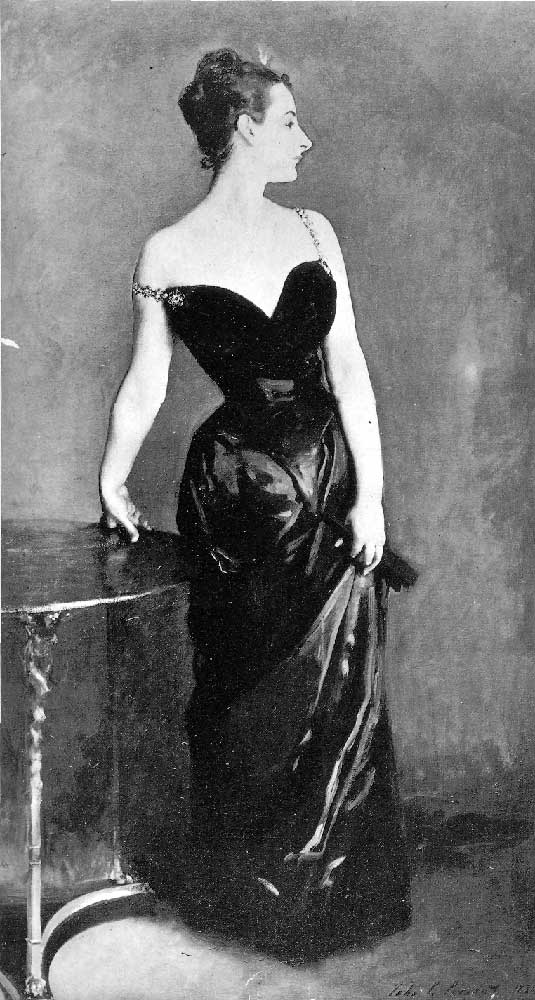
Now, like all obsessions – this story led me down a long rabbit-hole. The title, Carnation, Lily, Lily, Rose is taken from a painting by John Singer Sargent. I had to do a little research on him, and came across the famous story of Madame X.

In Paris he did a portrait of Madame Pierre Gautreau, an young American woman from New Orleans. She was a rising star in Parisian High Society and her portrait caused a huge stir when it was unveiled. A huge stir of the wrong kind.

Sargent had painted her with one strap of her gown hanging down off her shoulder. This, along with her plunging neckline and powder-white skin gave the painting a sensual excitement that wasn’t acceptable at the time.

A photograph of the original painting of Madame X.

A photograph of the original painting of Madame X.

The repainted Madame X - her gown strap is back up on her shoulder.

The repainted Madame X – her gown strap is back up on her shoulder.

He re-did the painting with the strap in a more demure position – but the damage was done. Ms. Gautreau had to slink back to Louisiana to escape the social ridicule. Sargent had to flee to England to regain his reputation.

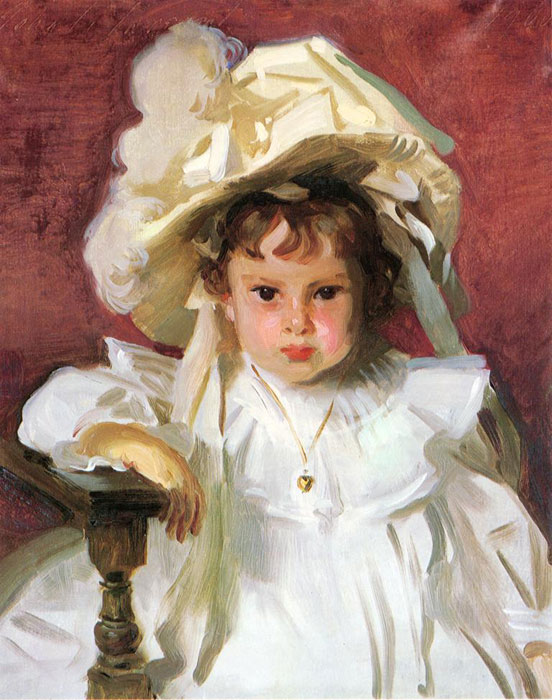
None of this has anything to do with the story – but it’s cool anyway. I’ve become a fan of Sargent because of this story, even though I’ve never been big on portraiture. I always stop and look at Dorothy whenever I visit the Dallas Museum of Art.

Dorothy, by John Singer Sargent, in the Dallas Museum of Art.

Dorothy, by John Singer Sargent, in the Dallas Museum of Art.

So, my advice is to read all of Stranger Things Happen – the other stories are just as odd, but in surprisingly different ways. Then go to the nearest good art museum and take a look at a Sargent – see what you can see in the eyes. It might be useful, help you remember things when you are stuck in limbo. We all will be there, sooner than we think.

I hope you enjoyed some of my month of short stories – it was fun and educational putting it together (though a surprising amount of work). Don’t know what I’ll do tomorrow… maybe a photograph.

Later.

I’ve been here for 3 days, and I’m trying to pretend that it’s just a vacation, like when we went to that island in that country. Santorini? Great Britain? The one with all the cliffs. The one with the hotel with the bunkbeds, and little squares of pink toilet paper, like handkerchiefs. It had seashells in the window too, didn’t it, that were transparent like bottle glass? They smelled like bleach? It was a very nice island. No trees. You said that when you died, you hoped heaven would be an island like that. And now I’m dead, and here I am.
—-Carnation, Lily, Lily, Rose, by Kelly Link

Short Story Day Thirty – Passion

30. Passion
Alice Munro
http://www.newyorker.com/archive/2004/03/22/040322fi_fiction

As we are in the ninth inning, the home stretch, of my month of short stories we come across Alice Munro. She is the master – the best of the best.

I have been voraciously reading Alice Munro for decades now… and she should be in my list of writers that I have read everything – but she writes so much (all short stories) that there is always more. Most of what she writes shows up first in the New Yorker – she is the quintessential New Yorker fictioner.

What she does is magical. Read her stories and pay attention to how she plays with time. There is usually several different time planes going on – complex, yet made clear by careful attention to detail. The story is often told by illuminating subtle changes in a character between fictional scenes that take place on different sides of a shift in the story. Often times this shift is never actually shown or described… merely inferred from what has scarred or uplifted (or both) the characters before and after. There are subtle connections across time and place – you have to look closely to figure them out – but they resonate deep in your mind as you read.

Today’s story, Passion, is pure Munro. A woman is looking back over a critical period of her life – how critical it was and in what way isn’t clear until the final sentence.

I didn’t do this on purpose – but it is very interesting to compare this story to yesterday’s – The Garden Party. Both are tales of class differences. But Passion – the Munro story – is the opposite… a mirror image, of Mansfield’s The Garden Party.

In this one, the protagonist is a poor girl that stumbles into contact with the wealthy. However, as occurs in yesterday’s tale – once in the other’s camp she is exposed to death, and is changed in complex and subtle ways. Both women (both about the same age) are smart, resourceful, and perceptive beyond their years and expectations and are relied upon to help keep things going smoothly. However, both learn that the world is a harder, more complicated, and dangerous place – with darkness, passion, and beauty all wrapped up and twined, twisted, and knotted together.

The wealthy Traverse family in today’s story is not as isolated or as heartless as the Sheridans in yesterday’s – but they are every bit as flawed and are quietly doomed.

Munro spells out this doom without embellishment or symbolism – she simply tells the story – with great skill. It’s perfect. It’s why she is the best.

She had thought that it was touch. Mouths, tongues, skin, bodies, banging bone on bone. Inflammation. Passion. But that wasn’t what she’d been working toward at all. She had seen deeper, deeper into him than she could ever have managed if they’d gone that way.

What she saw was final. As if she were at the edge of a flat dark body of water that stretched on and on. Cold, level water. Looking out at such dark, cold, level water, and knowing that it was all there was.

It wasn’t the drinking that was responsible. Drinking, needing to drink—that was just some sort of distraction, like everything else, from the thing that was waiting, no matter what, all the time.
—-Passion, by Alice Munro

Short Story Day Twenty-Nine – The Garden Party

29. The Garden Party
Katherine Mansfield
http://www.classicshorts.com/stories/TheGardenParty.html

This is day Twenty-nine of my Month of Short Stories – a story a day for June.

Katherine Mansfield was a writer from New Zealand that spent a large portion of her short life in Europe. She lived in the years around World War I. Her upbringing was very upper class (reflected in today’s story) but left that life behind for a bohemian existence. She hung out with some of the other great writers of the time like D.H. Lawrence and Virginia Woolf. She contracted tuberculosis and after years of illness she died at 34.

Today’s story is one of her later stories… and it’s one of the classics. When you first look at it what you see is a tale of class – the silly rich folks with their fancy smancy party, complete with cream puffs and a band, while down the lane the poor folks are dying. All this is true, and if it was all it would be a pretty good tale.

There’s more though, lots more. It’s a coming of age tale, with a twist. The young girl, Laura that has her first exposure to death… even to life outside of her garden party world – is modelled on the myth of Persephone. She visits the world of death and returns.

And the dead man that Laura sees – he is beautiful, untouched – he looks like he is sleeping. One of the turning points in the author’s life is when her beloved brother was killed in a grenade training accident in World War I. She said he was, “Blown to bits.”

So, here in a simple little story, we have issues of class, of life and death, of coming of age and the loss of innocence, and even the horrors of war. This complex tapestry – the end makes sense. Laura decides to tell us what life is… and she answers the only way she can.

There lay a young man, fast asleep – sleeping so soundly, so deeply, that he was far, far away from them both. Oh, so remote, so peaceful. He was dreaming. Never wake him up again. His head was sunk in the pillow, his eyes were closed; they were blind under the closed eyelids. He was given up to his dream. What did garden-parties and baskets and lace frocks matter to him? He was far from all those things. He was wonderful, beautiful. While they were laughing and while the band was playing, this marvel had come to the lane. Happy … happy … All is well, said that sleeping face. This is just as it should be. I am content.

But all the same you had to cry, and she couldn’t go out of the room without saying something to him. Laura gave a loud childish sob.

“Forgive my hat,” she said.
—-Katherine Mansfield, The Garden Party

Short Story Day Twenty-Eight – Pretty Boy

28. Pretty Boy
Richard Ford
http://www.guardian.co.uk/books/2005/jun/25/originalwriting.fiction5

This is day Twenty-eight of my Month of Short Stories – a story a day for June.

The cover of Richard Ford's novel - The Sportswriter.

The cover of Richard Ford’s novel – The Sportswriter.

One day, a while back… I remember I was at a crossroads, but I don’t remember what that was. Some sort of ridiculous existential panic. In adjusting my way of looking at the world, I decided to change what I was reading. That’s the sort of pitiful thing that I do. So I sat down with a fistful of recommended novels lists, and after a bit of seeking and thinking, I came up with The Sportswriter, by Richard Ford. I’m ashamed to admit that one reason was a strange, and probably perverse, fascination with the book’s cover.

So I bought the book and its much-ballyhooed sequel – Independence Day, and read them (the third novel in the Frank Bascome trilogy, The Lay of the Land, had not been published yet) in one gulp. I wasn’t sure what to think of the books…. They were very, very well-written – but I simply couldn’t get myself to care enough about Frank Bascome. I felt sorry for him – for the loss of his child – but his drowning in angst by simply living out the life of a New Jersey family man, sans family, wasn’t interesting enough. There didn’t seem to be enough there there.

Then, after a couple years, I stumbled across Richard Ford’s short stories… which were another deal altogether. More specifically, I read the collection Rock Springs. I found there was some meat on these bones. The stories in Rock Springs put Richard Ford in the category of Dirty Realism (this term was coined by Bill Buford of Granta – he said, “Dirty realism is the fiction of a new generation of American authors. They write about the belly-side of contemporary life – a deserted husband, an unwed mother, a car thief, a pickpocket, a drug addict – but they write about it with a disturbing detachment, at times verging on comedy. Understated, ironic, sometimes savage, but insistently compassionate, these stories constitute a new voice in fiction.”) – along with Raymond Carver, Tobias Wolff, Frederick Barthleme, Cormac McCarthy… and others. These are all writers I love and I was glad to find another one to read.

I read more about Richard Ford’s life – which I at first assumed was an Eastern, academic upbringing – to find he was born in Jackson, Mississippi, and lived a lot of places, including New Orleans (I think a person has to spend at least some time in New Orleans or he can’t fully understand humanity).

…..

Hmmmm…. That’s odd. While I was putting this together, I discoved that the story is in two parts and I had only read the first.

Here’s the second – Pretty Boy Part Two

Give me a few minutes to finish it up and I’ll get back to you.

…….

Ok, that was interesting. I think I liked the story better with the second half missing. There is a bit of action in the second half – but the characters are wooden and, in the end, it signifies nothing, or at least nothing much.

As a matter of fact, I wish I hadn’t read that second part. I think I’ll forget about it.

And so, he granted himself the year for his new money to take him someplace good. He told the two nice studious girls he’d been seeing since college that he was going away and maybe wouldn’t be back so soon. They each expressed regret. One drove him to the airport and kissed him goodbye. His family made no complaint.

In Paris, it was autumn, and he found a tiny, clean flat through a friend who knew a woman who did such things. It was light but noisy, so he was often out. He attended a beginners’ conversation class at the American Library, visited the American bookshop near where he rented in Rue Cassette. He read (for some reason) Thorstein Veblen and Karl Popper, but seemed to meet no one French. He declined dinner with the young business types from his class. He tried to speak, but found that if he spoke French to French men, they would answer him in English, which they wanted to practice.

—–Richard Ford, Pretty Boy

Short Story Day Twenty-Seven – From Hell’s Heart I Stab at Thee

27. From Hell’s Heart I Stab at Thee
Armando Vitalis
http://ubuntuone.com/6iBiMK1EvBCzdb8qqCgLdE

This is day Twenty-seven of my Month of Short Stories – a story a day for June.

A teacher once told me it was possible to make a living selling books that you had paid to have printed. This was decades before ebooks and online publishing. He said you could go around with cases of books and give talks or readings at book clubs, schools, and such and sell enough to get you through the day and on to the next stop. It would be a hardscrabble hand-to-mouth life… but it could be done.

I knew he was right, because I had met someone like that.

Nacogdoches, Texas, is a big town… or a small city in the deep piney woods of East Texas. I was there to deliver a talk on the effects of acid rain on the calcium cycle in red spruce forests at Stephen F. Austin University. My talk was over by noon and I had a hotel room for that night paid for by the University, and I was going to use it – so I had an afternoon to kill in Downtown Nacogdoches. There wasn’t much to do, but I wandered into some place off the square that sold antiques and notions – called The Runaway Mule.

There was a guy that seemed to be the owner, setting up folding chairs in a fan shape around a little worn wooden lectern. Nothing to do, I decided to help, and we chatted while we worked. I asked him about the name of his store.

“That’s a good question,” he said. “In 1912 a singing group called ‘The Six Mascots’ were singing in the opry house here. Someone rushed in and yelled that there was a runaway mule outside. The crowd left, figurin’ that the mule would be a better show that those singers. When they filed back in the head singer, Julius, was so pissed he let ’em have it. He was yellin’ stuff like, ‘Nacogdoches is full o’ roaches,’ and ‘the jackass is the flower of Tex-ass.’ Well, the crowd thought it was hilarious and the singers decided then and there to be comedians. That guy, Julius, changed his name to Groucho and they started goin’ by their family name, the Marx Brothers.”

That story seemed pretty far-fetched to me, but I had to admit it was a good one. We finished setting up the chairs. “What’s happening now?” I asked.

“Oh, the Nacogdoches Ladies Reading Society is having a meetin’.” the owner said. “Some writer I sure never heard of is coming in to try and sell some books.” He tapped a ratty looking cardboard box that had obviously been opened and re-sealed a few times, then pushed it under a folding table he had set up next to the lectern.

I thought this might be worth sitting in on, so I walked down and had a burger and shake a few doors down and came back in time for the Ladies Reading Society. Sure enough, I found the seats full of Texas matriarchs, gossiping and waving their programs to try and bat away the flies and heat.

Right on time, the author, Armando Vitalis appeared from the men’s room in the back of the store and took his place at the lectern. The writer was very tall and almost impossibly thin. His hair was thick, dark, long, and wild, with only a touch of gray starting to pepper his temples. He wore a light suit that was fashionable and expensive at one time but gone to shiny at the elbows and knees.

He introduced himself and went into a long story of how he had decided to become a writer while working as a bookkeeper at a foundry in Cleveland. He name dropped a few popular authors and expounded on their theories of fiction that he had pried from them during various parties at New York publishing houses. At hearing these famous names and stories of the exotic big city, the level of excitement of the Ladies Reading Society became noticeably higher – their faces would flush and their waving of programs went faster and more desperate.

Then Armando Vitalis did a couple of readings. First, he read an untitled short story that seemed to consist of a series of odd action-filled short scenes that seemed unconnected to each other. The women were confused, but eventually settled down in that way that folks sometimes do when they assume they are simply too uneducated and ignorant to understand what is being presented to them… but don’t want to admit it to anyone, even themselves.

Then he recited a scene from his new, as-yet unpublished novel, Laid With Iron Rails. It was an embarrassingly detailed love scene between an older woman and a much younger man. You could see the Reading Society ladies squirming, uncomfortable… but riveted nonetheless.

They all applauded with enthusiasm when he finished.

He sat at the folding table and commenced to autograph and sell copies of paperbacks he pulled from the ratty cardboard box and stacked on the table. The Nacodoches Reading Society lined up clutching their pocketbooks, waiting excited yet patient. Everyone bought at least one book. About half left with their purchases and the rest stayed behind, clumped together and talking in low tones, maybe hoping to get another chance to meet with the author.

I bought a copy of a novel, Game for His Crooked Jaw. I asked Vitalis to sign it “To Starbuck.” He glared at me, but I wanted him to know I recognized the quotes that he was using for his titles.

I never read the book. It was so poorly printed and cheaply bound, that it literally fell apart before I could get around to steeling myself up to diving into the thing.

The funny thing is, I did see Armando Vitalis one more time. That night, at the hotel bar, I saw him sitting at a table with the gray-haired, but remarkably well-preserved vice-president of the Nacodoches Ladies Reading Society. He seemed to be hitting a dark whiskey pretty hard while she sipped at a white wine. They were still there when I went back to my room.

There doesn’t seem to be any record of Armando Vitalis on the Internet anywhere. I don’t know how long he was able to keep up his dream of writing and selling his books. The only work I could find was this strange little short story From Hell’s Heart I Stab at Thee – which was published in a shoddy online zine called Handicapped by Laziness. The zine is long gone, but the link to the story still seems to work.

I’m not sure for how long.

She reached a point near the end of the market and was beginning to worry that her contact would not show. She was looking at a pyramid of strange, oblong, spiked fruits, nonchalantly resting her fingertips on one of the samples. She was trying to ignore the peddler that had sliced one open with a rusty machete and was offering her a sample of dripping purple flesh that gave off a pungent sour odor and was rapidly drawing an even thicker swarm of flies. Right then the top fruit in the pile exploded in the crack of a high powered bullet, spraying her with pieces of warm, sticky pulp and sending the crowd into a panicked frenzy.
—-Armando Vitalis, From Hell’s Heart I Stab at Thee

Short Story day Twenty-Six – The Secret Room

26. The Secret Room
Alain Robbe-Grillet
http://www.101bananas.com/library2/secretroom.html

This is day Twenty-six of my Month of Short Stories – a story a day for June.

The first book I read by Alain Robbe-Grillet was Jealousy (La Jalousie). I’m not sure why I read it (nobody I’ve ever met has read any Robbe-Grillet) – I think I picked up the paperback from a clearance pile in a used books store. Probably, I liked the cover.

It was an amazing book. Robbe-Grillet’s writing is “realist” or “phenomenological” or “a theory of pure surface.” There is no plot, no characters, no inner dialog… no nothing other than descriptions of scenes. In Jealousy there is an unseen and unheard narrator – the book is telling the reader what this person is looking at. Through repetition, geometric arrangements, repetition, details, and finally repetition – a story is built up, layer by layer. Jealousy takes place on a banana plantation where the unseen narrator is worried that his wife is having an affair with a neighbor named Frank.

The reason it works so well, I think, is that the mind of the reader fills in the gaps of story, character and situation that are completely absent from the text. Your imagination is guided by the images that are transmitted… especially by small details that change from one repetition of an image to the next. The book is entirely free of emotion – yet the tension, dread, and excitement builds in the reader’s mind… the inner vision that is conjured up is so much stronger – it is personally tuned to the psyche of the reader by the subconscious – than if it was spelled out by the author.

At least, that’s what I took from it.

Today’s story, The Secret Room, holds true to the Robbe-Grillet style. It is a single scene, meticulously detailed, with no explanation of who, why or how. Yet, at the end, the effect is strong, the emotions are stirred – though there are plenty of loose ends left hanging… so to speak.

One fact that might help, is that the story was dedicated by the author to Gustave Moreau. The story certainly could be interpreted as a description of a Moreau painting. The last word in the story certainly would indicate that.

But the painting moves back and forth in time. Is the story the reaction of a person looking at a painting? Is the author/writer/unknown narrator describing his own thoughts on what must have occurred? Or is he using the technique of a painting to convey the horror and contrasting the terror and violence with the beauty that still resides in the situation?

Almost certainly… all the above and more.

In the background, near the top of the stairway, a black silhouette is seen fleeing, a man wrapped in a long, floating cape, ascending the last steps without turning around, his deed accomplished. A thin smoke rises in twisting scrolls from a sort of incense burner placed on a high stand of ironwork with a silvery glint. Nearby lies the milkwhite body, with wide streaks of blood running from the left breast, along the flank and on the hip.
—-Alain Robbe-Grillet, The Secret Room

The Apparition, by Gustave Moreau

The Apparition, by Gustave Moreau