The Sound of his Horn – by Sarban

The lurid cover art from The Sound of his Horn by Saban

The lurid cover art from The Sound of his Horn by Saban

I finished Erik Larson’s Thunderstruck and wanted something light and easy to read – so I looked through my collection of pulp ebooks and came up with Sarban’s The Sound of his Horn. This was an odd bit of fiction that I had found recommended here and there across the interwebs.

It’s an interesting amalgam – told as a story-within-a-story… it has time-travel science-fiction aspects, alternate history, a possibly unreliable narrator (one of my favorite literary devices), themes akin to a reverse Island of Dr. Moreau, a bit of an unlikely love story, while at the heart it is a “Most Dangerous Game” tale on steroids.

What’s odd about the book is that it is told in a slightly archaic, literary style (I had to use the dictionary quite a bit as I read) but the story is full of lurid, shocking elements that would be at home in the most modern trashy paperback. In the story, the protagonist finds himself thrown a hundred years into a future where the Germans have won World War II. A Teutonic lord rules a massive forested estate where his decadent guests hunt half-naked women costumed as deer or birds. They are captured alive by the hunt and served as after-dinner entertainment trussed up and delivered under giant silver serving-domes.

See what I mean. And that is not the worst of it, by any means.

I really don’t know if I’ve read anything as strangely sophisticated and sleazy at the same time.

In summary – it’s a short novel and more than entertaining enough. It’s well worth reading – if that’s the sort of thing you want. It’ll stretch your mind more than a bit. You can get an ebook copy here or here.

The author, who chose the pen name of Sarban, was John William Wall, a British Diplomat for over thirty years and a published writer for about two. Other than The Sound of his Horn he has a couple collections of fantasy short stories (some ebooks here). He must have been an interesting man, a combination of a sharp mind and a sordid imagination.

Thunderstruck

Marconi antennas at Wellfleet

Marconi antennas at Wellfleet

Creative nonfiction is the use of fictional techniques, such as characterization, conflict, foreshadowing, in the service of a factually accurate narrative. To me, the most important aspect that separates creative nonfiction from, say, journalism or scholarly writing, is the use of scenes. The story is broken up into scenes of varying length and detail, carefully crafted and arranged to affect an emotional result in the reader, while staying strictly within the known facts.

In the many years since In Cold Blood there have been many masters of Creative Nonfiction… Mailer, Wolfe, McPhee spring to my mind immediately… but right now the current master of the genre, in my humble opinion, is Erik Larson.

I read “Isaac’s Storm” a few years ago and was absolutely enthralled. Of course, the fact that I am very familiar with Galveston and the Bolivar Peninsula made the story even more harrowing and effective. For years we vacationed at Crystal Beach on the Bolivar Peninsula and I would imagine the horror of the storm surge inundating the island. I would look at the black iron lighthouse and imagine the poor souls huddling inside as the water rose and the winds howled. I read the book before Hurricane Ike struck and wiped our old vacation haunts off the face of the earth.

Then I read “The Devil in the White City” – which didn’t have the same emotional effect on me – but was actually a better book. It was fascinating in its story (which I knew nothing about) of the fantastic Chicago World’s Fair. This story of man’s best creations on display was contrasted with the darkest depths of human depravity in the parallel story of H.H. Holmes, the country’s “first” serial killer, who set up shop in his “murder castle” constructed only a few blocks from the fair.

The book is mesmerizing.

I went to a lecture by Erik Larson at the Eisemann Center here in Richardson and loved it. He talked a lot about the research he did for his non-fiction. I remember he discussed one sentence in Isaac’s Storm where he described what Isaac Cline saw, heard, and even smelled while he walked from his office to his home the day before the hurricane hit. “People ask me how I know what he experienced on his walk over a hundred years ago,”  He went on to explain that he knew from Cline’s letters he walked home and Larson learned from the maps of the city that there were stables and workshops on the way, and Cline would smell the horses and hear the workers.

It was very impressive.

So now I’ve finished a third Larson non-fiction book, published a few years ago, Thunderstruck. This, like Devil in the White City contrasts a famous accomplishment – Guglielmo Marconi’s successful “invention” of wireless communication, with a horror – Hawley Crippen, the most unlikely of murderers. The two stories are told separately, until the unexpected coincidences of history brought the two together in an unexpected way.

I found the Marconi story the more interesting of the two. The murder was horrific in its details – but the murderer was portrayed as almost a sympathetic character. Marconi was especially interesting in the fact that he didn’t actually invent anything – he never really even understood how radio worked – but he had the single-mindedness, courage, and business acumen to put other people’s inventions to work in a way that made sense and was successful.

And isn’t that the most important thing… really?

Any criticism of the book is merely picking nits. Larson is famous for layering on detail and here, especially in his description of the murderer’s daily life, it piles up pretty thick and gets a little tedious. I would like to have had less information on Crippen’s love life and more on the fantastic, gigantic, wireless installations that Marconi built on both sides of the Atlantic – spending millions of dollars and risking his entire company trying to get Morse code across the sea – never mind that nobody thought it was possible, that undersea cables could already do the job, and Marconi had no idea what he was doing in the first place.

The ultimate irony is that, in an odd way, the murderer was responsible for Marconi’s ultimate success.

So, in short, very good book, put it on your reading list – enjoy yourself and learn something at the same time.

Larson has another book out that I haven’t read – “In The Garden of Beasts: Love, Terror, and An American Family in Hitler’s Berlin.“ Oh, man, that sounds good, doesn’t it?

Early Marconi Radio

Early Marconi Radio

Big Man Japan

Another review of a movie you (probably) will never see.

Why do I do this? Everyone in the world is out waiting in line to see the last Harry Potter film (I’ve only read one of the books and seen two and a half of the films) while I’m holed up with my laptop when I should be asleep and here I am watching another WTF stranger than strange bit of Netflix Streaming. The last two movies I’ve seen (and, more important, written about) have been Quintet (a candidate for worst movie ever) and now, Big Man Japan.

I know its a cult hit – but I’ve never met anyone that admitted to actually seeing Big Man Japan. I don’t even know how I came across it – probably fell into some webpage that mentioned that it was on Netflix and I couldn’t resist.

Now, I used to see a lot of film and read a lot of movie reviews. The problem is that too many reviews, especially written ones, simply outline the plot of the film in detail and that ruins the whole thing, doesn’t it? So I quit reading reviews until after I had seen a film. My idea is to go in blind, sit there knowing nothing, my brain an empty vessel to receive the cinematic genius unfettered by previous knowledge or expectation. The only problem is that about the time I decided on this course of action I ran out of money and time and hardly ever get to see anything anymore. Anything except when I lose my mind and stay up all night to watch weird stuff like “Big Man Japan.”

Therefore, I don’t want to talk too much about plot details. It would be interesting to see this film without knowing anything at all. It would be interesting, but you’d be pissed at me because I made you waste almost two hours of you precious life on this weird shit. So I guess, as a public duty, I should provide fair warning.

You see, the first third of the movie is a documentary-type exploration of Masaru Daisato, a middle-aged long-haired Japanese loser. His wife has left him and he scrapes by in a cluttered place eating rice and dehydrated seaweed. He carries one of those little folding umbrellas everywhere. Cryptically, he says he likes the umbrella and the seaweed because, “It only gets big when you want it to.”

Everybody hates this guy, they stare, they throw garbage into his yard, and spraypaint insulting graffiti wherever he goes. His wife has left with his daughter, there is a rusting swing set peeking out from the bags of trash outside his house.

He talks about his job. He makes about 5,000 a month (five thousand what… I don’t know) and wishes he made 8,000. He says that there isn’t as much business as there used to be. Though he doesn’t work much, he can’t travel. He has to be on call all the time. He seems to have a problem with the United States for some reason.

About a half-hour in we find out what his job is. He is a hero. They clamp electrodes to his nipples and shoot thousands of volts into his body and he grows into a huge, hairy, chubby guy with a bad haircut and a piece of pipe for a club. Then he goes out and fights giant monsters.

These monsters are tearing up Japan like Godzilla, except that nobody seems to care much about it and nobody seems to get hurt. The monsters are strange, disgusting, bizzaroids with strangely human faces (one has to keep flipping his combover as he tears buildings up by their foundation). The fights are filmed, but they air on television at two in the morning and the ratings are terrible. His agent tries to find sponsors to plaster advertisements on his chest and back to bring in an extra income – but he is so incompetent, cowardly, and unattractive the sponsors are hard to find and harder to keep.

The Strangling Monster

The Strangling Monster

Okay, this sort of thing goes forward, getting odder and odder (I’m leaving a lot out, trust me), until the final climax occurs and then, I’m warning you about this, the whole thing really veers off into truly WTF (and I don’t mean Win The Future) land. It’s pretty stunning, really. I’ve never seen anything even remotely like this. All through the movie you can’t help but wonder how serious the movie maker is. Is this a somewhat serious exploration of Japanese Culture, Capitalism, Monster Movies, Religious Ceremony, Ramen Noodles, Asian Pop Culture, Ozu, our treatment of the Aged, Reality Television, Fame, Heroism, and many other issues… or is this simply a big joke thrown in our face.

The last part of the film leaves no doubt.

It’s sort of genius, really, in a sort of sick, ridiculous, and annoying way. The only problem is that by that point I had actually come to care about Masaru Daisato. The scene where he takes his pixelated daughter to the zoo is heartbreaking. I wanted him to find redemption. I wanted him to defeat his enemies and win the girl.

And that is what the film ultimately skewers – the viewer’s expectations.

Does watching strange stuff like this stretch the mind, or is it only a lonely excuse for killing some time when I should be sleeping, waiting in line at Harry Potter, or out drinking?

Oh, one last thing. Peggy wrote the other day about remakes. It appears that a Hollywood studio has bought the rights to remake Big Man Japan. Or will it be a reboot?

Big Man Japan

Big Man Japan, ready to transform.

The movie answers one long-nagging question. When the hero grows to monster size, where does his clothes come from? In Big Man Japan it is answered. A trunk with a pair of giant purple nylon underwear inside follows the hero around. Before he is juiced up to giant size, the shorts are raised up by a winch onto two poles and the hero stands inside these, so when he grows, he he attired.

Quintet

Some say the world will end in fire;
Some say in ice.
—- Robert Frost

Ok, I’m going to write about a movie you will never see. I can’t really call it a review – the movie sucks so much and in such an interesting and ambitious way that it isn’t really reviewable. I knew it sucked – had known it sucked for decades. That doesn’t mean I didn’t want to see it. That doesn’t mean I didn’t enjoy watching it (Maybe I did, maybe I didn’t).

I’m not sure why I even bothered to watch it. Or why I even bother that it exists. I could write about a fictional movie. You’re not going to see this one anyway – so who cares if it actually exists. If nobody except me sees a movie-does it even exist?

This movie that you aren’t going to see is called Quintet and it stars Paul Newman and is directed by Robert Altman. When I think of science fiction dystopian film making… I always think of Robert Altman. It was made in 1979 – a year after I graduated for the last time.

Quintet

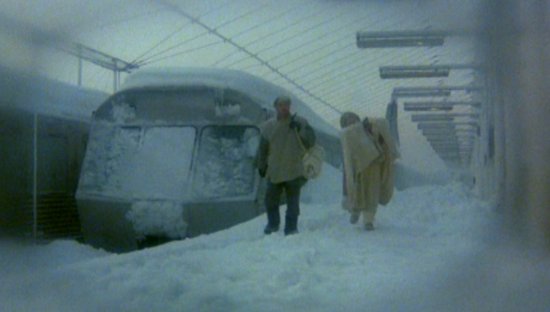
A scene near the begining of Quintet. Don't think I blurred the edges of the frame for artistic effect - I didn't. The whole movie looks like that. They must have used a gallon of vaseline on the lenses.

Back then I used to love to read the movie reviews in Time magazine. I think I enjoyed reading the reviews more than seeing the movies. Remember, this was long before the Internet – information was scant then. You tended to believe what you read.

Now we know better.

So I read the reviews of Quintet. It was a big deal – Paul Newman, Robert Altman, all-star international cast. With all this going for it, with all this at stake, it couldn’t suck. But it did. They didn’t really come out and say that – but we all knew how to read between the lines.

I bought my first television cable in about 1980. That was when HBO was still called Home Box Office. Quintet was on, but I only saw a few minutes of it. It actually looked like something I might enjoy – odd, eccentric, but entertaining in a quirky sort of way.

I was wrong.

Now, all these decades later, we have Netflix – and I’m able to watch this old chestnut in the privacy of my own laptop.

1979 were pre-global warming days – when it was assumed the world would end in ice, not fire. In the film, ice has taken over and the world is about to freeze solid. Everyone has given up and is waiting around to die. Paul Newman arrives from the wilderness – the prototypical outsider of the dystopian tradition – with a young pregnant wife. This should be a big deal – but nobody cares about anything. They go on playing this game, Quintet, and the losers get slaughtered and literally fed to the dogs.

ext for the image, e.g. “The Mona Lisa”

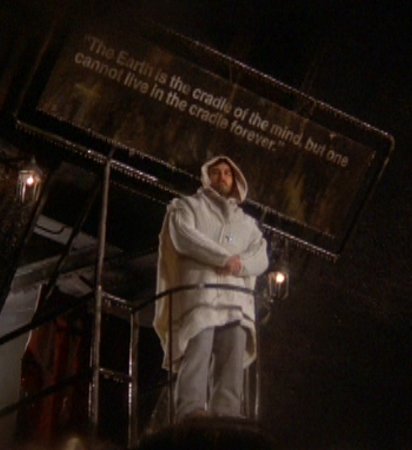
"The earth is the cradle of the mind, but one cannot live in the cradle forever." What the hell does that mean? I suspect very little.

The only interesting character is killed off thirty minutes in.

The move has a languid pace and an interesting frozen broken down look – but in the end, nobody gives a damn about anybody.

So why should we?

Another scene from Quintet

Paul Newman and Fernando Rey enjoying a hearty drink together. At least the beer is cold.

The Compleat Werewolf

The Compleat Werewolf

The Compleat Werewolf

There are too many werewolf stories around these days. And way too many vampire stories. I have not read any of the Twilight series, so I will not denigrate it, I will simply say it doesn’t interest me enough to waste my precious reading time. And I will not even look at a vampire story now – it has been so overdone.

We were talking about this the other evening in our writing group, and my whining brought back to my head a sudden memory of a long time ago. I remembered reading a short story called “The Compleat Werewolf” by Anthony Boucher, a giant in the world of early Science Fiction and mystery type stuff (he was a Science Fiction editor and a Mystery writer). Clearing the cobwebs and thinking hard, I remember I read it as part of a collection – probably around 1970 or so. I remembered bits of the plot: a professor changing from a wolf to a man in front of his class, forgetting he was naked, a bullet splashing off of a wall and the horror of the werewolf when he realized the near miss was silver, and a portly magician demonstrating the Indian rope trip to tragic ends.

Well, a quick Internet search and some library wrangling and I had in my hot little hands a copy of The Compleat Werewolf. I was surprised to find it was written in 1942 – the tale was older than I thought (there is a reference to the forty-eight states in the story). It held up well, though.

The whole basis of the tale is that a werewolf isn’t inevitably evil (though most are) and that, when used with discretion and intelligence, a power like that can be darn useful.

I enjoyed reading the thing. It is more a detective story than anything, though the whole mystery is pretty simple and unravels without much tugging of the sweater string. It is sparsely written and hardboiled enough to go down easy and quickly, but still has a few literary flourishes thrown in. I have to love any tale that includes the phrase, “this fantastic farrago of questions.”

To sum up, The Compleat Werewolf is a yarn. Not entirely serious, not without a wink or two, but a complete story, where a bad guy shoots himself, the hero (wolf) gets the girl (not as he had hoped… but better), and there are practical considerations in spite of supernatural occurrences.

So don’t be afraid to mosey down to your local biblioteca and check out this or some other collection of classic story telling. You might learn a thing or two and have a good time in the meantime.

New Orleans Noir

No place as pretty and sad as New Orleans. Depending on if the sun’s shining or not. You ever notice that? Sun’s out, ain’t no prettier place on earth. No place more … resplendent. But gray and gloomy, cloudy, rainy, this town is so shabby, dreary, and downright depressing, makes you wanna take morphine and die.

—– From the short story Marigny Triangle by Eric Overmyer from the collection New Orleans Noir

Since my son Lee enrolled at Tulane I have been reading material set in New Orleans as much as possible. Confederacy of Dunces, Across Magazine Street, The Awakening, The Moviegoer, the Dave Robicheaux series, Zeitoun…. And there are plenty more to go.

I just finished a book of short stories set in The Big Easy – New Orleans Noir. As the title suggests, it is a book of hardboiled crime fiction. Eighteen different stories from eighteen different authors: Thomas Adcock, Ace Atkins, Patty Friedmann, David Fulmer, Barbara Hambly, Greg Herren, Laura Lippman, Tim McLoughlin, James Nolan, Ted O’Brien, Eric Overmyer, Jeri Cain Rossi, Maureen Tan, Jervey Tervalon, Olympia Vernon, Christine Wiltz, Kalamu Ya Salaam, and Julie Smith. This is one book in a series of noir collections, each one set in a different city. I haven’t read any of the others… and I’m not so sure… what city can be more Noir than New Orleans?

The book is divided into two parts – pre and post Katrina. The earlier stories are all over the place: time, tone, setting, genre. Some have a bit of horror thrown in – the excellent “Pony Girl” by Laura Lippman, for example. Post Katrina – well, they focus in on a horror of an entirely different sort. Not so much the rising water but the breakdown in society that can ensue after a disaster like that. I remember the Nicaraguan Earthquake in ’72 – it was that breakdown that was even more frightening than the tumbling masonry.

New Orleans is a city of neighborhoods. Each story is set in a different part of the city: Uptown, French Quarter, Bywater, Faubourg Marigny… with a map in the front to keep you oriented.

As you might expect from a collection with eighteen authors, the stories are a bit uneven. Still, the good outweigh the bad by a large margin. Ones that especially resonated with me?

The Lippman “Pony Girl” – short, visual, horrific. Really good.

All I Could Do Was Cry, from the Lower Ninth Ward… by Kalamu Ya Salaam – heartbreaking.

… Now that I look over the table of contents, there is really only one that I didn’t like. I’ll have to reread that one… maybe I missed something.

I’ll have to single out one of the post-Katrina stories, the one by Julie Smith, the woman that put the collection together. Her story, Loot, was a little uneven in pacing, I would like to have seen it written out longer… but the basic story, of the friendship between a lawyer and her housekeeper, was wonderful and felt real.

Don’t take my word for it, read the story here.

Now I have to decide what to read next. I have to be careful what I read because the style and attitude of what I’m reading has such a huge impact on what I write.

Let’s see… I bought a Kindle Book, I Wish, from Wren Emerson and I want to finish that. But I never read only one book at a time, I have a handful of non-fiction library books and a half-dozen in my “Current Reading” collection on my Kindle.

I did read a short story, “Child’s Play” by Alice Munro this afternoon. She is so good, her stories so perfect and jewel-like, they make my heart ache. Nobody does it like she does.

We can all dream

Ok, since I’m thinking about New Orleans, how about a little Big Easy Jazz, OK?

Kick-Ass and Gregor Samsa

The other evening I finally found time to watch the 2010 movie Kick-Ass on Netflix streaming.

I’m not going to write a review of it, though I did enjoy the film. It’s the kind of thing you will like if you like that kind of thing.


I’d like to talk about a bit of the film, a single scene, and why it’s there.

This all has to do with believability – with generating the proper suspension of belief in the viewer. It’s a real problem for a writer. If he’s writing about vampires, or magic, or little prepubescent girls who massacre criminal goons like the rest of us swat flies; you have to find a way to get the reader/viewer to buy in to your own little personal fantasy.

An example – many, many years ago I took a (useless) fiction writing class in college. I wrote a character sketch modeled on a person that I knew well. The other members of the class rejected (rightfully so) my work because it, “wasn’t believable.” I objected to their rejection, explaining, “But.. but it has to be believable, it’s true!”

I didn’t understand the difference between believability and truth (the class was useless because it didn’t explain this to me, I had to figure it out myself a decade or so later). That’s the big advantage non-fiction has over fiction – non-fiction simply has to be true… it doesn’t have to be believable. Fiction, on the other hand, is always a pack of lies, but it has to be believable lies. That is much more difficult than simply telling the truth.

The key to believability is to make a deal with the reader right up front. If you tell your audience immediately, at the very beginning, then they will willingly suspend their disbelief and go along with you. They will gladly accept all the blood-drinking, invisibility spells, and jet-packs with Gatling guns, even though they know it is impossible in the real world, as long as you have told them this is what you are going to do. Be honest, be upfront, and they will gladly go along for the ride.

The best example of this?… easy, Gregor Samsa. You know, Kafka, The Metamorphosis, one of the greatest opening lines in all of literature.

As Gregor Samsa awoke one morning from a night of uneasy dreams he found himself transformed in his bed into a gigantic insect.”

There it is. The only question is what kind of insect. Some translations use “Cockroach,” but if you read the rest of the story carefully it is obvious that he is not a cockroach, but something like a round dung-beetle, about the size of a large dog….

But I digress…

It is, of course, thankfully impossible to have some bad dreams and wake up squirming in your bed, late for work, and wondering where those extra legs and that jointed carapace has come from. But yet, that doesn’t take away from the emotional impact of poor Gregor and his hopeless predicament. We read on without any question and with nary a concern that the story never explains how this has happened (Was he bitten by a radioactive dung beetle? A Slytherin curse gone horribly wrong?).

The answer is that Kafka has made a deal with us in the first sentence. He has stated the rules (Gregor Samsa, giant vermin, no explanation, hang on) and we accept them or stop reading right there with no harm done.

 It is critical that this is done right away. In the course of the story we learn a lot about Gregor’s life before his transformation. Kafka could have written the story with a handful of pages illustrating Gregor’s gray existence, pre-vermin, and then sprung the change on, say, a third of the way through.

That would suck. We would hate it. We would think that the author made a cheap turn and changed the story from a drab description of hopelessness to a supernatural tale of witchcraft or something. He would have to explain why that had happened or we would throw apples and then toss the tome in the garbage.  But since Kafka knew to strike his bargain while the iron is hot, a classic is born.

Gregor Samsa

Well, what the hell does all this have to do with Kick-Ass?

The movie does the same thing.

When you read reactions to the movie, surprisingly, the biggest complaint isn’t the murderous little girl, the buckets of blood, or the feel-good ending. People complain that the movie made a right turn partway through. They gripe it starts out as a typical light teenage angst comedy, with a nerd struggling to be more than he has been, trying to get the hot girl, doing stupid stuff. After a bit of this it changes completely into… what it changes into.

These people weren’t paying attention.

Like Kafka, the screenwriter(s) told everybody, right at the beginning, exactly what was going to happen. They made a bargain with us (if we saw it) and that’s why the subsequent activities, while shocking, shouldn’t come as a complete surprise – they fit neatly into the bargain that is struck, we were warned.

Remember the first scene? Maybe you don’t. It’s an interesting bit. It has nothing to do with the rest of the movie. The single character is never mentioned again. I think the action takes place after the rest of the story has run its course and has no relationship with anything else that happens.

The Credit Clouds part – a man wearing a superhero outfit stands at a corner protrusion of a high office building. Far below, bystanders watch as he spreads bright red wings and then fearlessly pitches forward, head first, winged arms outstretched, plummeting toward the sidewalk at increasing speed. The heroic music swells as the crowd of onlookers smiles, cheers, and claps as the hero moves faster and faster.

Then, with a loud thump, he crashed into a Taxi, crushing it, and killing himself instantly. The real hero, in voiceover, explains that this is a person with a mental problem and has nothing to do with the rest of the story.

Watch it here.

And there it is. The movie will be an exploration of everyman’s fascination with the Superhero myth, and how, when put to the test, the hero will be found wanting, with horrible and inevitable death the only possible result.

The entire movie in a nutshell. The violence. The sick humor. The theme of innocence lost in the face of a monstrous and dangerous world filled with evil.

Pay attention. You were warned.