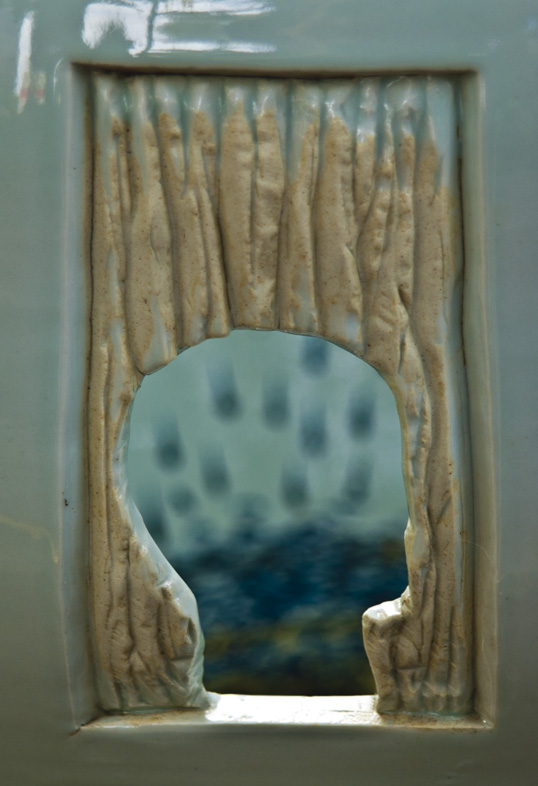
A Month of Short Stories 2017, Day 2 – The Itch, by Don DeLillo

Crow Collection of Asian Art
Sculpture Garden
Dallas, Texas

Over several years, for the month of June, I wrote about a short story that was available online each day of the month…. It seemed like a good idea at the time. My blog readership fell precipitously and nobody seemed to give a damn about what I was doing – which was a surprising amount of work.

Because of this result, I’m going to do it again this year – In September this time… because it is September.

Today’s story, for day 2 – The Itch, by Don DeLillo.

Read it online here:
The Itch, by Don DeLillo

But nobody showed up, so he sat awhile looking at the wall. It was one of those Saturdays that feel like Sunday. He didn’t know how to explain this. It happened intermittently, more often in the warmer months, and it was probably normal, although he’d never discussed it with anyone.
—-Don DeLillo, The Itch, opening lines

I have read some of Don Dellilo’s work… not what I would say a lot of it… not by any means all of it. The most notable absence is the massive novel Underworld which I have been meaning to read for a couple decades. Tomes of that weight and size require a commitment that I have been unable to grant for some time. Maybe soon.

Maybe before I die.

At any rate, I loved his novel White Noise enough that the other things he has written pale in my mind. That novel rotates around a bucolic modern scene that is interrupted by an Airborne Toxic Event of some kind… something that I am sort of familiar with in real life. It is an entertaining and haunting work of fiction.

In modernist fiction, there is an interesting difference between novels and short stories. In a novel, the strange detachment of modern life has to be dealt with and resolved… at least partially. In a short story, the author is free to wallow in the surrealism of daily life in this best of all possible worlds.

In today’s story that surrealism takes the form of an itch. The protagonist bounces from doctor to doctor… getting no help, and towards a possible love interest. But always present, if sometimes latent, is the itch, possessing a strange and fearful symmetry, and a perverse unpredictability. It doesn’t make life unbearable, but it probably makes it less fun. Which seems pretty unbearable.

Interviews:

I’m thinking of two dimensions of a screen or a page on which people read. We hope, writers hope, that in fact their characters are living in a three-dimensional world, first in the writer’s mind, then in the minds of readers.

When I’m conceiving a scene, do I see it in three dimensions? It’s not so easy to answer what appears to be a simple question. I see it — I see characters, I see people, I see streets, cars — and they seem to exist in this special level of mental reality. I could not distinguish the features of a character’s face when I have an idea concerning this character, when I see him or her in a room, and in most cases the room itself is fairly generic — except when I’m actually describing a room — this does happen somewhere in “Zero K” — and then I see a room much more clearly.
—-from an LA Times Interview

INTERVIEWER
Do you have any idea what made you a writer?
DON DeLILLO
I have an idea but I’m not sure I believe it. Maybe I wanted to learn how to think. Writing is a concentrated form of thinking. I don’t know what I think about certain subjects, even today, until I sit down and try to write about them. Maybe I wanted to find more rigorous ways of thinking. We’re talking now about the earliest writing I did and about the power of language to counteract the wallow of late adolescence, to define things, define muddled experience in economical ways. Let’s not forget that writing is convenient. It requires the simplest tools. A young writer sees that with words and sentences on a piece of paper that costs less than a penny he can place himself more clearly in the world. Words on a page, that’s all it takes to help him separate himself from the forces around him, streets and people and pressures and feelings. He learns to think about these things, to ride his own sentences into new perceptions. How much of this did I feel at the time? Maybe just an inkling, an instinct. Writing was mainly an unnameable urge, an urge partly propelled by the writers I was reading at the time.
—-From The Paris Review

Crow Collection of Asian Art
Sculpture Garden
Dallas, Texas

A Month of Short Stories 2015, Day 2 – What Is Remembered

The last two years, for the month of June, I wrote about a short story that was available online each day of the month… you can see the list for 2014 and 2015 in the comments for this page. It seemed like a good idea at the time. My blog readership fell precipitously and nobody seemed to give a damn about what I was doing – which was a surprising amount of work.

Because of this result, I’m going to do it again this year.

Today’s story, for day two – What is Remembered, by Alice Munro.

Read it online here:

What Is Remembered

This afternoon, I worked on making a list of stories I am going to read and write about for my June Month Of Short Stories and realized that a lot of them will be linking with the New Yorker. Well, not very surprising….

Here we are on the second day, and we have a story very different that the first… instead of the efficient, biting prose of Raymond Carver, we have the lush genius of Alice Munro.

She doesn’t cut her words to the bone. She is quite generous with her word count. For example, in today’s story, here is her description of the arrangement of napkins at a funeral’s buffet table:

She looked down at the table napkins, which were folded in quarters. They were not as big as dinner napkins or as small as cocktail napkins. They were set in overlapping rows, so that a corner of each napkin (the corner embroidered with a tiny blue or pink or yellow flower) overlapped the folded corner of its neighbor. No two napkins embroidered with the same color of flower were touching each other. Nobody had disturbed them, or if they had—for she did see a few people around the room holding napkins—they had picked up napkins from the end of the row in a careful way, and this order had been maintained.

The amazing thing, the genius of Munro, is that this seemingly odd bit of description encapsulates the whole story, somehow. It has nothing to do and everything to do with the rest of the work.

This is the story of an affair – or of a one-night stand… a one-evening stand, really. But it isn’t a prudish morality tale – it is a laying out of a woman’s life and how much more there is than meets the eye.

Alice Munro doesn’t write with words as much as she writes with time. What is Remembered, like much of her work, moves back and forth over handfuls of decades, following the echoes of the past into the future and the conception of the future into the past. Like the title implies, this is a story about memory and how a person’s fate isn’t so much shaped by what they do as much as it is by how they remember what they have done.

On the ferry ride home, after the fact:

She had to join the crowd of jostling bodies making their way up the stairs, and when she reached the passenger deck she sat in the first seat she saw. She did not even bother, as she usually did, to look for a seat next to a window. She had an hour and a half before the boat docked on the other side of the strait, and during this time she had a great deal of work to do.

No sooner had the boat started to move than the people beside her began to talk. They were not casual talkers who had met on the ferry but friends or family who knew each other well and would find plenty to say for the entire crossing. So she got up and climbed to the top deck, where there were always fewer people, and sat on one of the bins that contained life preservers. She ached in expected and unexpected places.

The job she had to do, as she saw it, was to remember everything—and, by remember, she meant experience it in her mind, one more time—then store it away forever. This day’s experience set in order, none of it left ragged or lying about, all of it gathered in like treasure and finished with, set aside.

She had “an hour and a half” and a “job she had to do.” She had to fix what had happened into her memory, all of it, exactly as it had happened.

As the rest of the tale unfolds, we learn she didn’t do her job well. She forgot a lot. And what she forgot might have been more important than what she remembered – it protected her from a life that was not only wildly different, was a life that would not have been her own.

What we remember, what we forget, what comes back to us after it is too late….

Tenth of December

Almost a year ago, for the month of June, I read and wrote about a short story every day, for the entire month. I’m collecting online stories again this year (already close to the requisite thirty) – though I haven’t decided whether to do the same thing again.

Any suggestions or feedback would be greatly appreciated. Si o No.

On Day 7 of last year I read and wrote about the story Sea Oak, by George Saunders. It made me want to read more. I have just finished a long, interesting, but somewhat repetitive tome and wanted something shorter and lighter. So I picked up a book of George Saunders short stories in a digital loan from my library. It was the collection Tenth of December – and has been almost universally praised, often listed as one of the best books of last year.

And it did not disappoint.

First of all, though, the negative. George Saunders has a great skill – an innovative way – with words. Sometimes it feels as if he is showing off. Unusual forms, unexpected voices, mannered style – it’s all here and may be layered a little thick. I can see why the jaded literati have are so enamored – he can be challenging. In a few places I wanted to tell him to simply get on with it.

But, still, the stories had heart. The true judge of a work is whether or not you care about the characters and in these stories you do. They will break you in unexpected places and in an unanticipated fashion.

Back to the style. One technique that he uses to devastating effect is to tell a story from several points of view – from characters that are about to intersect in surprising ways. He uses this technique to illustrate how completely different the world is seen by different people. He exposes the little lies everyone tells themselves… simply to get through the day.

The first story in the collection uses this technique in triplicate. A popular girl, an unpopular boy, and a meter reader with bad intentions all tell their own stories in their own voices, observing each other under harrowing circumstances. A delicate structure, but one of great strength.

Another story – this one available online from the New Yorker, Puppy – uses the same technique for two women. They observe and are observed by each other and both found lacking – though they both are doing the best they can.

The title story – also available online, Tenth of December – has a young boy living in a fantasy world inside his head and an older man with a big problem intersecting on a freezing mountainside. Each has no idea of the others plight but are able to arrive at an understanding in the end.

Arguably the oddest, and possible the most powerful story, the The Semplica-Girl DiariesRead it here, too, courtesy of the New Yorker – is written as a diary from a father to future generations. The jarring language and constant use of abbreviations makes it a hard read (I was halfway through before I figured out what “SG” meant) but by the end you realize it is worth the effort. A devastating comment on consumer culture, international capitalism, and exploitation of third world workers – all disguised as a diary of a father trying to have a nice birthday party for his little girl.

So, there are three stories you can read online. If you like them, get the book – it’s worth it.
And those are three more stories I can’t use for my month of short stories in June, if I decide to do that.

Don’t worry, there are more where those came from.

Short Story Day Twenty-One – Mexican Manifesto

21. Mexican Manifesto
Roberto Bolaño
http://www.newyorker.com/fiction/features/2013/04/22/130422fi_fiction_bolano

This is day Twenty-one of my Month of Short Stories – a story a day for June.

Illustration from the New Yorker

Roberto Bolaño considered himself primarily a poet. For most of his life he was a bohemian vagabond poet, working odd low-end jobs by day and writing poetry by night. Good work if you can get it.

He married in Europe and in 1990 his son was born. At that point he felt responsible for his family and began writing fiction to help pay the bills. Over a short period of time he produced a series of acclaimed novels, collections of short stories, and his magnum opus – 2666, which was published posthumously.

I haven’t read any Bolaño up to this point. I did buy a hardback copy of 2666 – the huge novel (900 pages) sits on the bottom row of my book shelf like a leaden lump of wood pulp; a mysterious Pandora’s box of secret promises, putative wisdom, and unknown wonders locked tight between its covers – only to be opened and released by masses of time, long sleepless evenings, and painful eye strain.

Maybe I should read The Savage Detectives or even the novella By Night in Chile first.

Today’s story Mexican Manifesto, was first published this year in the New Yorker. Since Bolaño passed away a decade ago – I assume this story was found in his papers or computer files.

It is a hazy memory of the narrator, thinking about his youth and the adventures he had with a woman as the two of them explored the world of public bathhouses in Mexico City. He talks about the bathhouses in general and the denizens of the rooms, corridors, and steam. He elaborates on a strange encounter when he and the woman hire a trio – an old man with filthy underwear and two young boys – to provide them with a sexual performance. It doesn’t work out right. Due to his leaky memory, the ethereal nature of the bathhouse, and the clouds of steam that conceal and confuse – it isn’t clear exactly what happened.

The story is a dream or a dreamlike memory or a dream of a memory, or a memory of a dream… or maybe just a half-forgotten recollection mixed up with a fantasy of something that might have happened a long time ago. Youthful adventures tend to warp as time goes by – they become like wisps of steam leaking into the outer chamber of a bathhouse, ghosts of time – they become what they weren’t.

Maybe they never were.

I’ll have to read the story again, and think more about its secrets. I think a key might be the mural described in the first paragraph. It’s in the foyer of their first and favorite public bath, Montezuma’s Gym. I want to figure out what the king sees.

Laura and I did not make love that afternoon. In truth, we gave it a shot, but it just didn’t happen. Or, at least, that’s what I thought at the time. Now I’m not so sure. We probably did make love. That’s what Laura said, and while we were at it she introduced me to the world of public baths, which from then on, and for a very long time, I would associate with pleasure and play. The first one was, without a doubt, the best. It was called Montezuma’s Gym, and in the foyer some unknown artist had done a mural where you could see the Aztec emperor neck-deep in a pool. Around the edges, close to the monarch but much smaller, smiling men and women bathe. Everyone seems carefree except the king, who looks fixedly out of the mural, as if searching for the improbable spectator, with dark, wide-open eyes in which I often thought I glimpsed terror. The water in the pool is green. The stones are gray. In the background, you can see mountains and storm clouds.
—-Mexican Manifesto, by Roberto Bolaño

Short Story Day Fifteen – Wiggle Room

15. Wiggle Room
David Foster Wallace
http://www.newyorker.com/fiction/features/2009/03/09/090309fi_fiction_wallace

This is day Fifteen of my Month of Short Stories – a story a day for June.

The massive, classic novel, Infinite Jest by David Foster Wallace has been on my to-read list for a long time…, along with 2666 by Roberto Bolaño and Underworld by Don DeLillo. But Jest is over a thousand pages, Underworld a tad over eight hundred and nine hundred for 2666. To tackle a tome of this magnitude takes a commitment of time I’m not sure I have (There aren’t that many years left) when so much shorter stuff is out there. Then again, I’ll always treasure Gravity’s Rainbow and Moby Dick and the other Big Long Books I’ve soldiered through. Who knows?

Today, submitted for your approval, is a short work by David Foster Wallace from the New Yorker. It’s a harrowing look at the soul-destroying numbness of working in a mindless modern cubical-cluttered workplace. Specifically, a midwestern backwater IRS office.

If it seems incomplete, it’s because it is. It is a snippet of Wallace’s last, unfinished novel, The Pale King.

David Foster Wallace committed suicide leaving The Pale King as a disorganized pile of paper and computer files. His friend and editor Michael Pietsch assembled the novel from that and it was published in 2011.

Before it came out, several selections were printed. The New Yorker also published a piece that’s still available online, Good People. It’s a completely different type of story (or snippet) even though it features the same character, Lane Dean, as today’s Wiggle Room.

Also, in the same issue, is a long article on Wallace, The Unfinished… it’s worth a read.

He felt in a position to say he knew now that hell had nothing to do with fires or frozen troops. Lock a fellow in a windowless room to perform rote tasks just tricky enough to make him have to think, but still rote, tasks involving numbers that connect to nothing he’ll ever see or care about, a stack of tasks that never goes down, and nail a clock to the wall where he can see it, and just leave the man there to his mind’s own devices. Tell him to pucker his butt and think beach when he starts to get antsy-and that would be just the word they’d use, antsy, like his mother. Let him find out in time’s fullness what a joke the word was, how it didn’t come anyplace close. He’d already dusted the desk with his cuff, moved his infant son’s photo in its rattly little frame where the front glass slid a bit if you shook it. He’d already tried switching the green rubber over and doing the adding machine with his left hand, pretending he’d had a stroke and was bravely soldiering on. The rubber made the pinkie’s tip all damp and pale beneath it.
—-from Wiggle Room, by David Foster Wallace

Short Story day 8 – Thirteen Wives

8. Thirteen Wives
Steven Millhauser
http://www.newyorker.com/fiction/features/2013/05/27/130527fi_fiction_millhauser

This is day eight of my Month of Short Stories – a story a day for June.

Steven Millhauser is another contemporary, modern author that I have wanted to read. I have a couple (actual, real, paper) books of his short story collections very near the top of my to-read pile. He won the 1997 Pulitzer Prize for Fiction for his novel Martin Dressler. I was very happy to see that this story, Thirteen Wives, was available on the New Yorker website – and added it to my June reading (and blogging) list.

Over the decades, the New Yorker has been one of the best, if not the best, consistent source for quality short stories. My only complaints are that they keep going back to the same writers again and again (though these are of unquestioned skill and even genius) – plus there has developed such a thing as a “New Yorker Story” – I wish they would work a little harder on introducing more diversity in their fiction – but I’m picking nits here. Hat’s off to the The New Yorker and their support of the short story as an art form.

Unfortunately, now, for the first time, I have come across a short story this month that I didn’t like. Thirteen Wives isn’t really a story – it reads more like an essay on the various aspects and complex dimensions of a marriage. Sure, it’s dressed up in the first person and the narrator pretends that the thirteen wives are actually different women (though he does say, “Never have I considered myself to be a man with thirteen marriages but, rather, a man with a single marriage, composed of thirteen wives.”) – but the author’s intentions are clear.

And he doesn’t go far enough. It comes across as a paean to marriage… which is OK, I suppose… but he doesn’t push it enough to make it interesting. He doesn’t deal very well with the aspect of time…. A marriage that lasts several decades is something beyond this story’s parameters – he does say he married these thirteen wives over nine years. Nine years is nothing.

As I read each section, I’m afraid my reaction was, “OK, that’s well written, a witty turn of phrase… but so what? Is that all?”

But that’s just me. Looking around the ‘net – I see folks that thought the story was excellent and exactly what they were looking for. Read it yourself, tell me what you thing.

It’s the peculiar fate of my thirteenth wife to evoke innumerable pasts that aren’t hers; she is composed of my memories of other women. To see her is to experience all the women barely noticed in public parks and crowded bus terminals, the half-seen women sitting at wrought-iron tables under the awnings of outdoor restaurants or waiting in line at ice-cream stands at the edges of small towns on hot summer nights, all the women passing on suburban sidewalks through rippling spots of sun and shade, the briefly stared-at women rising past me on escalators with glossy black handrails in busy department stores, the silent women reaching up for books on the shelves of libraries or sitting alone on benches under skylights in malls, all the vanished girls in high-school hallways, the motionless women in wide-brimmed hats standing in gardens in oil paintings in forgotten museums, the black-and-white women in long skirts and high-necked blouses packing suitcases in lonely hotel rooms in old movies, all the shadowy women looking up at departure times in fading train stations or leaning back drowsily on dim trains rushing toward dissolving towns. My thirteenth wife is abundant and invisible; she exists only in the act of disappearing.
—-Thirteen Wives, by Steven Millhauser

Short Story Day 5 – Symbols and Signs

5. – Symbols and Signs, by Vladimir Nabokov
http://www.newyorker.com/archive/1948/05/15/1948_05_15_031_TNY_CARDS_000214135

This is day five of my Month of Short Stories – a story a day for June.

Today we have another little jewel – this one published by the New Yorker in 1948, Signs and Symbols, by Vladimir Nabokov.

It reads so up-to-date, it’s hard to believe the story is sixty-five years old, published almost a decade before Lolita.

I don’t know if anyone else gives a damn, but I have been enjoying reading, researching, thinking about in depth, and writing a bit about each work… even if I am essentially doing a homework assignment each day for fun.

This story is an interesting one – much more complex and deep than it appears at first. It’s well known and a lot has been written about it:

It fascinates me how a great work of literature can spawn so many analytical studies – each one several times longer than the story itself.

I’ve been thinking a lot about a concept spelled out in the last article in the list – that of the difference between Story and Plot. The Story is what actually happens in the work of literature, in real time chronological and casual order. The Plot consists of these same events presented in the order and manner that they are in the narrative. The way the reader learns of these events is irrelevant to the Story – but the wide variety of Plots that can be applied is essential to the artistry and emotional impact of the work.

What Nabokov does with the plot – with the way he presents the story – is what makes Symbols and Signs resonate with a power and complexity hidden in its short length. He is telling multiple stories with the same plot – at least two and maybe three.

One trick he plays is to withhold from the reader certain key information that is needed to make the story complete. There are many questions:

  • Exactly how did the son attempt suicide?
  • Why is there a wagon wheel hanging in a tree in the painting he is afraid of?
  • There are subtle changes in the story (the title for example) between the New Yorker version and the subsequent versions – what is the meaning behind this?
  • What is the meaning of the specific cards mentioned in the deck that falls to the floor?
  • What are the rest of the ten flavors of jelly?

…. and so on. But the biggest mystery and the most perplexing for the reader is – Who makes the third phone call at the end of the story? Is the girl making another wrong number? Is it the hospital calling to report their son’s death? Has the son escaped and is begging to come home?

There are clues throughout the text to help answer these questions – though they are hidden and impossible to be sure about. Remember, that in addition to being a famous writer (and expert on butterflies) Nabokov took great joy and interest in the composition of Chess Problems. He says, “The strain on the mind is formidable; the element of time drops out of one’s consciousness”. Nabokov believed that the “originality, invention, conciseness, harmony, complexity, and splendid insincerity” of creating a chess problem was related to his writing. We should not be surprised to find riddles within riddles hidden in the story.

But even without the mysteries and puzzles and mental gymnastics the short story is a compelling one. It is so sad – you feel so much for the old couple – poor, waiting to die, buying a birthday present for their mentally disturbed son. There is an air of helplessness, leavened slightly by Nabokov’s keen sense of dark humor.

Here was Aunt Rosa, a fussy, angular, wild-eyed old lady, who had lived in a tremulous world of bad news, bankruptcies, train accidents, and cancerous growths until the Germans put her to death, together with all the people she had worried about.

I think about the boy’s rare and terrible mental problem. He is crippled by the thought that the entire natural world is a series of coded messages and communications about him. He must examine everything carefully and completely, all the time, under the horror that the whole world is purposed simply to defeat him.

But what of the opposite? The son is paralyzed with the belief that he is the center and purpose of the universe – but isn’t it more of a horror to believe that the universe is completely uncaring and even unaware of your existence?

That’s the terrible truth of the parent’s life. And there is nothing they can do about it.

All this, and much more, she had accepted, for, after all, living does mean accepting the loss of one joy after another, not even joys in her case, mere possibilities of improvement. She thought of the recurrent waves of pain that for some reason or other she and her husband had had to endure; of the invisible giants hurting her boy in some unimaginable fashion; of the incalculable amount of tenderness contained in the world; of the fate of this tenderness, which is either crushed or wasted, or transformed into madness; of neglected children humming to themselves in unswept corners; of beautiful weeds that cannot hide from the farmer and helplessly have to watch the shadow of his simian stoop leave mangled flowers in its wake, as the monstrous darkness approaches.
—-Signs and Symbols, Vladimir Nabokov