“…and then, I have nature and art and poetry, and if that is not enough, what is enough?”
― Vincent van Gogh

Vortex
Richard Serra
Modern Art Museum of Fort Worth
“…and then, I have nature and art and poetry, and if that is not enough, what is enough?”
― Vincent van Gogh
Vortex
Richard Serra
Modern Art Museum of Fort Worth
The last two years, for the month of June, I wrote about a short story that was available online each day of the month… you can see the list for 2014 and 2015 in the comments for this page. It seemed like a good idea at the time. My blog readership fell precipitously and nobody seemed to give a damn about what I was doing – which was a surprising amount of work.
Because of this result, I’m going to do it again this year.
Today’s story, for day fifteen – A White Heron, by Sarah Orne Jewett
Read it online here:
Day fifteen, halfway through. So much to read, so little time.
Today we go back into the past – A White Heron was written in 1886. Its themes, however, of city and country life, of man and nature, and of being faithful to one’s own instincts are as valid today as ever.
Sarah Orne Jewett was best known as a regional writer who produced works of “local color” describing the rural coast of Maine. The finely tuned descriptions of nature and the people of the area are the primary focus of her stories – the plot is secondary.
That’s the best way to read A White Heron – let the language take you to a specific time and place and don’t worry too much about what’s happening there.
Isn’t that among the best that a book can do?
Sylvia’s face was like a pale star, if one had seen it from the ground, when the last thorny bough was past, and she stood trembling and tired but wholly triumphant, high in the tree-top. Yes, there was the sea with the dawning sun making a golden dazzle over it, and toward that glorious east flew two hawks with slow-moving pinions. How low they looked in the air from that height when one had only seen them before far up, and dark against the blue sky. Their gray feathers were as soft as moths; they seemed only a little way from the tree, and Sylvia felt as if she too could go flying away among the clouds. Westward, the woodlands and farms reached miles and miles into the distance; here and there were church steeples, and white villages, truly it was a vast and awesome world.
In a field by the river my love and I did stand,
And on my leaning shoulder she laid her snow-white hand.
She bid me take life easy, as the grass grows on the weirs;
But I was young and foolish, and now am full of tears.”
― W.B. Yeats, The Collected Poems
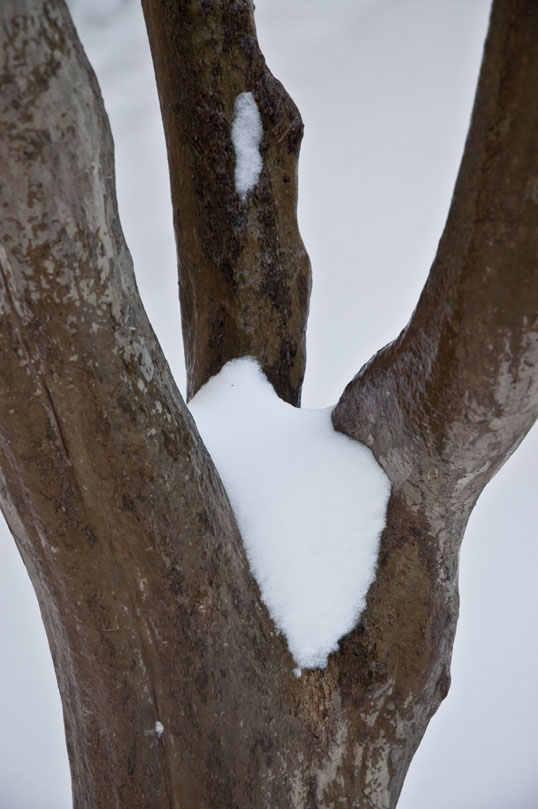
Crepe Myrtle trunk in the snow
“He was taught by the river. Incessantly, he learned from it. Most of all,
he learned from it to listen, to pay close attention with a quiet heart,
with a waiting, opened soul, without passion, without a wish, without
judgement, without an opinion.”
― Hermann Hesse, Siddhartha

Trinity River in the Fall,
Dallas, Texas
“The Line makes itself felt,– thro’ some Energy unknown, ever are we haunted by that Edge so precise, so near. In the Dark, one never knows. Of course I am seeking the Warrior Path, imagining myself as heroick Scout. We all feel it Looming, even when we’re awake, out there ahead someplace, the way you come to feel a River or Creek ahead, before anything else,– sound, sky, vegetation,– may have announced it. Perhaps ’tis the very deep sub-audible Hum of its Traffic that we feel with an equally undiscover’d part of the Sensorium,– does it lie but over the next Ridge? the one after that?”
― Thomas Pynchon, Mason & Dixon

Cedars Open Studios
1805 Clarence Street
Dallas, Texas
There is a geometry to art.
“Wherever forests have not been mowed down, wherever the animal is recessed in their quiet protection, wherever the earth is not bereft of four-footed life – that to the white man is an ‘unbroken wilderness.’
But for us there was no wilderness, nature was not dangerous but hospitable, not forbidding but friendly. Our faith sought the harmony of man with his surroundings; the other sought the dominance of surroundings.
For us, the world was full of beauty; for the other, it was a place to be endured until he went to another world.
But we were wise. We knew that man’s heart, away from nature, becomes hard.”
― Chief Luther Standing Bear

Another view of the Keeper of the Plains sculpture, Wichita, Kansas
“I don’t want realism. I want magic! Yes, yes, magic! I try to give that to people. I misrepresent things to them. I don’t tell the truth, I tell what ought to be the truth. And it that’s sinful, then let me be damned for it!”
― Tennessee Williams, A Streetcar Named Desire
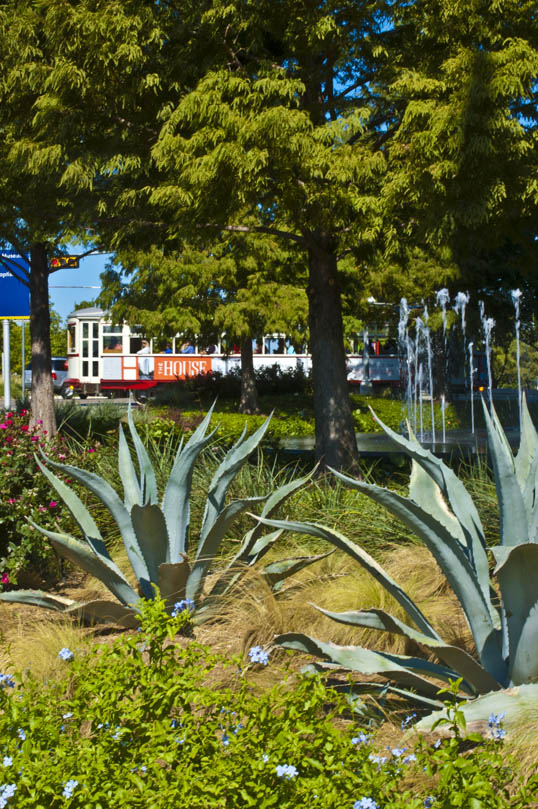
Hunt Headquarters Building, Dallas, Texas
Agave, Fountain, Cypress, and Streetcar.
There are hidden treasures in a modern city. They put little pockets of nature and beauty in the center of all the miles and acres of concrete, tarmac, and steel. Seek them out.
“Our civilization is flinging itself to pieces. Stand back from the centrifuge.”
― Ray Bradbury, Fahrenheit 451
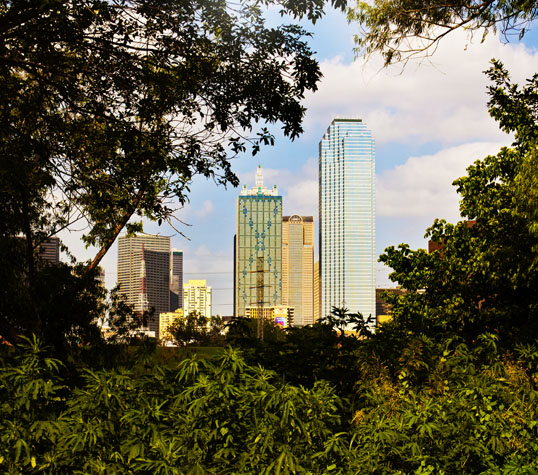
Trinity River Bottoms, Dallas, Texas
“She spent an astonishing amount of time in attending lectures and demonstrations, distributing literature for the Junior Anti-Sex League, preparing banners for Hate Week, making collections for the savings campaign, and such-like activities. It paid, she said; it was camouflage. If you kept the small rules you could break the big ones.”
― George Orwell, 1984

Trinity River Park
Fort Worth
Texas
“A human being is a part of the whole called by us universe, a part limited in time and space. He experiences himself, his thoughts and feeling as something separated from the rest, a kind of optical delusion of his consciousness. This delusion is a kind of prison for us, restricting us to our personal desires and to affection for a few persons nearest to us. Our task must be to free ourselves from this prison by widening our circle of compassion to embrace all living creatures and the whole of nature in its beauty.”
― Albert Einstein
Trinity River Audubon Center
Dallas, Texas

Cattails
“In a room the size of a ballroom the Pattern was laid. The floor was black and looked smooth as glass. And on the floor was the Pattern.
It shimmered like the cold fire that it was, quivered, made the whole room seem somehow unsubstantial. It was an elaborate tracery of bright power, composed mainly of curves, though there were a few straight lines near its middle. It reminded me of a fantastically intricate, life-scale version of one of those maze things you do with a pencil (or ballpoint, as the case may be), to get you into or out of something. Like, I could almost see the words “Start Here,” somewhere way to the back. It was perhaps a hundred yards across at its narrow middle, and maybe a hundred and fifty long.
It made bells ring within my head, and then came the throbbing. My mind recoiled from the touch of it. But if I were a prince of Amber, then somewhere within my blood, my nervous system, my genes, this pattern was recorded somehow, so that I would respond properly, so that I could walk the bloody thing.”
― Roger Zelazny, Nine Princes in Amber

Vines
“To live on a day-to-day basis is insufficient for human beings; we need to transcend, transport, escape; we need meaning, understanding, and explanation; we need to see over-all patterns in our lives. We need hope, the sense of a future. And we need freedom (or, at least, the illusion of freedom) to get beyond ourselves, whether with telescopes and microscopes and our ever-burgeoning technology, or in states of mind that allow us to travel to other worlds, to rise above our immediate surroundings.
We may seek, too, a relaxing of inhibitions that makes it easier to bond with each other, or transports that make our consciousness of time and mortality easier to bear. We seek a holiday from our inner and outer restrictions, a more intense sense of the here and now, the beauty and value of the world we live in.”
― Oliver Sacks
 Bill Chance