More photographs from the Nasher.

Children and Calder (Trois Bollards)

A pair of Giacometti, in front of a window.
———————————————————————————————————
Another new Video from Lana Del Rey
More photographs from the Nasher.
Children and Calder (Trois Bollards)
A pair of Giacometti, in front of a window.
———————————————————————————————————
Another new Video from Lana Del Rey

I like it when I have a membership in a museum or I can get in free – because then I don’t feel like I have to see the whole thing. I can concentrate.
What I like to do is to have one favorite thing. One work of art. I like to go to that on a bee-line and stare at it, walk around it, try to understand and possess it completely. You can’t do that if you go wandering through the galleries like a tourist hurrying to catch his bus outside. You have to be selective and patient.
When the Dallas Museum of Art first opened it was free. I was working only about a block away and I would walk over for a few minutes at lunch whenever I could. My favorite sculpture was Max Bill’s Rhythm in Space. I would walk into the sculpture garden and stare at that piece of carved curved granite. It meant something to me. This can’t be put into words, but it was an idea of motion, beauty, and the timelessness of stone. The hard, unyielding granite had been shaped into something graceful and light. The sculpture looked a little like a face from the front, but was reduced to precise geometric principles. The eyes and mouth appeared to be perfect circles – but only from a certain viewpoint. There is also a complex symmetry in the design…. So on and….
That’s what I saw.
It’s gone now. I don’t know where.
For a long time, my favorite sculpture was Tending (Blue) – but it’s gone now too. Well, it’s still there… but.
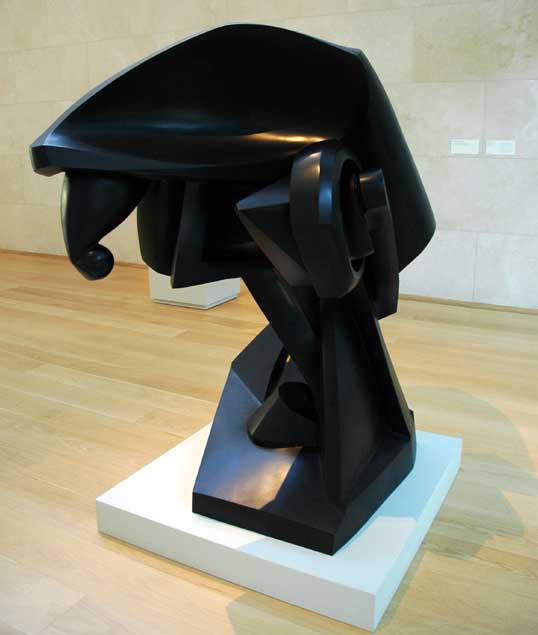
So now I’ve fallen in love with Large Horse, by Raymond Duchamp-Villon (the brother of Marcel Duchamp and Jacques Villon). It’s right up front, by a glass wall, at the Nasher.
I like to stare at it, walk around it. I’ve taken some pictures of it. I would like to take some more.
To me, it’s clear that it is a statue of a horse – but that horse has been morphed into a complex machine, full of pushrods, pistons, and gears. It has an impressive, solid bulk, but feels like it is about to propel itself out through the glass and speed down the street in a blur, smelling of ozone and oil.
It is cast in very dark bronze – almost black. It swallows a lot of the light, but what does escape is subdued by the power and mass of the horse. It shines with dark energy.
The sculptor was a cavalry doctor in World War I and must have had a close relationship, knowledge, and a deep connection with his horses. He chose this animal to convert into a cubist bronze. He was able to preserve the essential horseness of the shape while implying the obsolescence of the animal – overtaken by the more powerful, rugged, and easily controlled energy of machines.
Duchamp-Villon died too young. He contracted typhoid fever during the war. He died before he finished this sculpture. All he left was the finished small scale model. After his death, his famous brother, Marcel Duchamp (Nude Descending a Staircase) finished the job and had the sculpture cast in full-sized bronze.
Thanks.
.
.
.
.

Large Horse, by Raymond Duchamp-Villon
I decided to go downtown on Saturday for the first day of the Arts District’s Art in October celebration. The night before, I struggled to get to sleep, and didn’t get up as early as I wanted – but soldiered on anyway.
When I arrived at the DART station and was buying my ticket at the kiosk I looked up to see my train go by. They are scheduled every twenty minutes on weekends so I knew I would have to wait a while. No problem, it was a beautiful day and I settled down on a little seat on the deserted train platform and started to read my Kindle application on my Blackberry.
The Richardson Library now has Kindle books available for loan. I haven’t mastered the method yet, but I had managed to get a book of Billy Collins‘ poetry (“Ballistics”) to appear on the tiny screen – so that is good.
At a break between poems, I looked down and noticed a laptop bag right beside me, leaning up against my little seat. I looked around, nobody… so I unzipped the bag a bit and peered inside. There was a top-end laptop with accessories, including a really nice USB camera, folders of papers, and a VISA card stuck into a side pocket. I zipped it back up and sat there, trying to think of what to do.
A train going the other way pulled into the station and the doors opened wide right in front of me. I expected some panicked commuter to tumble out and yell, “Thank God it’s still here!” and grab his laptop case. It would be easy to get on the train and leave your case behind, but surely you would realize it was missing by the next stop. It would be easy to hop off and grab the next train back the other way.
Nothing.
I sat there for a second and stared at the gaping door in the train. I would love to have a nice high-end laptop like the one in the bag – among physical possessions that is the only thing I can really think of (now that I have my camera back). It would be so easy to simply stand up with the bag and get on that train. The platform was still empty.
I could actually see myself doing this – lifting the case and entering the train with a sigh, as if I was having to go to work on a Saturday. It would be the perfect crime.
A lot of people… maybe even most people (but not you, dear reader, surely) would not even consider this stealing. They would consider it a “found” laptop and they simply lucky. I wonder about people like that. What does the world look like to them? I guess they think of all the stuff that has been stolen from them and that the world owes them one now and then. I guess they have a piece of their head missing, the one that imagines the pain and suffering of someone else that has lost their valuables – in the case of a personal laptop, lost a big chunk of their life. Morality aside, a laptop case like that – with all the critical data in it – is a lot more valuable to the person losing it than to the person stealing it.
The train doors closed and it sped off.
Now what to do? My train would be there soon and I would have to make a decision. Obviously, until my train came, all I had to do was sit next to the case. Any thief would assume it was mine, only the owner would walk up and claim it. But my train would be the next one – nobody will arrive before then. Should I look in the case again, try to find a cellphone number? Should I take it with me and hope to locate the owner later? The easy thing to do would be to simply leave it where it sat and be done with it – but isn’t that about the same as stealing? I wouldn’t get to keep it but I would be abandoning it to a heartless and uncertain world – it would surely end in grief and while I would not be directly responsible and would not be aware of its fate, by inaction I would set the wheels in motion.
Luckily, I didn’t have to make the choice. I looked up and a Hispanic woman and a DART ticket official were walking up from the tunnel (the Arapaho train station is separated from the rest of the world by a wide, busy street – you have to go under it in a long pedestrian tunnel to reach the platform). The official asked me if the case was mine. She began to carefully probe the case, weary of terrorism (something that had not occurred to me until then). I didn’t mention that I had already opened it up. She moved the zipper and inch and saw the laptop within.
The woman that had made the report said the case had been there for a while, “At least five trains,” she said. She and I talked about how odd it was that nobody came back for the case. The official was making a report on her radio. I asked her if there was a lost-and-found and she said, “Yes, but I’m not allowed to do anything, I have to call for the transit police to pick it up.”
At that moment my train pulled up and I was gone.
On the train I went back to reading the Billy Collins poems on my Blackberry. The poems are short and I could pretty much digest one between each train stop.
One of them, “August in Paris” in typical Collins style, spoke of the poet watching a painter in France and standing behind the painter, taking notes, while he worked. He then made the jump to the reader, and how this readers can’t watch him work but he thinks about who they are.
He says, “there is only the sound of your breathing/and every so often, the turning of a page.”
I thought about this… how times had changed. There isn’t the sound of my breathing, but the clacking rails and the tumult of a crowded commuter train cabin. There is no turning of pages… only the silent movement of my thumb across the tiny black Blackberry trackpad and a new dinky screenfull of luminescent text appears.

Dining area at the Dallas Museum of Art. Glass by Dale Chihuly.

Nasher – Tony Cragg

Everyone is taking pictures, not everyone likes it.

The one person not taking photographs was sketching

At the Nasher

Ceiling of the Nasher
One of my favorite Bang Bang videos will not allow imbedding.
Shame.
It was only two weeks ago but it feels like a thousand years. I walked out of the sodden night rain soaked miasma through the glass doors and was smacked in the face with the bracing cold dry air conditioning. It felt like being slapped by mechanized civilization. After catching my breath I stood as straight as I could, gathered together whatever tatters of pride I had left – like collecting strips of tissue in a gale – and looked around.
The walls of Italian Travertine never felt more cave-like, the glass planes at each end were black as a well. The wooden floor was polished to suggest a muted simulacrum of the world above. The works were arranged carefully about the space – curves alien and familiar mixed and cast by an expert hand.
I knew nothing of Tony Cragg – the artist – although he is so very well-known and famous. He has had a long and varied career with shapes and accumulations and paintings and piles of things and sketches and whatnot. His stuff was scattered all around inside and out, up and down, filling every nook and cubbyhole with some precious object.
But I was drawn by siren call to this gallery, to these monumental curves.
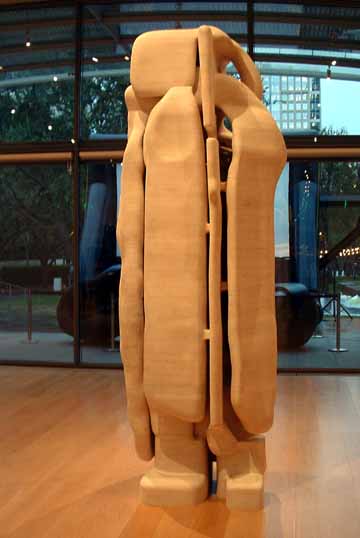
Tall and White. This was named Lost in Thought and it was my favorite. It looks like it is ready to start shambling across the floor. If I was a billionaire I would buy this and put it in my room so I could stick my hands inside and learn its secrets. Or maybe make it into a really big lamp.

People walked among the statues, looking up and down. I looked at the other guests. They were as interesting as the sculptures – but every bit as unreachable. Ghosts of moveable artworks. Made of meat.
My good camera was broken and the pictures are bad. It was too dark.

Some of the work had hidden faces. Some faces were not so hidden.
This one is called Mental Landscape. The label said it was made of Jesmonite. I had to look that up to see what it was.

Both of these two are called Ever After. One is made of wood and the other of bronze.
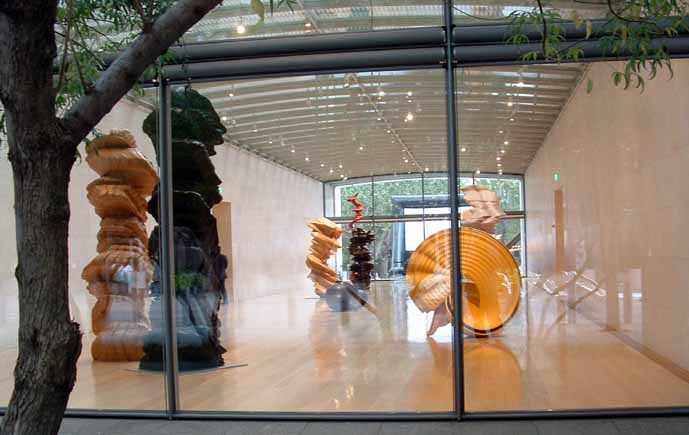
A view from earlier, from outside, looking in. The sculpture in the foreground is called Tree. It’s made of wood.
Some time long ago – I think it was the early spring of 2004 – Lee and I went down to the newly-constructed Nasher Sculpture Center in the still nascent Arts District of Dallas. I took some pictures of him, and wrote it up into my journal, The Daily Epiphany, at the time. It was popular enough that I re-wrote it into a magazine article and it was published in a local magazine, Richardson Living, (I’ll dig up what I wrote and put it up here when I get some time). The folks at the Nasher liked it so much they sent me some free tickets.
Now, about seven years later, Lee and I went down there again and I took some more pictures. Like most museums the artworks move around quite a bit – so nothing was exactly the same. Lee has, of course, grown a bit, and my camera is different. The trees in the Nasher garden have grown a lot. In 2004, the place felt like a finely tended garden – now it’s more like a forest glade.
It was hot as a humid blowtorch today, and the light wasn’t very good, so the pictures aren’t great. I wanted to go early in the morning, but the house was full of sleeping college age boys, nobody slept much last night, and it took some doing to get myself enthused and then roust them up and out the door.

Night (La Nuit) by Aristide Maillol
This is Lee sitting on a wall in front of Night (La Nuit) by Aristide Maillol.

Lee sitting by Night, 2004
Seven years ago, the sculpture was out in the grassy garden area.

Eve, by Rodin

Eve, by Rodin, 2004

Bronze Crowd, by Magdalena Abakanowicz
Bronze Crowd, by Magdalena Abakanowicz

Bronze Crowd, by Magdalena Abakanowicz - 2004

Richard Serra - My Curves are Not Mad
One sculpture that is still in the same place is Richard Serra’s My Curves Are Not Mad. That’s not surprising – it weighs fifty tons or so and I read somewhere that they had to do some serious work on the foundation when the museum was built. I did this by memory, but it looks like I stood in the exact spot I did seven years ago. You can really see how much the trees have grown.
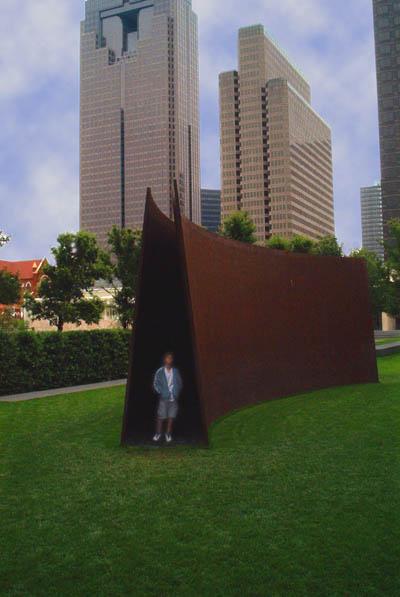
My Curves are Not Mad - Richard Serra, 2004
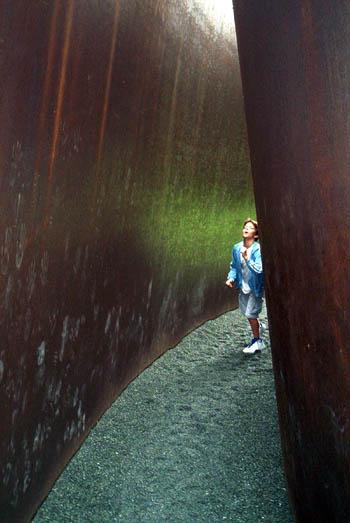
Inside My Curves are Not Mad - 2004
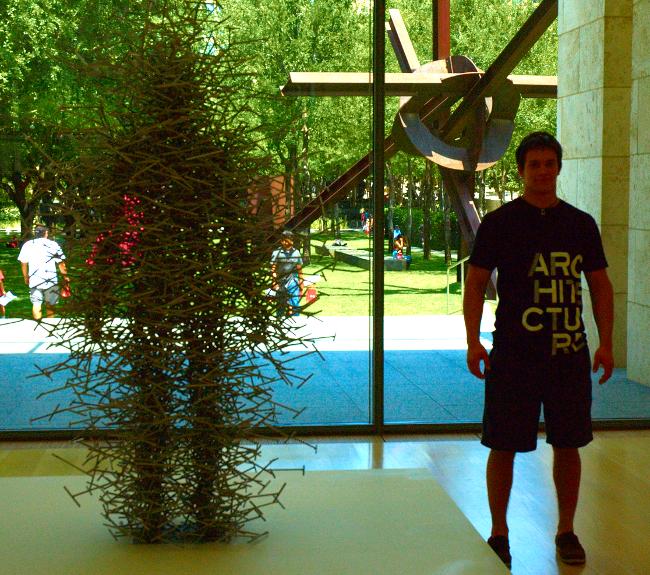
Quantum Cloud XX (tornado) by Antony Gormley
Quantum Cloud XX (tornado) by Antony Gormley used to be down at the bottom of the garden. I liked it there, it looked like a ghost emerging from the shrubbery. It’s always been one of my favorite pieces and I still like it. Actually, today I was glad it had been moved into the air conditioning.

Untitled (Sprawling Octopus Man), by Thomas Houseago
Untitled (Sprawling Octopus Man), by Thomas Houseago, is part of a temporary exhibit, called Satuesque.

Hammering Man, by Jonathan Borofsky
Everyone that has lived in Dallas for a long time remembers Hammering Man, by Jonathan Borofsky, because it used to grace Raymond Nasher’s shopping mall, Northpark. I love it that he was allowed to stay in the city.
The guide for our walking tour in the Dallas Arts District, standing at the end of the barrel vault at the Dallas Museum of Art, gestured toward the towering spire of Postmodern granite, the Trammell Crow Building, and said, “in the eighties there was a building boom in downtown Dallas.”
That simple sentence brought the memories tumbling out of the cowbwebby recesses of my creaking old head. At that time, I was working at the old Cotton Exchange building, only a few blocks away, and I would look out of my office window every day and watch the progress of the Trammell Crow tower as it rose out the enormous hole where a cracked parking lot used to be. It went up fast, it grew like a weed. I was young then, I still gave a shit, and was fascinated with the construction techniques – pouring the concrete floors and support columns, the utilities, the dark glass, and the polished granite cladding. I did not know what it would look like when finished and watching it grow was like a slow-motion puzzle being solved right in front of me. The building was assembled inside-out and looking at it now, almost thirty years later, I still know its innermost secrets.

The Winspear Opera House is surrounded by a massive sixty foot high sunscreen made of aluminum louvers.It is amazing how much cooler the killer Texas heat is under this high-tech shade. The picture shows a small section of the slats with the tip of the Trammell Crow Center beyond.
The Dallas Museum of Art was also built while I worked down there. Admission was free when it was new and I would walk over there almost every day at lunch and pick out one single painting or sculpture and stare at it until I felt that I possessed it completely.
Yesterday, I checked the Friday Newspaper (online, of course) to see if there was anything interesting to do over the weekend and I found a notice about a walking tour of the architecture of the Dallas Arts District at ten AM on Saturday. That sounded like a plan.

A pole-sitting sculpture in front of a new Condo Tower going up.
It was interesting… and although I’m pretty familiar with the Arts District, I did learn a few things.
At the turn of the century or so (1899, not Y2K) Ross Avenue was the street where all the wealthy scions of Dallas built their mansions. The only one remaining, The Belo Mansion was purchased and rebuilt by the Dallas Bar Association. Prior to that, for many years it was leased to a funeral parlor. In 1934, Clyde Barrow’s bullet-ridden corpse was displayed and attracted a crowd of thirty thousand macabre curious onlookers.
I was a little disappointed that the wonderful European sculpture was gone from the walk around the base Trammell Crow Building. Our guide said it had been moved to the Old Parkland Campus and that it would soon be replaced by a garden of Asian sculpture. That will be cool.
Of course, it’s common knowledge that the district features public buildings designed by four Pritzker Prize winning architects – I.M. Pei and the Morton Meyerson Symphony Center, Renzo Piano and the Nasher Sculpture Center, Norman Foster and the Winspear Opera House, and Rem Koolhaas and the Wyly Theater. At the east end of Flora street is the City Performance Hall (under construction) and the One Arts Plaza mixed-use development. It’s a bit sterile sown there on the east, but there is still a lot of construction.
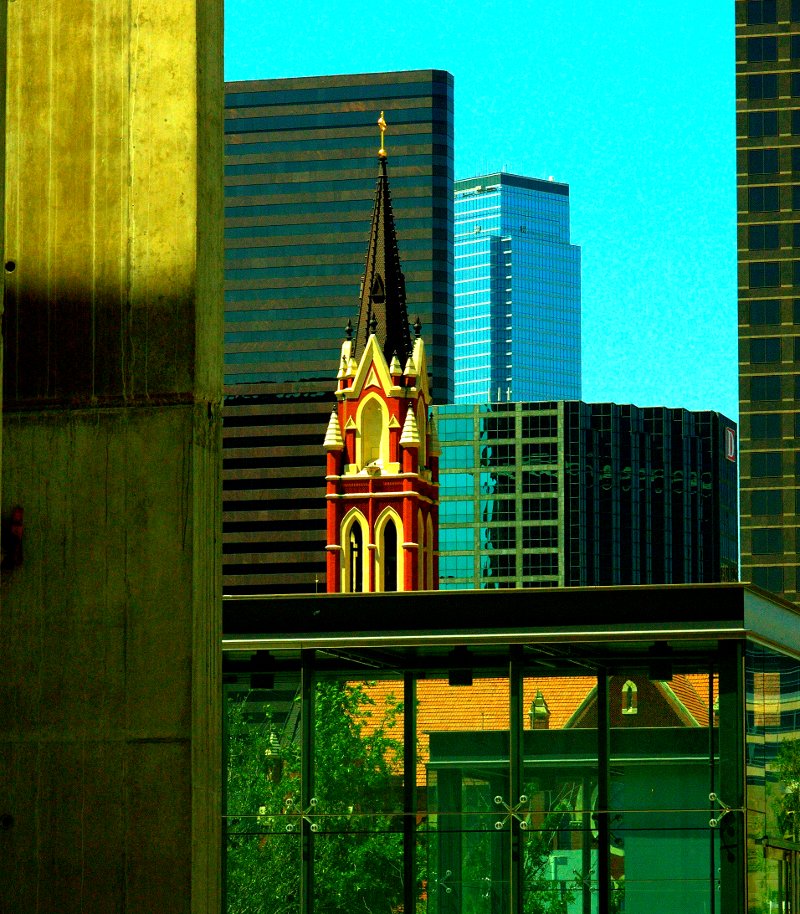
The Bell Tower of the Guadalupe Cathedral framed by skyscrapers. Taken next to the construction site of the new City Performance Hall.
We ended the tour there on the east end of Flora. I walked back taking some pictures. The Nasher was open for free, and I couldn’t resist a visit. The Trammel Crow Collection of Asian Art across the street is often overlooked – but it is always free and although it is small, there is always something wonderful to be found there. This time it was the art of Tenzin Norbu and Penba Wandu – they combine ancient techniques with a modern spin – the results are stunning. Norbu‘s painting, “Story of the Northern Plain” was the most beautiful thing I’ve seen in a long time.
The tour was fun. I guess they do these every now and then, if you find yourself in the Big D, I highly recommend it.

Aluminum Tube Skin on the Wyly Theater
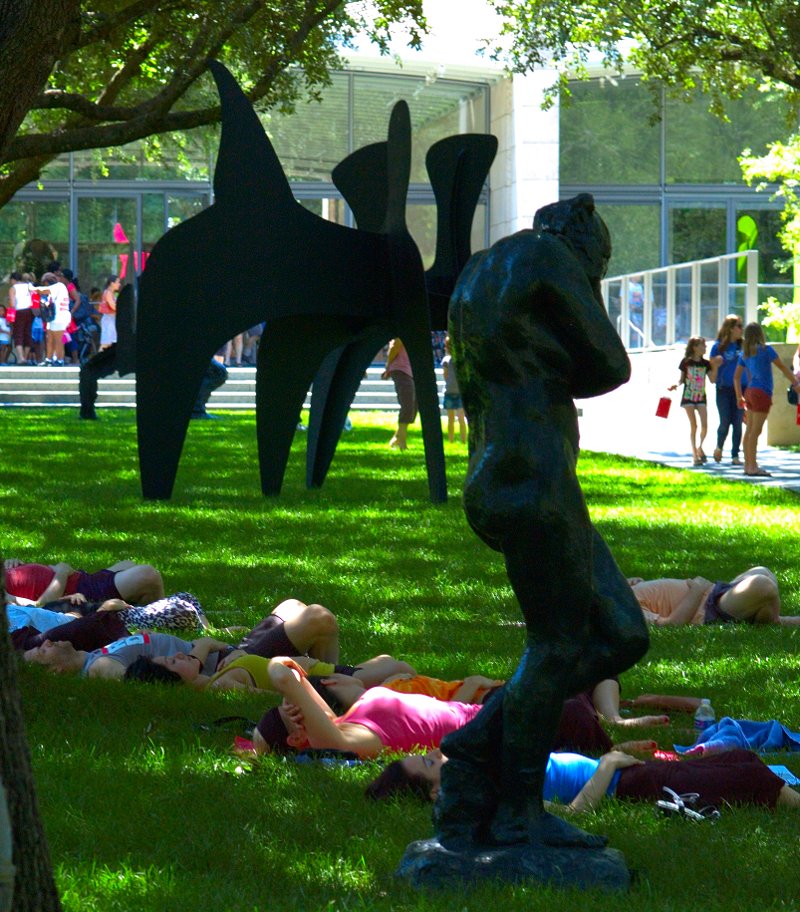
Eve, by Auguste Rodin, Three Bollards, by Alexandre Calder, and a yoga class.

Worshipping a New God.

Headless Construction. Magdalena Abakanowicz, Bronze Crowd, and the Condo Tower being built next door.
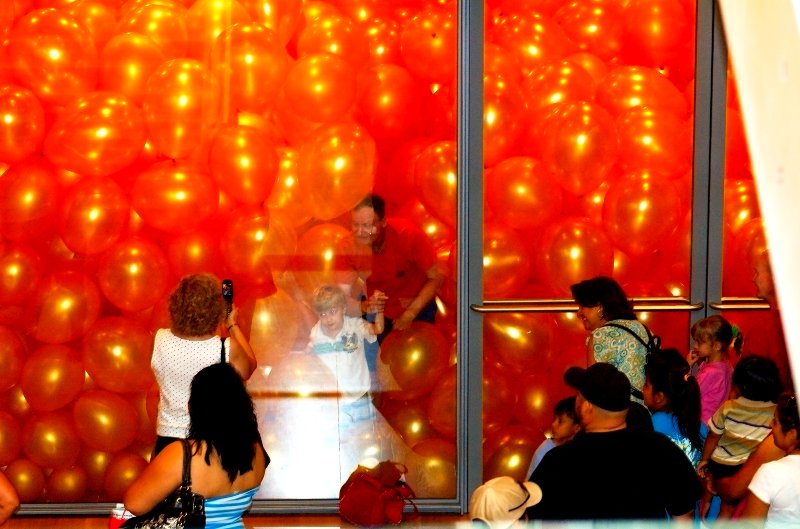
At the Nasher, they had a room full of balloons. It was an installation by British Artist Martin Creed. Children were queued up for a chance to get inside.
 Bill Chance