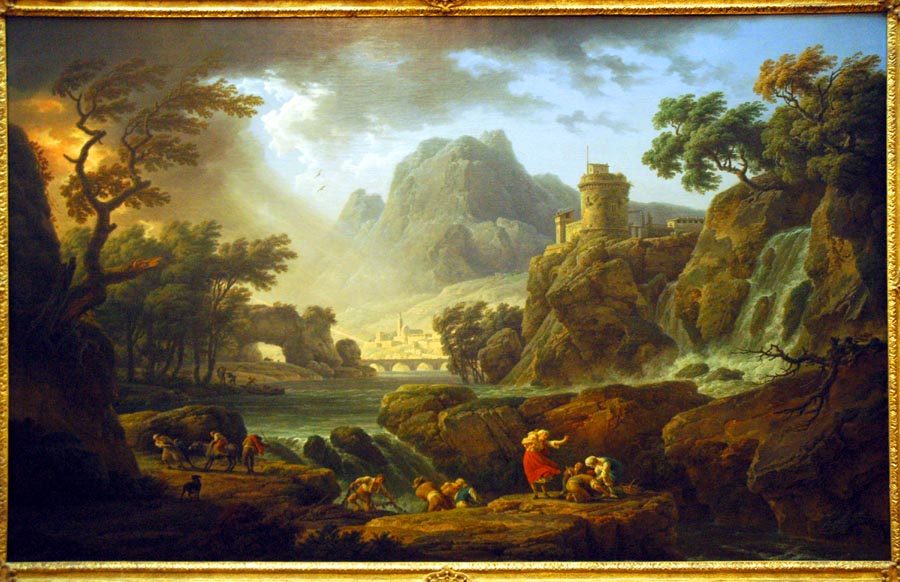
(click to enlarge) "Approaching Storm" by Claude-Joseph Vernet, Dallas Museum of Art
The river was teeming with plump fish. Today would have been a good catch. The storm blowing in from the sea will put an end to that. Dorothy came down with baby Aaron to warn us, wearing her favorite red dress. She’s holding him as he squirms, he wants to play with the fish. John and I are down on the rocks working, trying to get the day’s catch gutted and put up before the rain starts, while the rest pull in the nets. A stray dog is barking as Donna fights with the mule, the animals know what’s up and want to go home now, instead of helping us with our load.
A sudden flash startles me and I look up to see a giant bolt of lightning scream down at an angle from the glowering cloud. It strikes the city, golden in the distance. The sky has darkened leaving the cream limestone of the city’s domes and towers to almost glow in the last free rays of sunlight. A while later the thunder careens down the valley, distant booming echoes coming off the giant rocky crag of Gray Mountain behind the city and from the walls of the canyon itself.
Above me, high on the canyon walls is the Duke’s estate. New luxurious stone buildings built around the ancient ruins of a ruined castle. Since the Duke built the new tollbridge by the city, his fortune has increased tenfold. A lone figure, one of the Duke’s men, looks down, high overhead from the old ivy-covered tower. He is probably watching the boats; some nobles were out for a day on the river and were caught by the sudden wind. They are heading back in their carriage, leaving the boatmen to struggle with their craft.
The storm is building, piling up upon itself, towering overhead like an angry giant. The wind whips even wilder, I can smell hard rain approaching, the flashes of lightning come faster now. My excitement is beginning to be tainted by fear; the old highway back to the city runs along the canyon bed, under the stone arch; and even with the mule helping with the nets the storm will be strong upon us before we reach the bridge. The tumbling cataracts here in the last stretch before the sea can rise up quickly, many travelers have been engulfed, with their destination in plain sight.
I look at Dorothy and little Aaron, Donna and the mule, the netmen; all looking to me for guidance. I should have known this storm was blowing up, should have stopped work sooner, should….
Jim was jolted out of his reverie my something moving across his field of vision. Something thin, dark; something slinky, something sexy. He felt her in his gut even before he even really figured out what had startled him. The young woman walked by between his bench and the painting; his head turned to follow as she passed on by the big oils of landscapes and ocean scenes down the room and back several hundred years to painted scenes of Christ on the cross.
She was wearing a short black dress, black stockings, and her long dark hair poured over her shoulders. Her face… her skin was as pale as a cold egg. She carried a little notebook and a thick textbook; she must be here with a college class. She was young and thin and tall, moved with a nervous jumpy weightless ease, flitting along from painting to painting like a colt.
Jim stood from the bench and let out an audible sigh. It was time to go findShelby. He preferred the old masters, paintings that looked like something, art that told a story. He had been sitting on a padded bench in front of a Claude-Joseph Vernet painting, “Approaching Storm” for over half an hour.
His wife liked the modern stuff. He knew what gallery she’d be in. With another sigh he set off.
………………………………………………………..
MODERN AMERICAN ARTS DIGEST —– AUGUST 13, 2013
ELMORE SPENCER – AN ARTIST WATERS HIS ROOTS
—————————————————
Elmore Spencer has climbed the mountain of the art world. From a child prodigy that startled adults with his sketching skills at the age of six to a celebrated student of the Paris art schools to a meteoric rise to the jet-setting toast of the New York Art Society, Spencer has had it all.
Instrumental in founding the “New Realism” school, he then rejected this return to “Painting that looks like something” and veered off into innovative artistic experiments that challenged the border between art and observer, maintaining his success and popularity through it all.
Now, he struggles with a return to his roots, to maintain the connection with his audience that he feels his decades of success have cost him. The conflict of the avant-garde and the traditional, realistic and symbolic, is at the heart of what Spencer is up to now.
“It’s been a long road, but I’ve been lucky,” Spencer said in a recent interview, “To others its seems like a climb, a rise, but to me it feels like a spiral, the further I go, the more times I return to the same places.”
His newest installation in the Checkwith Gallery of the Kooning museum communicates that duality in Spencer’s own way. A large room in the gallery has been darkened, a dual-sided screen has been installed in the center of the room, along with two digital television projectors and a powerful sound system.
A film plays on this screen; a man walks from the murky distance, approaching the screen in slow motion. The man stands for a minute, then, on one side of the screen a small flame appears at his feet. The flames slowly grow until the man in engulfed. Finally he disappears in a massive wall of fire.
On the other side of the screen the same man is assaulted by drops of water falling from high overhead which increase in frequency and volume until they become a torrent falling. The water slows and stops and the man is gone.
Meanwhile the speaker system booms out the sound of water falling, the sound of roaring flame. It is interesting to note that both sounds are the same.
The film installation is work of art in itself, many, if not most, visitors assume that it is the artwork. With his playful genius, Spencer has visualized this darkened room as a controlled setting for his real art. He has constructed a series of twelve sculptures, to be placed into the area on a rotating basis.
One sculpture is a pair of lovers, constructed of modern materials, rugged and realistic. They sit on a bench in the darkest corner of the film room, they are only visible during the peak of the flame portion of the film, illuminated by the fire on the screen. They are locked in a kiss, an embrace, his hand is slipped inside her shirt, hers rests on his thighs. The museum receives dozens of complaints on the days this sculpture is set out.
Another sculpture is a mechanical museum guard. He stands inside the room. When the guard is present the film is turned off. Infrared proximity sensors pick up any patron that enters the room; and after a delay, the ersatz guard plays a recording, “I don’t know, they’re supposed to have turned the film on by now.”
Some of the sculptures placed in the room are designed to look at home there, others, such as the murder victim, placed in the corner with a knife protruding from his back like from a cheap detective movie, are obviously intended to shock or annoy. On certain days nothing is placed in the room, leading to a scene where patrons in the know walk around examining each other, trying to determine what is real and what isn’t.
Spencer has even been known to spend a day in his own installation, sitting on a bench with his famous sketchpad, drawing the reactions of the observers. This has been so successful; he has taken to walking around the museum sketching patrons looking at art.
“As artists we live for the people that look at our work, really. We never think about them, or study them, or try to incorporate their lives into the art itself. I want to change that…….”
………………………………………………………..
“Shelby,Shelby!”
She turned from the painting, a huge panel covering most of the wall, hand painted with extreme skill to look like a blow-up of an article from a art magazine, to see her husband standing there.
“What do you want?”
“It’s time to leave.” Her husband looks at his watch. She thinks he always is looking at his watch.
“I’m not finished reading this.”
“What the hell is that? What’s it supposed to mean? Might as well go home and read the paper.”
“It’s by Spencer, My Life, it’s called. I haven’t decided what it means yet.”Shelbyfelt anger welling up in her throat. She’s known James, her husband, her love, since they were children and had been angry many times over the many years, but nothing like lately. She could feel a fight coming on, a mean and nasty fight, and one with no resolution.
When they were young, when they were first married they would argue, like all newlyweds, like all friends. It would end quickly, though, with both giving in. The next day the argument would seem so silly.
Now, though, they fight, and the fights never end. They taper off into silence and simply flare up again at the next conflict, the next insult. She could feel the heat rising, like a hot nut right under her sternum.
“Come on!” Jim said, placing his hand on her arm, “We have things to do.”
Shelbywanted to explode, but the twentieth century gallery at the Kooning museum was not the place to have a knock-down, drag-out, so she walked stiffly in silence, stewing. They passed through room after room, moving back in time towards the rear entrance until they reached an area dominated by a huge landscape painting; the most famous work in the museum. It was a scene of icebergs, a giant white slope, begging for footprints, a brown and purple timeless sky. The ice in the foreground was littered with debris, a shattered mast, a glacier torn boulder. The ice rose in craggy veined cliffs all around pierced by an emerald green frozen tunnel, a mystery. The calm sea was disturbed only by circular waves radiating out from some unseen event.
She could not stand it any more, she was so furious.Shelbypulled away and sat quickly down on the circular bench. Jim sat down beside her, staring wide-eyed. Pulling in her anger, she started to speak.
“Jim I…”
“Excuse me, folks,” said a man they hadn’t noticed. He was gray-haired, wearing old jeans and a long-sleeved shirt. He was sitting on the floor, leaning against the wall under a Thomas Dougherty landscape, a large sketchpad resting on his knees. “Do you mind sitting there for a while, I’d like to draw the two of you. If you don’t mind.”
Jim stammered, “Well, we have…”
“Sure, go right ahead,”Shelbyinterrupted.
“Alright then, umm. turn toward each other a little, now look at me…. Fine, why don’t you hold her hand a little…. That’s right.”
He started in drawing right away. Working with colored pencils and some charcoal and a bit of an eraser. Jim and Shelby felt nervous; the fight, their day quickly forgotten.
“Ummm… try to relax, why don’t you tell me a story. Tell me about when you first met.”
“Well,” Jim started.Shelbywas surprised that he spoke up so soon. She was getting ready to talk, but he beat her to it.
“We met in junior high school, seventh grade, we were both thirteen. She sat if front of me inEnglish class. I remember, I loved her from the first moment I saw her. I thought she was the most beautiful thing I had ever seen. Our teacher was old, he would lean on a podium and lecture us all class long. The room was too small, our desks were crammed together, her seat backed right up against my desk. All I would do is sit there and stare atShelby’s hair. Her blonde hair. Sometimes she’d wear it down and it would fall in cascades right in front of me. Sometimes she’d wear it up, like a golden seashell, a yellow spiral. Sometimes in one ponytail, sometimes two, it didn’t matter. That was my favorite hour of every day, to sit in that hot crowded room and look atShelby’s hair. I felt like I could do this forever, for the rest of my life.”
Shelby and Jim sat there then and talked. They talked of old times, when they were young and when they started dating. They talked of old friends. They talked of their first apartment, of their first house, of the cars they had bought together, of the meals they had cooked, of the vacations they had taken. They forgot about the artist, ignored him until he finished. He put his pencils back into a little wooden case.
“Done.”
“Well, can we see it?” they asked together.
“See it? You can have it.”
“Really?”
“Really”
He handed them the paper and thanked them simply. The artist walked around the corner and was gone.
The drawing had the iceberg painting in the background. Carefully done in colored pencil and pastel chalk it was amazingly detailed and accurate. He must have been working on it for hours. The painting, or, rather the drawing of the painting faded in an oval spot near the center. He drew only around the edges, leaving a blank spot, waiting as he drew for someone to come along and fill it.
Shelby and Jim now occupied the oval. She gasped as she saw it. It was a life-like drawing, done mostly in pencil and charcoal, cross-hatch and shades of gray, only a hint of color added. Detailed. It was realistic except that they both were drawn naked.
Jim looked at the drawing of his wife’s breasts, at their intertwined hands. Shelby, at her husband’s naked body. She was shocked when she noticed that the artist had drawn in the patches of hair across Jim’s chest exactly right. The lower right corner had a quickly scribbled “ES.”
They suddenly noticed that over a dozen people surrounded them. They must have walked up to watch the famous artist work, but Jim and Shelby had not even noticed. Embarrassed by the gathering crowd pointing to details on the sketch, they rolled up the drawing, and headed out to their parked car. They held hands as they walked,Shelbyleaned her head on Jim’s shoulder as he drove.
They spent some money to have the print professionally framed and mounted at a shop across town that handled fine art works. Never really comfortable with the nudity, they couldn’t hang it in their living room. The framer recognized the signature, told them it would bring in tens of thousands of dollars, especially with the story of the sitters. He recommended a gallery. Even though they could really use the money, Jim and Shelby couldn’t sell it. It meant too much to them. They did hang it, in their bedroom, next to the closet.
For many decades, until the days of their death it was the last thing the saw at night when they went to sleep, the first thing in the morning when they woke up.
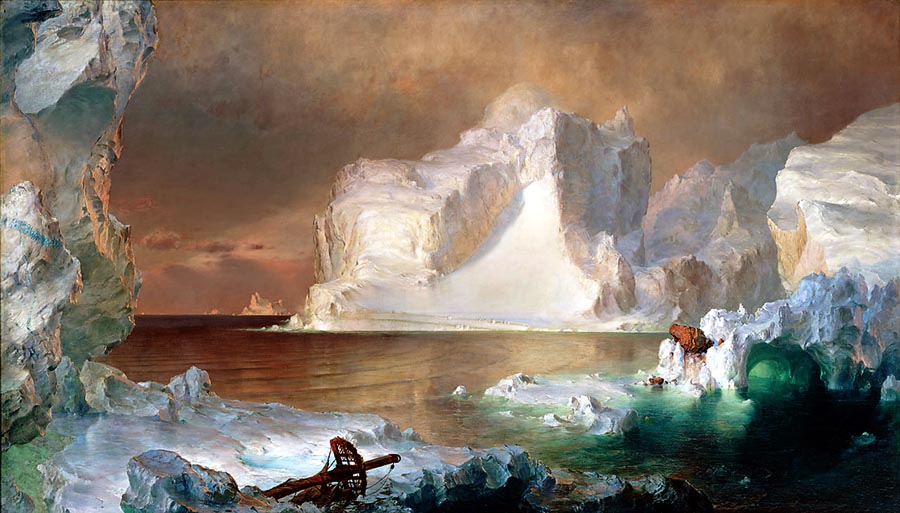
(click to enlarge) "The Icebergs" by Fredrick Church, Dallas Museum of Art










 Bill Chance