Free Rothko

I am very happy now that the Dallas Museum of Art has instituted free general admission to its public galleries. There is a qualitative difference when paying ten bucks to get into a museum as there is when it is gratis. It you shell out the bucks, you feel you have an obligation to get your money’s worth – to see and do and cram as much as possible into the experience. You are under pressure to enjoy yourself. With free admission you can wander in and out and have a relaxed and interested time.

When the museum first opened in downtown (moving from Fair Park) in 1983 I was working in the old (now long blown up to make room for the First Baptist Church’s Parking Garage) Cotton Exchange building, only a couple blocks from the museum. What I loved to do was to carve out an hour or so, maybe over lunch, maybe before I went home, and simply go to the museum and look at one single work of art. I’d plan it out ahead of time, choose a painting or sculpture, and then go stare at the crazy thing, and nothing else, for an hour. It was an amazing way to get to know a work – a lot different than a casual stroll through a gallery.

That’s not something you can do with a ten buck admission price.

So we were down there and I was interested in looking at the Rothko piece, Orange, Red and Red. I really enjoyed the play Red at the Wyly in February and wanted to see one of his paintings in the flesh, so to speak. During the play, the actors playing Rothko and his assistant actually splashed paint, the undercolor, covering a huge canvas. The people producing the play worked hard on getting the details right and partnered with the DMA – which made me thirst to lay my eyes on the real deal.

The problem was, I didn’t know where the Rothko was. It might have been up on the third level with the American paintings, but I didn’t see it there – it was too modern and abstract for that gallery anyway.

Later, we walked into a modern gallery off the Ross Avenue side of the museum and I thought for sure it would be in there – it fit in. But I couldn’t spot the thing so I walked up to a guard.

“Excuse me,” I asked, “Do you know where the Rothko is?”

“The Ronco?” he said.

“No, the Rothko… It’s a painting by Mark Rothko, they did a play… it’s an important… He was a painter in New York in like the fifties and sixties.”

The guard looked at me with a blank, confused look. “Maybe it’s in the American section.”

“I looked there and didn’t see it, but maybe I missed it.”

“Oh, and these paintings down here, in this gallery, they are all by female artists.”

He gave me a big, proud smile… he had found something he knew that I didn’t. I thanked him for his help and as I turned I looked over his shoulder and there, right there, behind and past him and out the entrance to the gallery, hanging on the wall of the big main spine corridor, was the Rothko. I couldn’t miss it.

So I took some time and stood there, not an hour… but at least a few minutes and looked at it. I could imagine the artist throwing down those rectangular fields of color and then staring at the work as it progressed… just like the guy in the play did.

It was pretty cool. And it was free.

Mark Rothko, Orange, Red and Red, Dallas Museum of Art

Mark Rothko, Orange, Red and Red, Dallas Museum of Art
Sound of Schoolkids

The other weekend we had another Writing Marathon. We met in Klyde Warren Park and walked across to the Dallas Museum of Art. The idea was to use the paintings as inspiration.

I’ve done that in the past… writing some fiction while sitting and looking at works of art. So I did it again – started a piece of fiction using objects and themes from a handful of painting that spoke to me that day. After pages of furious scribbling I came to a stopping place, the well had run dry.

So I switched to a bit of non-fiction, writing about what I saw, felt, and heard right then… as a little bit of writerly palette cleaning, a way to keep the pen moving, and to help remember the day.

This is what I’ve typed up out of my Moleskine:

There is a sound of a group of schoolkids moving through the gallery. The chatter, the echoing around the corners, the occasional squeak of a plastic sole scraped across polished wood.

An art museum is a place designed for the eyes, but it is a unique sound collection. Close your eyes and listen for the ping of the elevator door, a distant infant cry echoing through the labyrinth, a close jingle of keys.

The guards have rubber soled leather working shoes – silent as death and strong enough to stand in all day. I imagine their feet are sore and tired when they go home at the end of their shift.
Close your eyes and you can still feel the power of the art. There is so much time trapped in the layers of oil and pigment, drowned in the waves of brushmarks.

Open your eyes and look at the color. That blue robe is over four hundred years old – still as bright as the day it was layered down.

Nicolas Mignard  French 1606-1668 - The Shepherd Faustulus Bringing Romulus and Remus to His Wife - 1654

Nicolas Mignard, French 1606-1668 – The Shepherd Faustulus Bringing Romulus and Remus to His Wife – 1654 (detail)

Stand in front and extend your hand (not too close!) and feel yourself standing in the spot and position of the artist – though he had no electric light, no air conditioning. Next to the painting, on a little card, is a plaque with a number… Five Hundred (let’s say).

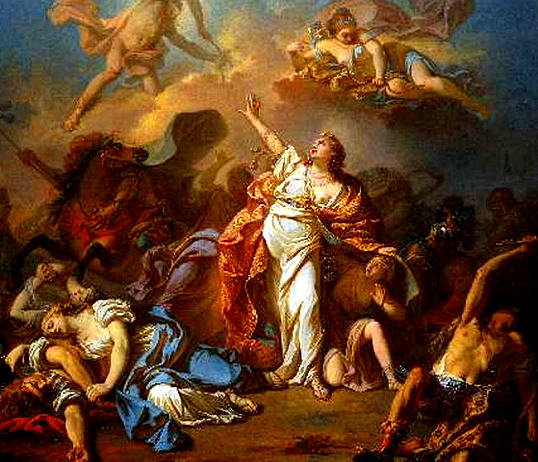
Jacques-Louis David, French, 1748-1825, Apollo and Diana Attacking the Children of Niobe, 1772

Jacques-Louis David, French, 1748-1825, Apollo and Diana Attacking the Children of Niobe, 1772

Pull out your phone, go to the indicated website (the museum has free WiFi, of course) and type in the number. (The museum posts this web address, dma.mobi – that contains so much information in a mobile interface… this is truly the best of all possible worlds). There, in your palm, appears a portrait of the artist – the tiny tinny speakers (forgot your earbuds again, didn’t you) speaks to you – a famous art historian lectures on those ancient times.

The glowing screen in your palm now changes every few seconds with a new image – a series of paintings by the same artist. This is too much. You can’t help but wonder what those ancient geniuses with their candles and oil paints would think of the tiny glowing screens. Sufficiently advanced technology is indistinguishable from magic.

Mysterious Hieroglyphics

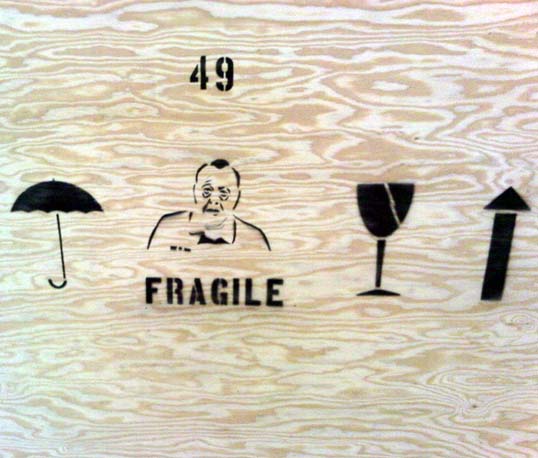
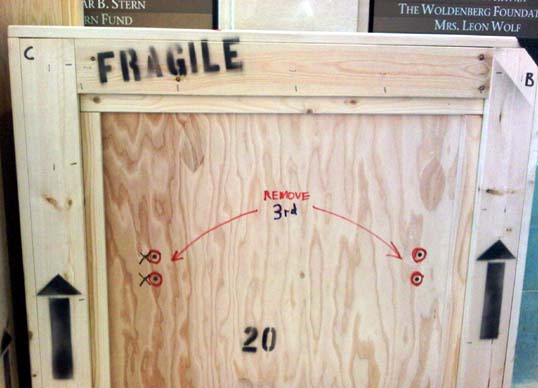
In a hallway in the New Orleans Museum of Art I saw a pile of wooden crates. Obviously a new exhibit on its way in – the plywood was stenciled with a set of transportation-related symbols.

mystery1

OK, there’s the “this end up” symbol – the “do not let this get wet” symbol – a “Fragile” symbol – but what’s up with the stencil of the guy? Does it mean, “May contain Winston Churchill”? Does it mean, “Dangerous Bags Under Eyes”? “Please notify the butler”? “The old man may be constipated”?

OK, I’m not stupid, I can figure out that the stencil probably means that the crate contains art. Still, who picked that symbol? Why is it important that everybody knows it contains art? Who is that guy anyway?

The museum has some great art – but I sort of enjoyed the hieroglyphics on the packing crates as much as anything.

If I had to guess, I’d think that the crates had at least part of an exhibit called “Lifelike” in them.

mystery2

mystery


mystery3

Two Archers

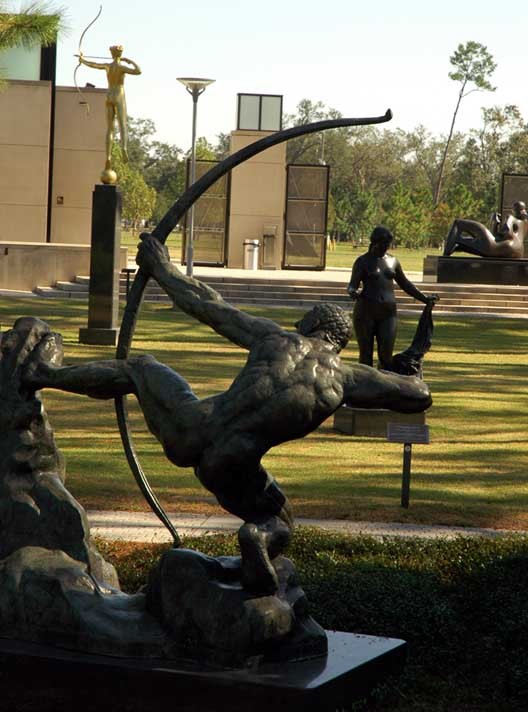
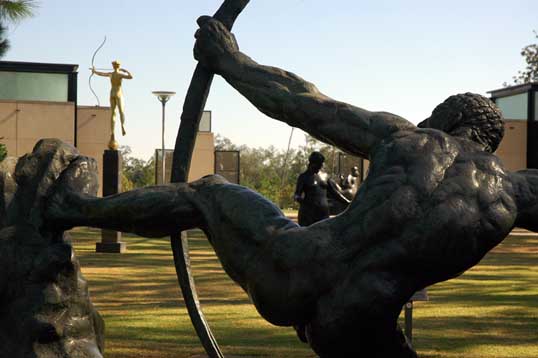
Besthoff Sculpture Garden, New Orleans, Louisiana

A good archer is not known by his arrows but his aim.

—-Thomas Fuller

(Click for a larger version on Flickr)

What we want is not freedom but its appearances. It is for these simulacra that man has always striven. And since freedom, as has been said, is no more than a sensation, what difference is there between being free and believing ourselves free?

—-Emil Cioran

(Click for a larger version on Flickr)

Sculptures in the photos:
Henry Moore, Reclining Mother and Child

Pierre Aususte Renoir, Venus Victorius

Augustus Saint-Gaudens, Diana, The Huntress

Antoine Bourdelle, Hercules the Archer

Karma

“Our lives are not our own. We are bound to others, past and present, and by each crime and every kindness, we birth our future.”

― David Mitchell, Cloud Atlas

Karma, Do-Ho Suh, New Orleans Museum of Art

Karma, a sculpture by Do-Ho Shuh, in the Besthoff Sculpture Garden at the New Orleans Museum of Art.

I rely on those below me to reach this height, and support so many others above, yet we are all blinded by our duties to the beauty around us. Trapped by the darkness of our burden. All we feel is the terrible weight.

Age of Steam

A few more photographs from my bike ride down to the old, Fair Park, location of the Museum of the American Railroad.

Museum of the American Railroad

Years ago, when my kids weren’t much more than toddlers, I made a discovery down along the edge of Fair Park – The Museum of the American Railroad. Along one side of the Art Deco complex of buildings was a strip made up of a half-dozen sets of steel rails with an amazing collection of rolling stock. They had everything from an old station to restored dining cars to some of the largest steam engines ever made.

The kids loved the place. They would clamber around an on the huge masses of steel. Their favorite thing, of course, was to climb up into the cab and sit in the driver’s seat, looking out and around the giant boilers. You could see their imaginations working.

The only problem was that it was a terrible location. A weedy, hidden spot, neglected, unknown – the powers that ran Fair Park obviously didn’t want the trains there and had no appreciation for the unique and amazing history on steel wheels. I kept expecting to read that the place was melted down for scrap.

Nevertheless, over the years, there were rumors of renewal and movement. For a while I read about a spot in downtown’s West End where a developer would use the trains to anchor a new complex. But the ups and downs of the economy always killed the ambitions and plans and the railroad museum began to get more and more run down.

There is nothing worse than watching a potential jewel, especially one in a city that is so sorely lacking in any history whatsoever, slowly corrode and die. It was obvious that the city and the Fair Park management were waiting until the place was so far gone they could kill it once and for all without fear of reprisal.

Then, a couple years ago, I read that the City of Frisco was coming to the rescue. When I moved to North Texas, Frisco was a small town, far to the north of the Dallas Fort Worth Metroplex. Over the last few decades the urban sprawl has vomited itself out across the cotton fields and swallowed Frisco whole. Now it is a huge shiny new city and hungry for signature attractions. What could be better than a museum made from a collection of antique locomotives? They already have a nice local museum up and going. So they put together a piece of valuable property right in the new city center and started plans for a new railroad museum.

When I first read about this a couple years ago my first thought was, “I’ll believe it when I see it.” I had seen this act before. However, I underestimated Frisco’s ability to get something done, and now, a short few years later, the site is ready and the rolling stock ready to move out to the suburbs.

The other day, I rode down the Dallas Santa Fe Trail from White Rock to Deep Ellum, and took a left turn under the mixmaster and into Fair Park. I rode around and took some photos. One stop I had to make was to see what was left of the railroad museum. It was sealed up with only a watchdog to bark at me through the wire. There weren’t any signs of activity that day, but I’m sure they were working on getting these huge old hunks of steel ready to move.

I’ve been following the news, trying to figure out when the big steam engines are going to move. I’d love to see these things on their journey – the first time they’ve moved in decades. That is so cool.

Sculptures at the Crow Collection of Asian Art

A couple of photographs I took the last time I was at the Crow Collection of Asian Art in the Dallas Arts District.


New Book of Mountains and Seas

One of the hidden gems down in the Dallas Arts district is the Crow Collection of Asian Art.

I was working in the Cotton Exchange building in downtown Dallas (the Cotton Exchange is gone now – they blew it up a couple years after I left) while they were building the skyscraper tower of the Trammell Crow Building. The construction site was visible from the windows of our office suite. I watched the steel skeleton climbing up and up – watched the workers scrambling over the latticework of girders. I watched the granite and reflective glass being raised and affixed to the building’s outer skin.

There is always a connection with a building that I watched go up. Since I saw it stretched out in time from the inside out – I feel I know all of its secrets. I know the shortcuts the architect made to get the outer shape. I saw the ventilation, plumbing, and elevator shafts carved out of the interior.

At one time the walkway around the base of the building contained an amazing collection of European sculpture and was one of my favorite places. The sculptures have been removed – and there is the promise to replace them with Asian pieces.

Behind the office building, on a floor level below, facing Flora street across from the Nasher Museum is the Crow Collection of Asian Art. Trammell and Margaret Crow have been collecting Asian art since the 1960’s and built the museum under a pavilion in back of the office tower. It is a small but effective museum, and a welcome addition to the other museums and performance venues in the Dallas Arts District – helping the area move towards the tipping point of becoming a well-known destination. In addition to exhibiting pieces from the permanent collection – the Crow Museum has developed a reputation for hosting impressive visiting temporary exhibitions.

Oh, one more thing. Admission to the museum is free.

A free museum is viewed in a different way than one that you have to pay to get in the door. Instead of making a big deal out of it – preparation and anticipation – you tend to simply wander in and take a relaxed view of the wonders within. I like it.

I have a confession to make – this time that I walked in to the museum it wasn’t because I had heard of some revelatory amazing exhibition or even that I felt the need for peaceful contemplation of a thousand years of artistic production.

I had to pee.

There are not a lot of public restrooms in a big city downtown. The homeless tend to take over and destroy any facilities that are open to anyone. So I decided to duck into the Crow Museum to use their restroom. Since I am a person that likes to meet their obligations – even though I should be able to use the bathroom and leave, there have been many times I’ve been to the Crow to see their art and not used the bathroom – I felt obligated to at least take a quick walk through the galleries.

I walked into the big room past the gift shop and found that it had been emptied. There was a bench in the center of the room and three digital projectors were shining on a long wall. The effect was that of a widescreen film being shown in a bare wooden room – very clean and beautiful. One guy was sitting at one end of the bench – I walked over and sat down on the other.

At first the film was showing some credits and bits of poetry while the soundtrack played some electronic music. It was very peaceful, but not much too it and after a few minutes I wondered, “Is this it?” It was an interesting thought – all this space and technology used to simply throw a few words on the wall along some jangling sounds. I began to wonder if it was an elaborate joke.

It wasn’t. I had come in right at the credits at the end. Soon the presentation looped back to the beginning and the real show began.

This was a film by Qiu AnXiong, an artist from Shanghai. The exhibition was called Animated Narratives and consisted of a two-part video installation called New Book of the Mountains and Seas, along with paintings associated with it.

The video started with a hand drawn animation of waves on the sea, then moved to a pastoral landscape. Soon, a farm appeared to grow on the land like an organic thing. The farm quickly grew to a village and then a walled town. Civilization continued to grow in an organic way – with fantastic animals taking the place of oil rigs, pumps, transportation, and warcraft. Everything grew and grew, with many scenes reminiscent of recent events, but warped into a strange surreal organic landscape. The Middle East (or something resembling it) is ravaged by oil production, the terrorists strike in a version of 911 even more surreal than reality, and then the inevitable disaster and destruction obliterated everything.

The film was in black-and-white and appeared to be animated ink drawings. After walking around and looking at some of the paintings, it was clear that it is actually paint on canvas. The artist overpaints as he photographs his work and generates the animation that way.

I really enjoyed the film and its presentation. You really have to see in it in its carefully constructed widescreen format to appreciate the work, but if you can’t make it to the Crow:

Here’s an online version (wait through the ads). I’m not sure how long this will be online.

Here’s another link to a version of the piece.

If that link doesn’t work for you, here’s about three minutes of the film. This section is near the end, and it does not do justice to seeing it live.

I enjoyed it enough to come back a couple days later and take a look at part two. This is another widescreen video set up in the mezzanine two floors higher up in the museum. It’s another animated work, this time concerning mad cow disease, genetic programing, biowaste disposal, environmental catastrophe and man’s eventual fate among the stars.

I couldn’t find the whole thing, but here is a bit of part two.

Don’t be afraid to wander into a museum, more or less unplanned. I should do this more often. I should not be so cheap to be afraid to do this even when I have to pay for it.