
The Taco Joint, Richardson, Texas
“Inconceivable!”
“You keep using that word. I do not think it means what you think it means.
—-William Goldman, The Princess Bride
The Taco Joint, Richardson, Texas
“Inconceivable!”
“You keep using that word. I do not think it means what you think it means.
—-William Goldman, The Princess Bride
“You can only cruise the boulevards of regret so far, and then you’ve got to get back up onto the freeway again.”
― Thomas Pynchon, Inherent Vice

Cover of Inherent Vice, by Thomas Pynchon
So, last September I read Inherent Vice by Thomas Pynchon because… well, because it is Thomas Pynchon – but more specifically because I had read that Paul Thomas Anderson (Boogie Nights, Magnolia, There Will Be Blood, The Master) was making a film based on the book and I wanted to experience the text first.
Pynchon has occupied a great many of my thoughts and a large part of my time ever since I first picked up a paperback copy of Gravity’s Rainbow at the KU Bookstore in 1976 or so (I was not able to finish it for a quarter century – not until a summary, an online page by page annotation, and wiki helped me keep the characters straight). I have read most of the rest of his oeuvre (still have an unopened copy of Bleeding Edge on my bookshelf) and am most assuredly a fan.
Up until I read Inherent Vice I considered Pynchon’s fiction to be unfilmable. After reading it, I agreed with PTA in that Inherent Vice was only almost unfilmable. He had tried to adapt Vineland into a movie, but realized that was impossible.
Because of business and inattention to the Internet, I missed the Dallas showings of the film in December, but finally a wider release was in the offing. My son and his friends saw it over the initial weekend, but I wasn’t able to fit the time in so I decided to go after work.
On Monday I logged into the Alamo Drafthouse website (it’s only a stone’s throw from my house and my work) and bought a ticket for that evening. I was tired and it was bitter cold and I knew that if I didn’t buy it ahead of time I would wimp out after work and go home and sleep.
The Alamo Drafthouse is such a nice experience. You get a reserved seat, craft beer (Temptress Baby!) and the food isn’t bad at all. I ordered a hamburger – a Royale With Cheese, of course. Alamo’s policy of no talking and no cellphones is certainly a welcome perk.
So… how was the film.
If you are a fan of Paul Thomas Anderson you will be disappointed. This isn’t a PTA movie; it is a Pynchon movie. PTA’s movies can be weird (Frogs!?) but this one is WEIRD. What makes it crazy making if you don’t know what to expect is that he sets the stage with so many familiar tropes and then abandons them without a moment’s hesitation or regret. From the trailer you might think that it is a detective story – about a search for a missing billionaire and the detective’s old girlfriend – hoary old familiar plot devices -, but from the book I knew that this is a feint – that nothing is going to be explained, nothing is going to make sense, and the mystery will fade away rather than be resolved. What the hell exactly is The Golden Fang anyways?
You might also think that this is going to be a druggie comedy in the style of The Big Lebowski. There are elements of that – but the comedy is overshadowed by Pynchon’s signature paranoia and despair.
But, that said – I thought it was great. It is the kind of thing you will like if you like that kind of thing.
Despite the ending being changed and large sections of the novel excised (you have to do this to get a tolerable running time) it is amazingly faithful to the book – for good and bad.
What was crazy for me is the way the characters speak. I have been reading Pynchon for so long I am very familiar with the unique language a Pynchonian character uses – his cadence, style, and subject matter. I have been reading these letters on the page and hearing them in my head for decades.
Now, to hear these words coming out of another human being’s mouth was astounding. I could only shake my head at this ephemeral world of imagination now come to life on the silver screen.
“What goes around may come around, but it never ends up exactly the same place, you ever notice? Like a record on a turntable, all it takes is one groove’s difference and the universe can be on into a whole ‘nother song.”
—-Thomas Pynchon, Inherent Vice
Cover of Inherent Vice, by Thomas Pynchon
I have always had an odd and powerful relationship with the novels of Thomas Pynchon. I have spent a good portion of my life with his work in my hands. It started with Gravity’s Rainbow – which took me twenty five years to read… and I consider it to be my favorite novel. Even though I first tried to read it in college I was not able to get through the massive tome until the advent of the internet. I had to follow along with a chapter by chapter summary and a hypertext compendium of characters and information to keep from getting lost.
Then, over the years, there was the almost equally massive V – then the short and bitter Crying of Lot 49. Time marched on to the West-Coast based Vineland and by the time Mason & Dixon arrived I was writing online and chronicled the devouring of this text as I went along.
From my old blog – The Daily Epiphany
Daily Epiphany -Friday, March 19, 1999
Snow-Balls have flown their Arcs
May 2, 1997. A little less than two years ago. That’s the exact day that
Mason & Dixon arrived from Amazon (an online journal is useful for finding useless factoids like that).Over those two years I have, sometimes dutifully, more often sporadically, with plenty of vacations and sabbaticals, slogged through the pages. I was well known to be seen carrying that book around, it’s cover handmade by me from the red white and blue Tyvek wrapper it arrived in. “Aren’t you finished yet?” asked on many occasions.
That didn’t bother me. After all, it took me twenty five years to read Gravity’s Rainbow. In some ways, Mason & Dixon, though shorter and less complex, was even more difficult. The weird faux colonial Olde English and bizarre capitalization and punctuation added an Extra Dimension of Difficulty to the usual Pynchonian Puzzlements.
So slowly I kept at it. Week by week the irregular, oval coffee-stain on the pager-edges moved, slice by imperceptible slice, from my right hand to my left.
Tonight, I finished it.
I bent the cover back and slid the crude Tyvek cover off and dropped it into the trash. It was replaced with the original two-layer cover, preserved from the travails of two years of pawing, stored safely in a dresser drawer.
In order to make room in my bookcase for the Pynchon, I had to pull something out. So, now, it’s Infinite Jest. It’s only 1,079 pages long. Print looks a little small. I even have a bookmark for it. I bought the book used and it contains a loose snapshot of some scrubby looking guy posing by a motorcycle. I have, of course, absolutely no idea who this is. That’ll do.
The thickness and size seemed familiar so, on a whim, I pulled that Tyvek bookcover out of the basket, turned the cover around.
It fit exactly.
A few years later, I tackled Against the Day, then fell off the Pynchon wagon (for no real reason except maybe the intrusion of real life) until now.
Now, I decided to read Inherent Vice – Pynchon’s noirish dark psychedelic detective crime novel.
“Dealing with the Hippie is generally straightforward. His childlike nature will usually respond positively to drugs, sex, and/or rock and roll, although in which order these are to be deployed must depend on conditions specific to the moment.”
—- Thomas Pynchon, Inherent Vice
“It had been dark at the beach for hours, he hadn’t been smoking much and it wasn’t headlights – but before she turned away, he could swear he saw light falling on her face, the orange light just after sunset that catches a face turned to the west, watching the ocean for someone to come in on the last wave of the day, in to shore and safety.”
—- Thomas Pynchon, Inherent Vice
I had the trade sale paperback on the shelf for a long time, but I had to read it right now because, next month, they are coming out with a movie made from the story.
Oh, and not just any movie, a Paul Thomas Anderson movie.
Imagine that, Paul Thomas Anderson filming a Pynchon novel. This is truly the best of all possible worlds.
Modern technology has advanced now to the point I could sit in my reading chair with the book in one hand and a tablet in the other, with web pages queued up to alphabetical and page-by-page summaries to help me with the complex plot and kaleidoscope of characters.
This is arguably his most accessible novel, if for no other reason it has a familiar setting and is woven upon a loom of an established detective genre. It is the only thing I’ve read by Pynchon that I would say is remotely filmable – though just barely.
It still has the Pynchonian style of paranoia, subtle complexity, and, especially, a huge cast of odd characters with odder names. I enjoyed the book immensely. It is, without a doubt, the kind of thing you will like if you like that kind of thing.
Now I am psyched for the film. Only a few days before the premiere. This will be the second beloved book (after Cloud Atlas) committed to celluloid (actually its digital equivalent) by a stylish director in the last two years. I loved Cloud Atlas (both the book and the film) though it predictably bombed at the box office.
I suspect a similar fate for Inherent Vice – I can’t imagine the ordinary teenage-minded moviegoer enjoying the complex interplay of humor and horror that the Pynchonian Universe produces splashed across the silver screen. But I will be there, staring up as if it were meant for me alone.
“You need to find true love, Doc.”
Actually, he thought, I’ll settle for finding my way through this. His fingers, with a mind of their own, began to creep toward the plastic hedge. Maybe if he searched through it long enough, late enough into the night, he’d find something that might help — some tiny forgotten scrap of his life he didn’t even know was missing, something that would make all the difference now.”
—- Thomas Pynchon, Inherent Vice
Looking at the IMDB page – it sure looks weird, seeing all those big time (and not so much) stars arranged against those wonderfully outlandish Thomas Pynchon character names.
Reese Witherspoon … Penny
Jena Malone … Hope Harlingen
Joaquin Phoenix … Doc Sportello
Josh Brolin … Bigfoot Bjornsen
Sasha Pieterse … Japonica Fenway
Owen Wilson … Coy Harlingen
Benicio Del Toro … Sauncho Smilax
Michael K. Williams … Tariq Khalil
Eric Roberts … Mickey Wolfmann
Maya Rudolph … Petunia Leeway
Martin Short … Dr. Blatnoyd
Sam Jaeger … Agent Flatweed
Katherine Waterston … Shasta Fay Hepworth
Martin Donovan … Crocker Fenway
Timothy Simons … Agent Borderline
Yvette Yates … Luz
Serena Scott Thomas … Sloane Wolfmann
Keith Jardine … Puck Beaverton
Elaine Tan … Xandra
Madison Leisle … Goldfang
Steven Wiig … Portola Barkeep
Jeannie Berlin … Aunt Reet
Christopher Allen Nelson … Glenn Charlock
Hong Chau … Jade
Jefferson Mays … Dr. Threeply
Peter McRobbie … Adrian Prussia
Samantha Lemole … Gold Fang Mom
Toyia Brown … Harmony
Diana Elizabeth Torres … Lourdes
Sophia Markov … Amethyst Harlingen
Andrew Simpson … Riggs Warbling
Victoria Markov … Amethyst Harlingen
Martin Dew … Dr. Tubeside
Michael Cotter … Rhus Farthington
Taylor Bonin … Ensenada Slim
Laura Kranz … Chryskylodon Patient
“Later they went outside, where a light rain was blowing in, mixed with salt spray feathering off the surf. Shasta wandered slowly down to the beach and through the wet sand, her nape in a curve she had learned, from times when back-turning came into it, the charm of. Doc followed the prints of her bare feet already collapsing into rain and shadow, as if in a fool’s attempt to find his way back into a past that despite them both had gone on into the future it did. The surf, only now and then visible, was hammering at his spirit, knocking things loose, some to fall into the dark and be lost forever, some to edge into the fitful light of his attention whether he wanted to see them or not.”
—-Thomas Pynchon, Inherent Vice
The extended trailer for Cloud Atlas is out:
I am so excited and stoked for this film… I started to write a blog entry about it, but when I did a search, I realized I Already Did – almost a year ago. Go read my old entry. Then go find a copy of the book, Cloud Atlas and read it. Before October, when the film of this unfilmable book comes out.
134 Terrifying Closeups of Bugs
I wish I had a decent Macro lens.
Beutiful bikes and a cool video.
Hey, an album of bicycle music – Bicycle

Beautiful Bikes and a cool video – The Porteur bicycle
Reform Is Not Enough: The Federal Government Needs a Complete Makeover
American government is a deviant subculture
This behavior by high-ranking public servants should be considered scandalous. People in Washington consider it business as usual, and don’t even raise an eyebrow.
Right and wrong no longer matter in this deviant subculture. Sealed off from personal responsibility by accumulated bureaucracy and thick walls of special interest money, our government is covered by a putrid mold of cynical gamesmanship and everyday hypocrisy. People scurry around its baseboards seeking short-term advantage, but big change is so inconceivable as to be laughable.
Even reformers have given up. What is politically feasible, they ask? The answer is clear: nothing.
Change will nonetheless happen, political scientists tell us. How? Through a crisis….The main challenge then will be not merely to reform Medicare and other unsustainable programs. The challenge will be to change the culture of government.
Literature’s greatest serial killers
I have read all but one book on this list. My favorite – Anton Chigurh, of course.
I’m sort of suprised Dexter (or Voldemort) isn’t on here – but I’m not sure that a popular series is considered “Literature.” I dunno, it’s not Crime and Punishment (or Macbeth, or even Lolita), but that still feels a little snobbish to me.
..

Suzy, dressed as a raven, in Moonrise Kingdom.
I very rarely get out to see an actual movie at an actual theatre any more. The biggest reason is that I hate going out to the suburban googleplex with everybody else and paying all that cash for an experience much worse than I can get at home on the HDTV.
One exception, though. Back in the day, back when I still had a life, I used to really enjoy going down to the Angelika on Mockingbird Lane. I would take the DART train down there on the weekend – sometimes not even knowing what I was going to see – and pick one of the offerings from the selection of art-house films. There is a little restaurant attached and sometimes I’d get pot stickers or something else simple to eat – make a leisurely afternoon of it.
There was none of the cattle-car feeling of the googleplex – none of the packs of loud, tittering teenagers, blaring lights and sounds of video games or awful garish food displays… I like the architecture of the Angelika – the open areas with little tables and chairs, the little stands with postcards and literature about the upcoming features – the classic old movie posters. It is a place designed to show a film, not corral huge herds of the faceless public into chutes and strip them of their cash.
There are now a whole set of theaters dedicated to art-house quality cinema in the Metroplex – the two Angelikas, The Magnolia, and the Inwood – to name a few. I love the Inwood especially, but it is a long difficult drive from where I live.
Often, when I look at the list of first run films at the googleplex I can’t find a single one I’m really interested in seeing. Today, when I thought of going down to the Angelika, it was tough to decide which one to see – there was Killer Joe – which looks good, but I wasn’t in the mood for NC-17 today… then there was Beasts of the Southern Wild, set in South Louisiana, but again, maybe too intense for a lazy early Sunday. They are showing a classic, The Graduate, and that would be good… but I’ve seen that film, maybe ten times already.
So I decided on the low-intensity alternative, Wes Anderson’s newest, Moonrise Kingdom. I have enjoyed almost all of his work (not a big fan of the animated film, that Mr. Fox thing) – though his highly mannered style can be a bit shrill at times.
I loved Moonrise Kingdom, by the way. The test for a work with a unique and personal style like Anderson’s is a simple one for me – do I care about his characters? Some of his work is so precious and so complex that the people at the center of the story are lost – and at the end you are left with an empty feeling. A lot of sound and fury, signifying nothing. Moonrise Kingdom is a simply story, however (which I will not discuss – no spoilers here) and the two main characters are sympathetic and easy to relate to. All the messy complexities of a Wes Anderson film are present, but these are played out by the large and familiar supporting cast, and don’t take away from the main conflict at the center.
Strip away all the Wes Anderson shiny trappings and odd eccentricities and it is simply a strange little love story.
When the film ended I thought, “Hey, that was better than I expected,” which is high praise, indeed.
Now I want to go back and see some of those others.
When I was a kid, I saw a lot of movies. The military bases all had a discount theater showing second-run films – though I didn’t know they were second-run at the time. Back in those days, we didn’t have the access to instant information and I didn’t know about films when they were released. So I would go to the base theater maybe three times a week, a quarter clutched in my paw, to see whatever was showing. I was pretty much an adult before I realized they didn’t play the Star-Spangled Banner (and everyone stand) before every movie. The rating system wasn’t really up to speed either, so it was pretty much hit and miss.
So I saw that they were going to show a movie called The Conqueror Worm. I would have been eleven or twelve. By that time I had read all of Edgar Allen Poe’s work and was familiar with the poem.
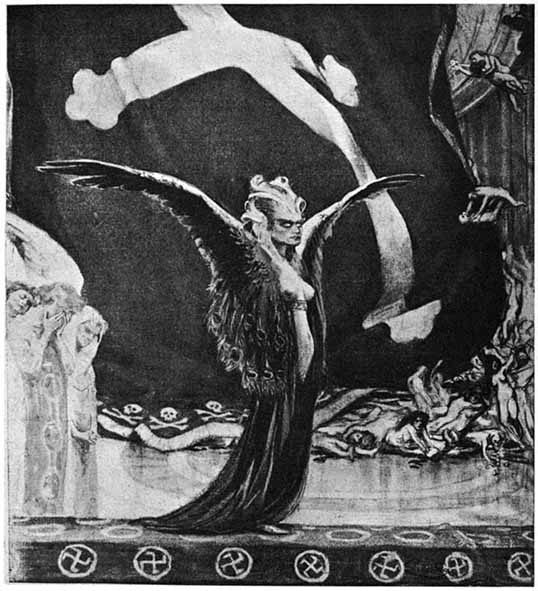
The Conqueror Worm, illustration by Frantisek Kupka
The Conqueror Worm – Edgar Allen Poe
- LO! ‘t is a gala night
- Within the lonesome latter years.
- An angel throng, bewinged, bedight
- In veils, and drowned in tears,
- Sit in a theatre to see
- A play of hopes and fears,
- While the orchestra breathes fitfully
- The music of the spheres.
- Mimes, in the form of God on high,
- Mutter and mumble low,
- And hither and thither fly;
- Mere puppets they, who come and go
- At bidding of vast formless things
- That shift the scenery to and fro,
- Flapping from out their condor wings
- Invisible Woe.
- That motley drama—oh, be sure
- It shall not be forgot!
- With its Phantom chased for evermore
- By a crowd that seize it not,
- Through a circle that ever returneth in
- To the self-same spot;
- And much of Madness, and more of Sin,
- And Horror the soul of the plot.
- But see amid the mimic rout
- A crawling shape intrude:
- A blood-red thing that writhes from out
- The scenic solitude!
- It writhes—it writhes!—with mortal pangs
- The mimes become its food,
- And over each quivering form
- In human gore imbued.
- Out—out are the lights—out all!
- And over each quivering form
- The curtain, a funeral pall,
- Comes down with the rush of a storm,
- While the angels, all pallid and wan,
- Uprising, unveiling, affirm
- That the play is the tragedy, “Man,”
- And its hero, the Conqueror Worm.
Oh yeah, that’s the stuff pre-teens should be reading, classic literature. It’s a miracle I ever went to sleep.
At any rate, I went to see the movie and was a bit disappointed to find out it had nothing to do with the poem or Poe in any way. It was a British production called Witchfinder General, staring Vincent Price. The title was changed and a tiny bit of Price narration at the beginning and end were tacked on to make a slim connection with American International’s string of cheap Poe pictures, directed by Roger Corman and starring Vincent Price. Those movies were campy, almost funny, spoofs of the horror genre. I had seen them already.
What I saw that day was something completely different. It was horrifying.
It’s over forty years later and I still remember most of that film. I remember the opening where the man is building the gallows out in the English Countryside. The basic plot (such as it is), the torture scenes, and the bleak hopeless ending all stuck with me, hanging on from my impressionable youth.
The film pretty much disappeared from existence. There were some bad, grainy, cut VHS transfers, a German version (with added nudity), and various versions here and there, but the original Witchfinder General was out of my reach. I did read about the film, and learn some of its history.
It was directed by Michael Reeves, a promising young director that had a bright future. For now, though, he was making low budget horror films. For Witchfinder General he wanted Donald Pleasance, but the studio insisted on Vincent Price. He thought Price was too broad and hammy and fought to get him to moderate his performance.
The story is that Price hated this and finally bellowed, “I have made eighty four films, what have you done?”
Reeves replied, “I have made two good ones.”
Later, once the film came out, Price understood what Reeves had wanted and went on to acknowledge that it was his best performance – full of quiet, understated evil.
The film received terrible reviews in England. It was considered grotesque. Playwright Alan Bennett said it was “the most persistently sadistic and morally rotten film I have seen. It was a degrading experience by which I mean it made me feel dirty.” In the United States, however, the critics mostly ignored the film and it went on to modest success (no doubt aided by hordes of underaged Poe-reading moviegoers).
Not only was it Vincent Price’s best performance but it was Micael Reeves’ masterpiece. He died at the age of twenty five of a barbituate overdose a few months after the movie’s release.
After discovering this and other juicy details in the intervening decades since I saw the thing, I was filled with a dark desire to see it again. I was glad when a newly restored version showed up on the Netflix Instant Queue. And it was pretty much as I remembered it. A nasty little piece of work.
It did have a surprisingly pleasant soundtrack. The “love theme” is a good example of lush classical music for film.
The movie is a simple story of Matthew Hopkins, a self-appointed Witchfinder General that roamed the countryside during the war between Cromwell and the Royalists. He would torture and execute witches for a fee – and he was good at his job. The hero of the story is a soldier who is in love with a beautiful young woman that falls into the Witchfinder’s clutches.
Most of the graphic horror is in the methods used to determine if the subject is a witch. For your education, here is a little documentary that shows the real historical methods of detecting witchcraft.
Since rewatching Witchfinder General/The Conqueror Worm, I had been thinking about the reaction to the film. It is a horror film, and maybe a tad graphic for its time – but it isn’t anything like a modern Saw or Chainsaw Massacre – though it shows a lot, at the most horrible instants, the camera cuts away. It is nowhere near as graphic as it seems to be, or as its reputation suggests.
It didn’t take much thought to realize the reason. Most horror films (even modern ones) have moments of humor, or reduced tension, or even winking at the camera. They have built in mechanisms to release the tension during the film. Witchfinder General does not do that. It is relentless. It presents an entire world – historically accurate, it talks about the anarchy that reined during the English Civil War – without rules, without mercy, without hope. The gorgeously filmed countryside is populated with evil men preying on the population’s fear, greed, and base desire for blood. There is madness loose in the world and there is no hope in resisting its inevitable victory, one way or another.
That is why the movie is so horrible and horribly effective at what it does.
BFI Screenonline – Witchfinder General (1968)
Michel Reeves: Witchfinder General
1968 New York Times Review of Conqueror Worm
Trailers from Hell – Witchfinder General/Conqueror Worm
Film Review The Conqueror Worm (1968)
The Conqueror Worm / Witchfinder General / Matthew Hopkins, Witchfinder General (1968) ***½
All my life, movies have been very important to me. I have always enjoyed watching them, going to the theater, sitting there in the dark and waiting for the curtains to rise on a whole ‘nother world.
In this modern digital age, in this best of all possible worlds, we now have such access to film – at any time, in any place, we can watch anything we want. The entire world and history of cinema is available in forms that weren’t even imaginable only a decade ago.
But I don’t ever seem to have the time to sit down and watch anything.
The other evening, I had a lot to do. I had promises to keep and miles to go before I sleep. But I was still sick, tired, and worn out… so I decided to go lay down, turn on the cable, and watch whatever came up.
What came up was Blue Valentine.
It was crackerjack.
It’s a character driven story of a young couple, played by Michelle Williams and Ryan Gosling. It jumps in time from the very beginning of their relationship to a point in time six years later when everything is on the rocks. They are both deeply flawed, working class people, who come from disastrously dysfunctional backgrounds and you can feel the fear and effort as they fight to raise themselves out of the doom that they have forseen.
Michelle Williams won a golden globe the other night… but I always think of her as the teenager in The Station Agent. She is a revelation in this movie – when she says she wants to be a doctor you wan to believe that is a possibility. Ryan Gosling is a wiry drunk with bad tattoos and a heart of gold. The transformation of the two from the scenes that represent the early stages of their relationship to the end is amazing – they seem to age a century in six years. Her face gets puffy and his gaunt, as the hope is slowly drained from their lives.
The movie was initially rated NC-17 – and there is a lot of rawness to the film, including the sex scenes. These have to be in the movie, though, the story is told through the sex as much as through the dialog.
After I watched it I wandered the web for a bit reading what other folks thought. The funny thing was how many people took sides – with one of the couple or the other. They couldn’t understand why the couple was having so much trouble making it work and were fishing around for someone to blame. Neither character had any idea how to behave and would, at any moment, make the wrong decision. They had no way to learn… other than to plow ahead as best as they could. There is a lot left unseen in the film, a lot must have gone down in the six years between… and the film treats us to the wreckage crashing down around the couple’s heads.
Both were decent people, inside. They are just like us.
I don’t want to give away any spoilers. The two timelines of the movie scream toward each other until we are witness to the final epiphany. Will the two lovers conquer all and march into the sunset arm and arm – damaged but hopeful? Or is all hope lost?
The characters are fatally flawed, but aren’t we all?
WordPress Blogs with entries tagged Blue Valentine:
Things the Chin Likes or maybe loves – this movie
I remember the first time I saw Riverdance on television, many years ago. I was channel surfing and stumbled across some random show on PBS. There was this line of people standing stick-straight with their arms stiffly at their sides, hopping up and down in a strange complex way. I knew nothing of Irish Dancing or anything else. My thought at the time was, unfortunately, “Uh-Oh, White People Dancing, this can’t turn out well.” Over time, I did learn better.
This new year has started, as do so many, with me getting sick. My careful resolutions have been thrown out already in a flood of virus induced respiratory difficulties. I actually don’t feel so bad, but I can’t stop coughing and if I can’t stop coughing, I can’t sleep. I missed a half-day of work, only the third time I’ve left work sick in thirty years (and the other two I was blind which I considered a good excuse). This time I was so tired I was scared I was going to make a mistake and somebody would get hurt.
So the other night I crept out from my room to sit up on the couch, swigging from a bottle of vile green liquid, and watching a bit of Teevee until I was exhausted enough to try and go back to bed. There was this movie on, a documentary, a film by Sue Bourne called Jig. It was fascinating enough that I hit the DVR record button so I could watch it the next day, with my head on more or less straight.
Jig is about the world of competitive Irish Dancing. At first, it’s a little disturbing – with the wigs and elaborate costumes on the little girls it has a “Toddlers and Tiaras” vibe going on. But it doesn’t take long to realize that these kids are learning to do something special. Every one of them is driven by the dance itself. They are going all over the world to compete… and they want to win, but what they really want to do is dance. They want to dance as well as they are capable of.
And that is something to enjoy and respect.
One important part of the film that I recognize is the dedication of the parents to the aspirations of their children. I’ve spent a lot of time and money on stuff like that, especially kids’ soccer. Thousands of dollars and tens of thousands of hours on practice, travel, tournaments. It’s easy to ask what do you really get out of something like that. It doesn’t matter. There is no choice… you do what you need to do.
In the documentary one father gives up his lucrative doctor’s practice in the States to move to England so his son can get better instruction in the dance. His son, Joe Bitter talks about his set dance. He says that it is so difficult that if he dances it cleanly it will be the best dance ever done.
The dancers… the kids handle the pressure pretty well, but man, take a look at the mother’s face in this clip while she’s watching her daughter dance. It’s the hardest thing you’ll ever do.
Any closed world like that of competitive Irish Dancing seems odd at first sight. But, sitting there on my couch like Jabba the Hut, coughing, I could not help but tip my hat to those kids and all their dedication and hard work. If you look closely and fairly you can see that they are trying to fly and coming a lot closer than any of us.
Irish Dancing Blogs
Christmas evening is always a good time to go out to a movie. Candy, Lee and I went to see a family feel-good film, The Girl With the Dragon Tattoo.
I had not read the book(s), nor seen the 2009 Swedish film (though I have now started the Swedish version on Netflix and have put the books in my queue, after I get some required reading done).
I very seldom go out to see films anymore – which is odd, since that was a big part of my life for so very long. One reason is that the very act of moviegoing has changed. Like so much of modern life it has become a mass phenomenon, an act of the herd instinct. The local mall grandstand seating googleplex is now the standard – thousands run through the entertainment machine – extracting money and delivering a couple of hours of tepid entertainment.
It has been so long this is the first time I noticed that the refreshment stands manned by local teenagers are being replaced by large touchscreens attached to complex vending machines.
Movie going to me has been a solitary, or at most an activity for two. Sitting there in the dark, peering at the screen, lost in the story. Now, the place is always packed for the hot new release and people keep streaming in after the film starts, wandering up and down the steep stairs looking for nonexistent empty seats. Their travels are framed by a constellation of smart phones lit up by audience members getting in some text messaging while the movie begins.
I even miss the endless silly static advertisement cards that used to rotate by during the interminable wait before the film started while cheesy music played over some pitiful portable picnic player. They were blurry slides for local clothing stores, Italian restaurants, or used car dealers. Now, the advertisements that run during the slack times are loud, slick and have better CGI production qualities than the movies themselves.
At any rate, I get over my old-fartedness and the movie starts. And it was good.
The direction, acting, cinematography was all top-notch. As you have been hearing, Rooney Mara as Lisbeth Salander is a revelation. I think the whole film can be summed up in the split-second look on her face when Mikael says to her, “I want you to help me find a killer of women.” Daniel Craig does not have as splashy a part – but his performance is every bit as important – and much more subtle. His character has an inner core of goodness wrapped in a clock of confusion. Mikael Blomkvist is smarter than he thinks he is – and that is hard to portray.
I think I approached the film in the right frame of mind. The book is a complex whodunit and there is no way they can get all that stuff up on the screen. So I paid no attention to the “mystery” at all. The guilty person is one of a set of candidates, and it didn’t really matter to the emotional heart of the film which one it was. I simply let the detectives detect.
She is watching the detectives
“Ooh, he’s so cute”
She is watching the detectives
When they shoot, shoot, shoot, shoot
They beat him up until the teardrops start
But he can’t be wounded ’cause he’s got no heartLong shot at that jumping sign
Invisible shivers running down my spine
Cut to baby taking off her clothes
Close-up of the sign that says “We never close”
He snatches at you and you match his cigarette
She pulls the eyes out with a face like a magnet
I don’t know how much more of this I can takeShe’s filing her nails while they’re dragging the lake
—-Watching the Detectives, by Elvis Costello
After a school of red herrings swim by and the hairy McGuffin fades from importance, there will be a revelation, the hero will be rescued at the last moment, and a twist that you should have seen coming (I did) will appear as if by magic. All boilerplate. We’ve been here before. Hitchcock did it best a half-century ago, so let it fall from the screen.
What makes the film work are the characters and the relationships – and that is what I concentrated on. The film is really not about a locked-door murder on an ice-bound island, it is about Lisbeth Salander and her struggle, against all odds, to become a human being. You see, they tell you that in the English title. The Swedish title (Män som hatar kvinnor – “Men Who Hate Women”) is more descriptive about the plot, but not the heart, of the story.
A couple quibbles… First, I really didn’t like the scene that played over the opening credits. It was slick, expensive, and visually impressive – black oil-like viscous CGI liquid splashing all over everything while Karen O sings her version of Zepplin’s “Immigrant Song” – but it had nothing to do with the rest of the movie. The music was fine – I would have preferred simply wintry shots of bleak Scandinavian scenery. That would have fit the mood better. What we saw was simply showing off.
The movie struggles with the awkward construction of the novel. The two main characters don’t even really meet (well, one meets the other, but not the other way around) until the film is about half over. This works fine in print, but feels disjointed on the screen. You want to say, “Just get on with it.”
There at the end too, the international finance part, seemed a bit out of character to me. I understand the revenge motive, and the desire to help out “my friend,” but still, it was a little much. Again, I thought it was showing off.
Still, quibbles aside, I enjoyed the film and look forward to the books, and the Swedish version, and the sequels, and the Swedish sequels, and the inevitable spinoffs (HBO series?)….
Oh, the motorcycle was way cool.
This long trailer contains a few spoilers. Also, watching it right after seeing the movie – I can notice the subtle censoring of the trailer (necessary). I have a rule, I don’t wear clothing with words on it (I don’t like being an unpaid advertisement – well, except for my employer… they give me shirts for free) but the black t-shirt Lisbeth Salander is wearing when Mikael first shows up at her place has a pretty cool saying on it (it’s blotted out in the trailer).
WordPress Blogs on the film (a small selection, here’s how to find them):

I saw the trailers for the new movie “The Debt” and wanted to see it. After I saw this review, I really wanted to see it:
The movie has Helen Mirren in it, so it has to be good.
…. Movie Trivia Question…. What movie does Helen Miren’s character (one of my favorites) say, “Anall Nathrach – Uthvas Bethuud -Dothiel Tienve,” or something like that? (who knows how that is spelled?) If you don’t know the answer to this one, shame on you.
The only problem is that I don’t get to the theater much anymore – we’ll see what I can do.
But, in the meantime, Peggy found out that there is an earlier version of “The Debt” – It is an Israeli production done in 2007. I wanted to see it, see it before I go to the recent one.
So I checked Netflix… no luck. Not in the libraries… not even on Amazon… the disk doesn’t seem to be available in a North American version (though that will probably change soon, with the remake out).
So, when you can’t get something anywhere else… you go to the getting place. I did, and I got it. Had to go back for the subtitles.
If the remake is half as good as the original, it is a great movie. A movie that makes you think… and a tense little thriller to boot.
I’m not sure how faithful the remake is to the Israeli original – but from the trailers it looks pretty darn faithful. The scar on Helen Mirren’s face is more pronounced than in the original (I like the subtlety here, actually) but it’s in the same spot.
I wonder if the actual method of capturing the Nazi (I’m not giving anything away here) in the remake is the same as the original? It’s… umm… original and very harrowing. I don’t know if they will have the courage to put a scene like that in a mainstream Hollywood production. I’ll have to see….
Ooops. I just rewatched the review above carefully. It is the same. What do you know. This truly is the best of all possible worlds.
So you go see it… the original or the new one… whatever. Think about it.
 Bill Chance