The Things You Don’t Do

“The voice says, maybe you don’t go to hell for the things you do. Maybe you go to hell for the things you don’t do. The things you don’t finish.”
― Chuck Palahniuk, Lullaby

Oblique Strategy: Always first steps

It’s tough being a carhop. You have to remember what car has what order. You have to be able to skate balancing a tray groaning with food and milkshakes. You have to be able to hook in onto the window… just right. You have to endure and handle the nuts and assholes.

The hours are long and the tips are small.

Poor Ethel. The only good thing about being a carhop is that at the end of the day you get to go home. But she doesn’t. She has to stand there, looking as beautiful as ever.

Is beauty its own reward? You exist mainly in the foggy yet electric haloed memories of teenagers long grown old and gray. Is it worth the effort to represent an age long gone by – an era of rollerskates and rootbeer in this age of smartphones and Spice?

Is there an app for that?

War Minus the Shooting

“Serious sport has nothing to do with fair play. It is bound up with hatred, jealousy, boastfulness, disregard of all rules and sadistic pleasure in witnessing violence. In other words, it is war minus the shooting.”

― George Orwell, The Collected Essays, Journalism and Letters of George Orwell 1903-1950

Dallas Arts District. Kids love the reflecting pool. The water is less than a quarter inch deep.

Oblique Strategy: Turn it upside down

Again, I was exploring the depths of my hard drive archives. I found this entry from October 16, 2002. It concerns my youngest son, Lee, who was nine years old.

Lee called me at work – he was home from school and a friend, G. was at our house. He wanted to know how to type on my computer. I gave him quick instructions on how to start up Word, how to save his work, and how to print it out when he was done. It turns out he and G. have an idea for a new sport, which they call Foondball, and they wanted to type out a list of rules.

When I came home I found my desk littered with sheets of notebook paper covered with crude drawings of athletic fields and different dimensions, markings, and goal layouts.

On the screen was their rules for Foondball:

Foondball

  • The game can only be played with 6 to 12 players.
  • You may use your hands to throw the ball and your feet to kick the ball and the goalie may use a hockey stick to block shots taken by the strikers.
  • The goals are at opposite ends of the playing field the field is 75 yards in length and is about 25 to 30 yards in width
  • The winner of the most rounds wins the match there are three rounds lasting 20 minutes and 5 minutes of rest between rounds
  • In the case of a tie the winner will be decided by a 10 minute overtime if no winner is decided then it is a draw
  • The goals are about- 6 to 7 feet high and 10 to 11 feet wide
  • The game begins with the thrower throwing the ball and the whacker hitting the ball the seekers catch the ball if the seeker on the whackers team catches the ball he may keep running to the goal if the seeker on the throwers side catches the ball he may run it back and try to score
  • Each goal is worth two points
  • If there is a foul the ball goes to the place where the foul was committed and thrown from there.
  • If a foul is committed within ten yards of the goal the person whom the foul was committed against gets to take a free shot he can throw the ball into the goal or he can kick the ball into the goal
  • If one team wins the first two rounds of the game then they automatically win the game
  • At no time during the game is play ever supposed to stop unless a foul is committed
  • There is a ten minute half time in between the 2nd and 3rd round
  • If a person scores on a foul then the goal only counts as one point
  • After a goal the team that scores is to throw the ball and play resumes
  • Helmets are to be worn
  • For each team – 1 goalie, 2 whackers, 1 seeker 2 throwers
  • The goalie may never come out of his 10 foot box
  • If a player is on concrete he may dribble the with his hands
  • The player may throw or kick the ball to one of his fellow teammates

Someday, maybe, kids will dream of glory on the foondball field, and trade photos, cards, and stories of who their favorite whackers, throwers, and seekers are.

Like Burning Tears

“And now, my poor old woman, why are you crying so bitterly? It is autumn. The leaves are falling from the trees like burning tears- the wind howls. Why must you mimic them?”
― Mervyn Peake, Titus Groan

Fall Colors
University of Texas at Dallas
Richardson, Texas
(click to enlarge)

Oblique Strategy: Revaluation (a warm feeling)

The trees along my drive to work have exploded into flame.
Their conflagration tinted according to their species from a sodium flame yellow, through orange, on to a deep blazing crimson.
Except for the cemetery, monocultured with live oaks, all their usual dark spinach.

I knew someone once, a long, long time ago. She said she liked the fall better than the spring. She liked the sense of foreboding, the knowledge that a cold storm was coming – the excitement of onrushing doom.

It took me decades to understand what she was talking about and how important it was.

The Fence

One death is a tragedy, a million deaths is a statistic.
—Joseph Stalin

Oblique Strategy: The most important thing is the thing most easily forgotten

I started my first “blog” (this was before anyone had thought of the name blog – we called them “online journals”) In 1996 or so. Mine was called “The Daily Epiphany.” As far as I can tell mine was the 13th online journal/blog on the internet. I wrote in it every day for more than ten years.

Tonight I was looking through my files, doing some organizing, and found an entry I had typed while driving back to Dallas from my uncle’s funeral in Kansas. It was almost exactly 20 years ago- November 30, 1997 – four years before 9/11, when our reaction to such things changed, when it became commonplace.

The entry was called “The Fence.” I printed it out and entered it into a writing contest once- It won a prize – ten dollars cash, sealed in a little envelope.

A cold, leaden day. That midwestern wet cold, a little above freezing; with wind that cuts. The sky had no blue, no indication of where the sun actually was. Only ripples, waves of lighter and darker gray.

Interstate 35, between Wichita and Dallas is mostly a straight shot. There is only one jump to the left, and a step to the right, in Oklahoma City. You have to get on I40 going west for an instant and then exit to the left, picking up southward again. Sixteen years ago, when I first moved from Hutchinson to Texas, this little jog shook me up. I hadn’t really been driving very long and had no experience with big city expressway killer traffic. The thought of quickly merging across three busy lanes to an exit filled me with dread and stress.

I was such a geek.

Now, of course, after all these years bumping and grinding through Dallas highways and byways this is second nature. I can merge and exit without a thought. Confidence, aggression, and peripheral vision.

But this time I didn’t exit. I wanted to take a break from the drive, go see something; so I continued West on I40, right into the heart of downtown Oklahoma City.

It’s not much different than downtown Wichita, or Tulsa, or any of the middle-big midwestern cities. A new baseball stadium is going up, new glass office buildings, some older brick hotels. It was Sunday, there was almost no traffic. As a matter of fact, there was some sort of BMX racing going on at the Convention Center. I saw more kids on bikes, jumping curbs, hot-dogging up and down stairs, than cars on the streets.

I didn’t know exactly how to get there, only that I was going between fourth and fifth streets, but it didn’t take long to find my way. I parked next to an older, large dark tan brick building. A typical neo-something older public place. It wasn’t until I got out onto the sidewalk I noticed that the glass had been broken out in all its windows. I knew it had been blown out.

I really didn’t know what to expect; didn’t even know why I had driven there. It has been over two years and I wasn’t even sure what had been done to the site recently. I only wanted to stop and rest for a minute, visit a piece of history, maybe try and fix the actual place that it happened in my mind.

The Murrah building itself is, of course, long gone. The planned memorial hasn’t been started yet. All that’s left is a rectangular grassy field, the lawn was yellow for the winter, that smooth professionally planted turf, put in to cover things up. To the south are some concrete remains of the foundation and parking garage. The entire city block is encircled with a high chain link fence.

And it was that fence that really packed the emotional wallop. You can watch the news stories, read the survivor’s accounts, but it doesn’t seem possible. That something so horrible could occur, not by accident, but on purpose, in the forgotten center of the country, is beyond belief. But walk up to that fence, and it’s all too real.

The worst is the toys. Hundreds of toys stuck into or tied to the bare wire. Teddy bears, stuffed animals, balls, birthday presents for children that will never grow up. A baby’s pacifier.

“Look, Mom! another Beanie Baby!” exclaimed a small girl, poking at a little toy dog on the fence with delight, too young to understand.

Other things too. Poems, letters, pictures, most laminated in plastic. One unprotected sign had run in the rain. The only legible part was the word “crying” in big, thick, colored letters. It too was fading, running, dripping down the ragged poster board. Someone had made little red felt Christmas stockings, each one with a jolly cloth Santa face. I didn’t count them, but I’m sure there were 168.

Many people seemed to go there without plans and put up what they had on hand. There were a lot of keychains. Hundreds of little crosses made of sticks.

There were quite a few people, but thankfully nobody selling anything. Many were obviously tourists, some taking pictures. Many appeared to be locals, though; alone, slowly, solemnly working their way around the fence, reading the notes, looking at the wreaths and the pictures. I wondered how many of these people had lost husbands, wives, children, friends in the blast; how many had actually been there , wondering why it hadn’t taken them; how often they went down there on cold, windy winter days to walk that stretch of chainlink.

The day was dark, but I was glad that I was wearing my sunglasses, I didn’t really want to show my eyes.

I drove on, and stopped for lunch at a Wendy’s south of town. I don’t eat fast food hamburgers any more, but I remembered being there seven years earlier with Candy and Nicholas, when he was an infant. I remember holding him, spooning a little Frosty into his mouth.

I sat at a table typing on the laptop for a bit. A crowd of kids, a ball team or bible class, boiled around me. They all had little plastic toys from their Happy Meals or whatever. They were all laughing, showing each other what they had, seeing who had the coolest toy. They were loud and a bit wild, bumping into me as I typed, but for some reason, I didn’t mind.

All Day Holiday

All day holiday
All day holiday
Home is so far away
“Where should I land?” My hollow voice is carried away on the wind
—-Shugo Tokumaru – Parachute (English Lyrics)

Clarence Street Art Collective, The Cedars, Dallas, Texas

Oblique Strategy: Discard an axiom

Our two sons drove back to Dallas, from New Orleans and Houston, for Thanksgiving. They always try to come back to run in the Turkey Trot eight-mile race on Thanksgiving morning. We used to always go down there with them, but now I sleep in and they drive themselves.

Turkey Trot 2011

Turkey Trot 2012

Turkey Trot 2013

Lee and some friends had tickets to see the Dallas Cowboys get the crap beat out of them at the death star – so he was gone most of the afternoon.

I ate too much and did, well pretty much nothing. I did get a little bike ride around the hood on the folder as the sun set and that was surprisingly enjoyable. There were a lot of people out and about.

Holidays are odd – they feel like wasted time, but they string together in your memory. At first you think they are the same, but there are changes.

From my old journal “The Daily Epiphany” – Thursday, November 25, 1999 Thanksgiving – The kids were what? seven and eight.

The feeling of satiety, almost inseparable from large possessions, is a surer cause of misery than ungratified desires.
—-Benjamin Disraeli

We have a family tradition of going camping over Thanksgiving. It’s usually the most pleasant time of year here in Texas, cool nights, warm days. Sometimes we get caught in rain but most years are clear and crispy. A four day trip to a nearby State Park, maybe Fairfield or Bob Sandlin. Red fall trees, inky sparkling night sky, the smell of wood smoke, brown curious deer paying a shy visit, bold nighttime raccoons looking for handouts. Out of the rat race, out of the stuffy too much food too much television couch potato place.
This year we couldn’t do it though. Candy Mom’s illness, soccer games, my work, all conspired to keep us in town; no matter how much we needed to get away, get out of the city.

We went to Candy’s sister’s for Thanksgiving dinner. I had an odd hankering for Chinese take-out, eating out of white foam containers, but the traditional turkey ‘n fixins’ was pretty good. Despite my forewarnings to myself I ate too much, and sank into that holiday hyperglycemic funk.

Nick and Lee played a tough, energetic two-kid soccer game out in the small back yard. The dead and desiccated landscape plants, dormant for the winter, brown, cracked and shattered as the ball whizzed back and forth, showering up a small cloud of bits of leaf and stem.

Poor Lee wore himself out, though. He curled up on the couch, blanket in hand, fingers in mouth, and looked awful while everybody else chowed down. Instead of the traditional watching of the Cowboy game I drove Lee home. We stopped for gas and I promised he could pick whatever he wanted out of the station’s cold-drink case. The poor woman working the counter on the holiday beamed at the cute little pouting kid rummaging around. He, not surprisingly, picked out a half-gallon of chocolate milk, the artificially thickened rich brown sugar stuff that kids love. I thought he’d pick a small bottle but the half gallon was only a dime more, so I guess Lee knows best.

At home he sucked down most of the carton and that revived him some, enough that he was up to playing some video games. Lee didn’t want to be alone, though, so I went back to his room with him. I climbed the steel ladder and curled up in the top bunk, it’s about a foot shorter than I am. I spent the bulk of the day there, fading in and out, dreaming strange and terrifying dreams while Lee sat below guiding Banjo Kazooie through his fantasy world.

…..

Stronger and Stranger

“I think it is all a matter of love; the more you love a memory the stronger and stranger it becomes”
― Vladimir Nabokov

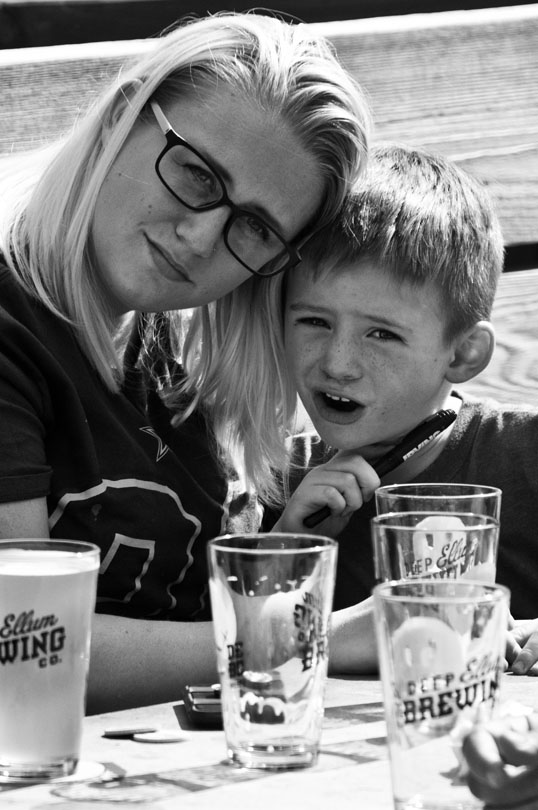
Deep Ellum Brewing Company, Dallas, Texas

Oblique Strategy – Imagine the piece as a set of disconnected events

I want to take more photos of people… and that is difficult for me. There is a high wooden bench, built into the wall, in the yard at Deep Ellum Brewing company. It is a great place to people-watch or to sit with a longer lens and shoot.

There was a family, with two young sons, out enjoying the beautiful fall Texas early afternoon. The two young boys were not very happy for a while – they looked tired and bored – cranky and on the verge of crying. Kids do that. Kids do that a lot.

I thought about shooting the pouty sad expressions – despite their misery, they were photogenic and the picture would have been funny. But they settled down quickly and this peaceful photo of one with their mother turned out to be the one I liked.

Like a bad memory I deleted the others. I think if we remembered all the tired, grumpy and frustrating times in our lives as clearly as we did the beautiful fall afternoons we wouldn’t be able to get out of bed in the morning.

A Month of Short Stories 2015, Day 2 – What Is Remembered

The last two years, for the month of June, I wrote about a short story that was available online each day of the month… you can see the list for 2014 and 2015 in the comments for this page. It seemed like a good idea at the time. My blog readership fell precipitously and nobody seemed to give a damn about what I was doing – which was a surprising amount of work.

Because of this result, I’m going to do it again this year.

Today’s story, for day two – What is Remembered, by Alice Munro.

Read it online here:

What Is Remembered

This afternoon, I worked on making a list of stories I am going to read and write about for my June Month Of Short Stories and realized that a lot of them will be linking with the New Yorker. Well, not very surprising….

Here we are on the second day, and we have a story very different that the first… instead of the efficient, biting prose of Raymond Carver, we have the lush genius of Alice Munro.

She doesn’t cut her words to the bone. She is quite generous with her word count. For example, in today’s story, here is her description of the arrangement of napkins at a funeral’s buffet table:

She looked down at the table napkins, which were folded in quarters. They were not as big as dinner napkins or as small as cocktail napkins. They were set in overlapping rows, so that a corner of each napkin (the corner embroidered with a tiny blue or pink or yellow flower) overlapped the folded corner of its neighbor. No two napkins embroidered with the same color of flower were touching each other. Nobody had disturbed them, or if they had—for she did see a few people around the room holding napkins—they had picked up napkins from the end of the row in a careful way, and this order had been maintained.

The amazing thing, the genius of Munro, is that this seemingly odd bit of description encapsulates the whole story, somehow. It has nothing to do and everything to do with the rest of the work.

This is the story of an affair – or of a one-night stand… a one-evening stand, really. But it isn’t a prudish morality tale – it is a laying out of a woman’s life and how much more there is than meets the eye.

Alice Munro doesn’t write with words as much as she writes with time. What is Remembered, like much of her work, moves back and forth over handfuls of decades, following the echoes of the past into the future and the conception of the future into the past. Like the title implies, this is a story about memory and how a person’s fate isn’t so much shaped by what they do as much as it is by how they remember what they have done.

On the ferry ride home, after the fact:

She had to join the crowd of jostling bodies making their way up the stairs, and when she reached the passenger deck she sat in the first seat she saw. She did not even bother, as she usually did, to look for a seat next to a window. She had an hour and a half before the boat docked on the other side of the strait, and during this time she had a great deal of work to do.

No sooner had the boat started to move than the people beside her began to talk. They were not casual talkers who had met on the ferry but friends or family who knew each other well and would find plenty to say for the entire crossing. So she got up and climbed to the top deck, where there were always fewer people, and sat on one of the bins that contained life preservers. She ached in expected and unexpected places.

The job she had to do, as she saw it, was to remember everything—and, by remember, she meant experience it in her mind, one more time—then store it away forever. This day’s experience set in order, none of it left ragged or lying about, all of it gathered in like treasure and finished with, set aside.

She had “an hour and a half” and a “job she had to do.” She had to fix what had happened into her memory, all of it, exactly as it had happened.

As the rest of the tale unfolds, we learn she didn’t do her job well. She forgot a lot. And what she forgot might have been more important than what she remembered – it protected her from a life that was not only wildly different, was a life that would not have been her own.

What we remember, what we forget, what comes back to us after it is too late….

Forget What You Want To Remember

“Just remember that the things you put into your head are there forever, he said. You might want to think about that.
You forget some things, dont you?
Yes. You forget what you want to remember and you remember what you want to forget.”
― Cormac McCarthy, The Road

Tom Wesselmann  Mouth # 11, 1967 Dallas Museum of Art

Tom Wesselmann
Mouth # 11, 1967
Dallas Museum of Art

I have always loved this piece of modern art in the DMA. I remember it from when I first moved here thirty four years ago. I worked downtown and would walk over to the museum at lunch and look at this (and other, of course) work of art to help make the day bearable.

Those were the olden days, ancient history, when you could take a lunch and get a needed break – unlike today where lunch is something you gobble at your desk while answering emails.

There was this cool little gift shop across the street from my office – in the old building that has since been converted into the Joule hotel. They had a postcard of this painting. I bought it, no reason, I simply wanted to own the image so I could look at it whenever I wanted. The young redhaired shopgirl asked me as she slid the card into a thin paper bag, “Do you know where this is?”

“Of course,” I said. “I go over at lunch and stare at it.”

I have no idea what she thought of that. She didn’t say anything.

Iguanas on my Roof

A sketch of the Casino at Montelimar, Nicaragua - once Somoza's beach house.

A sketch of the Casino at Montelimar, Nicaragua – once Somoza’s beach house.

I stumbled across a wonderfully interesting book this weekend; Iguanas on my Roof Funny, Sad, and Scary OVERSEAS ADVENTURES of a Foreign Service Family in Third-World Countries during the Vietnam War and Watergate Era. I found it on its Facebook Page and then bought a copy from Amazon for my Kindle.

Say what you want about e-books… but to learn about a publication from the web while riding on a commuter train, have it in my hand seconds later, and instantly start reading it – that’s something amazing.

The book is a slim, simple, heartfelt family memoir written by Nancy Stone, the mother of five. I went to high school with two of her kids in Managua, Nicaragua. One son was my age, a grade below me and in a lot of my classes, and a daughter was my little brother’s age. We all ran around a lot together my senior year (I graduated and left for Kansas University in 1974).

I immediately recognized the title – we had iguanas on our roof. I remember when we first moved to Nicaragua trying to sleep with some tremendous racket overhead. I crept outside and leaned a ladder up to the wall, climbing up to find out what it was. There were a half-dozen huge iguanas and an equal number of cats all chasing each other around on the corrugated galvanized roofing. I couldn’t tell who was chasing who – but it was a mess. After I learned what it was up there – it was easy to ignore the cacophony and sleep.

Although I knew the kids well, I don’t recall ever even meeting their parents and I certainly never knew their story. We were military and they were embassy – that didn’t matter to the young’uns, but there was a difference. Their father, Al Stone, was a railroad brakeman in the late fifties when he was inspired by the harrowing plight of hordes of desperate Mexican immigrants fleeing a drought to try and do something. He spent years in education and effort until he was able to go to work for the Department of State and the USAID program.

So the big family was off on a tour of the disasters of the third world. From living in the Philippines while Al was in Vietnam, to Lagos, to Washington DC, to Managua after the 1972 earthquake (where they crossed paths with your humble narrator), the book describes the shocking, the strange, the scary, and the silly of a long, often difficult trip.

I’ve always said that living in the third world is months of boredom punctuated by moments of sheer terror.

Most of what was in the book was familiar to me, even the sections from the Philippines and Nigeria. There are certain stock scenes common to life in any poverty-cursed tropical place. Every incident brought back memories of similar episodes and adventures from my own youth.

The crest from the American Nicaraguan School

The crest from the American Nicaraguan School

What was most interesting was seeing these recognizable installments from a different point of view. The book is told by an adult – a person where everything is new and strange. Nancy Stone was from California – thrust by fate, love, and dedication into a bizarre world of giant insects, bad infrastructure, iffy transport, dangerous and incomprehensible societies, and odd food. It was all so… foreign. Cultural and work protocols, manners, and etiquette were consummate challenges. But it all comes to an end. The final chapter is titled, “We Went Back Home.”

Where is home? I don’t understand the concept. People talk to me about being “homesick” – I have no idea what they are talking about.

You see, It felt differently to go through a journey like that as a kid. When you are young… it is simply how things are. You don’t know any better.

A few paragraphs of the story were written by the kids I knew – familiar voices I understand.

For me, for example, the place and time where I had the most trouble adapting was when I went to college in the states. My nickname for a couple years was “Banana Boat” – as in, “Bill, you’re an American like the rest of us, but you act like you just fell off a banana boat.” I was so happy to find four students from Barcelona that I could relate to – though I was bothered by their lispy Spanish and the incredible amounts of wine they drank.

I realize that the youngsters were able to assimilate into the local culture in a way the adults couldn’t even imagine. To this day, I’m ashamed of my terrible Spanish – but I learned that if I simply kept my mouth shut I could move around at will without anyone knowing I was an American. As a matter of fact – nobody would notice me at all. I could become invisible. That’s an amazing thing to be able to do in a place like that.

That even affects the memories I try to hang onto in my incipient dotage. For example, there are a lot of anecdotes like those in the book that I am willing to let go as they fade into the misty cobwebs of my crumbling brain. What I hang onto desperately are some of the ethereal emotions of youth, the colors of the country, and the smells of the culture.

For example (full disclosure – I’ve been writing notes about this recently for a short story I’m working on) there is the smell of the third world. It’s a smell of pork grease and wood fires – of sour sweat and homemade soap, of heat and desperation. A few years ago I walked out onto the deck of a ship as it cruised into Montego Bay at dawn. A fisherman in a tiny wooden skiff was off the port bow and I watched him untangle his nets. As the salmon glow of the sun, still hidden behind the mountains, filled the sky we moved into a thin cobalt mist of the morning cooking fires wafting offshore and there was that third world smell. I had forgotten… but it all came back in a rush.

That is what I am desperate to hold on to.

So, I any of y’all are curious enough to read about what it was like, over there, back then, go to Amazon, load up your ereader or wait for the bound paper, whatever. It’s worth your money and your time, trust me. Thanks for doing the work, Mrs. Stone, for collecting the memories, writing them down, and sending them out into the world.

It’s late, so late. I think I’ll pour a little Flor de Caña (I was so happy when that became available in Dallas), get my writing in, and call it a day.

The land of lakes, volcanoes, and sun. A painting I bought on my last trip to Nicaragua.

The land of lakes, volcanoes, and sun. A painting I bought on my last trip to Nicaragua.

The Perverse Lucidity of Nostalgia

“In her final years she would still recall the trip that, with the perverse lucidity of nostalgia, became more and more recent in her memory.”
― Gabriel Garcí­a Márquez, Love in the Time of Cholera

When I was a little kid I, because I was an army brat, saw a lot of movies. A lot of movies. You could see them on base for a quarter. A quarter was worth more then than it is now, but it was still pretty cheap. I thought everybody went to movies all the time for a quarter. It was a shock when I started college and realized that not all movies started with a playing of the Star Spangled Banner (like all films on military bases did – no matter where you moved, the movies would start the same way, with the same film behind the music).

In my isolation, what I didn’t realize is that these films were at least a year old. They were the equivalent of a lower-tier dollar theater today. The other thing is that I didn’t realize how bad some of these films were.

And as a movie-loving child, I didn’t realize how bad these films were, even after I saw them.

And, like a curse, I still remember so many of these films. I forget my ATM PIN number with regularity but hundreds of movies still well up from the stratified thick mists of memory up to a half-century fossilized now – still clear and sharp. But I remember them not as I am now, but as I was then. I recollect them as a wide-eyed child, sitting in the dark, in amazement and wonder at the flickering images on the screen.

Given the time, not surprisingly, a lot of them are of the cheap, second-rate, third-tier, science fiction, monster-riddled, space opera genre. In those days I thought The Green Slime was the greatest piece of art the world had ever seen. I remember enthusiastically hauling all my friends back the next day for an encore showing.

However, even within this fallow soil of vast film awfulness, a few jewels would fall. For example, I remember First Spaceship on Venus – an amazingly odd East German – Polish film adapted from a Stanislav Lem novel. How this came to be featured on American Military bases during the height of the cold war is a mystery. I was excited a few years ago when I was able to get a copy from Netlix. Now, the thing is readily available on the internet and, although dated, is still an effective piece of entertainment. I always liked the look of the rocket.

Movie Poster for First Spaceship on Venus (Silent Star) - I remember the excitement of seeing this poster, even though I was probably six years old at the time.

Movie Poster for First Spaceship on Venus (Silent Star) – I remember the excitement of seeing this poster, even though I was probably six years old at the time.

https://www.youtube.com/watch?v=PYT4qTkWWJA

Then, a few years ago, something came along to through those old memories back into my face. Mystery Science Theater 3000. If you don’t already know, the idea behind MST3K is that an ordinary everyman is trapped by evil scientists on a space station and forced to watch horrible old movies. He builds a few robot sidekicks to help pass the time and this motley crew are shown sitting there in silhouette, throwing up witty insults while the execrable cinema offerings are running across the screen.

My kids always said I should be on that show because of my bad habit of insulting the television to its face.

What the problem was, is that a lot of those films from my childhood showed up on MST3K – and, instead of the glorious examples of moving picture shows they were revealed for the celluloid crap they really were. I suffered from a terrible rejection of the beloved icons of my childhood.

Even First Spaceship on Venus showed up there. What a sacrilege.

I was reminded about this humiliation last night when Paste Magazine published a list of The Ten Most Unwatchable Films Featured on MST3K. I didn’t realize it has been 25 years since the show started… time flies. One good thing is that a lot of these are now available on Youtube – if you have a lot of time to waste.

Of the ten Paste Magazine reviled films – these are so bad they are in a world of their own and I only remember one of them from my childhood.

I won’t tell you which.

I will own up to one film, though. There was one movie I was that, although I didn’t remember the title, I did recall many scenes… the beautiful french temptress turning into a horrible monster with glowing green eyes, the dragon, and most of all, the spinning yellow spiral that burned the brave knights to death. I had always wondered what movie that was – and then, one day, I saw a bit of MST3K and there it was… The Magic Sword.

And now it’s out there on the internet and I can watch it whenever I want to.

You know, it isn’t as good as I remembered it… but it isn’t really all that bad.

MST3K Version

Unmessed-with Version

http://youtu.be/H6WAt7Px0VA

First Spaceship on Venus (more accurately known as Silent Star)