“An entire life spent reading would have fulfilled my every desire; I already knew that at the age of seven. The texture of the world is painful, inadequate; unalterable, or so it seems to me. Really, I believe that an entire life spent reading would have suited me best. Such a life has not been granted me…” ― Michel Houellebecq, Whatever
One Toke Over the Line
I don’t know what we were talking about but an odd thing came up in conversation (maybe online, maybe IRL) – that the song “One Toke Over the Line” was once performed on the Lawrence Welk show. I did some research to make sure that this was true and not some modern deepfake (It would be hilarious if it was) – but nope, it really did happen. Lawrence Welk himself described the song as a “modern spiritual.” Yeah… I guess it was. Wikipedia says Welk later claimed that ABC had forced him to play the misplaced song, as its executives had been pressuring Welk into including more contemporary material that Welk did not want on his show.
But even somebody as old-school as Lawrence Welk… what the hell did he think “toke” meant?
In reading about it, one take I found hilarious is pointing out that a lot of the musicians working on the Welk show were big-time session players and they all definitely knew what the song was about – they would have been laughing their asses off.
I know that some (most) of y’all are way too young to know about Lawrence Welk. I am old enough that I clearly remember the show airing – my grandparents generation loved, LOVED that show. It was so old-fashioned, so straight-laced… yet it had some odd underlying sexual tension… or at least I thought it did.
At any rate it was not the show to feature drug songs. And, of course, in this day and age, YouTube comes to the rescue. Here is the song, a little blurry, but still wonderful, wonderful.
“If life is an illusion it’s a pretty painful one.” ― Michel Houellebecq
Writing in my Moleskine Journal outside the Mojo Lounge, Decatur Street, French Quarter, New Orleans
Why writing by hand is better for remembering things
Of course I (and you) already knew this – but it’s good to be reminded. I remember in college in a moment of desperation I decided to cheat on an exam. I wrote out notes on tiny scraps of paper – struggling to make minute scribbles that I could still read – minuscule enough to conceal from the test-givers. Yeah, I know that’s cheating, and immoral… but it was a moment of hopeless weakness.
But once I completed the task I realized I didn’t need the notes anymore. It was so much work to copy then in their Lilliputian form, I had to concentrate so intently (my handwriting is terrible, btw) that the information was burned into my memory (at least for a day or so).
In the years to come that became another study technique for me. I would accumulate the most important information and recopy it – but as small and legible as I could – slowly, and with great effort. Then I throw the notes away.
It really worked.
“It is in our relations with other people that we gain a sense of ourselves; it’s that, pretty much, that makes relations with other people unbearable.” ― Michel Houellebecq, Platform
I woke up this morning in the popup and was cold. I hadn’t packed my sleeping bag or brought very many warm clothes- one pair of jeans and one flannel shirt, the rest shorts and T-shirts. Cold and apprehensive this might be a chilly vacation. But I shivered on down to the bathroom with my Barney-Bath Time Fun! towel for a shower. Meanwhile the Texas sun rose up into the trees and presto-change-o it was warm and all was right with the world.
We all decided on a hike for the day. We were camped in the Fort Sherman area, spot #2 and the trailhead was only a few spots down, between #5 and #6 and off we went. Not too far down the trail on a flat section between two creeks there was a stone marker:
Homesite of James (Jim) Francis & Ann Eliza Coston 1890 1924
It is hard to believe this thick woods, these tall trees were once a farm, not so long ago. It isn’t virgin forest, but at least it is a complete and varied habitat. No single species professional forest. I memorized the trees along the nature trail stretch, there were little poles with labels, Lee would carefully spell out each one.
Short Leaf Pine(tall and stately) Eastern Red Cedar(a beautiful tree with gorgeous stringy smooth bark) Sweetgum(Stunning red stars for leaves and spikey seed-balls for Lee to collect) White Oak (tall as the pines) Flowering Dogwood White Ash Winged Elm Mockernut Hickory Red Oak Tree Huckleberry Red Mulberry Willow Oak Possum Grapevine (not a tree, really) Red Maple American Elm (very few of these left) Blackjack Oak
At the end of the nature trail we crossed the road and went on down to the trout pond.
This is a little lake that the state stocks with trout every now and then. It is a calm spot, the water dyed a dark color from the leaves that fall in and steep like tea. The thick autumn woods, orange, yellow, brown, green reflected perfectly in the water; the twin forest disturbed only occasionally by the rings of wavelets as fish hit insects on the surface.
A little past the pond, Lee started to get tired (walking is tough on his short legs) so he, Candy, and the Giant Killer Dog turned back. Nick and I continued on, they would get the van and meet us at the playground by the fishing pier, at the other end of the trail. We wound our way through the deep dappled woods, the trail covered in a thick rich carpet of leaves. Crossing the road again, we pushed on to the Brim Pond, then turned off the trail to take a short cut to the road through a brushy field. It was tougher than it looked, I carried Nick on my shoulders so he wouldn’t have to walk through the brambles.
It won’t be long before he’s too big for that.
Next to the playground is an old cemetery. While Nick and Lee swing on the swings, climb on the bars, I can’t resist finding the gate in the fence and taking a look at the stones. There are only a handful.
Under an old oak in a patch of perennials, were two tiny rectangles of old limestone. Not enough room for dates, not enough even for names. Only the initials M.E.M. on one, T.H.M. on the other. I assume these were the original stones. A few feet in front were two more elaborate monuments – still old and worn, but newer looking than the small ones.
These new stones were square in cross section, about two feet in height, pointed, like tiny Philip Johnson skyscrapers. One had a design, a stylized lily and said:
Mary E Miller Born Mar 13,1834, Died Feb 3, 1907
The other:
T.H. Miller Born Feb 12, 1835, Died Apr 21, 1893
It also had a poem:
A loving husband, a father dear a faithful friend lies buried here
The top of this one had a stylized star and the legend LEAD KINDLY LIGHT
Nearby – a modern stone, no date.
Jesse Benson Grayrock Vols Texas Militia Confederate States Army
Finally, another simple stone,
J.F. Coston Texas CPL CO C5 REGT Texas INF Confederate States Army 1838 1903
“People are always shouting they want to create a better future. It’s not true. The future is an apathetic void of no interest to anyone. The past is full of life, eager to irritate us, provoke and insult us, tempt us to destroy or repaint it. The only reason people want to be masters of the future is to change the past.” ― Milan Kundera
The Blue Angels over my work parking lot.
Something that has surprised me about getting old (not getting older... getting old) has been the transformation of the future into the past. Where life used to be dominated by hopes and dreams it is now (and this happened with awful speed) possessed by memories.
Especially certain powerful, yet unpredictable memories. Something I have not thought about in decades will bubble up from the vast ancient soupy mess of my mind and… there it will be.
Often this memory will be so unexpected and ancient I’m not sure if it is even real or not. And with a memory, what is real? If a memory is of an event, person or an item that never happened or never existed – is it still a real memory? All memories are at least somewhat inaccurate – if not a complete fiction. What difference does it make?
And, to complicate things now, there is the internet. If a memory is of something that can’t be located online – how can it be real?
Por Ejemplo
Out of nowhere a couple of days ago a vivid memory came to me of a model rocket – a boost glider to be exact – that I think I made when I was in high school. Model Rocketry was a hobby of mine – as it was to many boys of my age. It was actually pretty cool – I’d order kits through the mail, build them, paint them, put a cartridge motor in them, launch them in the air – and finally watch as something went wrong. They would burn, or streamline straight in (called a Lawn Dart), or fly around in an uncontrollable tangle, or (if their parachute worked perfectly) drift away forever lost on high lofty Kansas winds.
Just kidding – often times… some times they would work – swoosh upward in a jet of smoke and the smell of black powder then have the ejection charge pop off the nosecone and deploy the plastic chute at the perfect apogee – a clot of kids would run after the slowing falling bits of paper tubing and balsa.
Now this memory was of a glider – a balsa airplane with a rocket attached to the nose. It was a difficult craft to build and fly – it was one of the last ones I built. My skills had improved over the precious few years of my youth.
The glider was unusual. It was tail-less with the wing an odd (and hard to make) swept inverted gull-wing – sort of an “M” shape. Gluing the wing panels in the proper angles and alignment with the correct balance and airfoil shape wasn’t easy. I was very proud of it.
But had I actually built it? I wasn’t sure. It was fifty years ago.
So it’s off to Google. I did a lot of searches on “tail less boost glider” and “model rocket glide recovery” and such without success. There were a lot of boost gliders out there but they all looked like regular airplanes – nothing with the strange shape I remembered.
I tried a different tack. I knew it was probably an Estes kit – I was an Estes rocket builder (as opposed to the Centuri models – which seemed flashy and unserious to me) and I figured that company might have it in its history. I found and downloaded PDF copies of their catalogs from 1970 through 1974. Then I went through the offerings (which brought the nostalgia tumbling back – either I or one of my friends had built and flown many of these kits).
I found it. It was an Estes Nighthawk.
Estes Nighthawk. Once I had the name, I found several photos. It looks just like I remembered it.
The kits were discontinued in the mid 70’s. They cost two dollars at the time. There is an old kit for sale online for $140.
I guess everyone is thinking about twenty years ago today. I’m not a big one for that kind of forced nostalgia – but I do have my blog – and I thought it would be interesting to review what I wrote down at the end of September 11, 2001.
I keep hearing people say how they were shocked and how much their view of the world changed that day. Of course that is very true for the people that were directly affected… but for me… I’m almost ashamed to say I wasn’t shocked. I wasn’t even surprised. It seemed like something that was going to happen, we just didn’t know where, how or when.
The world always exists as a thin membrane between our daily lives and the void of chaos beyond. September 11, 2001 was a day that the membrane broke… more than usual.
The Daily Epiphany Tuesday, September 11, 2001
A record of the day
We have awakened a sleeping giant and instilled in it a terrible resolve. —- Admiral Isoroku Yamamoto.
I stayed up watching TV way too late last night and overslept in the morning. Luckily, my work has a generous flextime policy; but I had some stuff I had to get done. The City of Dallas had some samplers and I had to be there before they picked up so I could collect my split samples for our own analysis. I pried myself from under the covers and stumbled into the shower – then shaved and dressed as quickly as I could. As I dashed out the door to the car I saw Candy’s mom watching TV in the living room. There was only a glimpse as the front door closed and the show cut away to breaking news of a skyscraper (obviously the World Trade Center) and some smoke. I started the car and headed out late into the heart of the morning rush hour.
Most people watched the horror unfold on television. I listened to it on the radio, tuned in as I fought my way around the LBJ freeway loop. I was at about the Garland Road exit when the second plane hit.
That was it, wasn’t it? The first plane… I kept hoping it was an accident or at worst, an isolated crazy person. When that second plane came in though, that’s when it was clear what was going on, that’s when the world changed.
I made it to work and to my desk. At that point I felt strangely isolated. The Internet was so bogged down I couldn’t get any news off of my computer. The only two ways I could find anything out were reports by phone from a cow-orker’s wife and text reports on my web-phone.
Finally, some guys came into my cube and told me the other building had a conference room set up with a television feed. We decided to head over there. I worried a little about the City’s sampling crew and considered dropping some sample bottles in case they showed up but decided it wasn’t a good day to leave an unoccupied plastic cooler sitting in a parking lot.
I shouldn’t have worried. Considering what we do at my work it was obvious that security was going to be tight. The whole campus was closed – nobody was getting in or out.
Simply crossing the street to the other building was an adventure. The security guard made us dump everything out of our pockets. She removed the batteries from our cell phones. “I know what I’m looking for, but you don’t,” she said. Then everybody was frisked – and a pretty thorough frisking, too. I think that’s the first time I’ve been searched like that – though it’s possible I simply don’t remember it before.
Finally seeing the television pictures in the conference room on the big screen TV… well, you know what it was like, you saw them too. The bizarre juxtaposition of such a beautiful, sunny day with the horror unfolding underneath. I remember being in the Trade Center, it was a calm warm day when I was there, two decades ago. They let us go on up above the observation deck and walk around on the roof walkway. I remembered the sheer size of the two towers and understood why the giant airliners looked so small – why the first reports thought it was private planes.
Both towers had already collapsed by the time we made it to the conference room. They kept rerunning the horrific footage of the crumbling structures hurtling down in a cloud of debris over and over. At that point there was still not very much information coming across from the Pentagon – many reports were that the plane had actually missed and had crashed into a helicopter pad next to the building. That’s always one difficult thing about watching a disaster like this (like this? There has never been anything like this) – the constant stream of rumor and speculation, the slow winnowing of fact.
We watched until it became numbing. By the time I walked back to my office the announcement was made that “the terrorists don’t appear to be targeting defense plants,” so we weren’t frisked again – though the site was still locked down tight.
I was actually able to get some work done – I strongly wanted to try and continue my ordinary responsibilities as much as possible. I talked to Candy on the phone, especially when the kids came home from school. They were doing fine – Lee was more or less oblivious and Nick very curious, but not upset or frightened. I talked to him and his major question was, “Why would anybody do this? Don’t they know what they are getting themselves into?” Nick has been fascinated with Pearl Harbor ever since he saw the movie and seems to see some strong connections here.
I was an architect, she was an actress. I drew the Eiffel Tower upon her dress. So we could see the world… The flash burnt our shadows right into the wall. But my best friend and I will leave them behind in Hiroshima. I will keep her secrets, I will change my name. My sweetheart and I are saying goodbye to Hiroshima.
—-My Favorite, Burning Hearts
The opening of Hiroshima Mon Amour
I have been taking too much pleasure in the NBA playoffs and as always happens when you take too much pleasure in something it all went to shit. My team, after a fantastic start, crashed and burned and went down to humiliating and ignominious defeat.
My lesson learned, again, I turned the game off and switched over to the always reliable backup – The Criterion Channel (the best streaming money you can spend). I cruised through the copious selection of marvelous and recherché moving picture shows and settled on a classic that I have never seen, Alan Resnais’ Hiroshima Mon Amour.
Resnais had made his reputation with a string of documentary films, including the first-rate Night and Fog, about the Nazi death camps. He was approached to make a similar nonfiction work about the Hiroshima bomb and traveled to Japan to start work. He realized that he could not make a simple documentary about that horror, especially for Western audiences (who, in the 1950’s, generally thought of the bomb as the end of the war) and proposed he make a fictional film instead.
He hired the novelist Marguerite Duras to write the screenplay and made a groundbreaking film. The surface plot is about a French actress (played by the luminous Emmanuele Riva) in Hiroshima to make a documentary about the bombing – she has a brief but intensely passionate affair with a Japanese architect (played by the equally riveting Eiji Okada). They have only thirty-six hours before she must go back to Paris.
But time in the film isn’t the same as it is in the real world. The story is told in conversations between the couple, in flashbacks, in dream sequences, in bits of newsreel footage.
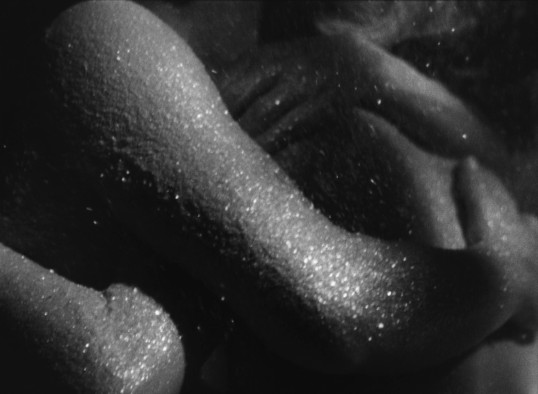
The fourteen minute opening sequence is an amazing kaleidoscopic montage surrounding a scene of two naked bodies writhing in passion while radioactive dust falls from the sky and sticks to their sweat-drenched skin.
The film is full of questions, symbolism, conundrums wrapped in enigmas, doubling (the actress has had forbidden affairs with soldiers of both of the West’s enemies in WWII) and all the other accouterments of the French New Wave.
Despite all this, the film is watchable to anyone tired of the MCU. If nothing else, you can look at Emmanuele Riva and her expressive face (at eighteen and thirty four) as she is buffeted by history, war, the past, and the passion of today.
Emmanuele Riva in Hiroshima Mon Amour
Decades ago I stumbled across an obscure New York band called My Favorite. I have been a bit of a fan ever since. Watching the movie I realized that one of their “popular” songs, Burning Hearts, was inspired by the movie. Cool.
He remembers those vanished years. As though looking through a dusty window pane, the past is something he could see, but not touch. And everything he sees is blurred and indistinct.
― Wong kar-wei, In the Mood for Love
Mojo Coffee, Magazine Street, New Orleans, Louisiana
(click to enlarge)
A Gentle Touch
The drugs didn’t work. The stents failed to keep the flow going. Time had wracked its fatal damage in its efficient and inexorable way.
Nobody really told him what was happening but he knew. Especially the way they were gathering around him, a circle of faces either somber and quiet or swallowed in a false cheer. When they told him his sister was flying in from Seattle he knew the end was very close. She had not been on a plane in fifty years.
He had so many tubes stuck in him that when he would move the slightest bit one or another would be jostled and he would be hit by a horrific beeping from the machine attached to that conduit. If he was alone, he would suffer, palming the call button again and again for what seemed like an eternity until a nurse would finally come and turn off the infernal sound. It was worse if others were in the room – they would cluck and scatter like chickens until the nurse came – their protestations bothered him more than the beeping.
The balance of his life between future and past, between memory and hope, had now shifted completely to memory and the past. There was no future left and no hope.
And finally his memory was beginning to collapse and implode, fewer and fewer recollections were left. The past would slowly go to black and white, like an old television, then begin to fade until only a handful of echoes were left.
His life had been full. His marriage had lasted over half a century. He had been blessed with children, grand children, great grandchildren. He had a few victories and many, many defeats.
He was shocked, however, at what remained after all these accomplishments and catastrophes had faded.
Many decades ago his company sent him to a multi-evening seminar to learn a new accounting software program. He had met a woman there. She was sitting in the back near where he was and he noticed her walking to the front table to get supplies.
After the classes some of the employees would grab a coffee and talk about the software and how much they didn’t want to use it. Each time the woman seemed to end up sitting next to him at the large round table.
The two of them enjoyed talking to each other and he felt strangely excited on the drive home. After the last day of the class a handful of folks decided to keep meeting in the evenings – both he and the woman were in that group.
It was the start of a decade long friendship. The meeting became the high point of his week. The two of them would almost always sit next to each other. He remembered that sometimes she would laugh at something or make a point and reach out and gently touch him – on the shoulder or leg.
Nothing more ever came of the two of them. They had never even met outside of that group. He decided that they simply enjoyed each other’s company. He couldn’t say why.
The friendship eventually faded and finally dissolved completely. He hadn’t spoken to her in twenty years. Now, in his weakened state, he could barely remember her name and wasn’t sure the hazy memory was right.
But as the last few days fell away, the times he spent with her loomed larger and larger in his mind. His family wondered about the otherworldly expression on his face and the fact he paid less and less attention to them.
“He’s losing his mind,” they all said. And shook their heads sadly.
They weren’t wrong. But he was aware enough to wonder why it was this particular set of memories that were filling his last few miserable, precious days. Pleasant, bittersweet memories. Something that, at the time, meant little in the flow of days.
As his heart struggled, weakened, and finally gave out his final thoughts were of a quiet laugh and the innocent gentle touch of a friend’s hand along his leg.
“Our memory is a more perfect world than the universe: it gives back life to those who no longer exist.”
― Guy de Maupassant
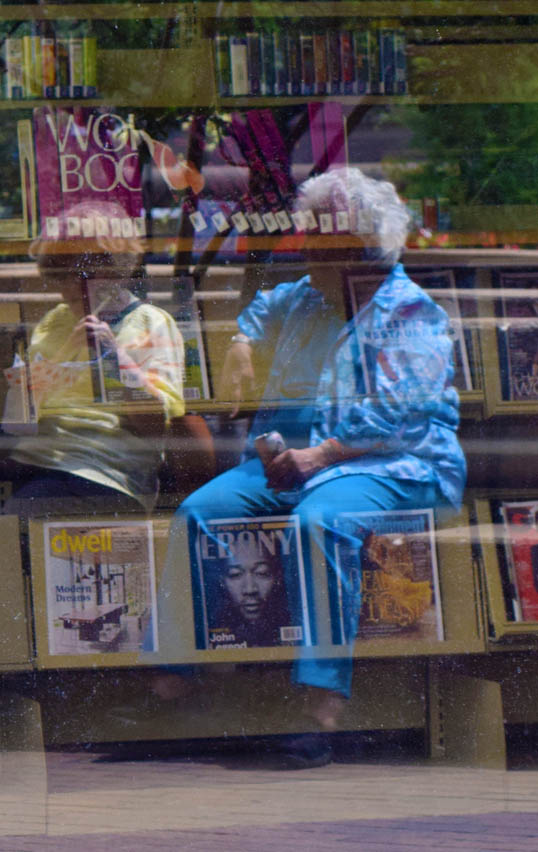
Window Reflection, Dallas Public Library
In perusing the interwebs I came across a nice list of ten online long(er)-form short stories. So I’ll test the patience and attention span of everyone in this best of all possible worlds and slide away from flash fiction for a while.
“It is the time you have wasted for your rose that makes your rose so important.”
― Antoine de Saint-Exupéry, The Little Prince
Sunflower
A friend called me one Saturday morning to tell me there were fields of Sunflowers blooming, vast, beside the Interstate on the way to Austin. I drove down there to take photographs. It was amazingly beautiful, the miles of yellow faces looking into the sun.
Today’s story reminded me of that day and these photographs.
“Our memory is a more perfect world than the universe: it gives back life to those who no longer exist.”
― Guy de Maupassant
Old Man River, Robert Shoen, New Orleans
I have been feeling in a deep hopeless rut lately, and I’m sure a lot of you have too. After writing another Sunday Snippet I decided to set an ambitious goal for myself. I’ll write a short piece of fiction every day and put it up here. Obviously, quality will vary – you get what you get. Length too – I’ll have to write something short on busy days. They will be raw first drafts and full of errors.
I’m not sure how long I can keep it up… I do write quickly, but coming up with an idea every day will be a difficult challenge. So far so good. Maybe a hundred in a row might be a good, achievable, and tough goal.
Here’s another one for today (#96) Almost There! What do you think? Any comments, criticism, insults, ideas, prompts, abuse … anything is welcome. Feel free to comment or contact me.
Thanks for reading.
Forgot
Harold Sammons died at work, suddenly. His heart stopped beating. He was coming out of the break room with a cup of coffee on his way to the morning meeting. The last one out of the break room, there was nobody to see him go down or smell the hot coffee splashed across the floor. They did hear the cup shatter.
Since nobody saw him, nobody really knows how long Harold was dead. Since they heard the cup and came, curious, and the paramedics were there almost immediately (the fire station was right next door) they revived him and he came back to life.
There was brain damage. It was to be expected.
His short-term memory was gone. He would talk to someone and forget who he or she was. It was embarrassing, but people understood. He would forget where he was or where he lived or the PIN code on his phone (or even what that glass rectangle was useful for).
For the eighteen months he survived after he died and came back, it made life difficult, but not unbearable. While he couldn’t remember five minutes ago, fifty years in the past was as clear as crystal. There were so many things he forgot that came back to him now.
He forgot his first rock concert. He forgot how excited he was when the band did an encore. Now he remembered, “Everyone cheered so loud they came back out and played another song!” That naïve happiness came flooding back.
He forgot how many fireflies there used to be. Clouds of cold sparks. Now he could see them, even though they are now rare.
He forgot how everyone, young and old, used to watch the same shows on television together and could talk about them the next day. Nobody had more than one set so watching television was a social act.
He forgot how going out for a hamburger and maybe some ice cream was a big deal and a real treat.
He forgot that every house only had one phone and it was attached to the wall. The phone knew its place and its purpose.
He forgot swimming in a lake. The water had a green cast and a slight smell. The bottom was soft mud.
He forgot about front porches with rockers and gliders and the neighbors walking by.
He forgot about Zippo lighters that had liquid fuel and little yellow cards of replacement flints.
He forgot the taste of cold milk from a glass bottle.
He forgot the woman he loved first and loved most. He married someone else and never knew where she went. And now she was back and not a day older. Her smile as magnificent as ever.
These weren’t like old dusty memories that suddenly get stirred up. These weren’t like an unexpected odd odor that you know you have smelled before. The unfathomable labyrinth within his brain had been broken open and the distant past was as fresh and new as the sun is in the sky.
For those last eighteen months people would see the confused emaciated old man in his wrinkled ancient suit shuffling along or sitting motionless on a bench – they would feel pity and dread the day when they would end up in the same sorry state.
But for Harold Sammons the time after he came back from the dead was the best of his life. He no longer forgot.









 Bill Chance