The Point Where Imaginative Seeing And Outside Seeing Meet

“In a lucid dream, you have a sharper sense of color and lucidity than with your eyes open. I’m interested in the point where imaginative seeing and outside seeing meet, where it becomes difficult to differentiate between seeing from the inside and seeing from the outside.”
—-James Turrell, The Other Horizon

From the Houston Museum of Fine Arts website:

In the mid-1960s James Turrell pioneered a new concern with the phenomena of space and light, often referred to as the Light & Space Movement. Turrell sought not to depict light but to use light itself as his material, and his earliest works investigated the effects of artificial light. He also developed a number of installations that heightened the relationship between light and the architectural frame.

The MFAH commissioned Turrell’s The Light Inside for the underground tunnel linking the museum’s Caroline Wiess Law Building with the Audrey Jones Beck Building when the latter opened in 2000. The Light Inside turns the walls of the tunnel into vessels for conducting light. An expanded version of his earlier explorations of light in his Shallow Space Construction series, Turrell’s The Light Inside is an all-encompassing environment.

Transcending the traditional confines of built spaces, The Light Inside acts as both a passage and a destination. The raised walkway guides visitors forward and gives them the sense of floating in space, while the changing cycle of illumination (which shifts from blue, to crimson, to magenta) further invites contemplation. The Light Inside makes the experience of moving between the Law and the Beck Buildings not only an exploration of light and space, but also a profound and awe-inspiring experience.

JAMES TURRELL  American, born 1943  The Light Inside  1999  Neon and ambient light

JAMES TURRELL
American, born 1943
The Light Inside
1999
Neon and ambient light

I have been a big fan of James Turrell for over a decade, ever since a certain day in 2004. That was the day near the opening of the Nasher Sculpture Center – when I took Lee down there to visit the sparkling spanking new museum. I wrote about it in a blog entry that was eventually published in a local magazine.

My favorite piece might have been the installation Tending (Blue) by James Turrell. We walked into a little opening lit by odd, shifting colors into the wall at the north end of the garden. The passage made a right turn and opened into a small room lined with dark stone benches. The walls on the upper half were featureless and smooth. A gray skylight lighted the whole chamber. The effect was strange and very peaceful. I liked it a lot.

Lee and I left the chamber and walked back up the garden and inside the building. We wandered downstairs and into the auditorium where a film was showing. It told the story of Raymond Nasher and his late wife, how they started out building Northpark Mall, acquired a fortune, and then became premiere collectors of modern sculpture. Mr. Nasher talked about his life, his wife, and his passion for the new sculpture center. The film then showed the construction of the center, how a handful of visionary architects and a few thousand men in hard hats converted a grimy downtown parking lot (I’ve parked there many times, put my quarters or dollar bills into a rusty numbered slot) into a thing of great value and beauty. They talked a lot of how it will be there forever. The film was fun and interesting – it really helped me appreciate the place.

On opening day Raymond Nasher said, “I put Patsy (his wife, the collector, who had passed away a couple years before) in charge of the weather today, and, as you can see, it’s beautiful.

One thing was odd, though. On the part of the film that covered opening day, Nasher and Turrell themselves went into the Tending (Blue) chamber that Lee and I had walked out of only minutes before. The benefactor and the artist sat on the benches and looked around. The skylight rectangle in the ceiling wasn’t gray like we saw it, but a deep cerulean blue.

“What’s up with that?” I asked.

“Let’s go back and check it out,” Lee said.

We hiked back down and entered the chamber again. The skylight was still gray. Something didn’t look right, though. I stood under it, looking up, trying to figure out what I was seeing and how it could change colors so dramatically. I was halfway convinced that it was a rectangle of light projected on the ceiling by some hidden apparatus (the upper walls are washed in subtle changing color from hidden computer controlled LED’s) when I was suddenly struck between the eyes with a big, cold drop of water. I wiped my face in surprise and looked down at some small pools of water at my feet.

“That’s weird, Lee,” I said, “I can’t believe it, but this roof is leaking.”

I looked back up, trying to find the telltale discoloration of a water leak, when, with a sudden shock, I realized what the hell I was actually looking at. That wasn’t a skylight, that wasn’t a projected rectangle at all, it was simply a big hole in the ceiling. I was looking directly at the sky. Once my eyes and my brain were in sync I could see the subtle variation of the clouds passing by overhead. The edges of the hole must have been cut back like razors – there was no visible frame around the opening, simply a featureless rectangle of light. It was amazing.

That’s why the rectangle looked blue in the film – it was a cloudless day. Now I want to go back. I want to go at sunset… I want to figure out how to go at dawn. The city sky at night… will it be brown? I want to sit in there during a rainstorm. I especially want to go there on that rarest of Texas days, a snowstorm.

Now, of course, Tending (Blue) is no more, destroyed in a paroxysm of greed and corruption.

JAMES TURRELL  American, born 1943  The Light Inside  1999  Neon and ambient light

JAMES TURRELL
American, born 1943
The Light Inside
1999
Neon and ambient light

When I went to Houston over the holidays to visit my family there I wanted to visit the Turrell work at the Museum of Fine Arts, The Light Inside. It’s a tunnel under the street between two buildings, festooned with Turrell’s signature unreal lighting and surreal experience.

A really cool thing, though the experience is a little lessened by the museum guard constantly barking out, “Stay on the walkway! Don’t touch the sides!” It’s beautiful and memorable, though it does lack the pure esthetic simplicity and connection with nature that the late Tending (Blue) offered.

JAMES TURRELL  American, born 1943  The Light Inside  1999  Neon and ambient light

JAMES TURRELL
American, born 1943
The Light Inside
1999
Neon and ambient light

I can’t write about Turrell without mentioning Roden Crater. Since the 1970’s he has been hollowing out an extinct volcano in a desolate and isolated stretch of Arizona – converting it into a giant gallery for his manipulations of light, space, and expectations. Visiting this place in at the top of my bucket list.

I only hope I’m able to live long enough.
Video of James Turrell and Roden Crater

I Live My Life In Growing Orbits

“I live my life in growing orbits which move out over this wondrous world, I am circling around God, around ancient towers and i have been circling for a thousand years. And I still dont know if I am an eagle or a storm or a great song.”
― Rainer Maria Rilke, Rilke’s Book of Hours: Love Poems to God

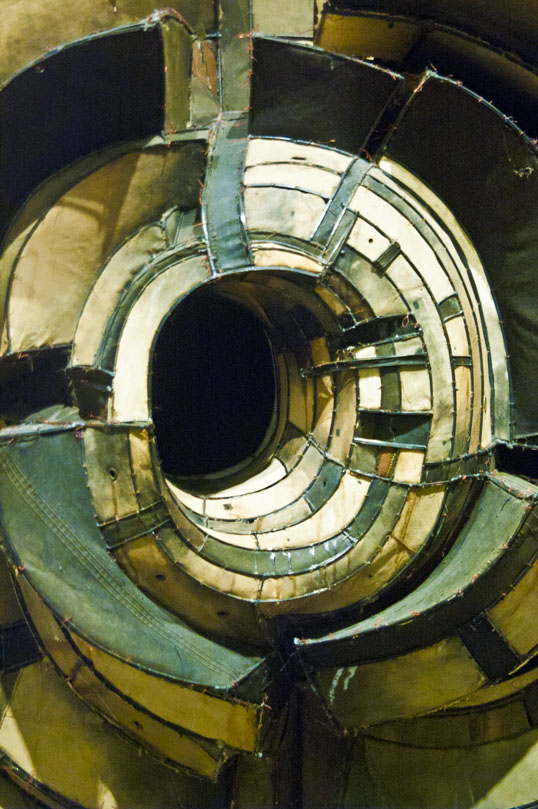
Lee Bontecou American, Born 1931 Untitled 1962 Welded steel, epoxy, canvas, fabric, saw blade, wire Museum of Fine Arts Houston, Texas

Lee Bontecou
American, Born 1931
Untitled
1962
Welded steel, epoxy, canvas, fabric, saw blade, wire
Museum of Fine Arts
Houston, Texas

Hatched From A Swan’s Egg

“His own image; no longer a dark, gray bird, ugly and disagreeable to look at, but a graceful and beautiful swan. To be born in a duck’s nest, in a farmyard, is of no consequence to a bird, if it is hatched from a swan’s egg.”
― Hans Christian Andersen, The Ugly Duckling

David Smith American 1906-1965 Leda 1938 Painted Steel

David Smith
American 1906-1965
Leda
1938
Painted Steel

Museum of Fine Arts
Houston, Texas

From the label text:
David Smith learned the technique of welding steel from working in a car factory, and he applied this skill to the art of sculpture. Leda is based on the Greco-Roman myth about a god who takes the form of a swan and then seduces a woman. Here, Smith offers a witty interpretation of the unlikely act of lovemaking between a bird and a woman.

The Labours Of A Spasmodic Hercules

“A small daily task, if it be really daily, will beat the labours of a spasmodic Hercules.”
― Anthony Trollope

Paul Manship American, 1885-1966 Hercules Upholding the Heavens 1918 Bronze The Museum Of Fine Arts Houston, Texas

Paul Manship
American, 1885-1966
Hercules Upholding the Heavens
1918
Bronze
The Museum Of Fine Arts
Houston, Texas

The Power Of the Machine

“The power of the machine imposes itself upon us and we can scarcely conceive living bodies without it.”
—-Raymond Duchamp-Villon

Horse by Raymond Duchamp-Villon

Large Horse by Raymond Duchamp-Villon

My favorite sculpture – one I have gazed upon many times in the Nasher Sculpture Center, here in Dallas, is Large Horse by Raymond Duchamp-Villon. I wrote about it more than three years ago.

At the time I said:

I like to stare at it, walk around it. I’ve taken some pictures of it. I would like to take some more.

To me, it’s clear that it is a statue of a horse – but that horse has been morphed into a complex machine, full of pushrods, pistons, and gears. It has an impressive, solid bulk, but feels like it is about to propel itself out through the glass and speed down the street in a blur, smelling of ozone and oil.

It is cast in very dark bronze – almost black. It swallows a lot of the light, but what does escape is subdued by the power and mass of the horse. It shines with dark energy.

The sculptor was a cavalry doctor in World War I and must have had a close relationship, knowledge, and a deep connection with his horses. He chose this animal to convert into a cubist bronze. He was able to preserve the essential horseness of the shape while implying the obsolescence of the animal – overtaken by the more powerful, rugged, and easily controlled energy of machines.

Duchamp-Villon died too young. He contracted typhoid fever during the war. He died before he finished this sculpture. All he left was the finished small scale model. After his death, his famous brother, Marcel Duchamp (Nude Descending a Staircase) finished the job and had the sculpture cast in full-sized bronze.

Thanks.

Large Horse, by Raymond Duchamp-Villon

Large Horse, by Raymond Duchamp-Villon

Over the holidays, I was in Houston to visit my mother and my sister and her family and was pleased to discover another Duchamp-Villon’s Large Horse in the Cullen Sculpture Garden at the Houston Museum of Fine Art.

It was like running into an old friend unexpectedly.

Large Horse, by Raymond Duchamp-Villon, in the Cullen Sculpture Garden, Houston,  Texas

Large Horse, by Raymond Duchamp-Villon, in the Cullen Sculpture Garden, Houston, Texas

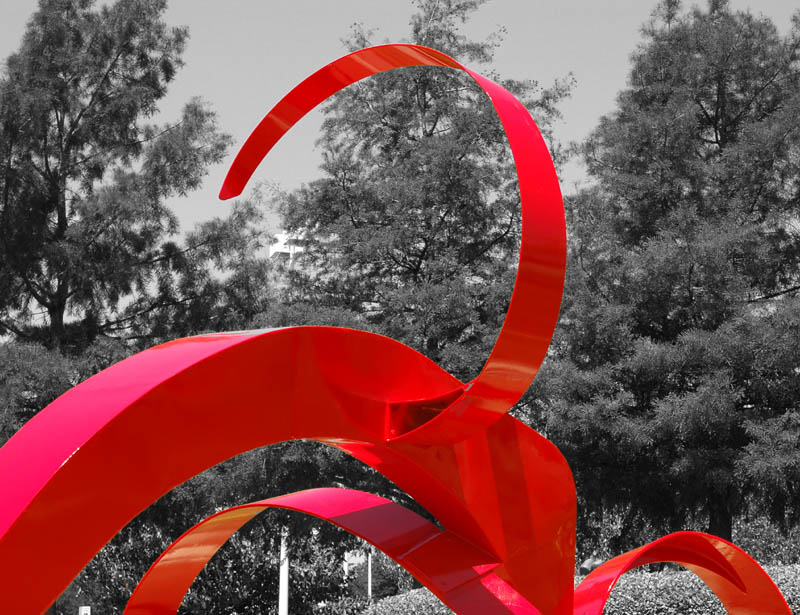
La Mujer Roja

“Even as a small child, I understood that woman had secrets, and that some of these were only to be told to daughters. In this way we were bound together for eternity.”
― Alice Hoffman, The Dovekeepers

Michelle O’Michael, Houston
La Mujer Roja
2000, Steel, paint
Frisco, Texas

Michelle O’Michael, Houston La Mujer Roja (click to enlarge)

Michelle O’Michael, Houston
La Mujer Roja
(click to enlarge)

Michelle O’Michael, Houston La Mujer Roja (click to enlarge)

Michelle O’Michael, Houston
La Mujer Roja
(click to enlarge)

The Geneva of my youth

Geneva

A photograph of me working at the Geneva Industries Superfund site in South Houston, Texas in 1984.

I was cleaning out a closet at home and came across this old photograph of myself in my youthful prime. Good lookin’ feller, don’t you think?

The picture was taken in, I believe 1983 or 84 – at the Geneva Industries Superfund Site in South Houston, Texas. The site was a bankrupt and abandoned manufacturing plant for Polychlorinated Biphenyls, amongst other nasties.

I’m not sure exactly who I was working for when the picture was taken… Weston Engineering, Ecology & Environment, or Jacobs Engineering… at any rate I was a contractor to the Environmental Protection Agency’s Superfund division. I was part of the TAT – the Technical Assistance Team – that provided expertise during the emergency removal at the site. We had a certain amount of money to go in, take care of any immediate hazards and prepare the site for a long-term remediation to come.

As you can see, I’m suited out and doing some monitoring to insure our safety plan fit the hazards on site. I’m wearing a respirator, which worked well because the major inhalation hazard was dust particles contaminated with PCBs which the respirator protects against well. The yellow case on the cinderblock is a rescue air pack. Inside is a coil of steel tubing full of highly compressed air attached to a plastic hood. If something went wrong and toxic gases were released I could throw the thing over my noggin and have five minutes of safe air to get the heck out of Dodge. Yes, I had practiced that and was confident I could get it on in a hurry.

Between me and the rescue pack are a couple of sampling pumps. Usually these are worn by workers, but I was using them as area samplers. I had a small portable lab set up either on site or in my hotel room and could quickly analyze the samples on a daily basis to make sure something unexpected wasn’t going on.

In my left hand I’m holding the probe of an HNU photoionization dectector – used to detect organic solvents in the air. The state of this equipment in 1984 was a lot more crude than it is today – the thing was big and most of it is hanging out of frame on the strap over my shoulder. In my right hand I’m holding an air horn. That site had a lot of water-filled holes, sumps, and pits all over it and it was so easy to fall in. I always carried that horn in case I got in trouble. You don’t see it, but I also had a radio – wrapped in a plastic bag – taped to my right arm.

In the background, past the rusty tank and before the metal building, you can see a long horizontal cylinder. This was an abandoned tank car that once was full of chlorine and the piping was all rusted. We went to a lot of trouble to mitigate that thing (this picture was probably taken right at the start of that operation) because that much chlorine released in the middle of Houston could have been devastating. It turned out to be empty.

Another tough job we did on that site was to plug an oil well. PCBs are heavier than water and there was a fear that the contamination would follow an old, uncapped well down through a thick clay layer and contaminate the city’s drinking water aquifer far below. We used some old maps to locate the well’s probable location and I went out with a steel tape and spray painted a big X where I thought it was (the whole area was paved over long after the well was abandoned).

We brought out a portable air compressor and a jack hammer and I was chosen to go out there fully suited out and jackhammer down through the concrete. I had some experience with using a jackhammer in protective gear (some work I had done the previous year around St. Louis – but that’s a whole ‘nother story), I was young and strong then, and I had done the measurements – so if I was wrong it would be me that had to do all the wasted work. I was very proud of the fact I hit that wellhead nail right on the head.

Then we brought out an entire drilling rig, full of roughnecks slinging pipe wearing respirators and Tyvek Suits in the Houston heat. Those guys drilled out the old mud, broken concrete, and burlap sacks that plugged the well, and then we concreted the whole thing up.

If you look at the Geneva site now you’ll see a bare green mound in the middle of a pretty rough part of the city. Most remediated waste sites look like this – the open ground patterned with the piping system and tanks of a groundwater interceptor and treatment system. Back then, though, it was frightening complex of rusting equipment, open pits, and ponds full of toxic chemicals.

Over a few jobs I spent months at Geneva. I worked even more at Crystal Chemical on the other side of Houston (I’ll write about that some time- real horrorshow). Then there was Cleve Reber in the swamps of Louisiana and the big train derailment in Livingston. There was a burning subterranean landfill in Tulsa, and countless oil spills all the way from New Orleans to West Texas. There were chemical trucks turned over in ditches, leaking rail cars, and burning pesticide factories in small towns.

I spent a lot of time when I was young out in isolated unpleasant places cleaning up other people’s messes. Actually, I didn’t work at this too long – nobody did, nobody could. It wears on you. It’s when you realize that wearing that respirator and mask, that suit with gloves and boots taped to the sleeves and legs so that nothing can leak in, feels normal, feels natural, that you realize it’s time to move on.