“Not only is the Universe stranger than we think, it is stranger than we can think.”
― Werner Heisenberg, Across the Frontiers
The Dallas Eye,
Dallas, Texas
I had a lot of work to get done today, even though it was Saturday, and i completed most of it – or as much of it as I could… so I took a break and watched a Marvel Movie streaming on my TV.
It was the second best movie set in a Multiverse I’ve seen recently. It wasn’t too bad, a bit of gaudy entertainment… but it wasn’t Everything, Everywhere, All At Once – not by a long shot.
As a matter of fact… if it was the second best…. It was also the worst movie set in a Multiverse I’ve seen lately.
“The train bore me away, through the monstrous scenery of slag-heaps, chimneys, piled scrap-iron, foul canals, paths of cindery mud criss-crossed by the prints of clogs. This was March, but the weather had been horribly cold and everywhere there were mounds of blackened snow. As we moved slowly through the outskirts of the town we passed row after row of little grey slum houses running at right angles to the embankment. At the back of one of the houses a young woman was kneeling on the stones, poking a stick up the leaden waste-pipe which ran from the sink inside and which I suppose was blocked. I had time to see everything about her—her sacking apron, her clumsy clogs, her arms reddened by the cold. She looked up as the train passed, and I was almost near enough to catch her eye. She had a round pale face, the usual exhausted face of the slum girl who is twenty-five and looks forty, thanks to miscarriages and drudgery; and it wore, for the second in which I saw it, the most desolate, hopeless expression I have ever-seen. It struck me then that we are mistaken when we say that ‘It isn’t the same for them as it would be for us,’ and that people bred in the slums can imagine nothing but the slums. For what I saw in her face was not the ignorant suffering of an animal. She knew well enough what was happening to her—understood as well as I did how dreadful a destiny it was to be kneeling there in the bitter cold, on the slimy stones of a slum backyard, poking a stick up a foul drain-pipe.”
― George Orwell, The Road to Wigan Pier
The Hole
I’ve been getting up early every day, even on the weekends, to go on a bike ride at dawn – to beat the heat. On weekends, that means I have my daily exercise out of the way by 8 AM. Which is weird for me, because it leaves so much of the rest of the day free.
So I had some of that most precious of possessions – a little bit of free time – and decided to pick a movie from The Criterion Channel to watch. After a bit of bouncing around I found a selection from Taiwan, The Hole. Directed by Tsai Ming-liang, Starring Yang Kuei-Mei and Lee Kang-sheng. It was blurbbed as: Set just prior to the start of the twenty-first century, this apocalyptic tale of pandemic alienation follows two residents of a crumbling Taipei building who refuse to leave their homes despite a virus that has forced the evacuation of the area. As rain pours down relentlessly, a single man (Lee Kang-sheng) is stuck with an unfinished plumbing job and a hole in his floor. This results in a very odd relationship with the woman (Yang Kuei-mei) who lives below him. Combining deadpan humor with an austere view of loneliness and surreal musical numbers, Tsai Ming-liang crafted one of the most haunting and original films of the 1990s.
The film seemed so much to be about the Coronavirus… a viral pandemic of unknown origin, a Chinese apartment building locked down, mysterious men spraying disinfectant, empty stores, coughing and then death…. It was hard to believe the movie was made almost a quarter-century ago – long before Covid.
The biggest difference is that this virus was spread by cockroaches and, after an initial flu-like stage, caused the victims to crawl around afraid of the light, like a roach. Pretty horrible.
The movie is slow and follows a man in an apartment – he has a food store nearby but no customers during the pandemic – and the woman in the apartment below him. The pipes are leaking and a plumber beats a hole in the floor of the man’s place which opens up in the ceiling of the woman’s. The two are then set at odds over the hole, the plumbing, and trying to get on with their lives. In addition to the disease it never stops raining, which adds an extra layer of depression to the tableau. The woman’s place is always wet – from the rain and the leaking sewer above – and she tries to get by with cases of paper towels as her wallpaper peels off all around her. This drab and depressing world is punctuated by colorful musical numbers lip-synced to old Grace Chen showtunes. No – this makes no sense… none at all.
The surprising thing is that all this depression and hopelessness actually has an upbeat… almost romantic ending. I’m not sure if what we see actually happens or is just another fantasy – but it is nice to watch, nice to think about.
“You only live twice: Once when you are born And once when you look death in the face” ― Ian Fleming, You Only Live Twice
Audubon Park, New Orleans
This weekend I found myself, wonder of wonders, with a little bit of time on my hands and deciding I wanted some free (or at least already paid for), mindless entertainment – I watched the newest installment in the James Bond franchise, No Time to Die, currently streaming on Netflix.
It was… OK, I guess. I still haven’t fully recovered from the experience of Everything, Everywhere, All at Once – so any other cinema will be a pale imitation of art… but it kept me mostly entertained for a while. I did like seeing Felix Leiter, Bond’s faithful longtime CIA sidekick, get some cred, even if it ends badly for him.
But I began thinking about No Time to Die being the 25th James Bond film. You see the franchise, with Dr. No coming out in 1962, when I was five, roughly parallels my life – or at least as much of it as I can remember. James Bond was always there – rebooted, changed, evolved… but always a cultural touchstone of some kind – always reflecting the times, distorted, like a funhouse mirror.
I remember seeing my first Bond Film, From Russia With Love – probably in 1964. My parents were huge bond fans and a little of that rubbed off on me – I was excited to go. At that age I didn’t really remember everything – but some scenes stick with me. There’s an assassination with a guy climbing out through a billboard, of course Rosa Klebb and her poisoned shoe. Most of all is the fight with the giant Red Grand on the train.
As an adult I was shocked when I realized that actor is Robert Shaw, who decades later played the grizzled old captain Quint in Jaws.
Then I saw Thunderball (for some reason I missed Goldfinger when it came out) – which was special to a kid that age – underwater fighting!
On and on over the years. Did you ever see the original Casino Royale? The comedy spoof with David Niven and Peter Sellers? Check it out. Some good looking women (including a very young Jacqueline Bisset) and a Tijuana Brass theme song.
Over my whole life a Bond film would pop up every few years… some good, some not-so – most just mindless entertainment. The worst were the gimmicky silly ones, especially with Roger Moore – I never liked his Bond – which was a shame I liked him on TV as Simon Templar in The Saint.
I’ve read a handful of the Ian Fleming novels. Not exactly my cup of tea but Bond on the page is a very interesting character. Daniel Craig is the closest… Literary Bond is not a very nice person.
So now we’re here. What’s next? I’m sure there will be something – that’s too much money to be left on the table – I’m pretty sure the franchise will outlive me. That’s pretty weird, now that I think about it.
“From the outer edge of his life, looking back, there was only one remorse, and that was only that he wished to go on living.”
― Ray Bradbury, The Illustrated Man
Window sign, Tattoo Parlor, Deep Ellum, Dallas, Texas
The Illustrated Woman
After work Craig drove off to the club to work out.
He didn’t exercise as an excuse to watch other people. He was serious about improving his fitness, he was working hard. But the first part of his program was to do a half hour on the stepper. There wasn’t much to do for thirty minutes except look around at the other folks working out.
He tried to do the stepper right. He would stand as upright as possible, keeping his weight on his feet, using his hands only for balance. A couple machines down some guy was flopped over forwards, resting his chest on the control panel, his arms on the handles. His entire weight was supported there, his blue spandex-covered butt stuck up in the back. Craig knew he didn’t get any real exercise that way and it must be killing his back.
In front of the steppers, past the always-busy treadmills was a warm-up area, where people do their stretching. This club was a serious place, not a lot of socializing, and although there is a wide variety of customers, a lot of serious bodybuilders hung out there.
Craig couldn’t help but notice one woman on the mat bending herself around, stretching. Tall and thin, almost gaunt, wearing wire-rim glasses and medium length blonde hair pulled into a ponytail. She wore white shorts, a gray athletic bra-top, black workout shoes and weightlifting gloves. She must have had some Yoga training, those were serious stretches. She stood, feet far apart, and keeping her torso and legs straight and locked bent over and touched her cheek to the inside of each calf. Then she rolled around and tapped the back of her head on the padded floor between her feet.
What caught Craig’s eye wasn’t only her extraordinary flexibility, it was her tattoo. Not a small, ordinary tattoo, but a big design. She was illustrated. The illustration was a vine, he guessed a climbing wild rose. He could make out red blossoms and maybe even thorns among the thick green leaves. It started as a spiral tendril between her breasts and grew into an arc over her left shoulder. It continued down her back in undulating curves and finally ended… well,Craig couldn’t really tell exactly where it ended.
He was not a big fan of tattoos, but he liked this one. It looked like a real part of her, not some odd design picked out in a drunken haze and buzzed in on an ankle in a whim. Jeez, though, that must have hurt. A good two or three square feet of skin under that electric needle.
He finished his time on the stepper and walked some laps to cool down before he started working on the weight machines. Down on one end of the club was the free weight area where the serious bodybuilders worked. One woman was sitting, doing concentration curls with a dumbbell. The biceps on her arm literally popped out like a hank of thick cords, you could almost see every muscle strand. She was like a sculptor in flesh. The sculptor and the sculpture too. Slow carving with sweat and plates of steel.
For the most part, the men down there had unmarked skin. He had never noticed before that all the women had large complex tattoos. Abstract patterns across their bellies. One had a tiger looking out of its lair drawn across her shoulder blades.
He thought back to something he heard on TV as a child, during the Olympics, Craig thought about it and decided it was the 1968 games in Mexico City. The announcer was talking about the East German women’s swimming team. She said something like, “The Communist Bloc girls have a big advantage over the American women because they have a weight lifting program. American women won’t lift weights because they are afraid they will look too manly .”
Thirty years ago before then… over half a century has passed now. A lot of water under the bridge. It’s odd that he remembered that from so long ago; he had no idea why it made such an impression. Things have changed a bit since then, though, haven’t they?
“Every Rejection, Every Disappointment Has Led You Here To This Moment”
— Alpha Waymond, Everything Everywhere All at Once
My bicycle locked up in front of The Alamo Drafthouse theater in Richardson, Texas. They have the coolest bike racks.
Partly out of desire… but mostly out of necessity (we are down to one working car) I have been riding the five mile commute to my work on my bike every day. The mornings are OK – except I have to get up twenty minutes before dawn so I’m riding before it gets too hot – the rising sun slowly burning away the morning fog. The afternoon commute is already too hot, though – here in Texas it’s already in the mid to high nineties most days.
There was a movie I’ve been wanting to see – Everything Everywhere All at Once. It was showing at the Alamo Drafthouse here in Richardson at 6:15. My commute is five miles, it’s three or so miles to the theater, and four and a half home from there. Easy riding – except for the heavy rush hour traffic around downtown Richardson and coming off Highway 75. So I sneaked out of work a few minutes early and rode up to the Alamo.
It was hot and I was sweating like a stuck pig. A bit embarrassing, but I arrived a bit early so I bought a cold beer (Lakewood Temptress on tap) and sat in a dark booth in the back of the cool bar until the movie was announced… I was able to cool and dry off enough to at least be almost presentable.
The movie is getting a lot of hype —- and it deserves every bit of it… and more. It is not a perfect film – it is way too ambitious for that – and when the filmmakers have a chance to go for it… the do that and more.
I can’t really explain the plot. It’s the story of a middle aged Chinese woman named Evelyn (played by the incredibly talented Michelle Yeoh) and her immigrant family (with a very American lesbian daughter) that lives in a tiny apartment over their failing laundromat. They are straining with family drama and friction and are about to undergo an IRS audit. At that point Evelyn discovers that there is an infinite multiverse made up of all the different realities that each person has created with every decision they make. Not only that, but there is an evil creature named Jobu Tupaki that is jumping through the multiverse, destroying everything. Jobu makes Thanos look like a piker. Evelyn, this failing version of Evelyn, this worst of all possible Evelyns, is the only person that can stop this.
She is torn between saving all the universes and trying to complete her IRS audit. Things get strange after that.
This is not a sufficient explanation of the plot or an adequate description of what the movie feels like – those things are impossible. You have to see it to believe it.
Boiled down – it’s the eternal struggle between the googly eye and the everything bagel (really). You have to see it to understand.
Just see it.
I want to see it again. It is so complex, layered, with so many references and symbols – one viewing is not enough (maybe a hundred wouldn’t be enough). Plus, it is a movie with a heart – a giant beating, sometimes bloody heart. It’s really funny too.
Oh, see it in a theater. I can’t imagine watching it for the first time at home, alone.
It was dark when the movie was over, but I have good lights, the traffic had died down, and my ride home was uneventful (and maybe a little fun).
I slept like a stone – dreaming of people with hot dog fingers and sentient stones.
“Am I tough? Am I strong? Am I hard-core? Absolutely. Did I whimper with pathetic delight when I sank my teeth into my hot fried-chicken sandwich? You betcha.” ― James Patterson
Daisies
I watched another Czech New Wave movie on The Criterion Channel – “Daisies” – a very odd and unique film.
Two somewhat attractive young women decide that since the world is going to hell in a handbasket they will do whatever they want. A lot of what they want is to convince older men to take them out to expensive restaurants where they eat and drink wine to excess – then take the men to a train – pretend to go with him – then jump off and run home without.
The movie is surreal and jarring – there is a scene where the women cut up the very film stock with scissors – until it is reduced to a jerky collage of heads and body parts. There is no plot – only the two women messing around. There is one scene with one of the two covering her naked body with the display cases of a Lepidopterist who is passionately in love with her.
At the “climax” of the film (such as it is) the two ride a dumbwaiter up through a series of odd tableaux viewed through a tiny grimy window until they arrive at a giant hall set with a log table – chairs for twenty or so – and a sideboard groaning with food. They start out sampling here and there before graduating to gorging themselves and finally a full-blown food fight where they destroy the feast. Then they appear wrapped in twine and newsprint trying to clean up their mess as best as they can – in apparent penance for their chaotic destruction.
They finish – happy and satisfied – stretched out on the table amidst the broken crockery and stained cloth until….
“The moment we cry in a film is not when things are sad but when they turn out to be more beautiful than we expected them to be.” ― Alain de Botton
Valerie and Her Week of Wonders
Waiting on a workman to come by and cut up a downed tree – I wanted to rest a bit and take in a film – something streaming from the Criterion Collection. I decided to dive back into the Czech New Wave and chose what is often regarded as the last movie in that movement (It was released after the Soviets invaded the country and clamped down on artistic freedom and everything else) – Valerie and Her Week of Wonders.
The movie has been described as a fantasy film, as a horror film, as a coming-of-age film, as a vampire film, as a fairy tale, and as soft-core pornography. It is all that and… maybe… more.
What it is not is a linear consistent plot-driven film. It is a hallucination inside of a dream, jumping around, people change identities, die and come back to life. There are elements of lesbianism, incest, rape, reincarnation, magic, and eastern European folklore.
Valerie is a beautiful thirteen-year-old that comes of age (symbolized by drops of blood on blooming daisies) and is then thrown into a mystery of magical pearl earrings, a vampire grandmother, an evil presence that might be her father or her uncle or an anthropomorphic polecat. I guess what we are seeing is the symbolic introduction of the young girl to the mysterious world of adult sexuality – seen through a warped and horrific kaleidoscope.
It obviously is not a movie for everyone – but I’m not everyone and I liked it. It was a fun way to wile away a bit of time while waiting for something else to happen.
For weeks, at work, Craig was seized with an odd obsession. He thought constantly about sneaking away in the afternoon and seeing a movie. It had been unbelievably hot – though it was a typical summer. Thirty-plus days in a row of triple digit temperatures. Coming up on two months without a drop of rain. This day after day of baking was affecting Craig’s brain – broiling his thoughts.
He thought of the multiplex down the street from his work. He thought of the cool darkness. The isolation and peaceful quiet, interrupted only by the cacophony of the film soundtrack itself. The crankle of ice cubes in a big paper cup, the swoosh of a straw, the smell of popcorn.
He dreamed of the time when he could lean back and close his eyes and feel the cushioned seat that jiggles a little, modern stadium seating, plenty of legroom. A modern bastion of entertainment, a pantheon to air conditioning. Cool whispers, dust filters. His fingers would feel the little paper stub in a pocket, a ticket to ride, escape.
It didn’t matter what the feature is… as a matter of fact, the more banal, the better. Some teen comedy maybe, or modern special effects smash hit mindless electric drivel. Escapism, is what they call it.
In his imagination he tells the girl at the front desk of the office, “I have an off site afternoon meeting,” and strolls out to the parking lot. It is only a five minute drive to the gigaplex; He sees himself locking his cellphone in the glove box of his car. The ticket seller, the ticket ripper, the concession slogger are all bored, the afternoon weekday crowd is light.
The worn carpet, the signs over the doors, the posters (coming soon)… He could see it all when he closed his eyes.
He didn’t do it though… He couldn’t do it. He worked in a factory, He was a critical cog in the machine. The oiled parts, hot and constantly moving, never know when his attention is needed.
So he took a hurried lunch, drove past the theater on his way back. The best he could do is to lean back a little between phone calls or emails, when nobody was standing in front of his desk with some question.
Lean back and close his eyes, try to smell the popcorn, hear the roar of the coming attractions.
“Lend yourself to others, but give yourself to yourself.”
—-Michel de Montaigne
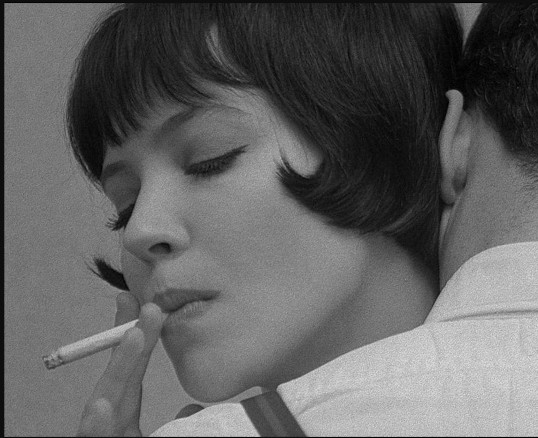
Anna Karina as Nana in Vivre sa Vie
When I finish a book – I have a tendency to look around for a movie of the same subject. After finishing Zola’s Nana – I first found a version on Netflix… but it was a Golan-Globus soft core R rated porn piece full of naked girls and leering old Frenchmen. Not that there is necessarily anything wrong with that – but it wasn’t what I was looking for (at the time).
Then I discovered, on the Criterion Channel, a French nouvelle vauge film by Jean-Luc Godard: Vivre sa Vie. The main character (the transcendent Anna Karina) is Nana, a Parisian woman that starts out wanting to be a movie star but ends up falling into a life of Prostitution. It was obviously inspired by (although very different) the Zola novel. And I watched it.
Susan Sontag called Vivre sa Vie “a perfect film” and “one of the most extraordinary, beautiful and original works of art that I know of”
The movie consists of twelve discrete tableaux – each one featuring a title card announcing what you are about to see. That breaks the film up and allows it to jump around, emphasizing the downward spiral of Nana’s life. In the novel, Nana preys upon the desires of the men around her – destroying them in the process. The movie is the opposite – the men around Godard’s Nana all prey on her desires and dreams, destroying her in the process. In the Novel, the men give Nana their money… in the Film Nana gives her hard earned cash to the men – she is reduced to a piece of property, a capital item that is expected to produce a certain amount.
This dreary, melodramatic story is contrasted with the luminous actress, Anna Karina. She fills almost every frame of the story and her beauty jumps out from the glorious black and white screen. I always have a tough time with the French New Wave, but I think this contrast is part of the appeal. The amazing potential of this beautiful woman reduced to disaster by the vagaries of cruel fortune.
Oh, one more thing… for you fountain pen nerds out there. There is a long scene where she writes out a letter – an application to work as a prostitute for a madame (it is heartbreaking). She is using a Parker “51” – a distinctive pen (hooded nib, arrow clip on the cap) – very popular at the time the film was made, and arguably the greatest pen ever. I’m ashamed of myself for recognizing that – and thinking it is cool.
‘I think we’re always responsible for our actions. We’re free. I raise my hand – I’m responsible. I turn my head to the right – I’m responsible. I’m unhappy – I’m responsible. I smoke a cigarette – I’m responsible. I shut my eyes – I’m responsible. I forget that I’m responsible, but I am. I told you escape is a pipe dream. After all, everything is beautiful. You only have to take an interest in things, see their beauty. It’s true. After all, things are just what they are. A face is a face. Plates are plates. Men are men. And life, is life.’
I always discuss important matters with children. Adults can only think about things they understand so everything stays on that boring human level.
—-Nobuhiko Obayashi
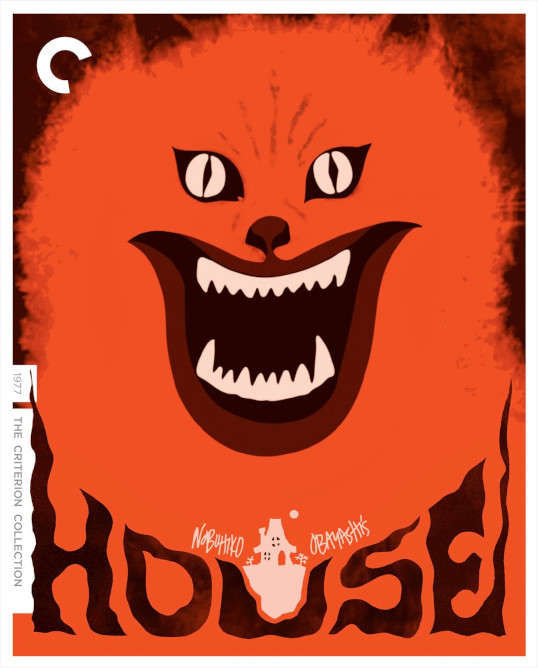
House (1977)
I knew I had some time to kill coming up so I decided to download a film from The Criterion Channel onto my tablet and watch it later. After some searching I decided on House – a Japanese horror film from 1977 that was supposed to be one of the weirdest films ever made.
And it was. Somehow this thing was made by Toho (the movie production company of Godzilla fame) in response to the success of Jaws. The two have nothing in common with each other – either in style, subject, or even a shared universe.
House is a trip – a strange, slightly perverse, bloody technicolor work of… if not crazed genius – at least extreme craziness. I would compare it to something else – but there is nothing else to compare it to.
The plot, such as it is, involves seven young Japanese schoolgirls with names that fit their personalities
Gorgeous – the main character – a thing of beauty
Fantasy – her best friend – a flighty girl who means well, but it subject to a lack of reality at most times.
Prof – bespectacled and brainy – the problem solver of the gang
Sweet – bubbly and naive – a bit frightened all the time
Mac – likes to eat and thinks of little else
Melody – a musical prodigy
Kung Fu – her name explains her gift – at one point she kicks her way out of her skirt and spends the rest of the film in her underwear.
These seven friends, after some misadventures, are bundled off for vacation to Gorgeous’ aunt’s house – which, of course is haunted, and very bad things begin to happen.
Fantasy finds Mac’s severed head in a well. The head proceeds to fly up and bite Fantasy on the ass. I told you it was weird.
What makes the film really strange and unexpected is the sweet, innocent and colorful tone which is mostly maintained even through the scenes of horror and bloodshed.
One thing I really liked were the beautiful painted backgrounds. At one point, once they leave a train, the seven girls are shown in front of an obviously painted scene of mountains and clouds. The camera pulls back revealing the painting – but it and the girls are in front of another, different panorama of mountains and clouds – this one also obviously painted.
So, if you want something more than a little different, but still very entertaining, pull up your streaming Criterion Channel and settle in for some House.



 Bill Chance