The Alchemist

“Don’t forget that everything you deal with is only one thing and nothing else. And don’t forget the language of omens. And, above all, don’t forget to follow your destiny through to its conclusion.”

—- Paulo Coelho, The Alchemist

Working cranking through my reading list – on a race with death – so many books, so little time – I queued up Paulo Coelho‘s The Alchemist. It’s a famous book, and has been recommended. I was happy to see that it was a slim volume – all the better for getting there in time.

You can say that the omens instructed me to read the book. I never cross the omens if it is at all possible.

The book is in the form of a fable… actually, it is a fable. It bears a strong resemblance to “The Man Who Became Rich through a Dream” from 1001 Nights (a folktale of Aarne-Thompson-Uther type 1645).

Is this a bad thing? I don’t think so. There are a lot of folk tales out there – any story told has been told before. I need to work on a list of these archetypal tales – I wonder how many can be updated into the big, evil city? Can I kill people in them?

I was of two minds reading the Alchemist. It’s a simple tale and I wanted more. But maybe that was simply my prejudice – I wasn’t expecting a fable, so I wasn’t satisfied with a fable.

But I’ve been to the desert and I know how it talks to you. I’ve never seen the pyramids but I can imagine what they would look like towering over the dunes by moonlight.

Now that I’m done, though, and moving on – I’m glad I read the thing. I’m not sure if I learned that much… I’ve heard it before. I wonder about the people that say, “This book will change your life,” – I guess that depends on what your life was before… but if a tale of symbols, omens, and following your own special destiny is a new and revolutionary concept for you … good luck with all that.

I wonder if an Alchemist has to learn Physical Alchemy? I’m a regular chemist, and p-chem almost killed me.

Oh, one more thing… even if it is a fable, it is one hell of a well-written one.

So, what do the omens tell me to read next…. maybe some nice, crude, violent crime noir. Something where some people die, people that don’t deserve it – people that follow their destiny to its conclusion… usually in some dark cold alley somewhere.

High-Rise

“Later, as he sat on his balcony eating the dog, Dr Robert Laing reflected on the unusual events that had taken place within this huge apartment building during the previous three months.”

—- Opening Line, High-Rise, by J. G. Ballard

It’s getting tough to decide on the next book to read. While I was considering the options I came across a few interesting articles comparing and contrasting the fiction of the late J. G. Ballard and the recent London riots.

I have been a fan of Ballard’s work for decades. It didn’t take me long to decide to dive in, especially when I discovered a copy of one of his classic works, one that I had never read, High-Rise.

About forty years ago, Ballard wrote three hyper-real novels about the relationships between society, technology, urban life, disaster, sex, and the monsters of the id. I have already read the excellent, interesting, and underrated Concrete Island and the infamous Crash. So I decided to complete the hat trick.

There are three minor characters and also the hero of High-Rise. The point of view circulates among Dr. Robert Laing, a medical school instructor that seems to be fleeing from the responsibilities of being a real doctor – Richard Wilder, a maker of documentaries that becomes overly attached to his video camera, and Anthony Royal, an architect that lives in a luxurious penthouse apartment.

These three live in a single forty-story condominium tower. It’s a brand-new building, part of a series of skyscrapers going up in a half-built complex on the outskirts of London. The three characters are representatives of the three classes in the building… that map out to their height above the ground. Wilder is from the second floor, where the lower classes live – although in this case they aren’t actually poor – they are made up of airline pilots, stewardesses, and television workers – wealthy enough all in any other setting. The middle part of the building, the largest section, from the shopping mall on the 10th floor up to about the swimming pool on the 35th and are represented by Laing- all professionals and respected members of the city at large.

Only the super-wealthy business tycoons occupy the top floors. At the very apex is Royal, who is credited with designing the building, though in reality, he only did the children’s playground on the roof and a few elevator lobbies.

The hero, the true protagonist is the building itself. It has a life and evil all its own… you can almost hear it speaking.

Pretty quickly, it becomes obvious that all is not right in this brave new world. There are obvious frictions between the three classes which spill out when the children of the lower floors try to use the swimming pool on the upper levels. The real trouble begins with parties. The innocent hedonism quickly becomes out of control, with plenty of illicit sex and bottles being thrown from balconies.

The three classes start out going to war with each other, complete with raiding parties and running battles over which group controls the important resources, such as the elevators and the garbage chutes. This is no Marxian polemic, however, and the three groups quickly lose their cohesion until it’s floor against floor, then small groups of apartments, then… well… let’s just say, things don’t end well.

Which, of course, is how I like it. I really enjoyed the book.

Ballard writes about such horrific descents into evil and madness with an almost geometric precision and symmetry. The building is designed just so, the cars are parked in a careful order, the balconies are arranged so everyone can see into everybody else’s’ business… once you think about it, the horrific events are not only understandable, they are inevitable.

It’s the sort of thing someone that had spent his childhood in a Japanese prisoner of war camp might have written.

A film is being made of the book, done by the director that made Cube – an interesting horror film with the best idea for efficient use of a simple filming set ever made.

He seems to be doing the film with the tower set in the middle of an ocean. I’m not sure if that is a good choice – one of the most interesting aspects of the novel is how, as things became worse and worse in the high rise, the residents became more and more insular, until they became, by choice, completely cut-off from the outside world. Also, in the book, there are more high-rises going up. Laing watches the one in front of his apartment being finished and then occupied. Near the end, he sees power going off in several floors over there – it is implied that the same horror that has infected his tower is spreading to the next. Set the building out in the ocean and you lose these details.

But… little concern. I’ll still go see the thing. I doubt if they can come up with a way to give it a happy ending. At least I hope not.

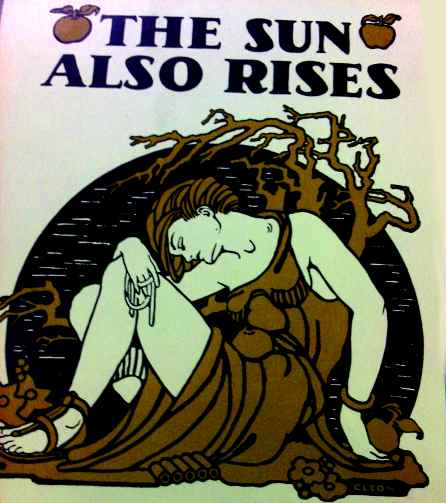
The Sun Also Rises

Sun

The Sun Also Rises

“In bull-fighting they speak of the terrain of the bull and the terrain of the bull-fighter. As long as a bull-fighter stays in his own terrain he is comparatively safe. Each time he enters into the terrain of the bull he is in great danger. Belmonte, in his best days, worked always in the terrain of the bull. This way he gave the sensation of coming tragedy.”

– Chapter 18, The Sun Also Rises, Ernest Hemingway

After another long day at work I drove to Love Field at ten to pick Nick up. He was returning from a few weeks in San Diego and out on a destroyer with the Navy.

While I was waiting at the baggage claim I finished reading Hemingway’s The Sun Also Rises.

As always, I am in awe of Hemingway’s tense terse prose and how he says so much with so little.

I have wanted to read this book ever since I read “The Drifters” by James Michener when I was in high school. There was a little bit of time that everybody was required to read “The Drifters.” The book made a big impression on me at the time, though I don’t remember any of it anymore. The only thing I remember is that the book made me want to go to Pamplona and run with the bulls.

Now I have to decide what to read next. Hundreds of books lie there, beckoning. So little time and so many stories.

Please forgive me. I’ve been thinking a lot about pride and seriousness. I want to work harder and do better on everything I do.

But right now I’m so tired. So I will bid a sweet adieu and trot off to dreamland. I’ll pick it up tomorrow.

The Sound of his Horn – by Sarban

The lurid cover art from The Sound of his Horn by Saban

The lurid cover art from The Sound of his Horn by Saban

I finished Erik Larson’s Thunderstruck and wanted something light and easy to read – so I looked through my collection of pulp ebooks and came up with Sarban’s The Sound of his Horn. This was an odd bit of fiction that I had found recommended here and there across the interwebs.

It’s an interesting amalgam – told as a story-within-a-story… it has time-travel science-fiction aspects, alternate history, a possibly unreliable narrator (one of my favorite literary devices), themes akin to a reverse Island of Dr. Moreau, a bit of an unlikely love story, while at the heart it is a “Most Dangerous Game” tale on steroids.

What’s odd about the book is that it is told in a slightly archaic, literary style (I had to use the dictionary quite a bit as I read) but the story is full of lurid, shocking elements that would be at home in the most modern trashy paperback. In the story, the protagonist finds himself thrown a hundred years into a future where the Germans have won World War II. A Teutonic lord rules a massive forested estate where his decadent guests hunt half-naked women costumed as deer or birds. They are captured alive by the hunt and served as after-dinner entertainment trussed up and delivered under giant silver serving-domes.

See what I mean. And that is not the worst of it, by any means.

I really don’t know if I’ve read anything as strangely sophisticated and sleazy at the same time.

In summary – it’s a short novel and more than entertaining enough. It’s well worth reading – if that’s the sort of thing you want. It’ll stretch your mind more than a bit. You can get an ebook copy here or here.

The author, who chose the pen name of Sarban, was John William Wall, a British Diplomat for over thirty years and a published writer for about two. Other than The Sound of his Horn he has a couple collections of fantasy short stories (some ebooks here). He must have been an interesting man, a combination of a sharp mind and a sordid imagination.

Thunderstruck

Marconi antennas at Wellfleet

Marconi antennas at Wellfleet

Creative nonfiction is the use of fictional techniques, such as characterization, conflict, foreshadowing, in the service of a factually accurate narrative. To me, the most important aspect that separates creative nonfiction from, say, journalism or scholarly writing, is the use of scenes. The story is broken up into scenes of varying length and detail, carefully crafted and arranged to affect an emotional result in the reader, while staying strictly within the known facts.

In the many years since In Cold Blood there have been many masters of Creative Nonfiction… Mailer, Wolfe, McPhee spring to my mind immediately… but right now the current master of the genre, in my humble opinion, is Erik Larson.

I read “Isaac’s Storm” a few years ago and was absolutely enthralled. Of course, the fact that I am very familiar with Galveston and the Bolivar Peninsula made the story even more harrowing and effective. For years we vacationed at Crystal Beach on the Bolivar Peninsula and I would imagine the horror of the storm surge inundating the island. I would look at the black iron lighthouse and imagine the poor souls huddling inside as the water rose and the winds howled. I read the book before Hurricane Ike struck and wiped our old vacation haunts off the face of the earth.

Then I read “The Devil in the White City” – which didn’t have the same emotional effect on me – but was actually a better book. It was fascinating in its story (which I knew nothing about) of the fantastic Chicago World’s Fair. This story of man’s best creations on display was contrasted with the darkest depths of human depravity in the parallel story of H.H. Holmes, the country’s “first” serial killer, who set up shop in his “murder castle” constructed only a few blocks from the fair.

The book is mesmerizing.

I went to a lecture by Erik Larson at the Eisemann Center here in Richardson and loved it. He talked a lot about the research he did for his non-fiction. I remember he discussed one sentence in Isaac’s Storm where he described what Isaac Cline saw, heard, and even smelled while he walked from his office to his home the day before the hurricane hit. “People ask me how I know what he experienced on his walk over a hundred years ago,”  He went on to explain that he knew from Cline’s letters he walked home and Larson learned from the maps of the city that there were stables and workshops on the way, and Cline would smell the horses and hear the workers.

It was very impressive.

So now I’ve finished a third Larson non-fiction book, published a few years ago, Thunderstruck. This, like Devil in the White City contrasts a famous accomplishment – Guglielmo Marconi’s successful “invention” of wireless communication, with a horror – Hawley Crippen, the most unlikely of murderers. The two stories are told separately, until the unexpected coincidences of history brought the two together in an unexpected way.

I found the Marconi story the more interesting of the two. The murder was horrific in its details – but the murderer was portrayed as almost a sympathetic character. Marconi was especially interesting in the fact that he didn’t actually invent anything – he never really even understood how radio worked – but he had the single-mindedness, courage, and business acumen to put other people’s inventions to work in a way that made sense and was successful.

And isn’t that the most important thing… really?

Any criticism of the book is merely picking nits. Larson is famous for layering on detail and here, especially in his description of the murderer’s daily life, it piles up pretty thick and gets a little tedious. I would like to have had less information on Crippen’s love life and more on the fantastic, gigantic, wireless installations that Marconi built on both sides of the Atlantic – spending millions of dollars and risking his entire company trying to get Morse code across the sea – never mind that nobody thought it was possible, that undersea cables could already do the job, and Marconi had no idea what he was doing in the first place.

The ultimate irony is that, in an odd way, the murderer was responsible for Marconi’s ultimate success.

So, in short, very good book, put it on your reading list – enjoy yourself and learn something at the same time.

Larson has another book out that I haven’t read – “In The Garden of Beasts: Love, Terror, and An American Family in Hitler’s Berlin.“ Oh, man, that sounds good, doesn’t it?

Early Marconi Radio

Early Marconi Radio

New Orleans Noir

No place as pretty and sad as New Orleans. Depending on if the sun’s shining or not. You ever notice that? Sun’s out, ain’t no prettier place on earth. No place more … resplendent. But gray and gloomy, cloudy, rainy, this town is so shabby, dreary, and downright depressing, makes you wanna take morphine and die.

—– From the short story Marigny Triangle by Eric Overmyer from the collection New Orleans Noir

Since my son Lee enrolled at Tulane I have been reading material set in New Orleans as much as possible. Confederacy of Dunces, Across Magazine Street, The Awakening, The Moviegoer, the Dave Robicheaux series, Zeitoun…. And there are plenty more to go.

I just finished a book of short stories set in The Big Easy – New Orleans Noir. As the title suggests, it is a book of hardboiled crime fiction. Eighteen different stories from eighteen different authors: Thomas Adcock, Ace Atkins, Patty Friedmann, David Fulmer, Barbara Hambly, Greg Herren, Laura Lippman, Tim McLoughlin, James Nolan, Ted O’Brien, Eric Overmyer, Jeri Cain Rossi, Maureen Tan, Jervey Tervalon, Olympia Vernon, Christine Wiltz, Kalamu Ya Salaam, and Julie Smith. This is one book in a series of noir collections, each one set in a different city. I haven’t read any of the others… and I’m not so sure… what city can be more Noir than New Orleans?

The book is divided into two parts – pre and post Katrina. The earlier stories are all over the place: time, tone, setting, genre. Some have a bit of horror thrown in – the excellent “Pony Girl” by Laura Lippman, for example. Post Katrina – well, they focus in on a horror of an entirely different sort. Not so much the rising water but the breakdown in society that can ensue after a disaster like that. I remember the Nicaraguan Earthquake in ’72 – it was that breakdown that was even more frightening than the tumbling masonry.

New Orleans is a city of neighborhoods. Each story is set in a different part of the city: Uptown, French Quarter, Bywater, Faubourg Marigny… with a map in the front to keep you oriented.

As you might expect from a collection with eighteen authors, the stories are a bit uneven. Still, the good outweigh the bad by a large margin. Ones that especially resonated with me?

The Lippman “Pony Girl” – short, visual, horrific. Really good.

All I Could Do Was Cry, from the Lower Ninth Ward… by Kalamu Ya Salaam – heartbreaking.

… Now that I look over the table of contents, there is really only one that I didn’t like. I’ll have to reread that one… maybe I missed something.

I’ll have to single out one of the post-Katrina stories, the one by Julie Smith, the woman that put the collection together. Her story, Loot, was a little uneven in pacing, I would like to have seen it written out longer… but the basic story, of the friendship between a lawyer and her housekeeper, was wonderful and felt real.

Don’t take my word for it, read the story here.

Now I have to decide what to read next. I have to be careful what I read because the style and attitude of what I’m reading has such a huge impact on what I write.

Let’s see… I bought a Kindle Book, I Wish, from Wren Emerson and I want to finish that. But I never read only one book at a time, I have a handful of non-fiction library books and a half-dozen in my “Current Reading” collection on my Kindle.

I did read a short story, “Child’s Play” by Alice Munro this afternoon. She is so good, her stories so perfect and jewel-like, they make my heart ache. Nobody does it like she does.

We can all dream

Ok, since I’m thinking about New Orleans, how about a little Big Easy Jazz, OK?