The Bacchae

eyes that run like leaping fire - Elliott Hundley

You have a glib tongue, as though in your right mind, Yet in your words there is no real sense.

Wretched man, how ignorant you are of what you are saying! Before you were out of your mind-but now you are raving mad.
—-Euripides, The Bacchae

A while back, this guy, Euripides, wrote this play, The Bacchae.

It’s a story of Dionysus, a vain, jealous and vengeful god and the horrible revenge he exacts on mere mortals that refuse to worship him. It’s a story of Pentheus, the vain, stuck-up, and arrogant king who wants order, lawfulness, and absolute attention to his iron rule. It’s a story of women running wild in the woods, ecstatic with passion, blinded by lust and wine. It’s a tale of voyeurism, with the victims pulling the spy down and tearing him limb from limb. It’s the story of a mother returning triumphantly home carrying the disembodied head of her own son under her arm thinking it to be a hunting trophy.

The play was considered too grotesque to be seriously studied until Nietzsche wrote in praise of the genre. Now, of course, the flamboyant themes, aberrant scenes, and bizarre excesses are the cat’s meow, and the play has become fashionable, especially as an opera, where the outlandish aspects fit in well with the dramatic chorus.

The great theme of The Bacchae is a fascinating and important one. It is the constant, eternal struggle between freedom and control. Can an organized, rational society survive if it allows the irrational passions of the human heart to exist and express themselves? How can it survive if it does not? Where is the line to be drawn? What is the healthy limits to ecstatic pleasure? Are there any? The two forces: authority and freedom, rational and irrational, the head and the heart, duty and joy, moderation and excess, wisdom and instinct, self-control and human passion, restraint and release – are forever locked together wrestling in a death-grip struggle, each unable to defeat the other because, without its opposite, neither can survive.

Recently, the Nasher Museum in the Dallas Arts District crated up the Tony Cragg exhibition and sent it back to where it came from. I really enjoyed this one and was sad to see it go. It was replaced by a group of sculptures called The Bacchae by Elliott Hundley, a young Los Angeles based sculptor. I saw some photographs of the work and was disappointed. It looked junky, simple, and nothing special.

I was wrong.

Photographs can not do justice.

I took the DART train down to the Nasher on a Target First Saturday event, where I could stroll in and out and take it all in at my leisure. I was stunned. The stars of the show are the large flat assemblages that take up huge swaths of museum wall space. These are incredibly complex masses of kaleidoscopic images, from found objects to cut out photographs, from comic-book word balloons to paragraphs of newspaper-ransom-note-cut-outs – all suspended in various ways in front of giant billboard-like images. The closer you look, the more detail jumps out. You could spend a year in front of a single one of these and not be able to tease out all the passion and information contained within.

More traditional 3-D sculptural works occupy the center of the space and I found these interesting and well-done, but I, like everyone else in the crowded room was drawn back, again and again, to stand right against the little foot-ropes holding the mob back, and stare at the square inch of work that was right in front of my eyes until I could look at each little paper figure impaled on a wire pin or read the little quotes or try to decipher the galaxy of little objects that are presented sticking out from the wall.

The artist calls these “bulletin boards” and I can see why. They are enormous collections of a universe of detail and, like a lot of art, change tremendously with perspective and distance. Standing away (or looking at a photograph) you can see a landscape of large images partially obscured by clouds of smaller details. Once you approach, these details become apparent and you stare at them. If you want to get even closer, on certain works the artist provides magnifying glasses attached to a matrix of wooden sticks and you can peer through into an even smaller, almost microscopic world, of printers dots splayed across the mounted magazine advertisements and ink-jet printed paper objects.

As I looked I could listen to the comments of the other patrons around me – especially the children. This was a free admission with family activities day so there were a lot of kids. They were, of course, instantly drawn to the collages and it was a struggle for their parents to keep them from touching anything. The little ones would comment constantly. “Oh, that’s gross!” was a common reaction, said in that kid way that doesn’t necessarily mean that they didn’t think it was cool. A few parents would try to explain, in that condescending “I have brought my spawn to the art museum now I must get them to understand how important this is and how great a parent I am” tone and attitude but their voices would trail off, overwhelmed by the sheer mass of stuff that was stuck up on the wall in front of them.

Now, writing this, I want to go back and look at it all again. I want to try and break some of it down and see if I can relate it to the Euripides play now that I know a little more about it. I know I will. I can see a few hours stolen here and there to waste standing against that low rope staring at all that stuff stuck to all those pins.

detail from the LIghtning's Bride - Elliott Hundley

Elliott Hundley: The Bacchae

Review: ‘Elliott Hundley: The Bacchae’ at the Nasher

Art Review: Is Elliott Hundley’s Work More Suited For A Tim Burton Film Than the Nasher?

Sparknotes: The Bacchae

Elliott Hundley The Bacchae Exhibit at Nasher Sculpture Center

Contemporary Art (1) – Elliot Hundley

elliott hundley

Late Night at the Dallas Museum of Art

I remember when the Dallas Museum of Art was constructed (its building – the first edifice in the Arts District, before that it was in Fair Park) – I was working in the now long-imploded Cotton Exchange building right next door. In those salad days, the museum was free and almost empty. I would go over at lunch, eat from a sack and look at my favorite sculpture – Rhythm in Space (now gone, I don’t know where)  in the garden and then stroll past the Stake Hitch (gone too, sadly, controversially,  and inexplicably) to see what was up.

That was a long time ago.

A few days back, looking ahead, I found information on the festivities in the Dallas Arts District on Friday Night. This was their Late Nights at The Museum where the place would be open until Midnight with all sort of activities scheduled. It was also the birthday of the museum and also, outside, the Crow Musuem of Asian Art would be celebrating Chinese New Year.

My intention was to leave from work and get down there at about six. I was exhausted, however, and went home for a quick power nap and a bite to eat (I ate at home to save money, there would be food trucks in the district) before I caught the train downtown.

I was glad that I had wolfed down that sandwich – sure enough, there were eight trucks in a double line along Flora Street, but they were engulfed in a massive crowd. The lines to get some vittles stretched out hundreds of yards.

The crowds mobbing the eight food trucks along Flora Street in the Arts District.

I continued on down the street to the Crow. There was a dragon dancing in the middle of the street but I could not even see it through the massive throng of spectators. It looked cool, but I decided I would flee from this crowd by retreating into the Dallas Museum of Art.

That didn’t work. The museum was even more packed that the street outside. Everyone coming through the door was immediately directed into a long line to purchase admission tickets. Everybody (except me) was dressed to the nines. The The Fashion World of Jean Paul Gaultier: From the Sidewalk to the Catwalk is the exhibition that has all the town talking and everyone had dragged out their best fashions. There were two tall beautiful women wearing short metallic dresses in line behind me and we talked about a Lady Gaga lookalike contestant (there was going to be a contest later) that slowly tottered by. Her massive platforms made for difficult walking across the glass-smooth and rock-hard polished granite floors.

There were many Gagas in attendance – in many different incarnations. There was the big blonde hair and high platforms with sunglasses and  fishnets mentioned above, a lot of long platinum wig with bangs and glued facial bling (Poker Face) and I saw one with drink cans in her hair (Telephone). I didn’t see anyone in a meat dress.

Before long, a young man in an expensive Italian suit walked up and gathered the women and their extensive entourage from the queue behind me and whisked them off. He had some sort of connections and was able to bypass the waiting. The line did move quickly and before long I had paid my ten dollars and received a little purple cardboard square that went around my wrist on an elastic band.

I fought my way through the thick and fashionable crowd to the restaurant area at the North End. The Dallas Museum o fArt is not set up to handle large crowds very well. There was a stage set up and a Madonna impersonator with two dancers were gyrating around, but it was almost impossible to see anything. A few folks had arrived earlier and taken possession of the few tables and were holding their turf like a Roman legion. The museum guards were rushing around making sure nobody leaned on a balcony edge or stood on a stairway, making it impossible for anyone else to get a glimpse of what was going on.

I have been to the museum hundreds of times, so I knew of a hidden little slit window up on the top floor that looked down onto the festivities. I walked up there and watched for a while.

The Madonna Show

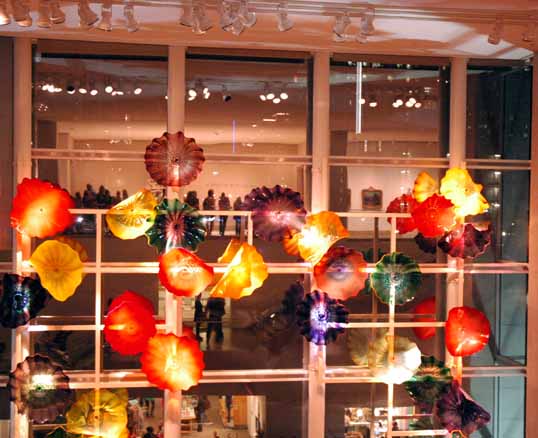
Gawkers reflected in the windows behind the Chihuly glass flowers.

The Gaga lookalike contestants parade around in front of the judges. This is the best view I could get, from the little slit window high above.

For a couple of hours I walked the galleries. Back amongst the paintings, it was fairly empty, actually. The massive crowds were concentrated out in the main hall -where folks waited to get into the Gautier exhibition or simply milled around aimlessly.

The crowds in the central hall of the Dallas Museum of Art.

I wonder what this guy was thinking... "Wow, there are too many people here! I give up!" or, more likley, "Hey! Quit staring at my penis!"

I always criticize Dallas for not having a culture or a scene of its own. Now, with the rise of the Dallas Arts District and the explosion of people actually living there (Uptown, Downtown, the Cedars) there is a chance for something exciting to develop. Of course, that means I give up the experience I used to love – of being there almost by myself, of the feeling that all this was built just for me. It means fighting the crowds, which I don’t like. Of course, I can always find someplace else.

At ten I fought back into the festivities to listen to Brave Combo (another blog entry). Then I retreated back into the European Painting Galleries. Earlier, I had noticed a sign promoting a late night DJ back there promising, “Stroll through the galleries while listening to retro and punk French music spun by – DJ Wild in the Streets.” Oh that sounded like a plan.

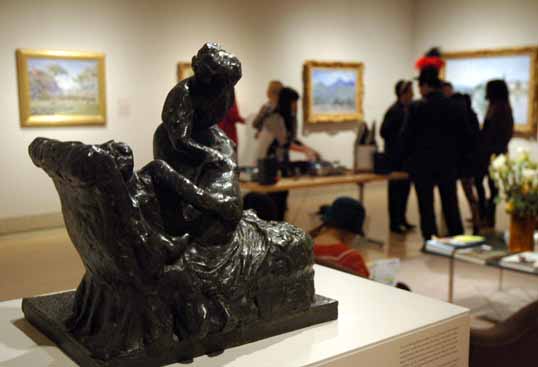
In the foreground, The Masseuse, by Edgar Degas. In the background, DJ Wild in the Streets.

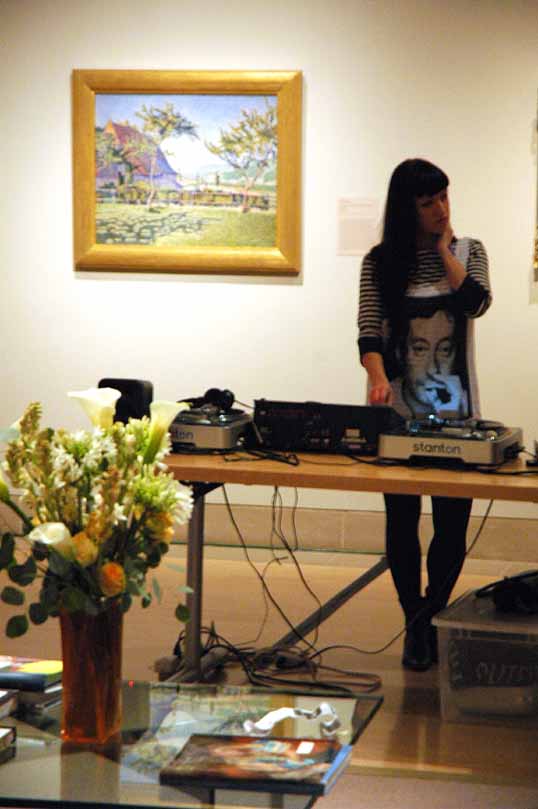
The DJ and her entourage.

DJ Wild in the Streets

And it was very nice. I was tired by then and it was very relaxing to look at the Impressionist paintings while the DJ spun her disks. It wasn’t too loud and there weren’t too many people and I liked it a lot.

At midnight I hoofed it back to the train station at Pearl before it turned into a pumpkin. A couple was having an amazingly loud an angry argument – I heard her yell, “His name is Maurice… OK! OK!.” and the response, “I don’t give a fuck what his name is!” I moved on down the platform and considered calling 911 before they came to blows. There were no police at the station, even though there was a deadly shooting there only a couple days ago. Before I did anything, my train pulled up and off I went.

I almost nodded off on the ride home – but at one point a couple of folks standing at the front showed each other their Museum of Art purple wrist entrance things, and I, and the rest of the train car, raised our arms and showed them ours.

Gawking over the Gaultier Exhibit

“Like a Virgin”: Countdown to Gaultier’s First Exhibition

DC9er Mixtape, Vol. 12: DJ Wild in the Streets

Style Alert __ Jean Paul Gaultier

From The Sidewalk To The Catwalk

Enfant Terrible

Fashion World Of Jean Paul Gaultier At DMA

I always think of this clip by John Hughes as the quintessential Art Museum experience. Late Night at the DMA is not like that.

Eccentric Flint

When I go to a local museum – one that I visit on a regular basis – I’ll usually pick out one piece of art, go to it, and study it for as long as I can.

Plus, there are pieces that I always go to and… it feels like checking in – or paying a visit to an old friend. I don’t know why certain works resonate with me… and I try not to think about it. I like ’em, and that is something I want to be good enough.

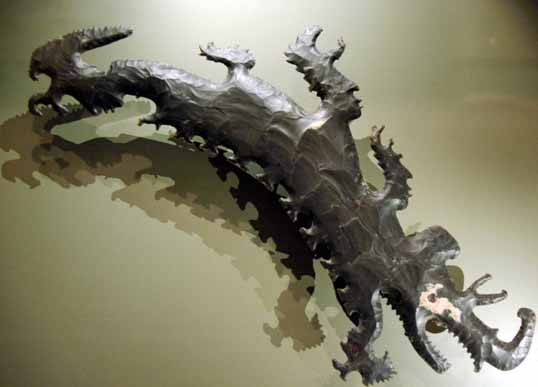
At the Dallas Museum of Art, one piece that I have always loved, one that I keep going back to ever since I first saw it decades ago, is an eccentric Mayan ceremonial flint knife.

Mayan Flint Knife from the Dallas Museum of Art

From the museum card:

Eccentric flint depicting a crocodile canoe with passengers.

 Mexico or Guatemala: southern Maya lowlands, Maya culture

Late Classic period, c. A.D. 600-900

This sacred blade shows a moment in the Fourth Creation of the world on August 13, 3114 B.C. The blade is shaped as a monstrous crocodile canoe; water flowers decorate its belly as it sinks down into the dark waters of the spirit world. In the canoe is the soul sacrificed First Father accompanied by two attendants, who may be embodiments of his parents. The canoe represents the Milky Way, pivoting in the night sky from east-west to north-south. The Maya saw this pivoting as the sinking of the canoe and the raising of the precious maize tree. When the canoe sank, First Father was miraculously reborn as Maize, the sustenance and flesh of humanity.

Because it represents this mythic act, this blade was probably an especially powerful talisman of a living king, who became the reincarnation of First Father as he held the blade. The blade itself, bundled in textiles, was probably carried by the king into battle as the focus for his spiritual energies and as his tactical inspiration. The flinty stone connoted lighting to the Maya and was called by the same name as the bright but dangerous bolts of light that accompany life-sustaining rain.


There is a brutal beauty about this flint. I can picture the Mayan king going into bloody battle with this ceremonial knife gripped in his fist.

Teaching packet on the Mayan Flint

Wikipedia – Eccentric Flint

Lost in Thought and luxury living

The Museum Tower Condominiums tower over Tony Cragg's "Lost in Thought"

The Tony Cragg exhibit is about to end down at the Nasher. The Museum Tower outside continues to stretch its mirrored mass skyward, now plainly visible through Renzo Piano’s semitransparent roof. I still haven’t heard what they are going to do about the fact that the tower is intruding on the skyspace of Tending(Blue)… if anything.

The tower will have 122 condominiums priced from 1.2 to 4.1 million dollars a pop – plus a custom priced full floor residence. I’ll never set foot in the place, that’s for sure.

Take a look at their advertising. The Nasher Sculpture Center features in every scene of fine bred humans smiling their way through their artistic day. They are using the Sculpture Center to hawk their condominiums. At the same time their tower has already destroyed what was, to many, the crown jewel of the museum experience.

I have nothing against rich people, and I applaud their luxury. But if you are going to spend that much for an apartment… can’t you throw out a dime or so and figure something out… give us back our art installation? Why did they not think of this beforehand? Tending(Blue) was the coolest place in the city. It was the best place for the ordinary citizen to watch a sunset. You can have your multi-million dollar views, but let us have our own little piece of the sky.

Please?

Ganesha, Lord of Obstacles

Ganesha, Lord of Obstacles. From the Crow Collection of Asian Art

Ganesha, Lord of Obstacles, Lord of Beginnings
India, 10th Century
Stone
Clever Ganesha

Ganesha and his half brother Skanda were promised a boon by their parents, Shiva and Parvati. The prize would go to the one who returned first from circling the universe. Skanda, a keen warrior, geared up for his voyage and took off with great speed. Ganesha fortified hmself with a modaka, his favorite sweet, and respectfully circumambulated his parents. Long before Skanda returned, Ganesha was awarded the prize.

Adapted from the Siva Purana, trans. Paul Courtright


Sculptures at the Crow Collection of Asian Art

A couple of photographs I took the last time I was at the Crow Collection of Asian Art in the Dallas Arts District.


New Book of Mountains and Seas

One of the hidden gems down in the Dallas Arts district is the Crow Collection of Asian Art.

I was working in the Cotton Exchange building in downtown Dallas (the Cotton Exchange is gone now – they blew it up a couple years after I left) while they were building the skyscraper tower of the Trammell Crow Building. The construction site was visible from the windows of our office suite. I watched the steel skeleton climbing up and up – watched the workers scrambling over the latticework of girders. I watched the granite and reflective glass being raised and affixed to the building’s outer skin.

There is always a connection with a building that I watched go up. Since I saw it stretched out in time from the inside out – I feel I know all of its secrets. I know the shortcuts the architect made to get the outer shape. I saw the ventilation, plumbing, and elevator shafts carved out of the interior.

At one time the walkway around the base of the building contained an amazing collection of European sculpture and was one of my favorite places. The sculptures have been removed – and there is the promise to replace them with Asian pieces.

Behind the office building, on a floor level below, facing Flora street across from the Nasher Museum is the Crow Collection of Asian Art. Trammell and Margaret Crow have been collecting Asian art since the 1960’s and built the museum under a pavilion in back of the office tower. It is a small but effective museum, and a welcome addition to the other museums and performance venues in the Dallas Arts District – helping the area move towards the tipping point of becoming a well-known destination. In addition to exhibiting pieces from the permanent collection – the Crow Museum has developed a reputation for hosting impressive visiting temporary exhibitions.

Oh, one more thing. Admission to the museum is free.

A free museum is viewed in a different way than one that you have to pay to get in the door. Instead of making a big deal out of it – preparation and anticipation – you tend to simply wander in and take a relaxed view of the wonders within. I like it.

I have a confession to make – this time that I walked in to the museum it wasn’t because I had heard of some revelatory amazing exhibition or even that I felt the need for peaceful contemplation of a thousand years of artistic production.

I had to pee.

There are not a lot of public restrooms in a big city downtown. The homeless tend to take over and destroy any facilities that are open to anyone. So I decided to duck into the Crow Museum to use their restroom. Since I am a person that likes to meet their obligations – even though I should be able to use the bathroom and leave, there have been many times I’ve been to the Crow to see their art and not used the bathroom – I felt obligated to at least take a quick walk through the galleries.

I walked into the big room past the gift shop and found that it had been emptied. There was a bench in the center of the room and three digital projectors were shining on a long wall. The effect was that of a widescreen film being shown in a bare wooden room – very clean and beautiful. One guy was sitting at one end of the bench – I walked over and sat down on the other.

At first the film was showing some credits and bits of poetry while the soundtrack played some electronic music. It was very peaceful, but not much too it and after a few minutes I wondered, “Is this it?” It was an interesting thought – all this space and technology used to simply throw a few words on the wall along some jangling sounds. I began to wonder if it was an elaborate joke.

It wasn’t. I had come in right at the credits at the end. Soon the presentation looped back to the beginning and the real show began.

This was a film by Qiu AnXiong, an artist from Shanghai. The exhibition was called Animated Narratives and consisted of a two-part video installation called New Book of the Mountains and Seas, along with paintings associated with it.

The video started with a hand drawn animation of waves on the sea, then moved to a pastoral landscape. Soon, a farm appeared to grow on the land like an organic thing. The farm quickly grew to a village and then a walled town. Civilization continued to grow in an organic way – with fantastic animals taking the place of oil rigs, pumps, transportation, and warcraft. Everything grew and grew, with many scenes reminiscent of recent events, but warped into a strange surreal organic landscape. The Middle East (or something resembling it) is ravaged by oil production, the terrorists strike in a version of 911 even more surreal than reality, and then the inevitable disaster and destruction obliterated everything.

The film was in black-and-white and appeared to be animated ink drawings. After walking around and looking at some of the paintings, it was clear that it is actually paint on canvas. The artist overpaints as he photographs his work and generates the animation that way.

I really enjoyed the film and its presentation. You really have to see in it in its carefully constructed widescreen format to appreciate the work, but if you can’t make it to the Crow:

Here’s an online version (wait through the ads). I’m not sure how long this will be online.

Here’s another link to a version of the piece.

If that link doesn’t work for you, here’s about three minutes of the film. This section is near the end, and it does not do justice to seeing it live.

I enjoyed it enough to come back a couple days later and take a look at part two. This is another widescreen video set up in the mezzanine two floors higher up in the museum. It’s another animated work, this time concerning mad cow disease, genetic programing, biowaste disposal, environmental catastrophe and man’s eventual fate among the stars.

I couldn’t find the whole thing, but here is a bit of part two.

Don’t be afraid to wander into a museum, more or less unplanned. I should do this more often. I should not be so cheap to be afraid to do this even when I have to pay for it.

A Week and a Day

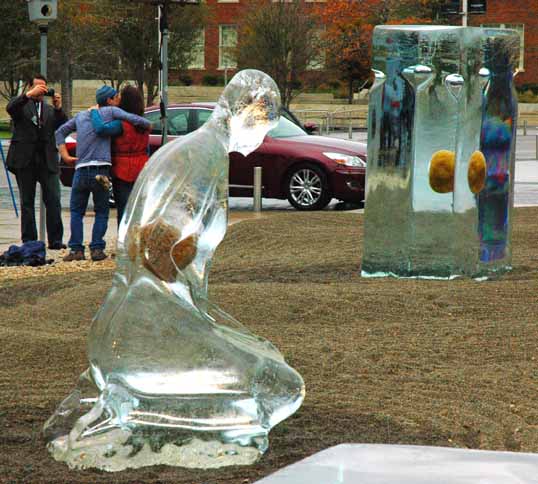
Saturday – It’s been eight days since I saw the art installation Transcendence downtown. The ice sculptures have been melting all this time.

First Night

Next Day

The Day After That

A couple days after that

I had to see what has happened in the meantime. Would the ice be completely melted? Would the installation still be there?

I drove down and parked down the street. It was still there, the gravel was still raked, and there was a lot of ice left in the two big blocks. The taller block had fallen over and broken in two, but the large horizontal block was not noticeably smaller.

The two human forms were nothing other than small irregular pieces of ice. The stone from one of them was missing. I remembered the story the woman from the Dallas Center for Architecture had told me.

She said that she had heard that one of the stones in the human forms was from the parents of a childhood friend of the artist. This friend had passed away and after the ice is melted and the artwork is closed the stone will be given back to the parents to be placed in their stone garden on their rural home as a memorial. A nice story.

Maybe that one stone is now in a garden on the Oklahoma border. I’d like to think so.

While I was taking pictures I could hear a lot of noise – a metal grinding sound with a series of loud clacks – coming from behind a wall surrounding an unfinished building next door. I realized that some kids were skateboarding over there. After a few minutes a couple boards came flying over the wall and then their owners scampered through a gap in a fence after.

“What is this?” they asked, “Is that ice?”

I explained that it was an art work, that there had been large sculptures of ice that have been melting for a week. They had never heard of a Zen rock garden, so I explained as best as I could. They seemed to think it was cool.

“I’m glad we didn’t walk around in there,” one of them said.

So am I.

The two human form sculptures, what is left of them

A reminder of what one of these looked like at the unveiling

The large upright block fell over - you can see the light-colored gravel it rested on.

What it looked like at the unveiling

A group of women walked by after leaving the Opera House.

Golden Boy

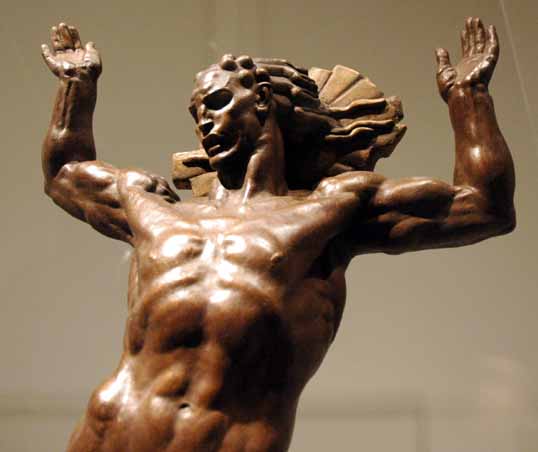
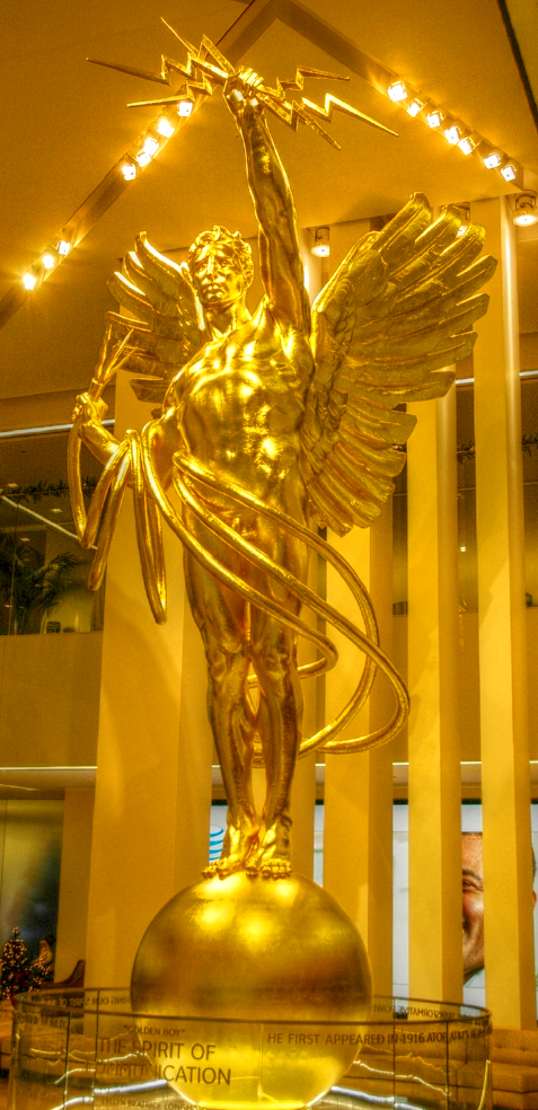
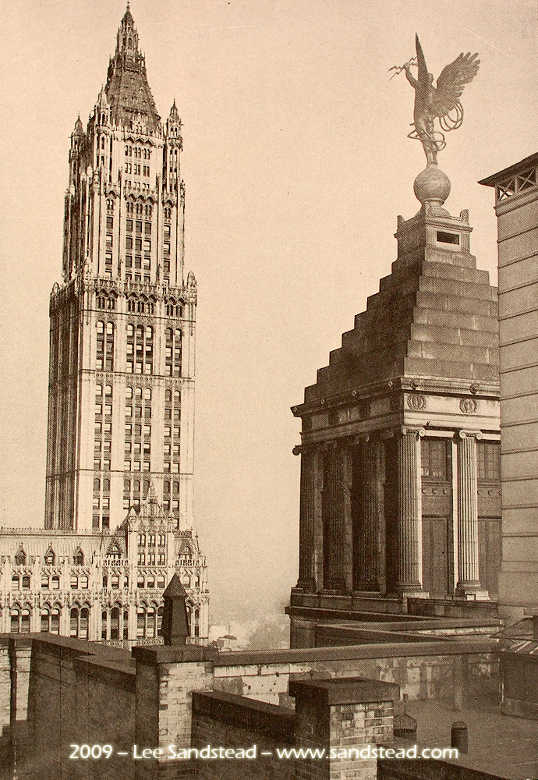
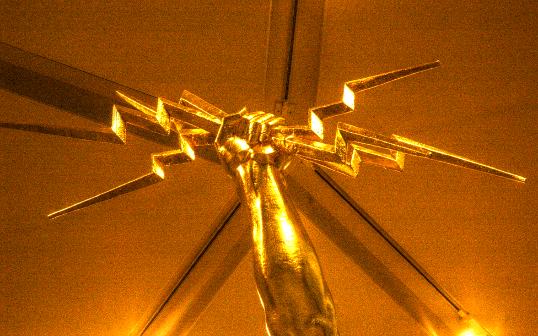
In 1914 the American Telephone and Telegraph company commissioned Evelyn Beatrice Longman to create a sculpture named The Genius of Electricity for their new headquarters at 195 Broadway in New York City. The final design was a massive winged nude male figure clutching lightning bolts in one hand and a coil of high-voltage cable wound around his body held in the other.The sculpture was completed in 1916 and hoisted to a pyramid constructed on the top of the building.

It was twenty four feet in height and was cast in bronze and covered with gold leaf. It weighed over sixteen tons. The statue towered over lower Manhattan until 1984. During the 1930’s the name of the statue was changed to The Spirit of Communications – although most people knew it by its nickname, Golden Boy. In 1984 AT&T moved up the island into the famous postmodern building designed by Philip Johnson. There was no perch on the roof, but the massive lobby contained the statue with no problem.

I visited New York about this time and remember seeking out the AT&T building as I walked the streets. Its architecture was still new and exciting. I remember the building, but I don’t think I actually entered the lobby. Now, I wish I had – I wonder if I would have remembered a huge naked gold statue standing there.

The next decades were turbulent times for the telecommunications industry and for Golden Boy. The AT&T building was sold and became the Sony Building. Golden Boy went across the Hudson and for years was displayed at two different locations in New Jersey. AT&T, of course, was carved up by the Federal Government – broken down into the baby bells.

One of these, Southwestern Bell, grew until in 2005 it swallowed its parent and became the new AT&T. Soon, the headquarters ended up in downtown Dallas, in the Whitacre Tower. Finally, in 2009, Golden Boy followed suit and was installed in the lobby of the building.

I stumbled across this history… I don’t know where. I have a book that lists notable Dallas sculptures but it was published prior to Golden Boy’s cross-country journey. Once I learned he was there, I had to go see him.

After I took at look at some melting ice (a sculptural form far more fleeting than bronze and gold leaf); I took a ride on a streetcar, then hoofed it across downtown to the AT&T headquarters.

I looked a little scruffy with my cheap jacket and bag of camera stuff – but garnered no more than a glance from the guard at the huge round desk at the entrance as I circled around taking pictures. The statue dominates the lobby – there is even a really nice curved couch behind the sculpture where you can sit down, relax and stare up at his golden ass. Yes, by the way, he is completely nude and, more or less, anatomically correct.

I had arrived near the end of the day and the lobby was dotted with serious-looking men in expensive suits shuffling on their tailored overcoats for the cold trip home at the end of the workday. The lobby is lined with cellular stores that open outward onto the street. These were full of folks looking for Christmas presents – for themselves or others.

It’s a modern, clean space – the almost-century old statue looks great but maybe a little out of place. Maybe he should be up on top of the building after all. He could spend his days staring across the street to the roof of the Magnolia Hotel down at that other Dallas iconic rooftop sculpture – the Pegasus.

Golden Boy - in all his glory

It is a beautiful statue... but somehow - he doesn't look too happy. I think he wants to be outside.

The view of the statue from AT&T Plaza through the entryway.

The statue on his perch at 195 Broadway. Photo by Lee Sandstead.

There is another famous statue in the distance. Photograph from Lee Sandstread

The Next Day

It was with more than a little trepidation that I drove downtown to take a look at Shane Pennington‘s installation for TEDxSMU, Transcendence. I had left the place in shambles the night before, with drunken Christmas Hooligans tramping across the Zen garden, poking at the ice, and posing in (for them) hilarious poses with the artwork, snapping a record on their iPhones.

I was relieved to find that the Zen Garden had been restored. There were some folks out keeping an eye on the installation, and a few hardy souls were braving the spitting rain.

Everyone agreed that the thing was mesmerizing in the daylight, even with the overcast skies. I would love to see the ice in bright daylight.

I had an interesting conversation with a woman from the Dallas Center for Architecture. She had given the tour of the Arts District that Morning (the one I attended a few months ago), had discovered the sculptures, and had returned for a closer look.
She said that she had heard that one of the stones in the human forms was from the parents of a childhood friend of the artist. This friend had passed away and after the ice is melted and the artwork is closed the stone will be given back to the parents to be placed in their stone garden on their rural home as a memorial. A nice story.

I would like to return every day while the sculpture melts, if possible. That may be difficult, but I know I can make it a few more times. I have no idea how long it will take before it is all gone. The biggest change from last night were in the human forms – their heads and faces were noticeably smaller and had lost all detail.

A wonderful thing. The only aspect it lacks… if this were my installation I would definitely put in a webcam.

This photo was shot through the large monolith of ice, and you can see a human form beyond.