the experience of the work is inseparable from the place in which the work resides. Apart from that condition, any experience of the work is a deception.”
― Richard Serra

the experience of the work is inseparable from the place in which the work resides. Apart from that condition, any experience of the work is a deception.”
― Richard Serra
“Well, I know now. I know a little more how much a simple thing like a snowfall can mean to a person”
― Sylvia Plath, The Unabridged Journals of Sylvia Plath
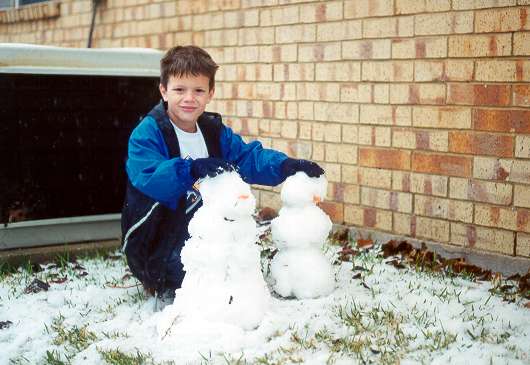
From my blog (I called it an “Online Journal” then), The Daily Epiphany, Tuesday, February 29, 2000
We had a bit of an ice storm a couple weeks ago. Although pitiful by northern standards, Lee, having lived in global-warming ravaged north-Texas all his life, was very proud of his two tiny snowmen. We keep small carrots in the house for salads and to feed the crickets that we feed to the toad – also good for snow-noses. No lumps of coal for eyes.
Even though he semi-hid them around the side of the house, the big kids found them that night and kicked them down.
And a piece of flash fiction for today:
“I wonder if the snow loves the trees and fields, that it kisses them so gently? And then it covers them up snug, you know, with a white quilt; and perhaps it says, “Go to sleep, darlings, till the summer comes again.”
― Lewis Carroll, Alice’s Adventures in Wonderland / Through the Looking-Glass
It was a long drive from Lawrence back to Dallas and we had to leave at six in the morning to insure we made it home in time to watch the Cowboys get beat. It was very cold with most of Saturday’s snow still frozen on the ground.
There was a thick… it couldn’t have been fog because it was too cold – some sort of pea-soup frozen haze… smothering everything. Over an hour later the sun rose unseen over the vast flint-hill plains. The haze slowly lightened into a gray blanket.
We stopped to switch drivers at one of the Kansas Turnpike rest areas, the ones with the oddly shaped water towers.

And I took this photo of one of the few trees within a hundred miles… blurred and obscured by the fog.

“I do know that for the sympathy of one living being, I would make peace with all. I have love in me the likes of which you can scarcely imagine and rage the likes of which you would not believe. If I cannot satisfy the one, I will indulge the other.”
― Mary Shelley, Frankenstein
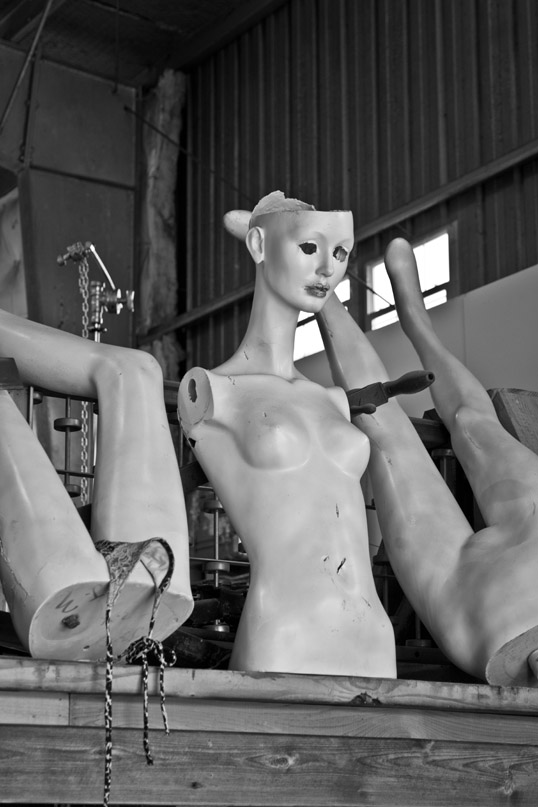
(Unfinished Sketch)
R had been hiding out at Fred and Ethyl’s house, in their basement. Fred and Ethyl weren’t their real names, of course, it wasn’t safe to know anybody’s real name – and they had this old-fashioned sense of humor. R felt safe in the basement but Fred and Ethyl said they had seen this non-descript car, so non-descript that it had to be ordinary on purpose, driving slowly around the neighborhood. Fred and Ethyl were worried and they kicked him out – left him in the woods.
The woods were mostly Cedar, Fred called it a Cedar Brake. There were a whole series of them along the lake, with thicker woods full of bigger trees and heavy brush, in between. R spent a lot of time looking at the Cedar trees nothing better to do. They were dark and twisted their trunks looking like misshapen limbs – bodies curled together. There was fresh new wood growing from roots up to the dark green fuzzy needles and a lot of old dead stuff mixed and twisted in.
R wasn’t much of an outdoorsman and it was getting hard on him, living in the breaks. He had plenty of food so far. On the way out from the basement they had stopped at this warehouse store and Ethyl went in and bought cases of canned food – chili, beans, some kind of ham. R knew he’d get sick of eating this stuff fast, especially eating it all cold, but what’s to do?
Fred had given R and old sleeping bag and a big sheet of plastic, in case it rains, but it hadn’t yet. The package said something about a painter’s drop cloth. He didn’t relish the thought of huddling under the sheet in a storm.
R had found a flat spot along the top of a little ridge above the lake. The trees here were thicker than down in the Cedar Breaks, and that’s where he set up with his sleeping bag, piece of plastic, and the suitcase he had brought. R tried to keep up appearances as much as he could, washing his socks and underwear out every morning down at the lake. His suitcase held his extra suit – wool, Italian, very expensive. Each day here, though, he wore some tan trousers and a dress shirt. He had two extra shirts but he cold tell they were going to get terribly worn pretty soon. He wished he had some more appropriate clothes – more suitable for living in the breaks. His suitcase also contained four fat green cylinders of money, big bills, wrapped in a rubber band. He had given two others (the smaller of the ones he carried) to Fred and Ethyl saying, “Here, take all I’ve got on me,” while keeping the rest hidden away tucked up inside the suitcase.
There used to be some sort of park along the lake. It must have been a big deal years ago – there were a handful of old run-down cabins lining a stretch of leaf-covered asphalt. R thought about breaking into one and sleeping there, but he was worried that he’d be found out – the first place to look – and the one cabin that he had stuck his head into through a torn screen had such an awful smell of old death he couldn’t bear to pry open the door. There were still people on the other side of the lake; he could hear the chugging diesel motors at night as they pulled giant camping trailers in and out. When the light was right he could spot old retired folks sitting in colorful folding chairs along the water. By their posture he guessed they had poles and lines in the water. R wondered if they ever caught anything.
It hadn’t taken very many days for R to fall into a rough uncomfortable routine. Without anyone to talk to, the days were already starting to smear. It was late afternoon and R was sitting at an old picnic table in a large Cedar Brake above the old cabins. There was only one seat board left – the other side was bare rusty pipe with flecks of corroded bolts that used to hold the wood. The top was missing the middle board too – but it was the least rotted of all the picnic tables left.
R bent over to flick a spot of dried mud off his leather loafer when the bullet whizzed by. It passed so close to the back of his neck he thought he could feel the heat radiating off the slug as it flew by passing through the back part of his shirt collar but missing his flesh altogether. Then there was the echoing report of the shot and the smack-crack as the bullet careened through some cedar limbs.
R threw himself to the ground and was up in a flash dashing through the thick maze of cedars as fast as he could. Another shot threw chunks of wood through the air. R caught a sudden smell of fresh shattered cedar; it brought back an involuntary memory of hiding in his uncles’ suit closet as a kid, smelling the fresh cedar and old wool.
R had seen his share of gunfire but it wasn’t anything like this. He was used to handguns in crowded city streets – the survivor was always the first to shoot, the whole thing over in seconds, the most ruthless and quick would be the one that survived. Everything was so close. R was always the first to fire.
This was different. R was being hunted with a high-powered rifle and as he ran he’d glace back with every twist and turn. He could see nothing. His mind raced with thoughts of camouflage and ex-military snipers, trained and paid – specialists in this kind of work.

Jessie Greengrass on the Intersection of Muse and Routine
If you’re like most people, you have a New Year’s resolution in place and you may have even stuck to it so far this year. Good for you! Realistically though, you’re going to fail. How long have you said you really should get in shape, or lamented the need for more quality time with family and friends? The fact is, despite the most earnest commitment, resolutions just don’t work.

Guilt, fear, and low self-esteem can stop you from living by your own wisdom. Here’s how to overcome them.

After the sudden and intense drama of getting hit, they suffered from devastating symptoms that wouldn’t go away. It seemed like no one could help—until they found each other.
“And once the storm is over, you won’t remember how you made it through, how you managed to survive. You won’t even be sure, whether the storm is really over. But one thing is certain. When you come out of the storm, you won’t be the same person who walked in. That’s what this storm’s all about.”
― Haruki Murakami, Kafka on the Shore

“The sunlight claps the earth, and the moonbeams kiss the sea: what are all these kissings worth, if thou kiss not me?”
― Percy Bysshe Shelley
From my blog (I called it an “Online Journal” then), The Daily Epiphany, November 26th, 1998
Thanksgiving Day, Lake Bob Sandlin State Park
I woke up this morning in the popup and was cold. I hadn’t packed my sleeping bag or brought very many warm clothes- one pair of jeans and one flannel shirt, the rest shorts and T-shirts. Cold and apprehensive this might be a chilly vacation. But I shivered on down to the bathroom with my Barney-Bath Time Fun! towel for a shower. Meanwhile the Texas sun rose up into the trees and presto-change-o it was warm and all was right with the world.
We all decided on a hike for the day. We were camped in the Fort Sherman area, spot #2 and the trailhead was only a few spots down, between #5 and #6 and off we went. Not too far down the trail on a flat section between two creeks there was a stone marker:
Homesite of
James (Jim) Francis
& Ann Eliza
Coston
1890 1924
It is hard to believe this thick woods, these tall trees were once a farm, not so long ago. It isn’t virgin forest, but at least it is a complete and varied habitat. No single species professional forest. I memorized the trees along the nature trail stretch, there were little poles with labels, Lee would carefully spell out each one.
Short Leaf Pine(tall and stately)
Eastern Red Cedar(a beautiful tree with gorgeous stringy smooth bark)
Sweetgum(Stunning red stars for leaves and spikey seed-balls for Lee to collect)
White Oak (tall as the pines)
Flowering Dogwood
White Ash
Winged Elm
Mockernut Hickory
Red Oak
Tree Huckleberry
Red Mulberry
Willow Oak
Possum Grapevine (not a tree, really)
Red Maple
American Elm (very few of these left)
Blackjack Oak
At the end of the nature trail we crossed the road and went on down to the trout pond.
This is a little lake that the state stocks with trout every now and then. It is a calm spot, the water dyed a dark color from the leaves that fall in and steep like tea. The thick autumn woods, orange, yellow, brown, green reflected perfectly in the water; the twin forest disturbed only occasionally by the rings of wavelets as fish hit insects on the surface.
A little past the pond, Lee started to get tired (walking is tough on his short legs) so he, Candy, and the Giant Killer Dog turned back. Nick and I continued on, they would get the van and meet us at the playground by the fishing pier, at the other end of the trail. We wound our way through the deep dappled woods, the trail covered in a thick rich carpet of leaves. Crossing the road again, we pushed on to the Brim Pond, then turned off the trail to take a short cut to the road through a brushy field. It was tougher than it looked, I carried Nick on my shoulders so he wouldn’t have to walk through the brambles.
It won’t be long before he’s too big for that.
Next to the playground is an old cemetery. While Nick and Lee swing on the swings, climb on the bars, I can’t resist finding the gate in the fence and taking a look at the stones. There are only a handful.
Under an old oak in a patch of perennials, were two tiny rectangles of old limestone. Not enough room for dates, not enough even for names. Only the initials M.E.M. on one, T.H.M. on the other. I assume these were the original stones. A few feet in front were two more elaborate monuments – still old and worn, but newer looking than the small ones.
These new stones were square in cross section, about two feet in height, pointed, like tiny Philip Johnson skyscrapers. One had a design, a stylized lily and said:
Mary E Miller
Born Mar 13,1834, Died Feb 3, 1907
The other:
T.H. Miller
Born Feb 12, 1835, Died Apr 21, 1893
It also had a poem:
A loving husband, a father dear
a faithful friend
lies buried here
The top of this one had a stylized star and the legend
LEAD KINDLY LIGHT
Nearby – a modern stone, no date.
Jesse Benson
Grayrock Vols
Texas Militia
Confederate States Army
Finally, another simple stone,
J.F. Coston
Texas
CPL CO C5 REGT Texas INF
Confederate States Army
1838 1903
This one had some faded red flowers placed on it.
And a piece of flash fiction for today:
From Flash Fiction Online
“People are always shouting they want to create a better future. It’s not true. The future is an apathetic void of no interest to anyone. The past is full of life, eager to irritate us, provoke and insult us, tempt us to destroy or repaint it. The only reason people want to be masters of the future is to change the past.”
― Milan Kundera

Something that has surprised me about getting old (not getting older... getting old) has been the transformation of the future into the past. Where life used to be dominated by hopes and dreams it is now (and this happened with awful speed) possessed by memories.
Especially certain powerful, yet unpredictable memories. Something I have not thought about in decades will bubble up from the vast ancient soupy mess of my mind and… there it will be.
Often this memory will be so unexpected and ancient I’m not sure if it is even real or not. And with a memory, what is real? If a memory is of an event, person or an item that never happened or never existed – is it still a real memory? All memories are at least somewhat inaccurate – if not a complete fiction. What difference does it make?
And, to complicate things now, there is the internet. If a memory is of something that can’t be located online – how can it be real?
Por Ejemplo
Out of nowhere a couple of days ago a vivid memory came to me of a model rocket – a boost glider to be exact – that I think I made when I was in high school. Model Rocketry was a hobby of mine – as it was to many boys of my age. It was actually pretty cool – I’d order kits through the mail, build them, paint them, put a cartridge motor in them, launch them in the air – and finally watch as something went wrong. They would burn, or streamline straight in (called a Lawn Dart), or fly around in an uncontrollable tangle, or (if their parachute worked perfectly) drift away forever lost on high lofty Kansas winds.
Just kidding – often times… some times they would work – swoosh upward in a jet of smoke and the smell of black powder then have the ejection charge pop off the nosecone and deploy the plastic chute at the perfect apogee – a clot of kids would run after the slowing falling bits of paper tubing and balsa.
Now this memory was of a glider – a balsa airplane with a rocket attached to the nose. It was a difficult craft to build and fly – it was one of the last ones I built. My skills had improved over the precious few years of my youth.
The glider was unusual. It was tail-less with the wing an odd (and hard to make) swept inverted gull-wing – sort of an “M” shape. Gluing the wing panels in the proper angles and alignment with the correct balance and airfoil shape wasn’t easy. I was very proud of it.
But had I actually built it? I wasn’t sure. It was fifty years ago.
So it’s off to Google. I did a lot of searches on “tail less boost glider” and “model rocket glide recovery” and such without success. There were a lot of boost gliders out there but they all looked like regular airplanes – nothing with the strange shape I remembered.
I tried a different tack. I knew it was probably an Estes kit – I was an Estes rocket builder (as opposed to the Centuri models – which seemed flashy and unserious to me) and I figured that company might have it in its history. I found and downloaded PDF copies of their catalogs from 1970 through 1974. Then I went through the offerings (which brought the nostalgia tumbling back – either I or one of my friends had built and flown many of these kits).
I found it. It was an Estes Nighthawk.

The kits were discontinued in the mid 70’s. They cost two dollars at the time. There is an old kit for sale online for $140.
It seems that I am not the only one that has memories. There are plans, instructions, and diagrams online. Some folks have been building these.
And now once the memory has been confirmed and all this extra information uncovered… I have a conundrum.
Should I build one? Should I build two? (one to keep and one to fly – destroy or lose)
Should a memory stay a ghost or can it be resurrected.
“Yes, and imagine a world where there were no hypothetical situations.”
― Jasper Fforde, First Among Sequels

“Love never dies a natural death. It dies because we don’t know how to replenish its source. It dies of blindness and errors and betrayals. It dies of illness and wounds; it dies of weariness, of witherings, of tarnishings.”
― Anais Nin

(Twenty Minute Writing Exercise)
A thousand little streams screamed down the steep jungle mountainside and joined together into a quickflowing rocky river before leaving the coastal valley and dumping into a gravel delta formed since the last eruption. Here the river broke up again into rivulets dumping their sediment and spreading out until they reached the sea. The short stretch where the water all took the same course was called Zahouetek – a corruption of the native’s ancient language – a combined phrase that meant “Many Waters.” At least that is what Marvin had been told.
“I wrote in to the Guinness Book of Records People and told them to list the Zahoutek as the shortest river on earth,” Marvin said.
“Is that so,” replied Cynthia. She answered it as a disinterested statement, not as a question. Marvin answered anyway.
“Yes, it’s true. But there are these two rivers… the D River in Oregon and the Roe River in Montana. They were fighting it out for the shortest river until Guinness gave up and didn’t list the shortest anymore.”
“So, this isn’t the shortest? “
“No, I guess not. Still, it’s pretty short, isn’t it?”
Cynthia didn’t answer. She dipped a toe and then turned to walk back up to the house. For a second, she was silhouetted against the mist that rose from the cold river into the warm air above. Marvin thought she was the most beautiful thing he had ever seen. As she turned toward the house, she caught Marvin looking at her and her face clouded with anger as she spun away from his eager gaze.
She had not walked more than ten feet when the thumping sound of a helicopter started echoing down the valley.
“Oh! Oh! He’s coming back,” squealed Cynthia, her languid laziness suddenly dispelled by the sound. She started hopping and walking fast towards the little flat landing pad next to the house on.
“Shit! He’s coming back,” Marvin muttered as he followed, with a little less speed and a lot less enthusiasm. “I wish the damn thing would crash.”
“What? Marvin? What?” Cynthia asked without turning her head. “I can’t understand you when you talk and you’re behind me like that.”
“Sorry dear, nothing, nothing at all.”
The chopper was descending quickly down the center of the valley. It would land at the house before they could reach it. It was a small two-man craft piloted by Ralph McKenzie – a geologist that was on the island studying the volcano. At first, Marvin had welcomed Ralph’s presence. It was nice to have some new company on the island. Marvin had bought the property for its isolation and its natural beauty. He and Cynthia were the only people on the island – everything had to be brought by launch from Port du Monde. Even the servants commuted across the straight. Marvin thought that being alone with Cynthia would bring them together… but it seemed to get on her nerves.
When Ralph first showed and talked about the work he wanted to do Marvin gladly had the landing pad constructed. The trouble started right from the start, though. He didn’t like the way that Cynthia, his wife, stared at the work crew as they graded and finished the oval patch of gravel that the chopper would use. She seemed impatient, chewing her nails as the men slaved and sweated in the heat.
As the days went by and Ralph spent more and more time at the house, Cynthia’s interest in the geologist and the work he was doing up on the mountain grew. The little helicopter was the only way to reach the upper reaches of the volcano and, of course it could only carry Cynthia and Ralph alone.
One time Marvin insisted on taking a ride and visiting Ralph’s observation station, but he wasn’t impressed. The smell of sulfur and the roar of the gas down in the crater made for an uncomfortable atmosphere. Marvin couldn’t understand the attraction and never went back. Marvin was considering forbidding his wife from making the trip, feigning concern for her health, when, a month ago, Ralph banned it himself.
“The volcano is gathering power. I’m afraid it may erupt any day now. I don’t want to put you at risk, Cynthia.”
Marvin’s wife fluttered her eyes. “If it isn’t safe for me… how can it be safe for you?”
“Oh, don’t worry about me,” Ralph said. “I’ve been doing this all my life. I know when the getting is good.”
By the time Marvin had reached the house, Ralph had already landed and entered the building. Cynthia went in after him and when Marvin strode up to the door, they both came out, pushing past him.
“Ralph says we have to go, have to go now!” Cynthia shouted at him.
“Yes, I’m afraid so, old boy,” Ralph said calmly. “The volcano is going to go any minute. The lava dome has cracked, I’m afraid it’s going to happen.”
Marvin was suspicious, but there wasn’t much he could do. “Well, I guess we better radio for a launch.” The servants had taken the day off, at Cynthia’s request, and had crossed the straight in the boat. “There’s no way off the island right now.”
“Well, that’s what I just now checked on, chap,” said Ralph in that awful cloying tone he used sometimes. “The radio is out, just came from there.”
“Out?” asked Marvin.
“Completely out,” nodded Cynthia.
“So you see, old chap, I’ll take the chopper and Cynthia across the straight and we’ll send a boat back for you. Simple as that.”
“Simple as that,” repeated Marvin. He didn’t like it at all. There had been plenty of time for Ralph to sabotage the radio.
So this is they would do it. Abandon him there, waiting for an eruption, no radio. He knew that launch would never come. And then Cynthia would be rid of him, and she would be with Ralph, her beautiful geologist. And they would have his money.
But what could he do? Marvin thought and thought. He couldn’t suggest that Cynthia stay behind, that wouldn’t look right. Ralph had to pilot and there was only room for one more.
“Simple as that,” was all he could say.
Cynthia looked way too happy and eager as she climbed into the chopper. Ralph didn’t even look at him as he spun up the rotors and took off. The tiny craft dipped through a bit of mist and then sped off over the sea.
“Simple as that,” Marvin muttered as it disappeared. “So that’s it,” he added. As an answer, the mountain grumbled and the earth shook. A large piece of the slope tumbled off and crashed into the river, throwing up a wall of water and foam.
“Well, I guess ol’ Ralph wasn’t kidding, was he?” Marvin said to nobody in particular. “Well, he thinks he knows everything, but he doesn’t know it all.”
Marvin walked quickly down to the edge of the water, where there was a little shed. He dialed the combination and pried open the door. Inside, hidden under a dark tarp, was a small, plastic kayak, with a paddle bungied to the seat. Working quickly because the mountain was shuddering again, this time more violently , Marvin hauled the craft down to the river. He slid it in from the shallow bank, undid the paddle, and set off as quickly as he could.
“They think they know everything, but they don’t know it all!” Marvin sang as the little boat shot through the shallow gravel bar at the end of the river and coursed out into the sea. He had kept his little kayak a secret – it had come over on the launch and he had stuck it in the shed while Ralph had Cynthia up on the mountain in his little helicopter. Marvin grinned as he paddled. The straight would be a long trip, paddling by hand, but he knew he could make it. The two of them, they would have their story already, how Marvin couldn’t make it, how he had sacrificed himself so they could live. But he would fool them, he would show up, very much alive, and asking why they hadn’t sent the launch when there was still time.
At first, the little craft skimmed across the waves, but Marvin noticed it getting slower and slower. At first he thought it was only fatigue, but he realized the boat was suddenly riding a lot lower in the water. He twisted around and saw a quickly flowing leak filling the inner floatation cell of the kayak with water. Running his had back he found a hole, a big hole. It had been plugged with some red putty or something, and it had dissolved in the water. He was sinking. He was going to drown.
“I guess they did know it all, in the end,” he said, as the red plastic boat slipped beneath the waves. The mountain behind him let out a roar of agreement.
 Bill Chance