“I do not love the bright sword for its sharpness, nor the arrow for its swiftness, nor the warrior for his glory. I love only that which they defend.”
― J.R.R. Tolkien, The Two Towers

The Fort Worth Museum of Modern Art
Fort Worth, Texas
“I do not love the bright sword for its sharpness, nor the arrow for its swiftness, nor the warrior for his glory. I love only that which they defend.”
― J.R.R. Tolkien, The Two Towers
The Fort Worth Museum of Modern Art
Fort Worth, Texas
“If we listened to our intellect, we’d never have a love affair. We’d never have a friendship. We’d never go into business, because we’d be cynical. Well, that’s nonsense. You’ve got to jump off cliffs all the time and build your wings on the way down.”
― Ray Bradbury

(click to enlarge)
Book With Wings
Anselm Kiefer
Modern Art Museum of Fort Worth
“The Total Perspective Vortex derives its picture of the whole Universe on the principle of extrapolated matter analyses.
To explain — since every piece of matter in the Universe is in some way affected by every other piece of matter in the Universe, it is in theory possible to extrapolate the whole of creation — every sun, every planet, their orbits, their composition and their economic and social history from, say, one small piece of fairy cake.
The man who invented the Total Perspective Vortex did so basically in order to annoy his wife.
Trin Tragula — for that was his name — was a dreamer, a thinker, a speculative philosopher or, as his wife would have it, an idiot.
And she would nag him incessantly about the utterly inordinate amount of time he spent staring out into space, or mulling over the mechanics of safety pins, or doing spectrographic analyses of pieces of fairy cake.“Have some sense of proportion!” she would say, sometimes as often as thirty-eight times in a single day.
And so he built the Total Perspective Vortex — just to show her.And into one end he plugged the whole of reality as extrapolated from a piece of fairy cake, and into the other end he plugged his wife: so that when he turned it on she saw in one instant the whole infinity of creation and herself in relation to it.
To Trin Tragula’s horror, the shock completely annihilated her brain; but to his satisfaction he realized that he had proved conclusively that if life is going to exist in a Universe of this size, then the one thing it cannot afford to have is a sense of proportion.”
Douglas Adams, The Restaurant At The End Of The Universe
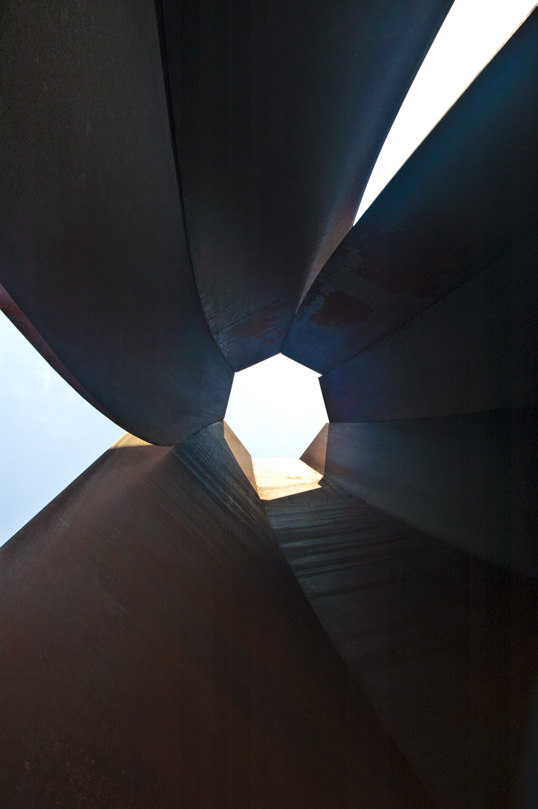
inside of:
Vortex
Richard Serra
Modern Art Museum of Fort Worth
“Anybody can look at a pretty girl and see a pretty girl. An artist can look at a pretty girl and see the old woman she will become. A better artist can look at an old woman and see the pretty girl that she used to be. But a great artist–a master–and that is what Auguste Rodin was–can look at an old woman, portray her exactly as she is . . . and force the viewer to see the pretty girl she used to be . . . and more than that, he can make anyone with the sensitivity of an armadillo, or even you, see that this lovely young girl is still alive, not old and ugly at all, but simply prisoned inside her ruined body.”
—-Robert A. Heinlein, Stranger in a Strange Land

Modern Art Museum of Fort Worth
“…and then, I have nature and art and poetry, and if that is not enough, what is enough?”
― Vincent van Gogh

Vortex
Richard Serra
Modern Art Museum of Fort Worth
“To photograph people is to violate them, by seeing them as they never see themselves, by having knowledge of them that they can never have; it turns people into objects that can be symbolically possessed. Just as a camera is a sublimation of the gun, to photograph someone is a subliminal murder – a soft murder, appropriate to a sad, frightened time.”
― Susan Sontag, On Photography

Modern Art Museum of Fort Worth
Fort Worth, Texas
The last two years, for the month of June, I wrote about a short story that was available online each day of the month… you can see the list for 2014 and 2015 in the comments for this page. It seemed like a good idea at the time. My blog readership fell precipitously and nobody seemed to give a damn about what I was doing – which was a surprising amount of work.
Because of this result, I’m going to do it again this year.
Today’s story, for day thirty – The Omnibus, by Arthur Quiller-Couch
Read it online here:
Now we come to the last short story of the month…. I still have a massive list of stories – of course I will still read. I do try to average a short story a day and have for most of my life. That’s a lot of stories. So much to read, so little time.
I’ll still write about the ones that seem to have special meaning for me, personally, like A&P or Life After High School. I do need to put together a permanent page with links to all the short stories – weed out the ones that are no longer available online. Otherwise, that’s it ’til next June… I guess.
Today’s story Omnibus is a familiar scene to all of us that ride public transport regularly. In the story it’s a vehicle pulled by horses – but it’s all the same whether it’s this or an electric train, a diesel bus, or a jet plane. Somebody gets on in obvious emotional turmoil… everyone knows they should do something, say something, offer help… but it is rare that the connection is made.
Public places are sometimes the hardest to actually relate to the public.
The last line of the story used the term Whittingtons. I had no idea what that meant. After some research – I think it refers to Richard Whittington and the legend that grew around him – Dick Whittington and His Cat.
The last two years, for the month of June, I wrote about a short story that was available online each day of the month… you can see the list for 2014 and 2015 in the comments for this page. It seemed like a good idea at the time. My blog readership fell precipitously and nobody seemed to give a damn about what I was doing – which was a surprising amount of work.
Because of this result, I’m going to do it again this year.
Today’s story, for day xx – The Untold Lie, by Sherwood Anderson
Read it online here:
“The mass of men lead lives of quiet desperation. What is called resignation is confirmed desperation. From the desperate city you go into the desperate country, and have to console yourself with the bravery of minks and muskrats. A stereotyped but unconscious despair is concealed even under what are called the games and amusements of mankind. There is no play in them, for this comes after work. But it is a characteristic of wisdom not to do desperate things.”
—- Henry David Thoreau, Walden
Today’s story is a chapter from Sherwood Anderson’s longer work – a short story cycle, Winesburg, Ohio.
It’s a tale of quiet desperation from two men – one that has earned it and one that hasn’t. There is an amazing scene early on – a flashback of sorts – of how the father of one of the two died.
When the train struck and killed him and his two horses a farmer and his wife who were driving home along a nearby road saw the accident. They said that old Windpeter stood upon the seat of his wagon, raving and swearing at the onrushing locomotive, and that he fairly screamed with delight when the team, maddened by his incessant slashing at them, rushed straight ahead to certain death. Boys like young George Willard and Seth Richmond will remember the incident quite vividly because, although everyone in our town said that the old man would go straight to hell and that the community was better off without him, they had a secret conviction that he knew what he was doing and admired his foolish courage. Most boys have seasons of wishing they could die gloriously instead of just being grocery clerks and going on with their humdrum lives.
Though the time, setting, and overall tone could not be more different, it reminds me somehow of Updike’s A&P – how easy it is to fall into habits and how little decisions can reverberate through time, to the end of life.
In the end, the story does not say who is right and who is wrong – it does not dare to take sides concerning what is the correct road taken. The title says it all – no matter what decision is made, no matter what advice is given – it will be… everything is lies.
The last two years, for the month of June, I wrote about a short story that was available online each day of the month… you can see the list for 2014 and 2015 in the comments for this page. It seemed like a good idea at the time. My blog readership fell precipitously and nobody seemed to give a damn about what I was doing – which was a surprising amount of work.
Because of this result, I’m going to do it again this year.
Today’s story, for day twenty eight – The Destructors, by Graham Greene
Read it online here:
I looked up, read, and used today’s story The Destructors by Graham Greene for one reason… it’s mentioned in Donnie Darko. What better reason can there be?
There would be headlines in the papers. Even the grown-up gangs who ran the betting at the all-in wrestling and the barrow-boys would hear with respect of how Old Misery’s house had been destroyed. Driven by the pure, simple, and altruistic ambition of fame for the gang, Blackie came back to where T. stood in the shadow of Misery’s wall.
T. was giving his orders with decision: It was as though this plan had been with him all his life, pondered through the seasons, now in his fifteenth year crystallized with the pain of puberty.
The first important thing to think about in this story is that it isn’t called “The Destroyers” but “The Destructors.”
Read through modern eyes, the actions of the gang are horrible and wasteful. But think about the area around Old Misery’s house – it was destroyed by the blitz. These young boys are raised in the quick aftermath of destruction – and are given an opportunity to do one better than the random violence of war.
And then, in the most haunting part of the story, there’s another passage that reminds me of a modern pop-fiction film reference. The boys come across Old Misery’s life savings, but they don’t steal anything, they burn. Like The Joker in The Dark Knight – they just want to watch the world burn.
“We aren’t thieves,” T. said. “Nobody’s going to steal anything from this house. I kept these for you and me—a celebration.” He knelt down on the floor and counted them out—there were seventy in all. “We’ll burn them,” he said, “one by one,” and taking it in turns they held a note upward and lit the top corner, so that the flame burnt slowly toward their fingers. The gray ash floated above them and fell on their heads like age. “I’d like to see Old Misery’s face when we are through,” T. said.
“You hate him a lot?” Blackie asked.
“Of course I don’t hate him,” T. said. “There’d be no fun if I hated him.” The last burning note illuminated his brooding face. “All this hate and love,” he said, “it’s soft, it’s hooey. There’s only things, Blackie,” and he looked round the room crowded with the unfamiliar shadows of half things, broken things, former things. “I’ll race you home, Blackie,” he said
The last two years, for the month of June, I wrote about a short story that was available online each day of the month… you can see the list for 2014 and 2015 in the comments for this page. It seemed like a good idea at the time. My blog readership fell precipitously and nobody seemed to give a damn about what I was doing – which was a surprising amount of work.
Because of this result, I’m going to do it again this year.
Today’s story, for day twenty seven – The Boarded Window, by Ambrose Bierce
Read it online here:
Ambrose Bierce… I guess you can say is a witty writer. Born in a log cabin – like the one in today’s story – all his life he was a sardonic observer of society and the human condition. I know him from the story An Occurrence at Owl Creek Bridge and his odd and bitter lexicon The Devil’s Dictionary. He published extensive fiction and journalism – always at the center of controversy because of his biting satire. Although the details are fuzzy – he died, probably in front of a firing squad, in Mexico while following Pancho Villa and his army.
Today’s selection is a typical tale – the language is a bit stilted and old – but there is surprising complexity in the way it is told. For example, take a close look at how the narration jumps around in time and how different sources are used – without changing the point of view. It gives a subtle indication of an unreliable narrator and the impression that everything is not quite what it seems.
The little log house, with its chimney of sticks, its roof of warping clapboards weighted with traversing poles and its “chinking” of clay, had a single door and, directly opposite, a window. The latter, however, was boarded up–nobody could remember a time when it was not. And none knew why it was so closed; certainly not because of the occupant’s dislike of light and air, for on those rare occasions when a hunter had passed that lonely spot the recluse had commonly been seen sunning himself on his doorstep if heaven had provided sunshine for his need. I fancy there are few persons living today who ever knew the secret of that window, but I am one, as you shall see.
And then, at the end, the twist ending. Not too surprising, nothing you don’t see… but that doesn’t lessen the impact, does it.
 Bill Chance