Daily Writing Tip 38 of 100, Eat the Mountain

For one hundred days, I’m going to post a writing tip each day. I have a whole bookshelf full of writing books and I want to do some reading and increased studying of this valuable resource. This will help me keep track of anything I’ve learned, and help motivate me to keep going. If anyone has a favorite tip of their own to add, contact me. I’d love to put it up here.

Today’s tip – Eat the Mountain

Source – Thunder and Lightning by Natalie Goldberg

A writer’s path includes concentration, slowing down, commitment, awareness, loneliness, faith, a breakdown of ordinary perceptions – the same qualities attributed to monks or Zen masters. Writers practice for literature and for the illusory victory of publication, while monks prepare for enlightenment, which is nothing less than ego’s great disappointment.

After another exhausted after-work evening staring at the blank page I think about what writing is. At the end, it’s simply pushing the keys. Sometimes, though, they are so hard to push.

I Kept My Tune

“So I went ahead and made me a guitar. I got me a cigar box, I cut me a round hole in the middle of it, take me a little piece of plank, nailed it onto that cigar box, and I got me some screen wire and I made me a bridge back there and raised it up high enough that it would sound inside that little box, and got me a tune out of it. I kept my tune and I played from then on.”
― Lightnin’ Hopkins

Denton, Texas

Denton, Texas

Daily Writing Tip 37 of 100, Start Where You Are

For one hundred days, I’m going to post a writing tip each day. I have a whole bookshelf full of writing books and I want to do some reading and increased studying of this valuable resource. This will help me keep track of anything I’ve learned, and help motivate me to keep going. If anyone has a favorite tip of their own to add, contact me. I’d love to put it up here.

Today’s tip – Start Where You Are

Source – From The 90-Day Novel by Alan Watt

Our job as artists is to build a body of work. When we drop our preconceptions about what good writing is and we give ourselves permission to write poorly, everything changes. Permission to write poorly does not produce poor writing, but its opposite. We become a channel for the story that wants to be told through us. Rather than impressing our reader with our important writing, we can impress with our willingness to be truthful on the page.

Killing off the inner editor while writing a first draft is the second hardest thing in writing fiction.

The hardest thing is bringing him back to life when the editing begins – which is the real place where writing takes place.

Old Frogs Command the Dark

“Come come! Come Out!
From bogs old frogs command the dark
and look…the stars”
― Kikaku, Japanese Haiku

Dallas, Texas

Dallas, Texas

Daily Writing Tip 36 of 100, Don’t Warm Up Your Engines

For one hundred days, I’m going to post a writing tip each day. I have a whole bookshelf full of writing books and I want to do some reading and increased studying of this valuable resource. This will help me keep track of anything I’ve learned, and help motivate me to keep going. If anyone has a favorite tip of their own to add, contact me. I’d love to put it up here.

Today’s tip – Don’t Warm Up Your Engines

Source – The 38 Most Common Fiction Writing Mistakes by Jack Bickham

Such static or backward-looking approaches to fiction are probably lethal in a novel, and are certainly fatal in a modern short story. Readers today – and that of course includes editors who will buy or reject your work – are more impatient than ever before. They will not abide a story that begins with the author warming up his engines. If a setting needs to be described, it can be described later, after you have gotten the story started. If background must be given the reader, it can be given later, after you have intrigued him with the present action of the story.

Back in the day, classic literature didn’t have to do that. You remember the tomes you read in school that would spend page after page on backstory and description before anything remotely interesting would happen.

I used to pride myself on getting through this. It was true that the payoff at the end was usually worth the work up front.

But now I’m getting too old. I don’t have enough time left for all this. I used to always finish every book I started. Now, though, if I’m not into it within the first few pages – that’s all she wrote.

Advice From Experts

Here’s some simple advice:
Always be yourself,
Never take yourself too seriously.

And beware of advice from experts,
Pigs and members of Parliament.
—-Kermit the Frog

Denton, Texas (click to enlarge)

Denton, Texas
(click to enlarge)

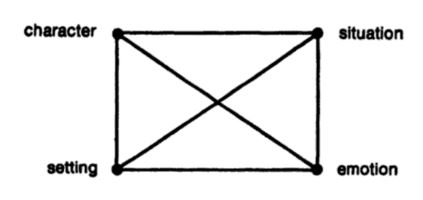
Daily Writing Tip 35 of 100, The Quadrangle: Character, Setting, Situation, Emotion

For one hundred days, I’m going to post a writing tip each day. I have a whole bookshelf full of writing books and I want to do some reading and increased studying of this valuable resource. This will help me keep track of anything I’ve learned, and help motivate me to keep going. If anyone has a favorite tip of their own to add, contact me. I’d love to put it up here.

Today’s tip – The Quadrangle: Character, Setting, Situation, Emotion

Source – Creating Short Fiction by Damon Knight

quad

This time, let’s say, you’re thinking about an orphan who has found a loaded revolver in a garbage can. That’s an intriguing situation, but you have no idea where to go from there.

Try making a list of four things the orphan might do next. If you write down the first four things you think of, maybe they come out something like this:

  • Hold up a liquor store
  • Kill somebody
  • Kill himself
  • Throw the gun away

Now cross out all four. Think of the fifth solution, the one that is not obvious.

Suppose your fifth solution is:

  • Give it to somebody

All right, to whom dies he give it? Out of the silent half of your mind an image swims up: a woman who is being abused by her husband.

Now you have a sense of what the emotional charge of the story will be. (If you don’t feel any strong emotion about this ending, it’s the wrong one; find a sixth solution, or a seventh.)

I like the idea of throwing out the first four, or more, obvious ideas to try and find the one, true story.

Show’N Tell

“Don’t tell me the moon is shining; show me the glint of light on broken glass.”
― Anton Chekhov

Store Window Denton, Texas (click to enlarge)

Store Window
Denton, Texas
(click to enlarge)

Daily Writing Tip 34 of 100, The Open-ended Writing Process

For one hundred days, I’m going to post a writing tip each day. I have a whole bookshelf full of writing books and I want to do some reading and increased studying of this valuable resource. This will help me keep track of anything I’ve learned, and help motivate me to keep going. If anyone has a favorite tip of their own to add, contact me. I’d love to put it up here.

Today’s tip – The Open-ended Writing Process

Source – Writing With Power by Peter Elbow

The open-ended writing process is at the opposite extreme from the direct writing process. It is a way to bring to birth an unknown, unthought-of piece of writing-a piece of writing that is not yet in you. It is a technique for thinking, seeing, and feeling new things. This process invites maximum chaos and disorientation. You have to be willing to nurse something through many stages over a long period of time and to put up with not knowing where you are going. Thus it is a process that can change you, not just your words.
***
To begin the sea voyage, do a nonstop freewriting that starts from wherever you happen to be. Mosyt often you just start with a thought or a feeling or a memory that seems for some reason important to you. But perhaps you have something in mind for a possible piece of writing: perhaps you have some ideas for an essay; or certain characters or event are getting ready to make a story. You can also start by describing what you wish you could end up with. Realize of course that you probably won’t. Just start writing
***
Keep writing for at least ten or twenty or thirty minutes, depending on how much material and energy you come up with. You have to write long enough to get tired and get past what’s on the top of your mind. But not so long that you start pausing in the midst of your writing.
Then stop, sit back, be quiet, and bring all that writing to a point. That is, by reading back or just thinking back over it, find the center or focus or point of those words and write it down in a sentence.
***
Now repeat the cycle.

What great advice!

Sometimes I write a story with the entire thing preplanned in my mind (or in an outline on paper) and sometimes I start out staring at that blank page with no idea where I’m going. I have to admit, the unknown voyage, for me, usually ends up stranded on the rocks somewhere, taking on water fast – about to sink. I like how this teacher seems to systematize the usystemic – to organize the chaos.

I like the idea of, “start by describing what you wish you could end up with.” Of course the next sentence is frightening.

I’m going to have to study his technique and see how it works for me. At any rate, it will give me a dollop of badly-needed confidence.

Maybe you would want to do the same.

Tabasco and Log Cabin

“I’ve long believed that good food, good eating, is all about risk. Whether we’re talking about unpasteurized Stilton, raw oysters or working for organized crime ‘associates,’ food, for me, has always been an adventure”
― Anthony Bourdain, Kitchen Confidential: Adventures in the Culinary Underbelly

Dix Coney Island Denton, Texas (click to enlarge)

Dix Coney Island
Denton, Texas
(click to enlarge)

Dix Coney Island