Melancholia

I usually struggle when writing about film to find something useful to write about without giving too much of the movie away. I have stopped watching or reading film reviews (before I see a film) at all – they all take the surprise away. I want to be stunned, if possible.

No such problem with Melancholia – the movie itself tells you the ending in the first few minutes. The director has said he doesn’t want there to be any suspense. He wants everyone to know how the movie ends. It ends with the destruction of the earth.

Since I don’t read film reviews any more I had never heard of Melancholia, even though I have been a semi-fan of the controversial and provocative director Lars von Trier for many years. It came on cable with an irresistible summary – “A woman’s troubled relationship with her sister is complicated by the appearance of a mysterious planet on a collision course with earth.” How could anyone resist a film like that?

The movie is divided into two chapters – each one named after one of the sisters. The first is “Justine” – and it concerns the events surrounding Justine’s (played by Kirsten Dunst) wedding reception. It’s a fancy, expensive affair, paid for by her sister’s fabulously wealthy brother-in-law John (Keifer Sutherland), and put together by a strange wedding planner (Udo Keir – he keeps walking by with his hand in front of his face to keep from looking at the bride – she has ruined “his wedding”). There’s the incredibly bitter mother (Charlotte Rampling), the asshole boss (Stellan Skarsgård), and plenty of other colorful characters.

The driving force, however, is Justine’s depression. She is crippled by melancholia to the extent that she often can’t even move. Lars von Trier has said that the movie was inspired by his own bouts with depression which make it impossible for him to work. Justine tries to put on a happy face at her own wedding celebration and to appreciate her husband, but it’s all hopeless. She is doomed.

Kirsten Dunst gives an amazing performance of a woman destroyed by depression, drowning in sadness so deep it can’t be swept away. It is painful to watch, but feels true to life – she helps us understand how she feels and how hopeless it all is.

The second chapter is titled “Claire” and the focus shifts to Justine’s sister as the mysterious planet, ironically named Melancholia appears and skims by the earth. Claire is played by Charlotte Gainsbourg, the daughter of Jane Birkin and Serge Gainsbourg – and has already had a long influential career in film, music, and fashion. As the doom earth is about to suffer become more and more obvious the roles of Claire and Justine become reversed.

The ultimate irony of Melancholia is that suffering from crippling depression makes you surprisingly equipped to deal with the end of the world.

So that’s the story of the film. Depressed woman finds out that reality is even worse than what she feared and then everybody dies.

Obviously, this isn’t a tale for everybody. At times it is maddeningly slow, and the lack of hope takes away the suspense that usually feeds a moviegoer’s hunger for entertainment. However, there is a strange beauty in doom, especially cinematic doom, and once the curtain comes down our little blue planet is still spinning out there. There really isn’t a giant killer planet lurking on the other side of the sun and we can take a little joy out of that.

I was surprisingly buoyed by Justine’s struggle (and Dunst’s performance) and her doom will, ultimately, be shared by us all – it’s only a matter of timing. She was able to muster up a little dignity at the end, and that might be enough.


Tampopo

Do you have a recipe that requires egg yolks? This provocative scene from Tampopo is one hell of a way to separate an egg.

It was early afternoon and I was down in East Dallas, overheated and very hungry. As I contemplated the twists of neighborhood streets and grids of avenues I tried to think of someplace to get something to eat… something good, quick, cheap, interesting, on the way home, and, preferably, someplace I’ve never been to before.

One word popped into my dehydrated and sun-frazzled brain – Tampopo.

Tampopo, on Greenville Avenue in Dallas

Tampopo is a bright humble-looking little Japanese café on Greenville Avenue – just south of Northwest Highway (on my way home). I had heard of it, driven by it, but never actually stopped there. Its name (Japanese for Dandelion) has always fascinated me, because it is also the name of one of my absolute favorite films.

Tampopo (the movie) is an odd lark of a film, a Japanese comedy loosely modeled after a Clint Eastwood Western yet set in a Ramen Shop run by a young widow named Tampopo. It is a wondrous wandering mess of a movie – jumping around in tone and sliding sideways into odd set pieces that have very little to do with the main story….

Except they are all about food. Tampopo is struggling with her third-rate Ramen shop until a macho truck driver and his sidekick come along and end up devoting their skill and energy into creating the perfect ramen. It is greatness.

The movie is very difficult to see in the United States. I had to jump through some hoops to get a copy of a DVD and it is one of my prized possessions.

So, I stopped in at Tampopo (the restaurant) and ordered some Beef Udon soup. I was a little disappointed they didn’t offer Ramen – but I’m a bit of an Udon man myself anyway. It was good and a nice treat on a hot day.

My Beef Udon Soup. Unfortunately, I had a telephoto and couldn’t get the soup in focus… but you get the idea.


.

Moonrise Kingdom

Suzy, dressed as a raven, in Moonrise Kingdom.

I very rarely get out to see an actual movie at an actual theatre any more. The biggest reason is that I hate going out to the suburban googleplex with everybody else and paying all that cash for an experience much worse than I can get at home on the HDTV.

One exception, though. Back in the day, back when I still had a life, I used to really enjoy going down to the Angelika on Mockingbird Lane. I would take the DART train down there on the weekend – sometimes not even knowing what I was going to see – and pick one of the offerings from the selection of art-house films. There is a little restaurant attached and sometimes I’d get pot stickers or something else simple to eat – make a leisurely afternoon of it.

There was none of the cattle-car feeling of the googleplex – none of the packs of loud, tittering teenagers, blaring lights and sounds of video games or awful garish food displays… I like the architecture of the Angelika – the open areas with little tables and chairs, the little stands with postcards and literature about the upcoming features – the classic old movie posters. It is a place designed to show a film, not corral huge herds of the faceless public into chutes and strip them of their cash.

There are now a whole set of theaters dedicated to art-house quality cinema in the Metroplex – the two Angelikas, The Magnolia, and the Inwood – to name a few. I love the Inwood especially, but it is a long difficult drive from where I live.

Often, when I look at the list of first run films at the googleplex I can’t find a single one I’m really interested in seeing. Today, when I thought of going down to the Angelika, it was tough to decide which one to see – there was Killer Joe – which looks good, but I wasn’t in the mood for NC-17 today… then there was Beasts of the Southern Wild, set in South Louisiana, but again, maybe too intense for a lazy early Sunday. They are showing a classic, The Graduate, and that would be good… but I’ve seen that film, maybe ten times already.

So I decided on the low-intensity alternative, Wes Anderson’s newest, Moonrise Kingdom. I have enjoyed almost all of his work (not a big fan of the animated film, that Mr. Fox thing) – though his highly mannered style can be a bit shrill at times.

I loved Moonrise Kingdom, by the way. The test for a work with a unique and personal style like Anderson’s is a simple one for me – do I care about his characters? Some of his work is so precious and so complex that the people at the center of the story are lost – and at the end you are left with an empty feeling. A lot of sound and fury, signifying nothing. Moonrise Kingdom is a simply story, however (which I will not discuss – no spoilers here) and the two main characters are sympathetic and easy to relate to. All the messy complexities of a Wes Anderson film are present, but these are played out by the large and familiar supporting cast, and don’t take away from the main conflict at the center.

Strip away all the Wes Anderson shiny trappings and odd eccentricities and it is simply a strange little love story.

When the film ended I thought, “Hey, that was better than I expected,” which is high praise, indeed.

Now I want to go back and see some of those others.

A Nasty Little Piece of Work

When I was a kid, I saw a lot of movies. The military bases all had a discount theater showing second-run films – though I didn’t know they were second-run at the time. Back in those days, we didn’t have the access to instant information and I didn’t know about films when they were released. So I would go to the base theater maybe three times a week, a quarter clutched in my paw, to see whatever was showing. I was pretty much an adult before I realized they didn’t play the Star-Spangled Banner (and everyone stand) before every movie. The rating system wasn’t really up to speed either, so it was pretty much hit and miss.

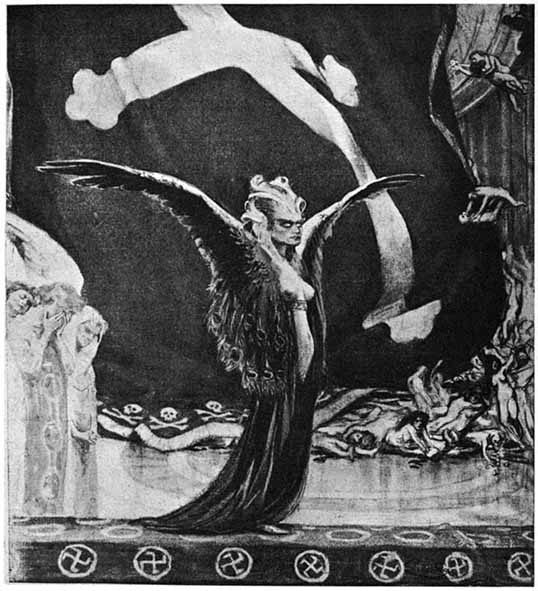
So I saw that they were going to show a movie called The Conqueror Worm. I would have been eleven or twelve. By that time I had read all of Edgar Allen Poe’s work and was familiar with the poem.

The Conqueror Worm, illustration by Frantisek Kupka

The Conqueror Worm – Edgar Allen Poe

  • LO! ‘t is a gala night
  • Within the lonesome latter years.
  • An angel throng, bewinged, bedight
  • In veils, and drowned in tears,
  • Sit in a theatre to see
  • A play of hopes and fears,
  • While the orchestra breathes fitfully
  • The music of the spheres.
  • Mimes, in the form of God on high,
  • Mutter and mumble low,
  • And hither and thither fly;
  • Mere puppets they, who come and go
  • At bidding of vast formless things
  • That shift the scenery to and fro,
  • Flapping from out their condor wings
  • Invisible Woe.
  • That motley drama—oh, be sure
  • It shall not be forgot!
  • With its Phantom chased for evermore
  • By a crowd that seize it not,
  • Through a circle that ever returneth in
  • To the self-same spot;
  • And much of Madness, and more of Sin,
  • And Horror the soul of the plot.
  • But see amid the mimic rout
  • A crawling shape intrude:
  • A blood-red thing that writhes from out
  • The scenic solitude!
  • It writhes—it writhes!—with mortal pangs
  • The mimes become its food,
  • And over each quivering form
  • In human gore imbued.
  • Out—out are the lights—out all!
  • And over each quivering form
  • The curtain, a funeral pall,
  • Comes down with the rush of a storm,
  • While the angels, all pallid and wan,
  • Uprising, unveiling, affirm
  • That the play is the tragedy, “Man,”
  • And its hero, the Conqueror Worm.

Oh yeah, that’s the stuff pre-teens should be reading, classic literature. It’s a miracle I ever went to sleep.

At any rate, I went to see the movie and was a bit disappointed to find out it had nothing to do with the poem or Poe in any way. It was a British production called Witchfinder General, staring Vincent Price. The title was changed and a tiny bit of Price narration at the beginning and end were tacked on to make a slim connection with American International’s string of cheap Poe pictures, directed by Roger Corman and starring Vincent Price. Those movies were campy, almost funny, spoofs of the horror genre. I had seen them already.

What I saw that day was something completely different. It was horrifying.

It’s over forty years later and I still remember most of that film. I remember the opening where the man is building the gallows out in the English Countryside. The basic plot (such as it is), the torture scenes, and the bleak hopeless ending all stuck with me, hanging on from my impressionable youth.

The film pretty much disappeared from existence. There were some bad, grainy, cut VHS transfers, a German version (with added nudity), and various versions here and there, but the original Witchfinder General was out of my reach. I did read about the film, and learn some of its history.

It was directed by Michael Reeves, a promising young director that had a bright future. For now, though, he was making low budget horror films. For Witchfinder General he wanted Donald Pleasance, but the studio insisted on Vincent Price. He thought Price was too broad and hammy and fought to get him to moderate his performance.

The story is that Price hated this and finally bellowed, “I have made eighty four films, what have you done?”

Reeves replied, “I have made two good ones.”

Later, once the film came out, Price understood what Reeves had wanted and went on to acknowledge that it was his best performance – full of quiet, understated evil.

The film received terrible reviews in England. It was considered grotesque. Playwright Alan Bennett said it was “the most persistently sadistic and morally rotten film I have seen. It was a degrading experience by which I mean it made me feel dirty.” In the United States, however, the critics mostly ignored the film and it went on to modest success (no doubt aided by hordes of underaged Poe-reading moviegoers).

Not only was it Vincent Price’s best performance but it was Micael Reeves’ masterpiece. He died at the age of twenty five of a barbituate overdose a few months after the movie’s release.

After discovering this and other juicy details in the intervening decades since I saw the thing, I was filled with a dark desire to see it again. I was glad when a newly restored version showed up on the Netflix Instant Queue. And it was pretty much as I remembered it. A nasty little piece of work.

It did have a surprisingly pleasant soundtrack. The “love theme” is a good example of lush classical music for film.

The movie is a simple story of Matthew Hopkins, a self-appointed Witchfinder General that roamed the countryside during the war between Cromwell and the Royalists. He would torture and execute witches for a fee – and he was good at his job. The hero of the story is a soldier who is in love with a beautiful young woman that falls into the Witchfinder’s clutches.

Most of the graphic horror is in the methods used to determine if the subject is a witch. For your education, here is a little documentary that shows the real historical methods of detecting witchcraft.

Since rewatching Witchfinder General/The Conqueror Worm, I had been thinking about the reaction to the film. It is a horror film, and maybe a tad graphic for its time – but it isn’t anything like a modern Saw or Chainsaw Massacre – though it shows a lot, at the most horrible instants, the camera cuts away. It is nowhere near as graphic as it seems to be, or as its reputation suggests.

It didn’t take much thought to realize the reason. Most horror films (even modern ones) have moments of humor, or reduced tension, or even winking at the camera. They have built in mechanisms to release the tension during the film. Witchfinder General does not do that. It is relentless. It presents an entire world – historically accurate, it talks about the anarchy that reined during the English Civil War – without rules, without mercy, without hope. The gorgeously filmed countryside is populated with evil men preying on the population’s fear, greed, and base desire for blood. There is madness loose in the world and there is no hope in resisting its inevitable victory, one way or another.

That is why the movie is so horrible and horribly effective at what it does.

BFI Screenonline – Witchfinder General (1968)

Michel Reeves: Witchfinder General

1968 New York Times Review of Conqueror Worm

Trailers from Hell – Witchfinder General/Conqueror Worm

Film Review The Conqueror Worm (1968)

The Conqueror Worm / Witchfinder General / Matthew Hopkins, Witchfinder General (1968) ***½

Kelsey Gunn – Wasting your time, but not very much

http://vimeo.com/35175220

As I scoured the depths of YouTube for bits of amusement to stick into my one per week “lazy entry” that I call, “what I learned this week” I kept stumbling across these little jewels of odd humor done by the folks at 5 Second Films. These were only eight seconds long (the three second title sequence doesn’t count) and would cram more story, characterization, and humor into those tiny slices of time than any SNL sketch.

As I watched and collected the ones I liked, I noticed that the same actress kept showing up in my favorites. She was always referred to as “Kelsey” and it wasn’t hard to figure out that she was Kelsey Gunn.

So I have become a fan. Why? I don’t know – she is funny, of course, and has that nerd-girl pretty quality. So now I’m subscribed to her on Facebook and watch her Vimeo Channel and  follow her on Twitter and watch her 5 Second Films, and See what she’s up to on IMDB (She’s Actually Kelsey Gunn (II))

Will Kelsey Gunn ever become famous and win Oscars and stuff? Is Batman a Transvestite? Who knows?

Oh, here she is at 2:16 in  “Meter Maids” – I’m not too sure about her Southern Redneck accent (but then again, I am a cono-sewer of the type) but the “Sexy Dance” is up there.

WordPress Blogs:

5 Second Films: Wasting Your Time, But Not as Much as This Article

Forget The Lengthy Summer Blockbusters. Michael Rousselet Talks To Kevin & Bean About 5-Second Films

The Joy of 5 Second Films

5 Second Film’s “Another Spider”, w/ the 5SF debut of Juliette Lewis

5-Second Films With Patton Oswalt        –      Part Two

Favorite YouTubers

5 Second Films Compilation

5×20 Seconds of Fun

Sweet Gender Divide Bro

Blue Valentine

All my life, movies have been very important to me. I have always enjoyed watching them, going to the theater, sitting there in the dark and waiting for the curtains to rise on a whole ‘nother world.

In this modern digital age, in this best of all possible worlds, we now have such access to film – at any time, in any place, we can watch anything we want. The entire world and history of cinema is available in forms that weren’t even imaginable only a decade ago.

But I don’t ever seem to have the time to sit down and watch anything.

The other evening, I had a lot to do. I had promises to keep and miles to go before I sleep. But I was still sick, tired, and worn out… so I decided to go lay down, turn on the cable, and watch whatever came up.

What came up was Blue Valentine.

It was crackerjack.

It’s a character driven story of a young couple, played by Michelle Williams and Ryan Gosling. It jumps in time from the very beginning of their relationship to a point in time six years later when everything is on the rocks. They are both deeply flawed, working class people, who come from disastrously dysfunctional backgrounds and you can feel the fear and effort as they fight to raise themselves out of the doom that they have forseen.

Michelle Williams won a golden globe the other night… but I always think of her as the teenager in The Station Agent. She is a revelation in this movie – when she says she wants to be a doctor you wan to believe that is a possibility. Ryan Gosling is a wiry drunk with bad tattoos and a heart of gold. The transformation of the two from the scenes that represent the early stages of their relationship to the end is amazing – they seem to age a century in six years. Her face gets puffy and his gaunt, as the hope is slowly drained from their lives.

The movie was initially rated NC-17 – and there is a lot of rawness to the film, including the sex scenes. These have to be in the movie, though, the story is told through the sex as much as through the dialog.

After I watched it I wandered the web for a bit reading what other folks thought. The funny thing was how many people took sides – with one of the couple or the other. They couldn’t understand why the couple was having so much trouble making it work and were fishing around for someone to blame. Neither character had any idea how to behave and would, at any moment, make the wrong decision. They had no way to learn… other than to plow ahead as best as they could. There is a lot left unseen in the film, a lot must have gone down in the six years between… and the film treats us to the wreckage crashing down around the couple’s heads.

Both were decent people, inside. They are just like us.

I don’t want to give away any spoilers. The two timelines of the movie scream toward each other until we are witness to the final epiphany. Will the two lovers conquer all and march into the sunset arm and arm – damaged but hopeful? Or is all hope lost?

The characters are fatally flawed, but aren’t we all?

WordPress Blogs with entries tagged Blue Valentine:

Why So Blue?

Blue Valentine {My Thoughts}

Blue Valentine Review

Things the Chin Likes or maybe loves – this movie

Film: Blue Valentine

Blue Valentine

Scene: Blue Valentine – Motel Dance

My Very Own Blue Valentine 

Jig

I remember the first time I saw Riverdance on television, many years ago. I was channel surfing and stumbled across some random show on PBS. There was this line of people standing stick-straight with their arms stiffly at their sides, hopping up and down in a strange complex way. I knew nothing of Irish Dancing or anything else. My thought at the time was, unfortunately, “Uh-Oh, White People Dancing, this can’t turn out well.” Over time, I did learn better.

This new year has started, as do so many, with me getting sick. My careful resolutions have been thrown out already in a flood of virus induced respiratory difficulties. I actually don’t feel so bad, but I can’t stop coughing and if I can’t stop coughing, I can’t sleep. I missed a half-day of work, only the third time I’ve left work sick in thirty years (and the other two I was blind which I considered a good excuse). This time I was so tired I was scared I was going to make a mistake and somebody would get hurt.

So the other night I crept out from my room to sit up on the couch, swigging from a bottle of vile green liquid, and watching a bit of Teevee until I was exhausted enough to try and go back to bed. There was this movie on, a documentary, a film by Sue Bourne called Jig. It was fascinating enough that I hit the DVR record button so I could watch it the next day, with my head on more or less straight.

Jig is about the world of competitive Irish Dancing. At first, it’s a little disturbing – with the wigs and elaborate costumes on the little girls it has a “Toddlers and Tiaras” vibe going on. But it doesn’t take long to realize that these kids are learning to do something special. Every one of them is driven by the dance itself. They are going all over the world to compete… and they want to win, but what they really want to do is dance. They want to dance as well as they are capable of.

And that is something to enjoy and respect.

One important part of the film that I recognize is the dedication of the parents to the aspirations of their children. I’ve spent a lot of time and money on stuff like that, especially kids’ soccer. Thousands of dollars and tens of thousands of hours on practice, travel, tournaments. It’s easy to ask what do you really get out of something like that. It doesn’t matter. There is no choice… you do what you need to do.

In the documentary one father gives up his lucrative doctor’s practice in the States to move to England so his son can get better instruction in the dance. His son, Joe Bitter talks about his set dance. He says that it is so difficult that if he dances it cleanly it will be the best dance ever done.

The dancers… the kids handle the pressure pretty well, but man, take a look at the mother’s face in this clip while she’s watching her daughter dance. It’s the hardest thing you’ll ever do.

Any closed world like that of competitive Irish Dancing seems odd at first sight. But, sitting there on my couch like Jabba the Hut, coughing, I could not help but tip my hat to those kids and all their dedication and hard work. If you look closely and fairly you can see that they are trying to fly and coming a lot closer than any of us.

Irish Dancing Blogs

Between the Folds

The second floor of the Crow Collection of Asian Art is separated into two galleries. These are connected by a glassed-in passageway that stretches above the fountains and stairs below. For the last few years this passage was filled with hundreds of tiny origami cranes made by schoolchildren and hung in a folded paper cloud. I really liked this and was not happy to find that it was taken down. I have no idea if they are going to repeat the installation.

Origami Cranes at the Crow Collection of Asian Art

I wanted to ride my recumbent for some exercise but didn’t have much time. So I looked around the web for a video to watch… one that offered some interest but that wasn’t too long. Documentaries sort of meet this requirement so I found one on streaming Netflix called Between the Folds. It was a PBS film about Origami.

Other than the cranes in the Crow – and the time when Lee was about six and sent me out for a book on paper-folding – I never have thought about Origami, but the documentary was fascinating. There were artistic paper folders – from some that used thousands of folds to construct realistic sculptures to one guy that was trying to make the best work of art he could with only one fold. There were mathematicians interested in using the intersecting art and science of creased paper planes to illuminate secrets of the universe.

One of these guys, to be honest, grated on my nerves a little. He is Erik Demane and he is a second generation professor at MIT. He has that self-serving shit-eating grin that all those home-schooled, MIT genius grant winning, got my Ph.D. at twenty guys always have – or at least what they show on their PBS documentaries. He said something that really got under my skin. He talked about how he only did things that “Are Fun.” “If something isn’t fun it doesn’t interest me.”

That bugs me because I always feel that activities that are important are never “fun.” If in doubt between two courses of activities, the one that is “less fun” is always the correct one to choose. I’m not talking about relaxation or amusement or recreation – but neither was he. He was saying that he chose his life’s work based on what was “fun.” To me, that’s a waste of his rather tremendous potential.

But I can’t really be aggravated at the guy. After all he is a professor at MIT, amazing all the incoming freshman girls with his abilities to fold paper. I bet he plays the ukulele at cocktail parties. He has a good beard.

But most of all, I’m serious now, he posts one of his classes online. I have always wanted to take a math course at MIT and now I can. That looks like fun. I only wish I could find the time from all the other, important stuff I have to do.

Here's some origami I did. I'm working on a story and I decided to origami my draft. The design is called, "This is a bunch of crap."

Woman in the Dunes

When I was a child, I was always seeing, in small, sheltered areas of sand or loose dust, the cone-shaped depressions where ant lions lived. I was fascinated by these and looked them up in the encyclopedia (these were the decades long before the Internet – I can’t imagine how rich my childhood would have been had I access to that unlimited fount of useless knowledge) and learned of the insect hiding at the bottom of the self-constructed pit. These sand-traps had a strange fascination for me, I would seek them out and study their various sizes, locations, and patterns of distribution.

I never seem to see these anymore. I don’t know why?

For some reason, it was years before I ventured out to an ant lion pit with a simple sheet of typing paper and learned how easy it was to scoop up the sand and sift it off the paper in such a way as to expose the tiny, flat, gray, insect with the immense mandibles that hid at the bottom of the cone, waiting for unfortunate prey.

In looking for a movie to watch from the Criterion Collection I settled on, for no real reason, a strange Japanese work called Suna no Onna (literally “Sand Woman) – better known by its English name – Woman in the Dunes.

I had heard of this movie decades ago – but for the longest time, never was able to see it. You forget how hard it used to be… I’m talking before a thousand channels of cable television, before VHS even… to see obscure foreign films. You could read about them, and I did, but you could never actually see them.

I read the book, by Kōbō Abe, and wondered if the film followed it closely. Finally, about ten years ago, I was able to get a VHS copy at an avant-guard video store. I was very disappointed. The transfer was so bad all I could see was a blur. It really made no sense. I hoped the original was better than this horrible copy of a copy of a copy.

It is. The Criterion Collection edition they are streaming from Hulu+ is crisp and clear. Because of this, the black and white visuals of moving sand are awe-inspiring.

The story is a simple one. An entomologist, scouring a remote seaside area looking for the key beetle that will get his name immortalized into the entomology texts, and simply trying to escape the city for a awhile, is tricked into getting himself lowered by rope ladder into a deep well in the sand. At the bottom is a recently widowed woman (she lost her husband and daughter to a sand cave-in) who needs help it the nightly task of shoveling the sand out of her home.

The rope ladder is pulled up and he is trapped.

The movie is a long one, slow moving, and concentrates on the man’s slow realization of the hopelessness of his situation, of his eventual resignation to his fate, and on the complex evolving relationship between him and the woman. She has trapped him, but she was trapped herself, and really didn’t have any choice. She is terrified that he will leave.

I was young when I read the book. I didn’t realize how universal the man’s fate was. We’re all stuck in that well of sand and all we can do is shovel as fast and as hard as we can.

Ant Lion Pits

The Criterion Collection

I don’t know about any of you, but over the past year I have become less and less happy with the selection that Netflix has streaming online. More and more, I have been going over to Hulu+ which I began paying for a while back. I bought Hulu+ for the television shows. I have been so busy it has been almost impossible for me to sit down and watch an entire film, so I have been diving into the shallow pedestrian seas of TeeVee – both current and classic. Hulu has always been a good place for that. Hulu, however, doesn’t have the best interface in the world and I have been having trouble finding what I wanted.

So a month or so ago I sat down and did some work figuring out the site structure and how to find what I want. While doing this I discovered a staggering fact.

Hulu+, starting in February of 2011 started streaming the entire Criterion Collection of movies online. The entire collection.

More

More

More

So what? – you must be asking. What the hell is that? Criterion Collection? Who cares?

Criterion is a company that is dedicated to putting the best films of international cinema onto digital media (DVD, Blu-Ray, Streaming) and doing an amazingly bang-up job of it. Their catalog is up to somewhere around eight hundred films now, with more every day.

If you know me, having access to something like this, from my roku box on the television, to my laptop computers (Hulu+, unlike Netflix, will even work on Linux), to our Kindle Fire…. well, that’s like dumping a big ol’ pile of Heroin in my lap.

Where to start? Well, first off, I found the Criterion Selections after stumbling across a film, I’m embarrassed to say, I’ve been looking for for a while – In the Realm of the Senses. This Japanese film, banned in Japan, has a notorious reputation of being nothing more than high class pornography, with a horrendous, vile, and violent conclusion.

After actually watching the thing, I can report honestly, that the reputation is well earned. So, on to the next film.

What next? I have seen a lot of these over the decades and want to watch them again – but there are a lot that I have never seen… and a few I’ve never even heard of.

I can watch these great classic movies while I’m riding my exercise bicycle. Wait, let me get my list of New Year’s Resolutions out….

Here’s a list from Paste Magazine of ten recommended films, this looks good:

  • The Kid (1921)
  • George Washington (2000)
  • The Seven Samurai (1954)
  • La Jetée (1962) (source material for 12 Monkees)
  • Jules and Jim (1962)
  • The Blob (1958)
  • The 400 Blows (1959)
  • Wild Strawberries (1957)
  • M (1931)
  • The Vanishing (1988)

I’ve seen all but two of these… but it is a worthy list.

Here’s a recommendation for:

  • Knife in the Water (1962)
  • Lord of the Flies (1963)
  • Ratcatcher (1999)

This guy is blogging his way through the whole thing. So is this guy… and this guy too, and this guy.

So many films, so little time.

Any suggestions, please leave a comment.