What I learned this week – July 29, 2011

Pulp Cover

Gratuitous Pulp Paperback Cover


Kurt Vonnegut

Eight rules for writing fiction:

1. Use the time of a total stranger in such a way that he or she will not feel the time was wasted.

2. Give the reader at least one character he or she can root for.

3. Every character should want something, even if it is only a glass of water.

4. Every sentence must do one of two things — reveal character or advance the action.

5. Start as close to the end as possible.

6. Be a sadist. Now matter how sweet and innocent your leading characters, make awful things happen to them — in order that the reader may see what they are made of.

7. Write to please just one person. If you open a window and make love to the world, so to speak, your story will get pneumonia.

8. Give your readers as much information as possible as soon as possible. To heck with suspense. Readers should have such complete understanding of what is going on, where and why, that they could finish the story themselves, should cockroaches eat the last few pages.

— Vonnegut, Kurt, Bagombo Snuff Box: Uncollected Short Fiction (New York: G.P. Putnam’s Sons 1999), 9-10.


But I’m not complaining! You know why? Because the cardinal rule of dealing with negativity is: Don’t complain about negativity.

—Nathan Bradford, How to Deal With Negativity


It’s a shame my children are grown, because now, I finally have an instructional video on how to properly read them a fairy tale. Actually, if they had had the Internet when my kids were little (we had dialup…) I could have simply played this to them. Mounted an iPad on their crib (oops… no Flash… – mounted an Android Tablet on their crib) and let them watch to their heart’s desire.

Pretty good, huh. Still, though, I think it needs more cowbell.


Pulp Cover

Gratuitous Pulp Paperback Cover

What I learned this week, July 22, 2011

Hakuna Matata

Hakuna Matata

Goals are important, but they are only metrics. A goal is useful for making sure you are on the right track, but it doesn’t work very well for motivation. To get where you need to go, you need to concentrate on the journey. If all you look at is the final goal, you will be overwhelmed and will fail. Look at the next step. If you enjoy the journey and are able to make yourself take that next little baby step, always, no matter what, then you will be unstoppable.


If you put the water bladder in your hydration pack upside down, you will get thirsty very quickly.


A prime lens on an SLR produces a picture that is sharper than one from a zoom.


With today’s tools, the idea of waiting for approval from the minions of a multinational sounds as lazy and self-defeating as a band that won’t burn CDs until they get a major label record deal. Just as musicians have to know their way around a sound board, writers need facility with the layout and design software used to create books, the ins and outs of formatting for ebooks; they need design sense enough to guarantee that their book looks good inside and out.

We used to wait passively for the pearly gates to open and then gratefully pass our manuscripts through to hallowed ground. In music and in books, those days are gone forever. And good riddance.

—- With Traditional Publishing Dies the Passive Writer-Victim by Leonce Gaiter in the Huffington Post


The problem is that these are all goods and services, …, and goods and rights are not the same things. People tend to concur upon rights …, and they do not depend upon others to supply and pay for their rights. With goods, there is always a political argument: about the value of the good, who is to get it and who is to pay.

from A Fling with the Welfare State, by Noemie Emery


If you want to be on the cutting edge – you have to be prepared to bleed.

Man Between the Ponds

Man between the ponds

Man between the ponds

There are these two flood control ponds down in the park at the end of my street. Every day, every damn day, I drive to work down my alley, facing the ponds, and then make a left turn over a little bridge and past them. Every day.

In the evenings the ponds are popular with walkers, picnickers, and fishermen (though I have never seen anyone actually catch anything). But during the day, the area is pretty much deserted, save an occasional walker on the trail.

A while back as I was making my left turn, I thought I caught a lone figure out of the corner of my eye. I was not paying much attention, though, I was thinking about work, so I put it out of my mind quickly. But the next day, I saw the same thing.

The next day, I paid a little more attention. Sure enough, there was a black-clad figure out in the middle of the ponds. The two ponds are separated by a concrete apron – during wet seasons the water flows over this spillway. Lately, however, under drought conditions, this area is as dry as a bone. There is still some water leaving the ponds, not much more than a trickle, it must be seeping through under the concrete.

But why would someone be standing out there? I thought I saw a city truck down by the road, maybe it was a workman digging out algae or repairing a pipe or something.

Then the man disappeared. I didn’t know if he was gone for good, or simply making his appearance during some time other than my morning commute.

And then he was back. This time I could see clearly enough to realize that this was a black-clad person out between the ponds doing some exercises, probably Tai Chi Chuan or some variation. I could see him progressing smoothly through his set of exercises and movements.

It was an arresting sight. The dark figure, clear, yet distant enough that I could not make out any details, moving, mysterious. There are a lot of people that practice various martial or meditative arts, usually in small groups, in the park or around the ponds, but nobody has chosen such a dramatic location as the apron between the ponds.

I started carrying my camera in the passenger’s seat in the morning in hopes of getting a picture. For a week the man didn’t show, but then this morning, there he was. I must have caught him at the end of his routine, he was standing motionless. I snapped a couple of shots and drove on. I don’t know how long he stayed there in that position.

I wonder if he is there on the weekend, on a day that I don’t have to rush out to work. I might walk a little closer, wait until he is finished, ask him details of what he is doing and why.

Or maybe I’ll let him remain a mystery – a distant dark figure out between the ponds, a monument to discipline and relaxation to be glimpsed for a second through a car window on days while I’m hurrying off to the rat race.

What I learned this Week, July 15, 2011

While I don’t share her enthusiasm for a certain morning cable talk show (though I did enjoy this bit of hilarity very much) I really like Peggy‘s Friday blog entries – Things I Learned This Week. Imitation is the most sincere form of flattery. I have no problem in blatantly ripping off her idea.

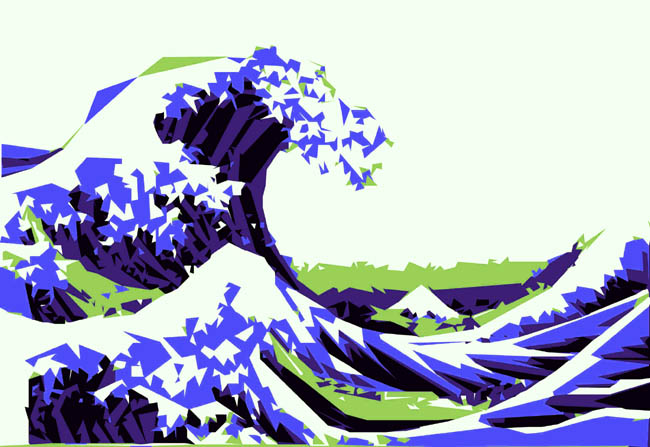
The Wave that Washes us all

The Wave that Washes us all

What I learned this week:

Procrastination caused by fear… I thought I was done with that, but I’m not. I still must say to myself:

I must not fear.
Fear is the mind-killer.
Fear is the little-death that brings total obliteration.
I will face my fear.
I will permit it to pass over me and through me.
And when it has gone past I will turn the inner eye to see its path.
Where the fear has gone there will be nothing.
Only I will remain
— Dune

Markus Zusak saidFailure has been my best friend as a writer. It tests you, to see if you have what it takes to see it through.


With proper hydration, the most brutal heat can be dealt with.


Too much habanera sauce – while not a good thing in all respects – will clear out your sinuses very quickly.


From a Blog Entry – Global Weirding Coming At Us All, by Walter Russell Mead (read the whole thing)

Except for some entrepreneurs, mavericks and renegades, our technocratic elites are mostly a bunch of rule followers and incrementalists.  They got where they are by scoring well on tests, manipulating the platitudes of conventional wisdom a little better than the next guy and by pleasing their supervisors.

This is almost exactly the wrong way to raise leaders for tumultuous times. …  We are producing legions of promotion-hungry bureaucrats and narrow specialists with no knowledge of or interest in the tumult and chaos that inevitably rises up in times like ours.  We then place them in large, bureaucratically run institutions and expect them to deal creatively with the unexpected, the revolutionary and the totally new.

I can not say it better.


Kingfish is better fried than grilled.

Wankelfish

Wankelfish

The Geneva of my youth

Geneva

A photograph of me working at the Geneva Industries Superfund site in South Houston, Texas in 1984.

I was cleaning out a closet at home and came across this old photograph of myself in my youthful prime. Good lookin’ feller, don’t you think?

The picture was taken in, I believe 1983 or 84 – at the Geneva Industries Superfund Site in South Houston, Texas. The site was a bankrupt and abandoned manufacturing plant for Polychlorinated Biphenyls, amongst other nasties.

I’m not sure exactly who I was working for when the picture was taken… Weston Engineering, Ecology & Environment, or Jacobs Engineering… at any rate I was a contractor to the Environmental Protection Agency’s Superfund division. I was part of the TAT – the Technical Assistance Team – that provided expertise during the emergency removal at the site. We had a certain amount of money to go in, take care of any immediate hazards and prepare the site for a long-term remediation to come.

As you can see, I’m suited out and doing some monitoring to insure our safety plan fit the hazards on site. I’m wearing a respirator, which worked well because the major inhalation hazard was dust particles contaminated with PCBs which the respirator protects against well. The yellow case on the cinderblock is a rescue air pack. Inside is a coil of steel tubing full of highly compressed air attached to a plastic hood. If something went wrong and toxic gases were released I could throw the thing over my noggin and have five minutes of safe air to get the heck out of Dodge. Yes, I had practiced that and was confident I could get it on in a hurry.

Between me and the rescue pack are a couple of sampling pumps. Usually these are worn by workers, but I was using them as area samplers. I had a small portable lab set up either on site or in my hotel room and could quickly analyze the samples on a daily basis to make sure something unexpected wasn’t going on.

In my left hand I’m holding the probe of an HNU photoionization dectector – used to detect organic solvents in the air. The state of this equipment in 1984 was a lot more crude than it is today – the thing was big and most of it is hanging out of frame on the strap over my shoulder. In my right hand I’m holding an air horn. That site had a lot of water-filled holes, sumps, and pits all over it and it was so easy to fall in. I always carried that horn in case I got in trouble. You don’t see it, but I also had a radio – wrapped in a plastic bag – taped to my right arm.

In the background, past the rusty tank and before the metal building, you can see a long horizontal cylinder. This was an abandoned tank car that once was full of chlorine and the piping was all rusted. We went to a lot of trouble to mitigate that thing (this picture was probably taken right at the start of that operation) because that much chlorine released in the middle of Houston could have been devastating. It turned out to be empty.

Another tough job we did on that site was to plug an oil well. PCBs are heavier than water and there was a fear that the contamination would follow an old, uncapped well down through a thick clay layer and contaminate the city’s drinking water aquifer far below. We used some old maps to locate the well’s probable location and I went out with a steel tape and spray painted a big X where I thought it was (the whole area was paved over long after the well was abandoned).

We brought out a portable air compressor and a jack hammer and I was chosen to go out there fully suited out and jackhammer down through the concrete. I had some experience with using a jackhammer in protective gear (some work I had done the previous year around St. Louis – but that’s a whole ‘nother story), I was young and strong then, and I had done the measurements – so if I was wrong it would be me that had to do all the wasted work. I was very proud of the fact I hit that wellhead nail right on the head.

Then we brought out an entire drilling rig, full of roughnecks slinging pipe wearing respirators and Tyvek Suits in the Houston heat. Those guys drilled out the old mud, broken concrete, and burlap sacks that plugged the well, and then we concreted the whole thing up.

If you look at the Geneva site now you’ll see a bare green mound in the middle of a pretty rough part of the city. Most remediated waste sites look like this – the open ground patterned with the piping system and tanks of a groundwater interceptor and treatment system. Back then, though, it was frightening complex of rusting equipment, open pits, and ponds full of toxic chemicals.

Over a few jobs I spent months at Geneva. I worked even more at Crystal Chemical on the other side of Houston (I’ll write about that some time- real horrorshow). Then there was Cleve Reber in the swamps of Louisiana and the big train derailment in Livingston. There was a burning subterranean landfill in Tulsa, and countless oil spills all the way from New Orleans to West Texas. There were chemical trucks turned over in ditches, leaking rail cars, and burning pesticide factories in small towns.

I spent a lot of time when I was young out in isolated unpleasant places cleaning up other people’s messes. Actually, I didn’t work at this too long – nobody did, nobody could. It wears on you. It’s when you realize that wearing that respirator and mask, that suit with gloves and boots taped to the sleeves and legs so that nothing can leak in, feels normal, feels natural, that you realize it’s time to move on.

Sleep Deprivation

Sleep

Sleep

Sleep is an eight-hour peep show of infantile erotica.
—-J.G. Ballard

I have had this terrible habit of coming home from work absolutely exhausted, grabbing the first edible crap from the fridge I can lay my paws on and then tumbling into a deep, restless sleep full of furtive uneasy dreams. I would then wake up late and be up most of the night, only to haul my tired ass back to work the next morning and start the whole sad cycle over again.

So yesterday I worked out a plan to combat this. Instead of going home, I stopped off at the library and did some writing. Then when I came home I was able to get a bit of stuff done and then it was time for bed – a healthy hour to retire.

As I put my head down on the pillow for a restful repose my phone went off. There was a pseudo emergency at work and off I went. Took care of this and that and came back home at about one thirty in the morning.

It’s impossible for me to go right to sleep after I’ve done stuff like that… too hyped up – so I wasn’t able to get back to the lad of nod until somewhere after three AM. That gave me a good, solid, 180 minutes or so of sleep.

The best laid plans…

All day today I was a zombie. It’s that awful dizzy nauseous sick lack-of-REM state where if I close my eyes for more than a blink I start to dream. My mind becomes clogged with brain-freezes and I can’t remember anything important. It scares me more than a little – it is too easy to make a dangerous mistake in a state like that… but I have to go on. There is too much to do and a few hours of missed shut-eye isn’t a good enough excuse to shut it down.

I am so miserable when I’m sleep deprived. I remember reading Alexander Solzhenitsyn, in The Gulag Archipelago when he talked about the worst torture of all was when they simply kept him awake for night after night, day after day. I find that easy to believe.

One of J. G. Ballard’s oddest and most harrowing short stories was Manhole 69 – where a group of subjects were surgically modified so they did not need to sleep any more. It seemed like a good idea – to get a third of your life back. But they all went catatonic, locked in a horrible prison inside their own minds. The human mind can’t stand continual consciousness; it becomes exhausted at simple existence.

So I stumble through the day, trying to put off any difficult critical thinking until tomorrow, and procrastinating on any demanding and crucial projects while I’m in such a state. The day fills with busy work – mundane tasks that I can do in my sleep (which is pretty much what is going on).

Until finally the clock winds down and I can crash. Now is the time. So I’d better stop writing.

See you tomorrow, when I’m worth a bit more of a quality effort.

Radio Paradise

Radio

Radio

Internet radio is a gift from the gods. I mean it, isn’t it amazing that this music can come out of the ether? And it follows  you around, were ever you go.

I have tried out a thousand Internet radio stations but I keep coming back to one, Radio Paradise. Right now, I’m at the library after work, listening to it on my laptop (yes, very good sound-isolating headphones, of course) trying to get some pages hammered off in one window, radio paradise in another, and this procrastinating tripe in a third.

Day after day, I’ve fallen into the bad habit of coming home from work and collapsing. To try and put that vice to rest, I’m going to stop off at the library on the way home. I guess I can fall asleep at this little cubicle, but at least it will be uncomfortable and I’ll drool and such – can’t snooze too long.

Back to Radio Paradise… over the last few years I have found so much great new music from their programming. It’s a great mix of old and new, popular and obscure (leaning toward the new and obscure) – mostly not too upbeat, but not too downcast either.

I love it when I can play it while I sleep and wake up to some mysterious music pouring and bouncing through the dark room.

At home, I’ve been playing around with the Roku Box and found something really cool. Radio Paradise has a channel on the box and while it plays the music it displays a series of HD still images. You can watch it here on your computer screen – but it is really something nice on a big screen HD television and sound system.

This truly is the best of all possible worlds.

Into the Blast Furnace.

The light - not the heat

The light - not the heat

It is so hot. I remember talking to people that moved to Dallas from Cleveland. I said, “Summers in Dallas are like winters in Cleveland – you can’t be outside for an extended time. You have to live running from one air-conditioned space to another.”

That understates it. You can, in cold weather, always dress for it, put on layers, preparation. In the heat, naked is as good as it gets, and that isn’t enough.

I am so tired of the droning of the air conditioner – the feeling of artificial, fake, conditioned air against my skin. It is painful, it pricks.

When I was younger I had a muffle furnace in my laboratory. Actually, over a period of years, I had a series of muffle furnaces. A muffle furnace is used to get something, usually a crucible containing some substance you are interested in, very, very hot. They are a little ceramic cave, with squiqqles of electric heating wires running all around. A heavy door swings down over the front, allowing you to lift and peek if you want. This is a door to hell. The inside glows like Hawaiian lava – then it gets even hotter. White hot.

Sometimes, whatever you have in the crucible explodes. A little. This makes the door swing out and a puff of superheated smoke jumps out. The door clangs shut. Any muffle furnace worth its salt will have a stained front, paint smoked by escaping violence from the reactions within.

I feel like that all the time.

Heat

Heat

Taqueria – La Marketa Cafe

Lee and I were driving downtown yesterday, later than I had wanted to go, it was Texas nuclear hot, and nobody had eaten. Lee announced that he had to have something to eat before we went to the Nasher. When a college boy says he has to eat, he has to eat.

I threw the criteria in to my head…

-We were headed downtown (not a lot of action downtown on the weekends – shame on Dallas)

-We were in a hurry (no sit down restaurants)

-No chain-type fast food (general rule of mine, whenever given a choice, I choose local, privately owned – have to support the peeps)

I did not have much of an idea until an old, musty memory came bubbling up. I was at the Dallas Farmer’s Market, buying vegetables, and I saw a Taqueria in a run-down stand right in the middle of things. I remember wanting to eat there in the worst way, but we had other plans that day.

Tex-Mex is not my favorite, but I love Taqueria food. Incredibly unhealthy, probably not too sanitary – but fast, spicy, and good. What can be better?

“I think there’s a taco stand in the Farmer’s Market, Lee. It’s not too far from the Nasher, can you handle that?” I said to Lee.

“Go for it,” he said. So I exited on Good-Latimer and threaded my way through the giant glass canyons of downtown to the Farmer’s Market.

The place was hopping. The ragged field that serves as a parking lot was filling up – groups and families were wandering around with bags of vegetables, flats of bedding plants, and carts with Mexican clay pots and sculptures. A street musician was playing wildly inappropriate music (I have never heard Steve Miller’s Swingtown done by a busker before) and they were setting up a stage for a cooking demonstration.

I love the Dallas Farmer’s Market and am glad that it has become so popular (at least on a Saturday morning). I’ve been going there ever since I worked downtown twenty years ago and would walk over for a bag of tomatoes before taking the bus home to Lower Greenville.

It has grown quite a bit since then – the area is now surrounded by condominium urban-hipster type developments and the city has built a new air-conditioned “shed” to accommodate more retailers than the traditional farmers and wholesalers that still line up in the lines of stalls in the old open sheds.

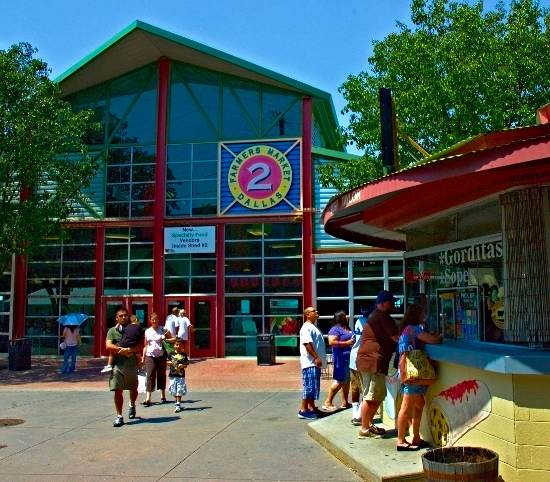
La Marketa Cafe in front of Shed 2 at the Dallas Farmer's Market

La Marketa Cafe in front of Shed 2 at the Dallas Farmer's Market

We walked up and in front of the new “Shed Number 2” was, sure enough, a run-down, rounded, concrete building with a sign that said, “La Marketa Cafe” and a big, hand-lettered menu board.

I asked if it was still early enough for breakfast and it was. The menu was complex, but we quickly settled on tacos and burritos – corn and flour – and the options:

chorizo
potatoes
ham
sausage
bacon
beans&cheese

“Two tacos, one corn, one flour, one sausage, one beans&cheese, one burrito…, bacon and two bottles of water.”

I had to repeat it twice, but I didn’t really care if they got it right. It’s all good. They asked if I wanted “everything?” and I said, of course, “Sure.”

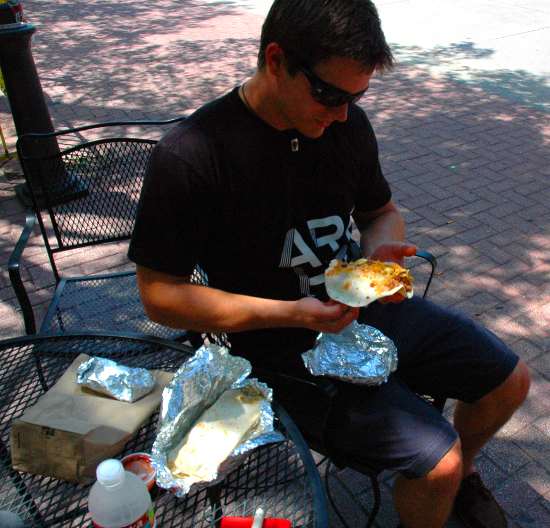
The food wasn’t very fast (there were a lot of people ordering and waiting), but it was very, very good. Large, full of eggs, onions. and peppers and “everything.” The best was the sauce (that’s the most important thing isn’t it?). Two paper ramekins – one with a hearty red, the other a wonderful spicy guacamole (I hate wimpy guacamole).
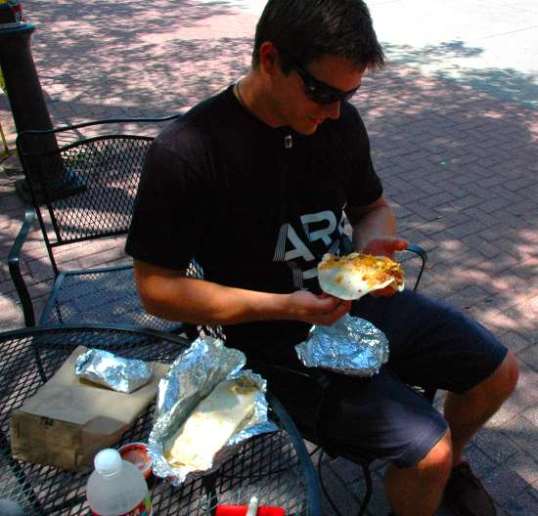
Lee getting ready to attack a breakfast taco

Lee getting ready to attack a breakfast taco

La Marketa Cafe (I have no idea where the Cafe come from) has now risen to the top of my extensive list of approved taquerias.

Now I want to go back, early, when there is a little cool morning air left wafting around, have some tacos, watch some people. I might even pick out a bag of tomatoes before I go back home.
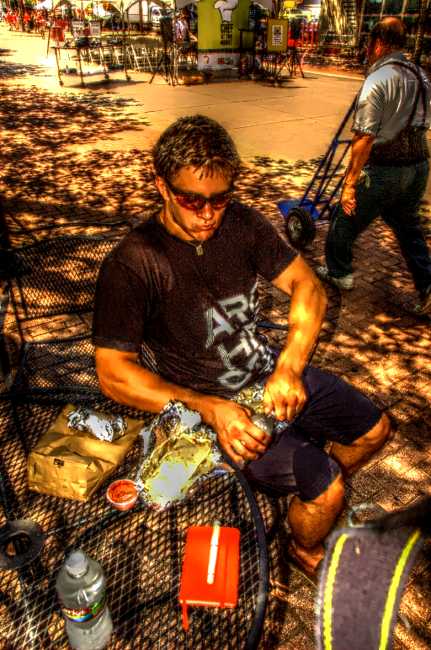
Eating al fresco in front of the taqueria

Eating al fresco in front of the taqueria - HDR

Then and Now at the Nasher Sculpture Center

Some time long ago – I think it was the early spring of 2004 – Lee and I went down to the newly-constructed Nasher Sculpture Center in the still nascent Arts District of Dallas. I took some pictures of him, and wrote it up into my journal, The Daily Epiphany, at the time. It was popular enough that I re-wrote it into a magazine article and it was published in a local magazine, Richardson Living,  (I’ll dig up what I wrote and put it up here when I get some time). The folks at the Nasher liked it so much they sent me some free tickets.

Now, about seven years later, Lee and I went down there again and I took some more pictures. Like most museums the artworks move around quite a bit – so nothing was exactly the same. Lee has, of course, grown a bit, and my camera is different. The trees in the Nasher garden have grown a lot. In 2004, the place felt like a finely tended garden – now it’s more like a forest glade.

It was hot as a humid blowtorch today, and the light wasn’t very good, so the pictures aren’t great. I wanted to go early in the morning, but the house was full of sleeping college age boys, nobody slept much last night, and it took some doing to get myself enthused and then roust them up and out the door.

Night (La Nuit) by Aristide Maillol

Night (La Nuit) by Aristide Maillol

This is Lee sitting on a wall in front of Night (La Nuit) by Aristide Maillol.

Lee sitting by Night, 2004

Lee sitting by Night, 2004

Seven years ago, the sculpture was out in the grassy garden area.

Eve, by Rodin

Eve, by Rodin

Eve, by Auguste Rodin

Eve, by Rodin, 2004

Eve, by Rodin, 2004

Bronze Crowd, by Magdalena Abakanowicz

Bronze Crowd, by Magdalena Abakanowicz

Bronze Crowd, by Magdalena Abakanowicz

Bronze Crowd, by Magdalena Abakanowicz - 2004

Bronze Crowd, by Magdalena Abakanowicz - 2004

Richard Serra - My Curves are Not Mad

Richard Serra - My Curves are Not Mad

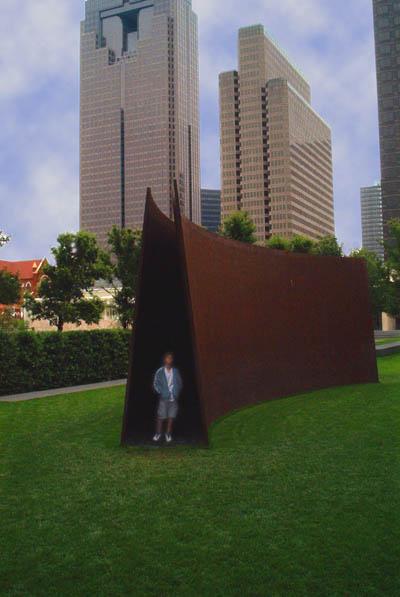
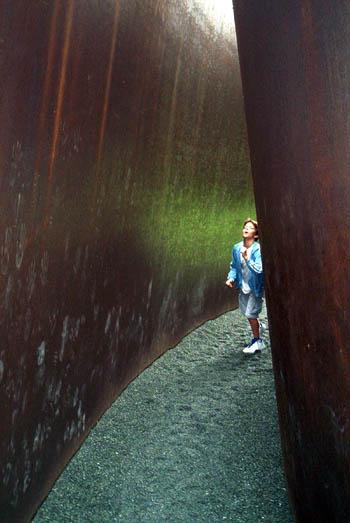
One sculpture that is still in the same place is Richard Serra’s My Curves Are Not Mad.  That’s not surprising – it weighs fifty tons or so and I read somewhere that they had to do some serious work on the foundation when the museum was built. I did this by memory, but it looks like I stood in the exact spot I did seven years ago. You can really see how much the trees have grown.

My Curves are Not Mad - Richard Serra, 2004

My Curves are Not Mad - Richard Serra, 2004

Inside My Curves are Not Mad - 2004

Inside My Curves are Not Mad - 2004

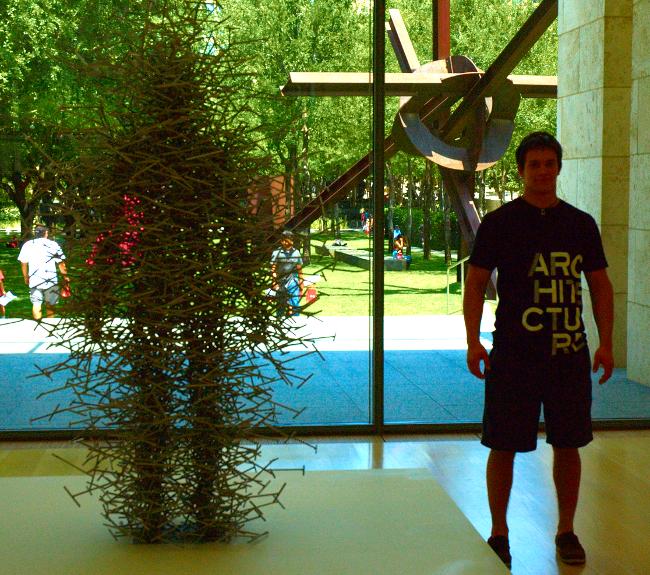
Quantum Cloud XX (tornado) by Antony Gormley

Quantum Cloud XX (tornado) by Antony Gormley

Quantum Cloud XX (tornado) by Antony Gormley used to be down at the bottom of the garden. I liked it there, it looked like a ghost emerging from the shrubbery. It’s always been one of my favorite pieces and I still like it. Actually, today I was glad it had been moved into the air conditioning.

Untitled (Sprawling Octopus Man), by Thomas Houseago

Untitled (Sprawling Octopus Man), by Thomas Houseago

Untitled (Sprawling Octopus Man), by Thomas Houseago, is part of a temporary exhibit, called Satuesque.

Hammering Man, by Jonathan Borofsky

Hammering Man, by Jonathan Borofsky

Everyone that has lived in Dallas for a long time remembers Hammering Man, by Jonathan Borofsky, because it used to grace Raymond Nasher’s shopping mall, Northpark. I love it that he was allowed to stay in the city.