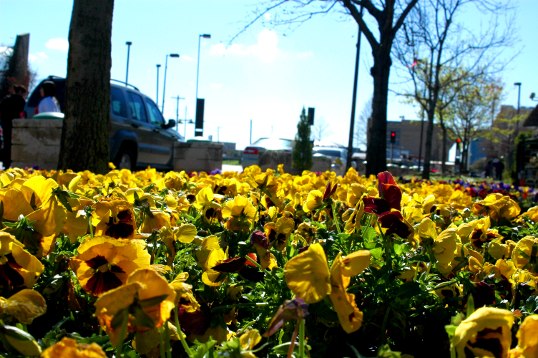
Down in the Dallas Farmer’s Market there are a couple of plant shops that specialize in bedding plants – annual color. The plants are laid out on the sidewalk in flats and make a beautiful, colorful, carpet.

Blue
Yellow

Purple

Red
Down in the Dallas Farmer’s Market there are a couple of plant shops that specialize in bedding plants – annual color. The plants are laid out on the sidewalk in flats and make a beautiful, colorful, carpet.
Blue
Yellow
Purple
Red

An old picture I took out my car window while waiting for a drive thru ATM.
The other day I had a little bit of time so I decided to head out with my camera and take some photographs. I made a little list of places to go – the rugby games near White Rock Lake, maybe a walk along the lake, a return to the Farmer’s Market, a stroll around Deep Ellum (I have some photographs from there, but wanted to supplement them before putting together an entry) and an arts and crafts market in Deep Ellum.
So I drove down to White Rock and discovered the Rugby games were delayed, so I wandered the streets down into Deep Ellum. I found a place to park, pulled my camera out, and walked to the market. I strolled the aisles, looking at the wares, and noticed there was a food truck set up.
It was a truck I’ve never tried before, Rock and Roll Tacos. I ordered some fish tacos and set about getting some pictures. I shot the truck, the market, some folks strolling around, and my food before I gobbled it down. I wasn’t really looking at my camera, simply pointing and shooting, having a fun time.
It seemed to be shooting too quickly so I checked the display. That’s when I realized that I had forgotten to put the memory card back in after sucking the old photographs off the night before. So I’m sorry – no pictures for you today. Well,….. the truck looked like a truck, the tacos looked like tacos, and the art market looked like an art market.
After a few seconds of frustration I felt better. It was a beautiful day, the fish tacos were good, and the art interesting. Without the camera I could simply look and enjoy.
Sometimes the world is better when not looked at through a viewfinder.
I love the idea of local folks still doing this sort of thing. I remember when I was a little kid I’d visit the newspaper office in the tiny town out in the wheat fields where my family was from. He set the paper in linotype and I loved watching the lead letter slugs being made. I remember being amazed at how hot the slugs were when he could pick them up (his hands were so callused).
A really interesting article from the New York Times on how reading fiction can improve our minds.
Brain scans are revealing what happens in our heads when we read a detailed description, an evocative metaphor or an emotional exchange between characters. Stories, this research is showing, stimulate the brain and even change how we act in life.
I found these passages particularly provocative:
The brain, it seems, does not make much of a distinction between reading about an experience and encountering it in real life; in each case, the same neurological regions are stimulated.
Keith Oatley, an emeritus professor of cognitive psychology at the University of Toronto (and a published novelist), has proposed that reading produces a vivid simulation of reality, one that “runs on minds of readers just as computer simulations run on computers.” Fiction — with its redolent details, imaginative metaphors and attentive descriptions of people and their actions — offers an especially rich replica. Indeed, in one respect novels go beyond simulating reality to give readers an experience unavailable off the page: the opportunity to enter fully into other people’s thoughts and feelings.
The novel, of course, is an unequaled medium for the exploration of human social and emotional life. And there is evidence that just as the brain responds to depictions of smells and textures and movements as if they were the real thing, so it treats the interactions among fictional characters as something like real-life social encounters.
I have always wondered if reading is a waste of time.
Apparently not.

I don’t know if I agree with the guy’s riding style – and it’s really just a long commercial for a brand of bike tire – but man, what a cool video!
Motivation.
It’s the battery, stupid: The looming 4G smartphone crisis
As more power, faster processor, fancier features are added to smartphones, the battery life becomes less and less. This is the one problem that will limit the post-laptop technological revolution. If your battery doesn’t work, your phone (or tablet) is useless.
The trouble with batteries, as everyone who makes phones will tell you, is that they don’t follow Moore’s Law. Batteries are an ancient technology that depend on chemistry that scientists have already pretty much optimized.
Very interesting article. I wonder if we will see a bifurcation in the phone market, with folks carrying both an old-technology phone for voice and text only (I only have to charge my crappy work Blackberry in my car during my commute) and another smart phone or tablet or in-between form factor (and leave this turned off most of the time) for all the other goodies.
The only way to play guitar
NEWSPAPERS AMERICA’S FASTEST SHRINKING INDUSTRY
“But we make the best buggy-whips in the world!”
Another dinosaur. We subscribe to the newspaper on the weekends so that I can access its digital content.
19 Signs That America Has Become A Crazy Control Freak Nation Where Almost Everything Is Illegal
#1 One California town is actually considering making it illegal to smoke in your own backyard.
#2 In Louisiana, a church was recently ordered to stop giving out water because it did not have a permit to do so.
#3 In the United States it is illegal to operate a train that does not have an “F” painted on the front. Apparently without that “F” we all might not know where the front of the train is.
#4 In many U.S. states is it now illegal to collect rain that falls from the sky on to your own property.
#5 In America today it is illegal to milk your cow and sell the milk to your neighbor. If you do this, there is a good chance that federal agents will raid your home at the crack of dawn.
#6 In Washington D.C. it is illegal not to recycle cat litter.
#7 It is illegal to give a tour of the monuments in Washington D.C. without a license.
#8 In the United States it is illegal to sell natural cures for cancer – even if they work.
#9 In the state of Massachusetts it is illegal to deface a milk carton.
#10 In the state of Alabama, bear wrestling is completely illegal.
#11 In Fairbanks, Alaska it is illegal to give alcoholic beverages to a moose.
#12 In Lake Elmo, Minnesota it is illegal to sell pumpkins or Christmas trees that are grown outside city limits.
#13 There is a federal law that makes it illegal to be “annoying” on the Internet.
#14 If you register with a false name on MySpace or Facebook you could potentially “spend five years in federal prison“.
#15 In Hazelwood, Missouri it is illegal for little girls to sell girl scout cookies in the front yards of their own homes.
#16 All over the United States lemonade stands run by children are being shut down because they do not have the proper permits.
#17 In Florida, it is illegal to bring a plastic butter knife to school.
#18 In San Juan Capistrano, California it is illegal to hold a home Bible study without a “conditional use permit“.
#19 In the city of Philadelphia, Pennsylvania it is illegal to make even a single dollar from a blog unless you buy a $300 business license.
In my surfing a few days ago I came across, as I’m sure you did, the news that after 244 years Encyclopedia Britannica was giving up on its print edition.
We never had Britannica in our house – it was too expensive. We had a cheaper, more “modern” looking set… I don’t remember the brand. Of course, my schools – every school (I went to… I think twelve different ones) library had a set of Britannicas. I wasn’t a big fan of them; they seemed too stuffy for my taste. I loved the top-line World Book (which looks like it is still in print) – I remember when I discovered the transparent acetate pages that showed the human anatomy in several layers. It seemed like amazing information luxury to me.
Most kids used the various encyclopedias to plagiarize their school reports, usually cribbing the short paragraphs out verbatim. I, on the other hand, used to read encyclopedias cover to cover, from AA, through Z, and on to devour each annual update and addendum. I loved reading them. I’d read my books at home, then I devour the ones in the school library, then on to the history sets (I loved these because they were in chronological order) and finally the long shelves of Time/Life educational books.
Sitting here, writing this, I remember the hours spent turning the pages, the slight fungus odor of the old paper, the weight of the editions as they came off the shelf, the nasty paper cuts – I remember following the footnotes and then the memory of getting to the same article in alphabetical order. I retained a surprisingly large amount of information – not sure how much good it did me. The tomes were good on dry facts but not so much on wisdom.
I am not overwhelmed with wistful nostalgic sadness, though. Plenty of people are full of woe that an age has passed and they lament the disappearance of such a totem of their youth. My thoughts run in a different direction. What I think about is what a kid that, in a vain attempt to satisfy his unquenchable curiosity, was forced to read encyclopedias cover to cover, volume to volume, could have done if he had been born a few decades later and had access to the internet. It would have been like drinking from a fire hydrant.
I’ve been seeing headlines like, “Encyclopedia Britannica killed by Wikipedia!” That is not true at all – Wikipedia is a great thing, but sometimes you want information that wasn’t written by nineteen-year-olds. There will always be a place for the verified truth.
“This has nothing to do with Wikipedia or Google,” Encyclopaedia Britannica Inc. President Jorge Cauz said. “This has to do with the fact that now Britannica sells its digital products to a large number of people.”
The top year for the printed encyclopedia was 1990, when 120,000 sets were sold, Cauz said. That number fell to 40,000 just six years later in 1996, he said. The company started exploring digital publishing in the 1970s. The first CD-ROM edition was published in 1989 and a version went online in 1994.
The final hardcover encyclopedia set weighs 129 pounds and is available for sale at Britannica’s website for $1,395.
An entire set costs more than an iPad. A low-end tablet is half that. There is an iOS app which is free, but has a $1.99 a month subscription for unlimited content.
If you went back in time to, say 1969, and said, “Hey, for half the cost of that shelf full of heavy books, I’m going to give you a little book or pad, about the size of a magazine, that you can take anywhere with you and when you touch it, the content you are looking for will appear on it, more or less instantly. It will be in full color, with sound and full-motion television, when appropriate. You’ll have to throw the old, paper ones away, though. To keep it updated you’ll have to pay two dollars a month. Oh, and if you need a break you can play Angry Birds on it too.”
What do you think the reaction would have been? It makes me think of Arthur C Clarke’s third law- Any sufficiently advanced technology is indistinguishable from magic. A fully loaded iPad would have looked like magic in 1969. And that’s 1969! I remember 1969. I was twelve. I was reading encyclopedias in 1969.
I wish I had had an iPad.

This is me in 1969 (or so). I look like a kid that read encyclopedias cover to cover.
No More Encyclopedia Britannica
Encyclopedia Books–The End of an Era
Goodbye Britannica, We Will Miss You!
Death of a Salesman Part 2: Encyclopaedia Britannicas Going Out Of Print
Encyclopedia Britannica going 100% Digital
Britannica encyclopedia out of print but the bibles still going strong
Encyclopedia Britannica to end print editions
No More Print edition of Encyclopaedia Britannica
WILL YOU MISS THE ENCYCLOPEDIA?
No more Encyclopedia Britannicas in book form
Encyclopedia Britannica is going digital only.
Encyclopedia Britannica to End Print Editions
No More Encyclopaedia Britannica Books
My Encyclopedia Britannica Set is Dusty but Not Forgotten
Encyclopaedia Britannica To Stop Publishing Books After 244 Years
Goodbye Encyclopedia Britannica
My thoughts on a lost era: Encyclopedia Britannica to stop printing books
Closing the Book: Encyclopedia Britannica Goes All Digital
Encyclopedia Britannica ends publication after 244 years
CHECK OUT SOME THINGS THAT ARE GOING BYE BYE
Wikipedia and the Internet just killed 244-year-old Encyclopaedia Britannica
Encyclopedia Britannica Goes Out of Print
ENCYCLOPAEDIA BRITANNICA, PRINTED NO MORE
Encyclopaedia Britannica To End Print Editions
Encyclopaedia Britannica wiped out by Wikipedia, selling final print edition
From the “I really wish I had thought of that,” department. Of course, the music is the “American Beauty” theme – but the fabric looks better than a plastic bag.
When I watch this, I think of what I know about chaotic systems and boundary conditions and I wonder if a setup like this could be designed to be “stable” – in that the fabric would continue to move in a random way, but staying within the boundary of the circle of fans – for an indeterminate time… like years. Imagine a museum exhibit that simply did this, day after day, week after week, for a year. I like to think of it still thrashing around in the dark, after the museum has closed, still dancing in inanimate beauty with nobody watching. Or, even better, I imagine a lonely museum security guard, at four in the morning, sitting there, looking at it, dreaming his own personal unique dreams.
And two pieces of cloth, plus my favorite Sigur Ros tune.
Really cool new Moleskine product.
Moleskine Messages – postal notebooks.
How do you pronounce Moleskine anyway?
And the correct answer.
More Moleskine hacks – How to set up a mini Moleskine for maximum productivity.
8 million hits – so you might have already seen this…. but even if you did, trust me, it’s worth watching again.
I loved Hee-Haw in high school. It was on in Managua, dubbed into Spanish (except for the songs and music). Trust me, Hee-Haw does not translate well. Still, I’d forgotten how much I loved this little ditty until I stumbled across it on a blog the other day.
Never Number One: A Whole Bunch of Great CCR Songs
5. “Travelin’ Band”/”Who’ll Stop the Rain” (1969) was denied by Simon and Garfunkel‘s “Bridge Over Troubled Water.” No reason for complaint there, really.
4. “Lookin’ Out My Back Door”/”Long as I Can See the Light” (1970) was held off by Diana Ross and “Ain’t No Mountain High Enough.” No shame in that, either.
3. “Green River” (1969) could not overcome the Archies and “Sugar Sugar.” We like “Sugar Sugar” more than most people do, but c’mon, that’s crazy.
2. “Bad Moon Rising” (1969) stalled at #2 behind “Love Theme from Romeo and Juliet” by Henry Mancini, which is pretty close to the exact opposite of “Bad Moon Rising.”
1. “Proud Mary” (1969) was blocked for a week by Sly and the Family Stone‘s “Everyday People,” which is a great record and a worthy rival. But the next week, Tommy Roe‘s “Dizzy” jumped over both of them to #1. And that is a crime not merely against rock, but against art itself.
50 new fairy tales are discovered in Germany
Read one of them here:
more:
In one sense, the rule of the law must be consistent with at least some form of public administration. Over the centuries, governments have had to enforce the criminal law, tear down firetraps, and issue driver’s licenses. It is often not easy to decide what disabilities prevent people from driving or what qualifications must be met to operate a heavy rig. But with conscientious officials, these focused tasks can be accomplished. Today’s “administrative state,” however, goes far beyond this modest level of public administration.
Well You Don’t Say: 10 White Singers We Once Thought Were Black
Lana Del Rey On SNL, Haters, & Her Hair In First Radio Interview And On-Air Performance
Rock Flashback: Patsy Cline’s Plane Crash, 1963
The 12 Dos and Don’ts of Writing a Blog
This guy found Eva in an album of 60s and 70s polaroids at a Berlin flea market. She appears prominently throughout the album, and his curiosity about her life led to Tuesdays with Eva, which began with this post.
Somewhere miles deep underground the dried salt remnant of an ancient sea is being squeezed by the unimaginable weight of the Mississippi delta building up above. All the loose mud from Ohio and Minnesota ends up washed downstream, piles up, and presses down. The salt becomes a sort of geological fluid and globs rise like pale columns in a crystalline subterranean lava lamp – reaching miles up until they almost burst forth under the starry sky.
One of these salt domes sits under Avery Island – pushing the land upwards above the surrounding sea-level flatness. It is truly an island – a disk-shaped protuberance rising above… not the trackless sea but the feckless swamp – a bit of dry, elevated land looking down on the miasma and the bog.
The salt dome rises and bears a number of gifts. There is the salt itself – mined or boiled from springs for centuries with only a short break when the saltwork was captured by Union troops during the Great War Between the States (as it is known in these here parts). There is the gift of petroleum – oil is dragged along and concentrated by the rising column until, like Spindletop to the west, a forest of derricks sprout up sucking at the black gold.
And finally, there is the gift of high, dry farmland – rich and fertile. The Avery Island Plantation could grow pretty much any crop and – luckily for us – they chose a unique crop, grown from seed brought back from Central and South America… Hot Peppers.
For Pepperheads and fans of spicy food Avery Island is capsaicin ground zero and a visit there, at least once during a lifetime, is a necessary pilgrimage – a hot sauce Hajj.
Avery Island is the home and only manufacturing facility of the McIlhenny Company – the maker of Tabasco Pepper Sauce. Every little red bottle – somewhere around 750,000 bottles a day – are made on Avery Island.
We were going to drive back to Dallas from Lafayette, about a seven hour drive, but I wanted to go see the McIlhenny Tabasco factory on Avery Island first so we drove south instead and, after a couple of wrong turns, crossed the little wooden toll bridge (one dollar per car) onto the complex of green hills atop the salt dome.
The first thing you notice when driving up to the factory is the smell. It is wonderful. It’s not a hot, painful tear-gas like capsaicin reaction like you might expect, but a mellow, complex warm feeling that envelops the whole complex. First, we took a tour of the factory. You get a lecture; watch a film, then walk past the filling lines behind a glass wall. It was a Sunday, so the filling lines weren’t running, which was fine with me – I’ve seen plenty of food filling equipment filling food in my day. It was good enough to be standing behind the glass looking at the place where all the goodness happens.
At the end of the tour was a little museum with facts about Tabasco Pepper Sauce. I already knew most of it, having seen it on the How It’s Made television show. The most amazing thing about Tabasco is that the ground up peppers are aged in second-hand whisky barrels and allowed to ferment for three years before being mixed with vinegar, blended, and bottled. The barrels are covered with a layer of Avery Island salt while they age. Ground peppers (the seeds are developed on Avery Island, though the peppers are grown in Latin America), water, salt, and vinegar… that’s it.
To help the pepper pickers pick the perfect peppers they are given le petit baton rouge – a little red stick. This is painted the color of a perfectly ripe Tabasco pepper.
Then we walked across to the Tabasco Country store and bought our share of touristy knick-knacks and hot sauce products. I looked long and hard at the gallon jugs of hot sauce with the plastic pumps – and was able to resist the siren song. They had a sampling table with all the different flavors, including one I have never seen before – a chipotle raspberry sauce (I bought a bottle). There is no reference to this chipotle raspberry Tabasco anywhere – it’s a bit gimmicky, but it tastes good.
They also had spicy cola, two flavors of ice cream, and anything else you can imagine – plus a few you can’t. Candy bought some stuff for Nick (he loves Tabasco) and a bag of cooking wood made from their broken fermenting barrels.
One odd thing I did buy was a big ziplock plastic bag of pure pepper mash. I’m not sure what I’m going to do with it, but it makes every room smell wonderful.
I took a walk around and snapped a few pictures, like a good tourist. Down at the end of the factory were some long brick buildings – these must be some of the fermenting warehouses where the sauce ages for three years in those oak barrels because the odor wafting out of the vents was unbelievably wonderful. One must have been the Chipotle warehouse because I could detect a smoky note in the air.
We had planned on stopping by a tony Cajun restaurant north of Lafayette on the way home, but there was a little trailer set up next to the country store selling red beans, rice, and sausage from crock pots. Of course, there was a large selection of spicy condiments available for testing.
I doubt the expensive restaurant had anything on the five dollar foam cup of red beans that I gobbled down with dabs of at least seven different Tabasco sauces on different nibbles.
There is a lot more to Avery Island – the Jungle Gardens and the Bird City went unvisited by us. We had a long drive ahead and couldn’t tarry. I’ll be back though, to smell that smell and explore some more. Once is not enough.
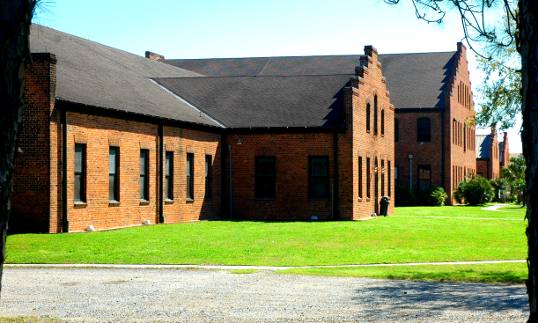
The factory has this crazy bayou gothic look to it.


The recycled whisky barrels with salt on top. The mash ages in these for three years.
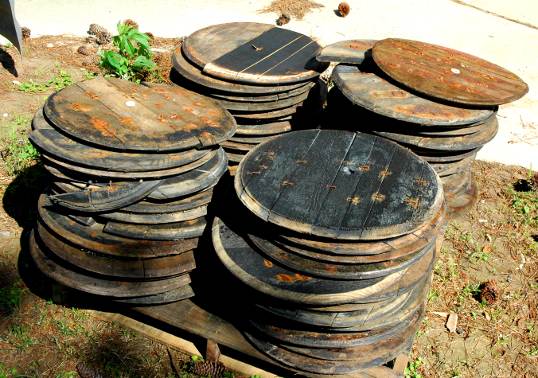
Walking around, I found this pallet of old barrel lids after the peppers have been aged.

A box of labels from the filling line.
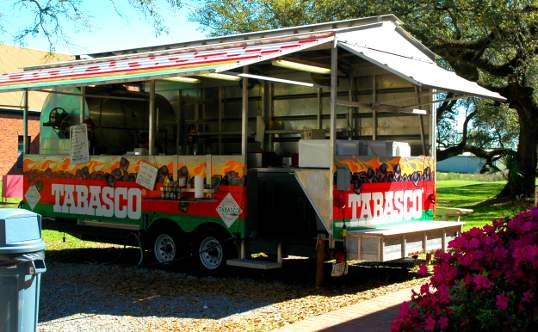
The food stand - great beans, rice, and sausage.

I haven't seen or read about this anywhere else.
Taking on Big Tabasco – Or, a little undercover research into le petit baton rouge
Tabasco’s Red-Hot Beginnings in Louisiana
The Fascination of Tabasco Sauce
Cajun Country’s Saucy and Spicy Tour
January, 2012. On the Geaux – Again – in Louisiana
McIlhenny Tabasco – Avery Island, Louisiana
Avery Island and Tabasco Sauce
Yes! My Camera Loves New Iberia Louisiana
5 Healthy Reasons to Love Tabasco Sauce
Avery Island – Tabasco, Alligators and Egrets
Touring the Tabasco Hot Sauce Factory and Scenic Avery Island, Louisiana
RV Trip Favorite Photos #51-55
Roadtrip: South Louisiana, Part 1
Well, I’m standing on the corner of Lafayette state of Louisiana
Wondering where a city boy could go
To get a little conversation, drink a little red wine
Catch a little bit of those Cajun girls dancing to Zydeco—-That Was Your Mother, Paul Simon
Sometimes I think I went all the way from Dallas to Lafayette just to use that bit of Paul Simon. It’s one of those songs that always sits only a hare’s breath beneath the surface of my conscious mind. But that’s not why we are here, we drove down from Dallas to watch Lee play Rugby. He’s on the Tulane Rugby team, a club team, and he’s here in Lafayette to play the University of Louisiana Lafayette Ragin’ Cajun Rugby Team.
I know very little about rugby – I watched some a handful of decades ago, but don’t remember much of anything. It didn’t take long to pick it up though. It was fun to watch the kids play. There seems to be three aspects to the game – the scrum, the weird out-of-bounds plays where players lift each other up for no apparent reason, and the running around.
I have spent so much of my life driving kids to practice or sporting events and sitting on the sideline watching the games. It felt totally natural to drive Lee from our hotel down to the University of Louisiana at Lafayette intramural fields and to stroll the sideline while he and his team played a spirited, but ultimately meaningless, game.
One thing about rugby, though. It is the only sport I know about that actually encourages unsportsmanlike behavior. The language used by both teams and the referee crew was amazingly obscene.
The people from long ago that played rugby said the best thing about the game is that both teams would party together after the game. Since this is South Louisiana, that means food, and the other team, the home team, provided bar-b-que. They had a big smoker trailer going on the other side pouring out blow smoke and delicious odors all day. The ribs were pretty damn good, but the local, artisanal sausage (three varieties – hot ‘n spicy, geen onion, and smoked) was absolutely amazing. I have to find out where to get some of this stuff.
Laissez les bons temps rouler

In the scrum - Tulane Green Wave versus the University of Louisiana at Lafayette Ragin' Cajuns

The out-of-bounds throw in. I really don't understand exactly what is going on here.
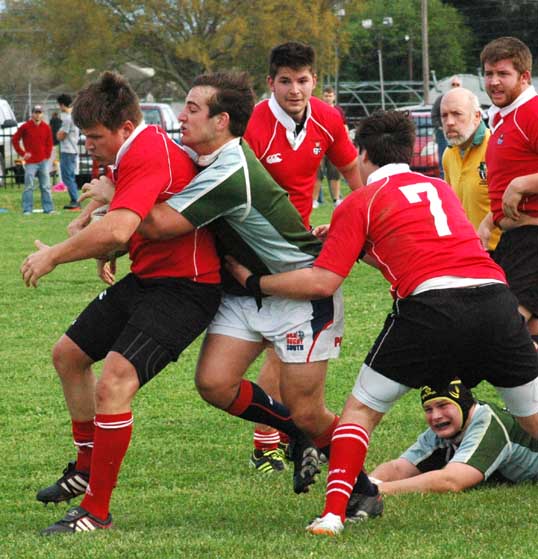
The running around part of a rugby game.

That's Lee, running around on the right side of the picture.
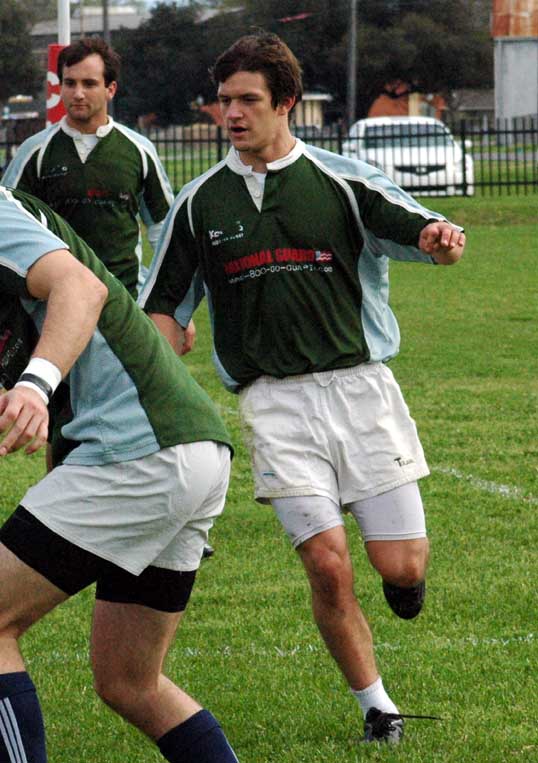
Lee

Lee, jumping into the play


Lee, pulling the ball loose.

After the game, local food provided by the other team. It doesn't get any better than that.

Such a lot of work for such crappy beer. A cannon that can shoot Bud Light, Bud Light Lime, and Pabst Blue Ribbon? Really?
Funny and smart tips to make life easier
Just the Two of Us (and Ken Jeong)

Make your own popping corn in a bag
I remember winning a cheap pocketknife in a claw machine when I was a little kid. I think the guy running the machine (it was at a fair, not a restaurant or something) set it so I would win. After all these years I still smile when I think of the clunk that knife made falling down the chute.
Five Keys to Sleeping Well Tonight
Noel Rockmore, ‘Picasso of New Orleans,’ revisited
Wordiness, Wordiness, Wordiness List
For a long time, I have had an idea that, when I was silly enough to say it out loud, received more than its share of derision. The idea is a theory I have had concerning the question of why has crime been falling so much in the last decades.
The most famous (and controversial) theory is from Steven Levitt and John Donohue – the Freakonomics Guys – they famously said that the drop in crime is mainly caused by the legalization of abortion in the US – so on and so forth. It is an unsettling theory, though a compelling one.
So I read Freakonomics and found the book to be well written and thought provoking, though I found their crime theory to be not completely convincing. I may have missed something, but they did not close the loop in my mind – they showed plenty of correlation, but failed to indicate causation.
Correlation does not prove causation. Never. Read and remember that. Very few people – and nobody that appears on television understands that simple sentence.
So, what is my theory of the drop in crime?
I have been saying for a long time (years before Freakonomics) – as a matter of fact, I predicted it before it really happened – that a large portion of the drop in crime can be attributed to the removal of lead from gasoline.
You see, for years I have had access to sampling results (some done by me) of lead in both emergency release situations (spills, waste sites, industrial pollution) and in background, “ordinary” locations and situations. Over those years I was repeatedly shocked at the elevated levels of lead near highways, especially in urban areas, and at the blood levels of lead in animals and humans living in those areas. These levels were regularly high enough to expect noticeable behavioral effects. While leaded gas was still being sold, I would talk about how I thought that was one environmental hazard that was more serious than anyone thought (and there were plenty of others that I thought/think weren’t/aren’t so important). When the tetraethyl lead anti-knock compounds were formulated out, I felt that we would see an improvement in behaviors from the populations (mostly densely urban) that were exposed to lead residues fairly quickly as the lead dissipated.
Nobody took my rantings seriously. I had one female actually tell me, “That is so typical, for a man to blame something like the drop in crime on some chemical.”
That didn’t make me very happy. My response was, “Well, I think it’s a typical response for a man that has had years of access to large numbers of lead sampling results and who has studied the dangers and effects of lead exposure to the point of doing work on protecting elements of the population from the possible effects of heavy metal poisoning.” She gave me a very dirty look and refused to talk to me any more. It’s no surprise I could never get dates.
I’m not sure what she objected to… was it my refusal to acknowledge the importance of unicorn saliva in making the world a friendlier place? This was before the Freakanomics book, so it couldn’t be a pro-choice argument (though that is a slippery slope point of view that nobody, rightly so, would touch with a ten foot pole). Now, I am very aware of the, “If all you have is a hammer, everything begins to look like a nail,” principle, and concede that there is a lot of that at work, but that still doesn’t mean I was wrong.
You see, unlike most people, and all pundits and politicians, I looked at the data first – then made predictions from the data – then tested this against reality. There is a huge difference between operating from data first and doing what the pundits and polititians do – coming up with some cute theory that you can benefit from and then searching for data to support it.
Well, now that I’ve dug up all this dirty laundry, what is the point? Someone else has come up with the same idea. After all these years, the New York Times has come out with an article that agrees with my point about lead levels and crime rates. There is a detailed study (pdf) that talks about it.
Of course, there are already articles that contradict the theory and I’m sure we will see more.
So what do I think? More importantly, what do I think now?
As I get older and more experienced (and more muddled and more cranky) I have come to believe the disconnect between correlation and causation is even more tenuous that we think. I’m beginning to believe that it is only under very rare and special conditions that we can even talk about causation in a confident way. I think that chaos (mathematical chaos, not philosophical chaos) rules almost everything we do – feedback loops, sensitivity to initial conditions, and unintended results are the norm, not the exception. I think that we are fooling ourselves when we think we know what’s going on and why.
So after decades of thought and research – why do I think that the crime rate is decreasing? Is Batman a transvestite? Who knows? I think the important thing is to remember to enjoy the walk in the evening that we were too scared to take a decade ago.
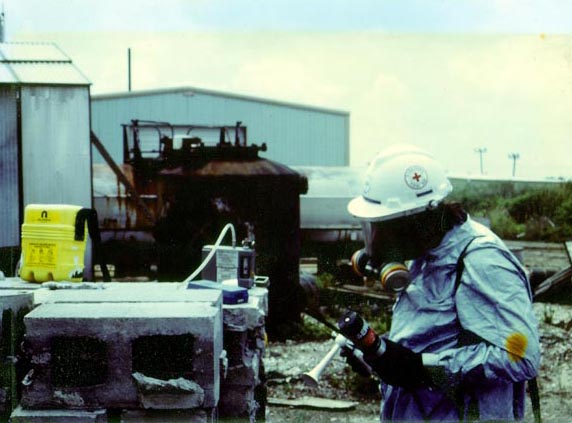
Here is an old, bad photo of me working on the Geneva Superfund Site in South Houston, Texas. Circa 1983. It's no wonder I couldn't get dates.
 Bill Chance