Great Big Books

For a goodly period of time now I have been reading short fiction. That is a good thing – I ‘m writing a mess of short fiction and I should read material similar to what I’m working on – plus, I simply don’t have spare time to waste on anything other than a series of wordly aperitifs.

A snack is not a meal, however, and I have felt an irresistible desire to devour a more hearty course of scribbling. There is a heartiness and depth to a long book. There is a feeling of victory as you down the entire thing. And there is meaning of a subtle nature that can only be conveyed over a longer period of time and greater number of pages.

So I opened up a new Collection in my Kindle library called, simply, “big” and have been watching for sales on ebooks. Even the heaviest tome only takes up a few billion bits of electron cloud inside my Kindle – and the price can be surprisingly affordable. There is no better bargain in the entertainment world than a long book. I’ve been working on variety too, from classics to modern, to homegrown to translated – it’s not hard.

Of course, I’m (mostly)leaving out long books I’ve read before (actually, I’m leaving out books I remember reading). The two that come to mind immediately are “Gravity’s Rainbow,” and “Moby Dick.”

Kindle

Call Me Ishmael

My list so far:

  • Against the Day, Thomas Pynchon (I’ve read about a third of it in the past – will start over. That seems to be how I read Pynchon… dive in, go as far as I can, then beat a retreat until I can return to the scene and soldier on)
  • The Alexandria Quartet, Lawrence Durrell (I know, not technically a single book. I’ve read the first one in the series, but remember little. Like the Pynchon above, I’ll have to start fresh).
  • American Gods, Neil Gaiman
  • Anna Karenina, Tolstoy
  • Battle Royale, Koushun Takami (saw the film, now I want to read the book. It’s surprisingly long – there must be a lot in there that didn’t make it onto the screen).
  • The Brothers Karamazov, Dostoyevsky (I read this in school. Wrote a paper about it. Don’t remember a single thing. Have to read it again).
  • The Three Musketeers, Dumas (After reading The Club Dumas, now I want to go over the source material. It’s been filmed to death, of course, so I’m curious about the original)
  • Cryptomonicon, Neal Stephenson
  • The Golden Notebook, Doris Lessing (Started this years ago, couldn’t get going. We’ll see how it goes this time)
  • Infinite Jest, David Foster Wallace (I’m shocked I’ve never read this. Shame on me)
  • Jonathan Strange and Mr. Norrell, Susanna Clarke (I know nothing about this book. Intend to keep it that way until I start to dig in).
  • Les Misérables, Victor Hugo (I’m shocked I’ve never read this. Shame on me)
  • War and Peace, Tolstoy (I’m shocked I’ve never read this. Shame on me)
  • The Wind-Up Bird Chronicles, Haruki Murakami (I’m a big fan of Murakami. Time to tackle his Big Book)

There are two I don’t have and am waiting to pick up on sale (I have time):

  • 2666, by Roberto Bolaño (I have this one in hardback – but would like to have an electronic copy before diving in)
  • Underworld, by Don DeLillo (I’m shocked I’ve never read this. Shame on me)

And finally, I’m starting with:

The War of the End of the World, by Mario Vargas Llosa.

The Kindle gives you running percentage that shows how far you are – a very helpful goal-setting device for devouring something Big. I’m at about sixty-six percent and enjoying the tome. It’s a horrific semi-historical account of an uprising around the previous turn of the last century in a poverty-and-drought-devastated area in Brasil.

I have a method of working my way through big, long, complicated books like this. I keep a pen and paper and carefully sketch out characters as they appear. The kaleidoscope of scenes filled with picaresque folks that comes strolling across the page can get confusing and frustrating without memory aids. This one is especially difficult because many of the protagonists have the same name. Usually, once I get about halfway through, I don’t need the notes anymore, as the characters have become close acquaintances of mine… over time.

I have no idea how long this will take or whether I’ll stick to it (will probably take breaks). I hope I’m able to live long enough.

Invisible Cities

Cities & Desire 5

From there, after six days and seven nights, you arrive at Zobeide, the white city, well exposed to the moon, with streets wound about themselves as in a skein. They tell this tale of its foundation: men of various nations had an identical dream. They saw a woman running at night through an unknown city; she was seen from behind, with long hair, and she was naked. They dreamed of pursuing her. As they twisted and turned, each of them lost her. After the dream, they set out in search of that city; they never found it, but they found one another; they decided to build a city like the one in the dream. In laying out the streets, each followed the course of his pursuit; at the spot where they had lost the fugitive’s trail, they arranged spaces and walls differently from the dream, so she would be unable to escape again.

This was the city of Zobeide, where they settled, waiting for that scene to be repeated one night. None of them, asleep or awake, ever saw the woman again. The city’s streets were streets where they went to work every day, with no link any more to the dreamed chase. Which, for that matter, had long been forgotten.

New men arrived from other lands, having had a dream like theirs, and in the city of Zobeide, they recognized something from the streets of the dream, and they changed the positions of arcades and stairways to resemble more closely the path of the pursued woman and so, at the spot where she had vanished, there would remain no avenue of escape.

The first to arrive could not understand what drew these people to Zobeide, this ugly city, this trap.

—-Invisible Cities, Italo Calvino

Invisible City - Gateway to Arcturus

Invisible City – Gateway to Arcturus

Thin Cities 5

If you choose to believe me, good. Now I will tell how Octavia, the spider-web city, is made. There is a precipice between two steep mountains: the city is over the void, bound to the two crests with ropes and chains and catwalks. You walk on the little wooden ties, careful not to set your foot in the open spaces, or you cling to the hempen strands. Below there is nothing for hundreds and hundreds of feet: a few clouds glide past; farther down you can glimpse the chasm’s bed.

This is the foundation of the city: a net which serves as passage and as support. All the rest, instead of rising up, is hung below: rope ladders, hammocks, houses made like sacks, clothes hangers, terraces like gondolas, skins of water, gas jets, spits, baskets on strings, dumb-waiters, showers, trapezes and rings for children’s games, cable cars, chandeliers, pots with trailing plants.

Suspended over the abyss, the life of Octavia’s inhabitants is less uncertain than in other cities. They know the net will last only so long.

—-Invisible Cities, Italo Calvino

For a month, starting on June 1, I read a short story every day and wrote a journal entry about them. For me at least, (I don’t know about how it was for you) it was a fun, interesting, and educational experience and exercise. One thing I learned is how wide the world of short fiction is – how varied and variable, diverse and divisive the styles, techniques, and artistry.

So I vowed to continue reading widely… and that brought me to a book by Italo Calvino – Invisible Cities (PDF). Technically, it’s a novel – a short novel. However, it is made up of a long series of very short sketches, each one describing a different, fantastic city – fifty-five in total. These are framed by an outer story, where Marco Polo is talking to Kublai Khan and telling the tales, thereby describing the cities he has visited.

Kublai Khan does not necessarily believe everything Marco Polo says when he describes the cities visited on his expeditions, but the emperor of the Tartars does continue listening to the young Venetian with greater attention and curiosity than he shows any other messenger or explorer of his. In the lives of emperors there is a moment which follows pride in the boundless extension of the territories we have conquered, and the melancholy and relief of knowing we shall soon give up any thought of knowing and understanding them.
—-Invisible Cities, Italo Calvino

The descriptions can be read individually, in relation to each other, and to the deep philosophical questions raised by the framing story.

It is short and easy to read, yet complex – with hidden aspects and dimensions that have to be teased out. It is so full of unique and interesting ideas that it slowed my reading down… I’d devour a half page and then have to rest to let the concepts and thoughts born by the text stop vibrating and resonating inside my head, let it all calm down, before I could read some more.

The book shows a lot of influence of Jorge Luis Borges… and is one book that is referred to as Borgesian. It is full of self-referential conundrums, mysterious contradictions, and postmodern enigmas.

I have to be careful about what I am reading when I write, because my reading is such an influence on what I write. I put up an entry containing something I wrote, Free Breakfast, while reading Invisible Cities a few days ago.

I would love to write like Italo Calvino… though nobody would read it. His fiction is a lot of fun, but it isn’t, for example, something that will ever be as popular as, say Harry Potter.

Now that I think about it… wouldn’t that be cool? A postmodern, Borgesian Harry Potter.

It could explore the duality of Harry Potter’s life. He lives in a cupboard, ignored, miserable, and hopeless for part of the year, then spends the rest in a world of Magic… where he is the chosen one. Which life is the real one… which is the real Harry Potter? Could the dire tragic life of poor Orphan Harry be so demoralizing that it drives him crazy? – Is the whole magical world of Hogwarts born from Harry’s desperation – an imaginary world where he gains unthinkable power and importance – where he becomes the chosen warrior in a war against the ultimate evil?

And what about Voldemort? He shatters his soul into a handful of pieces and stores each one in a Horcrux. He achieves immortality, at the price of a broken soul. Do these items then become Voldemort? How can a soul exist without consciousness? The potential for paradox and existential exploration are endless.

Even something as simple as the paintings…. Dead people make an appearance in the moving, talking paintings of Hogwarts. Is this a form of limited immortality? Do the paintings know they are dead? Are they sad? Are there moving and talking paintings with subjects that were never alive? Why not? If so… what are their memories? Do the dead paintings sleep? Do they dream of the living?

That would be a book worth reading… if someone had the skill to pull it off.

Hidden Cities 1

In Olinda, if you go out with a magnifying glass and hunt carefully, you may find somewhere a point no bigger than the head of a pin which, if you look at it slightly enlarged, reveals within itself the roofs, the antennas, the skylights, the gardens, the pools, the streamers across the streets, the kiosks in the squares, the horse-racing track. That point does not remain there: a year later you will find it the size of half a lemon, then as large as a mushroom, then a soup plate. And then it becomes a full-size city, enclosed within the earlier city: a new city that forces its way ahead in the earlier city and presses its way toward the outside.

Olinda is certainly not the only city that grows in concentric circles, like tree trunks which each year add one more ring. But in other cities there remains, in the center, the old narrow girlde of the walls from which the withered spires rise, the towers, the tiled roofs, the domes, while the new quarters sprawl around them like a loosened belt. Not Olinda: the old walls expand bearing the old quarters with them, enlarged but maintaining their proportions an a broader horizon at the edges of the city; they surround the slightly newer quarters, which also grew up on the margins and became thinner to make room for still more recent ones pressing from inside; and so, on and on, to the heart of the city, a totally new Olinda which, in its reduced dimensions retains the features and the flow of lymph of the first Olinda and of all the Olindas that have blossomed one from the other; and within this innermost circle there are always blossoming–though it is hard to discern them–the next Olinda and those that will grow after it.

—-Invisible Cities, Italo Calvino

Short Story Day Thirty-One – Carnation, Lily, Lily, Rose

31. Carnation, Lily, Lily, Rose
Kelly Link
http://www.fenceportal.org/?page_id=2327

This is day Thirty-One of my Month of Short Stories – the last day – a story a day for June (and one day in July).

Carnation, Lily, Lily, Rose - by John Singer Sargent

Carnation, Lily, Lily, Rose – by John Singer Sargent

Today, for the last post of my Month of Short Stories – I present to you a story I have definitely read before. It’s been a long time, though, and I wanted you to know about this story, this book, and the writer.

I remember clearly, back then… 2002? probably… I was looking for something to read. I came across an article in Salon that listed their favorite books of the year. There, nestled in with such literary giants of our time like The Corrections, Bel Canto, and Austerlitz, was an odd looking little book of stories called Stranger Things Happen by Kelly Link. The magazine raved about it.

Surfing around the web I found plenty of other folks giving it a lot of love. So I bought the thing.

And it was amazing. The stories are best described as adult fairly tales – fantastic and imaginative – passionate and very, very odd. It lived up to expectations.

So please go out and get this book. If you are cheap, it’s available for free download – as are her other works. If you download it and like it as much as I did, you will buy a copy (I think I’ve bought three over the years). She’s coming out with a hardback special limited edition later this year – but it’s a little over my price range right now.

Today’s story, Carnation, Lily, Lily, Rose is a strange piece of fantastic fiction. A recently deceased man, stuck is some sort of odd limbo, is writing letters to his still-living wife. Unfortunately, he can’t remember her name, though he does remember a girl, Looly Bellows, that beat him up in fourth grade.

As time goes on, the scene gets stranger and stranger as his mind continues to drift further away from the mortal plane. I’m not sure if it is an accurate depiction of what happens when we die, and I don’t know if I want it to be, but it’s the sort of thing that should happen if the universe has as much of a sense of perverse humor and strange surprises in the next life as it does in this one.

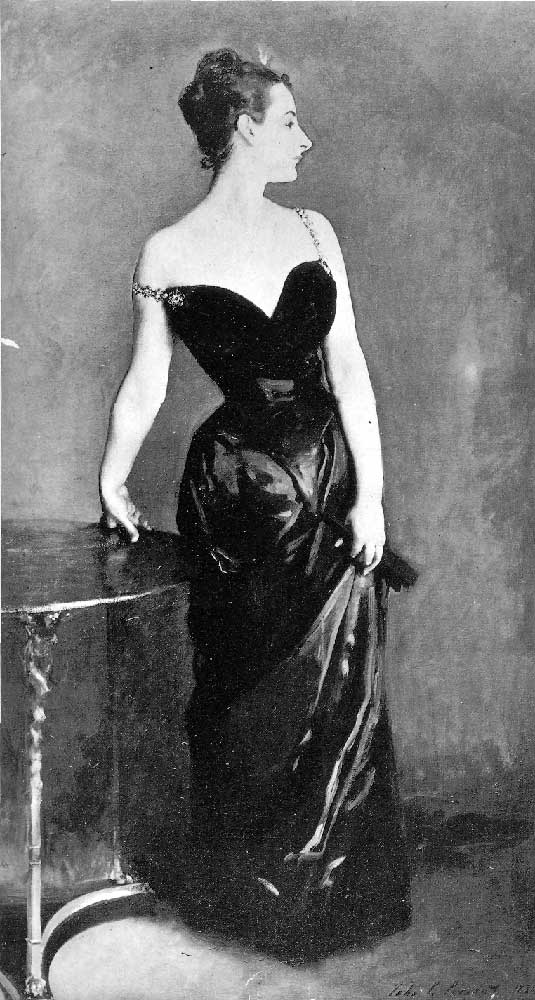
Now, like all obsessions – this story led me down a long rabbit-hole. The title, Carnation, Lily, Lily, Rose is taken from a painting by John Singer Sargent. I had to do a little research on him, and came across the famous story of Madame X.

In Paris he did a portrait of Madame Pierre Gautreau, an young American woman from New Orleans. She was a rising star in Parisian High Society and her portrait caused a huge stir when it was unveiled. A huge stir of the wrong kind.

Sargent had painted her with one strap of her gown hanging down off her shoulder. This, along with her plunging neckline and powder-white skin gave the painting a sensual excitement that wasn’t acceptable at the time.

A photograph of the original painting of Madame X.

A photograph of the original painting of Madame X.

The repainted Madame X - her gown strap is back up on her shoulder.

The repainted Madame X – her gown strap is back up on her shoulder.

He re-did the painting with the strap in a more demure position – but the damage was done. Ms. Gautreau had to slink back to Louisiana to escape the social ridicule. Sargent had to flee to England to regain his reputation.

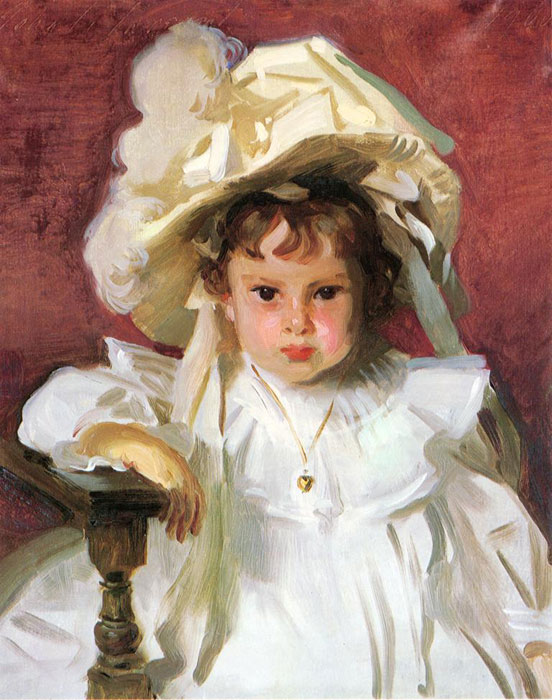
None of this has anything to do with the story – but it’s cool anyway. I’ve become a fan of Sargent because of this story, even though I’ve never been big on portraiture. I always stop and look at Dorothy whenever I visit the Dallas Museum of Art.

Dorothy, by John Singer Sargent, in the Dallas Museum of Art.

Dorothy, by John Singer Sargent, in the Dallas Museum of Art.

So, my advice is to read all of Stranger Things Happen – the other stories are just as odd, but in surprisingly different ways. Then go to the nearest good art museum and take a look at a Sargent – see what you can see in the eyes. It might be useful, help you remember things when you are stuck in limbo. We all will be there, sooner than we think.

I hope you enjoyed some of my month of short stories – it was fun and educational putting it together (though a surprising amount of work). Don’t know what I’ll do tomorrow… maybe a photograph.

Later.

I’ve been here for 3 days, and I’m trying to pretend that it’s just a vacation, like when we went to that island in that country. Santorini? Great Britain? The one with all the cliffs. The one with the hotel with the bunkbeds, and little squares of pink toilet paper, like handkerchiefs. It had seashells in the window too, didn’t it, that were transparent like bottle glass? They smelled like bleach? It was a very nice island. No trees. You said that when you died, you hoped heaven would be an island like that. And now I’m dead, and here I am.
—-Carnation, Lily, Lily, Rose, by Kelly Link

Short Story Day Thirty – Passion

30. Passion
Alice Munro
http://www.newyorker.com/archive/2004/03/22/040322fi_fiction

As we are in the ninth inning, the home stretch, of my month of short stories we come across Alice Munro. She is the master – the best of the best.

I have been voraciously reading Alice Munro for decades now… and she should be in my list of writers that I have read everything – but she writes so much (all short stories) that there is always more. Most of what she writes shows up first in the New Yorker – she is the quintessential New Yorker fictioner.

What she does is magical. Read her stories and pay attention to how she plays with time. There is usually several different time planes going on – complex, yet made clear by careful attention to detail. The story is often told by illuminating subtle changes in a character between fictional scenes that take place on different sides of a shift in the story. Often times this shift is never actually shown or described… merely inferred from what has scarred or uplifted (or both) the characters before and after. There are subtle connections across time and place – you have to look closely to figure them out – but they resonate deep in your mind as you read.

Today’s story, Passion, is pure Munro. A woman is looking back over a critical period of her life – how critical it was and in what way isn’t clear until the final sentence.

I didn’t do this on purpose – but it is very interesting to compare this story to yesterday’s – The Garden Party. Both are tales of class differences. But Passion – the Munro story – is the opposite… a mirror image, of Mansfield’s The Garden Party.

In this one, the protagonist is a poor girl that stumbles into contact with the wealthy. However, as occurs in yesterday’s tale – once in the other’s camp she is exposed to death, and is changed in complex and subtle ways. Both women (both about the same age) are smart, resourceful, and perceptive beyond their years and expectations and are relied upon to help keep things going smoothly. However, both learn that the world is a harder, more complicated, and dangerous place – with darkness, passion, and beauty all wrapped up and twined, twisted, and knotted together.

The wealthy Traverse family in today’s story is not as isolated or as heartless as the Sheridans in yesterday’s – but they are every bit as flawed and are quietly doomed.

Munro spells out this doom without embellishment or symbolism – she simply tells the story – with great skill. It’s perfect. It’s why she is the best.

She had thought that it was touch. Mouths, tongues, skin, bodies, banging bone on bone. Inflammation. Passion. But that wasn’t what she’d been working toward at all. She had seen deeper, deeper into him than she could ever have managed if they’d gone that way.

What she saw was final. As if she were at the edge of a flat dark body of water that stretched on and on. Cold, level water. Looking out at such dark, cold, level water, and knowing that it was all there was.

It wasn’t the drinking that was responsible. Drinking, needing to drink—that was just some sort of distraction, like everything else, from the thing that was waiting, no matter what, all the time.
—-Passion, by Alice Munro

Short Story Day Twenty-Nine – The Garden Party

29. The Garden Party
Katherine Mansfield
http://www.classicshorts.com/stories/TheGardenParty.html

This is day Twenty-nine of my Month of Short Stories – a story a day for June.

Katherine Mansfield was a writer from New Zealand that spent a large portion of her short life in Europe. She lived in the years around World War I. Her upbringing was very upper class (reflected in today’s story) but left that life behind for a bohemian existence. She hung out with some of the other great writers of the time like D.H. Lawrence and Virginia Woolf. She contracted tuberculosis and after years of illness she died at 34.

Today’s story is one of her later stories… and it’s one of the classics. When you first look at it what you see is a tale of class – the silly rich folks with their fancy smancy party, complete with cream puffs and a band, while down the lane the poor folks are dying. All this is true, and if it was all it would be a pretty good tale.

There’s more though, lots more. It’s a coming of age tale, with a twist. The young girl, Laura that has her first exposure to death… even to life outside of her garden party world – is modelled on the myth of Persephone. She visits the world of death and returns.

And the dead man that Laura sees – he is beautiful, untouched – he looks like he is sleeping. One of the turning points in the author’s life is when her beloved brother was killed in a grenade training accident in World War I. She said he was, “Blown to bits.”

So, here in a simple little story, we have issues of class, of life and death, of coming of age and the loss of innocence, and even the horrors of war. This complex tapestry – the end makes sense. Laura decides to tell us what life is… and she answers the only way she can.

There lay a young man, fast asleep – sleeping so soundly, so deeply, that he was far, far away from them both. Oh, so remote, so peaceful. He was dreaming. Never wake him up again. His head was sunk in the pillow, his eyes were closed; they were blind under the closed eyelids. He was given up to his dream. What did garden-parties and baskets and lace frocks matter to him? He was far from all those things. He was wonderful, beautiful. While they were laughing and while the band was playing, this marvel had come to the lane. Happy … happy … All is well, said that sleeping face. This is just as it should be. I am content.

But all the same you had to cry, and she couldn’t go out of the room without saying something to him. Laura gave a loud childish sob.

“Forgive my hat,” she said.
—-Katherine Mansfield, The Garden Party

Short Story Day Twenty-Eight – Pretty Boy

28. Pretty Boy
Richard Ford
http://www.guardian.co.uk/books/2005/jun/25/originalwriting.fiction5

This is day Twenty-eight of my Month of Short Stories – a story a day for June.

The cover of Richard Ford's novel - The Sportswriter.

The cover of Richard Ford’s novel – The Sportswriter.

One day, a while back… I remember I was at a crossroads, but I don’t remember what that was. Some sort of ridiculous existential panic. In adjusting my way of looking at the world, I decided to change what I was reading. That’s the sort of pitiful thing that I do. So I sat down with a fistful of recommended novels lists, and after a bit of seeking and thinking, I came up with The Sportswriter, by Richard Ford. I’m ashamed to admit that one reason was a strange, and probably perverse, fascination with the book’s cover.

So I bought the book and its much-ballyhooed sequel – Independence Day, and read them (the third novel in the Frank Bascome trilogy, The Lay of the Land, had not been published yet) in one gulp. I wasn’t sure what to think of the books…. They were very, very well-written – but I simply couldn’t get myself to care enough about Frank Bascome. I felt sorry for him – for the loss of his child – but his drowning in angst by simply living out the life of a New Jersey family man, sans family, wasn’t interesting enough. There didn’t seem to be enough there there.

Then, after a couple years, I stumbled across Richard Ford’s short stories… which were another deal altogether. More specifically, I read the collection Rock Springs. I found there was some meat on these bones. The stories in Rock Springs put Richard Ford in the category of Dirty Realism (this term was coined by Bill Buford of Granta – he said, “Dirty realism is the fiction of a new generation of American authors. They write about the belly-side of contemporary life – a deserted husband, an unwed mother, a car thief, a pickpocket, a drug addict – but they write about it with a disturbing detachment, at times verging on comedy. Understated, ironic, sometimes savage, but insistently compassionate, these stories constitute a new voice in fiction.”) – along with Raymond Carver, Tobias Wolff, Frederick Barthleme, Cormac McCarthy… and others. These are all writers I love and I was glad to find another one to read.

I read more about Richard Ford’s life – which I at first assumed was an Eastern, academic upbringing – to find he was born in Jackson, Mississippi, and lived a lot of places, including New Orleans (I think a person has to spend at least some time in New Orleans or he can’t fully understand humanity).

…..

Hmmmm…. That’s odd. While I was putting this together, I discoved that the story is in two parts and I had only read the first.

Here’s the second – Pretty Boy Part Two

Give me a few minutes to finish it up and I’ll get back to you.

…….

Ok, that was interesting. I think I liked the story better with the second half missing. There is a bit of action in the second half – but the characters are wooden and, in the end, it signifies nothing, or at least nothing much.

As a matter of fact, I wish I hadn’t read that second part. I think I’ll forget about it.

And so, he granted himself the year for his new money to take him someplace good. He told the two nice studious girls he’d been seeing since college that he was going away and maybe wouldn’t be back so soon. They each expressed regret. One drove him to the airport and kissed him goodbye. His family made no complaint.

In Paris, it was autumn, and he found a tiny, clean flat through a friend who knew a woman who did such things. It was light but noisy, so he was often out. He attended a beginners’ conversation class at the American Library, visited the American bookshop near where he rented in Rue Cassette. He read (for some reason) Thorstein Veblen and Karl Popper, but seemed to meet no one French. He declined dinner with the young business types from his class. He tried to speak, but found that if he spoke French to French men, they would answer him in English, which they wanted to practice.

—–Richard Ford, Pretty Boy

Short Story Day Twenty-Seven – From Hell’s Heart I Stab at Thee

27. From Hell’s Heart I Stab at Thee
Armando Vitalis
http://ubuntuone.com/6iBiMK1EvBCzdb8qqCgLdE

This is day Twenty-seven of my Month of Short Stories – a story a day for June.

A teacher once told me it was possible to make a living selling books that you had paid to have printed. This was decades before ebooks and online publishing. He said you could go around with cases of books and give talks or readings at book clubs, schools, and such and sell enough to get you through the day and on to the next stop. It would be a hardscrabble hand-to-mouth life… but it could be done.

I knew he was right, because I had met someone like that.

Nacogdoches, Texas, is a big town… or a small city in the deep piney woods of East Texas. I was there to deliver a talk on the effects of acid rain on the calcium cycle in red spruce forests at Stephen F. Austin University. My talk was over by noon and I had a hotel room for that night paid for by the University, and I was going to use it – so I had an afternoon to kill in Downtown Nacogdoches. There wasn’t much to do, but I wandered into some place off the square that sold antiques and notions – called The Runaway Mule.

There was a guy that seemed to be the owner, setting up folding chairs in a fan shape around a little worn wooden lectern. Nothing to do, I decided to help, and we chatted while we worked. I asked him about the name of his store.

“That’s a good question,” he said. “In 1912 a singing group called ‘The Six Mascots’ were singing in the opry house here. Someone rushed in and yelled that there was a runaway mule outside. The crowd left, figurin’ that the mule would be a better show that those singers. When they filed back in the head singer, Julius, was so pissed he let ’em have it. He was yellin’ stuff like, ‘Nacogdoches is full o’ roaches,’ and ‘the jackass is the flower of Tex-ass.’ Well, the crowd thought it was hilarious and the singers decided then and there to be comedians. That guy, Julius, changed his name to Groucho and they started goin’ by their family name, the Marx Brothers.”

That story seemed pretty far-fetched to me, but I had to admit it was a good one. We finished setting up the chairs. “What’s happening now?” I asked.

“Oh, the Nacogdoches Ladies Reading Society is having a meetin’.” the owner said. “Some writer I sure never heard of is coming in to try and sell some books.” He tapped a ratty looking cardboard box that had obviously been opened and re-sealed a few times, then pushed it under a folding table he had set up next to the lectern.

I thought this might be worth sitting in on, so I walked down and had a burger and shake a few doors down and came back in time for the Ladies Reading Society. Sure enough, I found the seats full of Texas matriarchs, gossiping and waving their programs to try and bat away the flies and heat.

Right on time, the author, Armando Vitalis appeared from the men’s room in the back of the store and took his place at the lectern. The writer was very tall and almost impossibly thin. His hair was thick, dark, long, and wild, with only a touch of gray starting to pepper his temples. He wore a light suit that was fashionable and expensive at one time but gone to shiny at the elbows and knees.

He introduced himself and went into a long story of how he had decided to become a writer while working as a bookkeeper at a foundry in Cleveland. He name dropped a few popular authors and expounded on their theories of fiction that he had pried from them during various parties at New York publishing houses. At hearing these famous names and stories of the exotic big city, the level of excitement of the Ladies Reading Society became noticeably higher – their faces would flush and their waving of programs went faster and more desperate.

Then Armando Vitalis did a couple of readings. First, he read an untitled short story that seemed to consist of a series of odd action-filled short scenes that seemed unconnected to each other. The women were confused, but eventually settled down in that way that folks sometimes do when they assume they are simply too uneducated and ignorant to understand what is being presented to them… but don’t want to admit it to anyone, even themselves.

Then he recited a scene from his new, as-yet unpublished novel, Laid With Iron Rails. It was an embarrassingly detailed love scene between an older woman and a much younger man. You could see the Reading Society ladies squirming, uncomfortable… but riveted nonetheless.

They all applauded with enthusiasm when he finished.

He sat at the folding table and commenced to autograph and sell copies of paperbacks he pulled from the ratty cardboard box and stacked on the table. The Nacodoches Reading Society lined up clutching their pocketbooks, waiting excited yet patient. Everyone bought at least one book. About half left with their purchases and the rest stayed behind, clumped together and talking in low tones, maybe hoping to get another chance to meet with the author.

I bought a copy of a novel, Game for His Crooked Jaw. I asked Vitalis to sign it “To Starbuck.” He glared at me, but I wanted him to know I recognized the quotes that he was using for his titles.

I never read the book. It was so poorly printed and cheaply bound, that it literally fell apart before I could get around to steeling myself up to diving into the thing.

The funny thing is, I did see Armando Vitalis one more time. That night, at the hotel bar, I saw him sitting at a table with the gray-haired, but remarkably well-preserved vice-president of the Nacodoches Ladies Reading Society. He seemed to be hitting a dark whiskey pretty hard while she sipped at a white wine. They were still there when I went back to my room.

There doesn’t seem to be any record of Armando Vitalis on the Internet anywhere. I don’t know how long he was able to keep up his dream of writing and selling his books. The only work I could find was this strange little short story From Hell’s Heart I Stab at Thee – which was published in a shoddy online zine called Handicapped by Laziness. The zine is long gone, but the link to the story still seems to work.

I’m not sure for how long.

She reached a point near the end of the market and was beginning to worry that her contact would not show. She was looking at a pyramid of strange, oblong, spiked fruits, nonchalantly resting her fingertips on one of the samples. She was trying to ignore the peddler that had sliced one open with a rusty machete and was offering her a sample of dripping purple flesh that gave off a pungent sour odor and was rapidly drawing an even thicker swarm of flies. Right then the top fruit in the pile exploded in the crack of a high powered bullet, spraying her with pieces of warm, sticky pulp and sending the crowd into a panicked frenzy.
—-Armando Vitalis, From Hell’s Heart I Stab at Thee

Short Story day Twenty-Six – The Secret Room

26. The Secret Room
Alain Robbe-Grillet
http://www.101bananas.com/library2/secretroom.html

This is day Twenty-six of my Month of Short Stories – a story a day for June.

The first book I read by Alain Robbe-Grillet was Jealousy (La Jalousie). I’m not sure why I read it (nobody I’ve ever met has read any Robbe-Grillet) – I think I picked up the paperback from a clearance pile in a used books store. Probably, I liked the cover.

It was an amazing book. Robbe-Grillet’s writing is “realist” or “phenomenological” or “a theory of pure surface.” There is no plot, no characters, no inner dialog… no nothing other than descriptions of scenes. In Jealousy there is an unseen and unheard narrator – the book is telling the reader what this person is looking at. Through repetition, geometric arrangements, repetition, details, and finally repetition – a story is built up, layer by layer. Jealousy takes place on a banana plantation where the unseen narrator is worried that his wife is having an affair with a neighbor named Frank.

The reason it works so well, I think, is that the mind of the reader fills in the gaps of story, character and situation that are completely absent from the text. Your imagination is guided by the images that are transmitted… especially by small details that change from one repetition of an image to the next. The book is entirely free of emotion – yet the tension, dread, and excitement builds in the reader’s mind… the inner vision that is conjured up is so much stronger – it is personally tuned to the psyche of the reader by the subconscious – than if it was spelled out by the author.

At least, that’s what I took from it.

Today’s story, The Secret Room, holds true to the Robbe-Grillet style. It is a single scene, meticulously detailed, with no explanation of who, why or how. Yet, at the end, the effect is strong, the emotions are stirred – though there are plenty of loose ends left hanging… so to speak.

One fact that might help, is that the story was dedicated by the author to Gustave Moreau. The story certainly could be interpreted as a description of a Moreau painting. The last word in the story certainly would indicate that.

But the painting moves back and forth in time. Is the story the reaction of a person looking at a painting? Is the author/writer/unknown narrator describing his own thoughts on what must have occurred? Or is he using the technique of a painting to convey the horror and contrasting the terror and violence with the beauty that still resides in the situation?

Almost certainly… all the above and more.

In the background, near the top of the stairway, a black silhouette is seen fleeing, a man wrapped in a long, floating cape, ascending the last steps without turning around, his deed accomplished. A thin smoke rises in twisting scrolls from a sort of incense burner placed on a high stand of ironwork with a silvery glint. Nearby lies the milkwhite body, with wide streaks of blood running from the left breast, along the flank and on the hip.
—-Alain Robbe-Grillet, The Secret Room

The Apparition, by Gustave Moreau

The Apparition, by Gustave Moreau

Short Story day Twenty-Five – The Use of Force

25. The Use of Force
William Carlos Williams
http://www.classicshorts.com/stories/force.html

This is day Twenty-five of my Month of Short Stories – a story a day for June.

I have always thought of William Carlos Williams as a poet. His poem “XXII” (which most people call “The Red Wheelbarrow“) has always been a wonderful touchstone to me – such an example of the power behind a few simple words. I never knew he wrote short fiction. And I really never knew that he was a physician. A biographer said that he, “worked harder at being a writer than he did at being a physician” – apparantly he was pretty good at both.

Does that illuminate today’s very short short story? Is it important that the author knows what he is writing about and in all likelihood is writing almost directly from experience?

That’s a tough question. I imagine that a very talented writer could imagine what it would be like to be a doctor when confronted with a stubborn child – of course, anyone could type out the same words. But the fact that an experienced physician wrote the piece gives it an air of authority that it wouldn’t have otherwise.

Is that important? Is it fair? Is Batman a Transvestite? Who knows?

At first, the story seems to be a musing on the use of power. Is it appropriate to force a human being to do what they don’t want to do? I don’t think that’s the real intent here, though. First of all, it is undoubtably a matter of life and death – diptheria was an often fatal disease then – both for the child and for society in general. Of course it was appropriate for the doctor to force her to give up.

The real point of the story is the doctor’s attitude. He seems to be a good man, a caring man, and is there to save the child’s life, after all. But her insubordination awakens a primitive passion in the doctor, he finds himself wanting to hurt the child.

It’s a fascinating scene, especially in the hands of someone that knows, and someone with the skills with words of William Carlos Williams.

Get me a smooth-handled spoon of some sort, I told the mother. We’re going through with this. The child’s mouth was already bleeding. Her tongue was cut and she was screaming in wild hysterical shrieks. Perhaps I should have desisted and come back in an hour or more. No doubt it would have been better. But I have seen at least two children lying dead in bed of neglect in such cases, and feeling that I must get a diagnosis now or never I went at it again. But the worst of it was that I too had got beyond reason. I could have torn the child apart in my own fury and enjoyed it. It was a pleasure to attack her. My face was burning with it.
—-William Carlos Williams, The Use of Force

Short Story Day Twenty Four – Red Nails

24 Red Nails (Conan the Barbarian)
Robert E Howard
http://www.gutenberg.org/ebooks/32759

This is day Twenty-four of my Month of Short Stories – a story a day for June.

Weird_Tales_Red_Nails

Nearly four years ago, WEIRD TALES published a story called “The Phoenix on the Sword,” built around a barbarian adventurer named Conan, who had become king of a country by sheer force of valor and brute strength. The author of that story was Robert E. Howard, who was already a favorite with the readers of this magazine for his stories of Solomon Kane, the dour English Puritan and redresser of wrongs. The stories about Conan were speedily acclaimed by our readers, and the barbarian’s weird adventures became immensely popular. The story presented herewith is one of the most powerful and eery weird tales yet written about Conan. We commend this story to you, for we know you will enjoy it through and through.
—-From Weird Tales, 1936

A dozen years ago, in February of 2001, I had just finished up a solo camping trip to Big Bend way out in far west Texas. I had a long drive back to the Metroplex, one I had made before. This time, however, I had picked a different route back, one that was slightly longer than usual.

Instead of going north to Interstate 20 and taking it back, I caught 67 through San Angelo and on to Brownwood, then north to the little hamlet of Cross Plains. Once I made it to that small town, I followed a little map that I had scribbled to a tiny house on the west side of town. I stopped, looked at the nondescript wood frame dwelling for a minute, then went back to my car and drove the rest of the way home.

I had wanted to see that house because of the person that lived in it in the 1930s – it was the childhood home, and the place he committed suicide, of Robert E Howard. Even though it looked exactly like a million other old farmhouses all across the Great Plains – I wanted to see this one… to see it, and nothing more.

Like anyone that has been a voracious reader for almost half a century now, I have read my fair share of pulp. Mostly devoured in the form of cheap paperback reprints, I was familiar with Conan, and with Robert E Howard… along with the other writers of depression-era fantastic, gothic, and strange tales – plus their imitators that have continued the tradition still.

But the specific incident that lead me to my stop in Cross Plains had occurred on a cult movie night at the Dallas Museum of Art. I had seen that they were showing a film I had never seen before – The Whole Wide World – an elegiac story of Robert E Howard (played by Vincent D’Onofrio) and his relationship with a girl named Novalyne Price (Renée Zellweger, in one of her first roles).

It was an amazing film and one that almost nobody had seen. It was so representative of the writing life, the desire for creativity and expression, the sad doomed love story, and the insane dreamer pounding out madness for pennies a word. Even the evocation of rural Texas in the depression felt true and fascinating. The representative from the distribution company came out and thanked everyone for seeing it – he said, “We are so proud of this movie and want as many folks as possible to see the film.” Now it’s more available… you should take a look.

I found out that it was based on a memoir by Novalene Price – called One Who Walked Alone – which hadn’t sold many copies. I ordered it from Amazon and (though it really wasn’t particularly well-written) enjoyed it thoroughly.

So here’s a pulp novella from Robert E Howard, Red Nails. Don’t think of Arnold and his movie when you read it… think of the doomed crazy boy hammering away in the back of that little farm house in that little town in Texas… fighting back his demons the only way he can – with a typewriter.

“Five dead dogs!” exclaimed Techotl, his flaming eyes reflecting a ghastly exultation. “Five slain! Five crimson nails for the black pillar! The gods of blood be thanked!”

He lifted quivering hands on high, and then, with the face of a fiend, he spat on the corpses and stamped on their faces, dancing in his ghoulish glee. His recent allies eyed him in amazement, and Conan asked, in the Aquilonian tongue: “Who is this madman?”

Valeria shrugged her shoulders.

“He says his name’s Techotl. From his babblings I gather that his people live at one end of this crazy city, and these others at the other end. Maybe we’d better go with him. He seems friendly, and it’s easy to see that the other clan isn’t.”

—-Red Nails, by Robert E Howard