Library Book Sale

The Richardson Library had their annual big-ass book sale this weekend down in the crowded basement multi-purpose room. This used to be a massive deal to me. I would get a huge donated shopping bag at the entrance and fight my way along the long tables piled with paperbacks or heaped with hardcovers – the stacks screaming, protesting the weight. I would fill my brown paper bag until the kraft was tearing, pay my fee, and eagerly get my haul home.

Now, though, I have my Kindle. There are more books hiding in that slim slip of plastic than I can possibly read in the few remaining years I have allotted to me. I feel fairly certain that I will pass through this vale of tears with more than a few files left unopened.

Kindle

Call Me Ishmael

Still….

I almost skipped the book sale, but I went more out of nostalgia than any logical purpose – though I do know there are books that I’ve been looking for that are not out in digital format. Plus, it is sometimes nice to have a real, physical paper book – something you can give away or curl up with when your peepers are tired of pixels.

So I eschewed a shopping bag and simply pushed myself past all the enervated shoppers. Once more into the breach.

A good part of the large but cramped basement room was dominated by a handful of families that knew each other. They had a fleet of the massive baby carriers (barely smaller than the aircraft variety) that blocked entire aisles and provided a perch for their pre-reading hellions to reach out their snot-and-saliva encrusted paws and pull teetering piles of books onto the floor while giggling like giddy gibbons. Their slightly older siblings were grabbing stuff out and exclaiming wisdom like, “I only want books about dogs!” or “Are you SURE this is a childrens’ book?” while their mothers clucked loudly at each other with self-satisfaction at the precociousness and preciousness of their satan-spawn procreations.

Finally, after forever, this boiling mass of distraction and pain moved out the front and could be heard arguing over the price of their purchases in the hallway. The sound in the room was reduced to a certain low growl made up of the combined almost-inaudible grunting of the serious bargain hunters scooping up endless tomes that they had never known of until today but could simply not live without. This is a sober business. The air-conditioning, installed under a government lo-bid contract, struggled to cut the heat and miasma of used book mold-spores and bargain-hunting sweat.

So, did I buy anything? You betcha.

Hardbacks were only two dollars and paper seventy five cents. It would be a crime to let this opportunity go unheeded.

I bought a really nice hardback copy of Alice Munro‘s Open Secrets. Someone at work expressed a love of short stories yet had never read any Munro (yeah, I know…). I want to reread “The Albanian Virgin” carefully and outline it – it is the most amazingly structured piece of short fiction I’ve ever seen and I want to try and figure out how she does it.

On a whim I grabbed a paperback collection by John McPhee. This one is called Table of Contents and is a collection of his amazing short non-fiction. I can always read me some McPhee and come out of it knowing something I didn’t before.

After choosing these two light bits of bon-bon I thought for a minute and hauled out a big hunk of meat – the nine-hundred page posthumous magnum opus 2666 by Roberto Bolano. I have had my eye on this gigantic pile of translated text for a bit. For some reason I thought it would be fun to attack it as a fortress of paper rather than a cloud of bytes. Will I ever actually read it?

Probably. If I live long enough. Stick around and find out.

The parking lot had been full and I had to hike almost to the post office to get to my car. A thin older man scuttled by me, on his way in. He stopped and stared at the burden under my arm.

“Hey, I want all three of those books! I was worried they would be all picked over by now!”

He shot off towards the maelstrom of the book sale. If he had waited I would have sold him the three I had… at only a slight profit.

Cloud Atlas

Where are you right now?
In my hut in my back garden in West Cork.

 Where do you write?
Here, at my desk; in my notebook, in an armchair; on planes.

How do you write?
By recording in words the scenes that are workshopped and staged in my imagination.

What keeps you writing?
My addiction to it.

Who do you write for?
Me, and the rest of the world. Nobody else.

—- David Mitchell, in Untitledbooks

Cloud Atlas

Cloud Atlas

What is my favorite book? What is the best book I’ve read? —These are unanswerable questions. There are so many and my opinions at the very top shift over time like sands in the wind or shadows in my memory.

Still there is an upper stratum. This is occupied by fossilized memories of hours, days, sometime years spent poring over pages of labyrinthine structure, subtle metaphor, and deep, thick, and complex prose. This is the land of Pynchon, the landscape of Mason & Dixon, V, and, most of all Gravity’s Rainbow. That book took me twenty five years to read… and it was worth every second.

It is the land of Moby Dick, of Infinite Jest, of House of Leaves.

It is the land of Cloud Atlas.

If you catch me at the right time, I’ll tell you that Cloud Atlas is the best book I’ve read. Other times I’ll tell you it’s my favorite book. Rarely does a single entity spend time in both positions – as far as I’m concerned, that’s great praise.

David Mitchell’s Cloud Atlas is a complex book and one with a unique structure – but it’s not hard to read. The structure is very carefully planned out, logical, and executed with panache – not like the shambling monstrous recursive story of Gravity’s Rainbow.

The book is a collection of six different story threads. The first half of the book the stories are half-told, in chronological order. It starts in the South Pacific, in 1850, in a sort of Melvilish, three-stooges version of a whaleless Moby Dick. The story then jumps to 1931 where a bankrupt musician tries to scam himself back into a state where he can feed himself and love again. Then it leaps to California in the 70’s with a thriller set at a nuclear plant.

At this point the stories move into the future, starting with a publisher trapped in a nursing home. We then switch to a dystopian future where the clones begin to rebel. Finally, we arrive in the unknown distant future where mankind has thrown off or lost its technological skin and is back to telling tales around the campfire.

Here, the book turns and goes back, working its way through the same stories again for their second half denouement, in reverse order, until we are left back in the 19th century South Pacific.

What is the connection between these diverse threads? You will have to read the book to find out.

Does this scare you? Will you avoid this tome in favor of the newest vampire mystery? Shame on you. Or not. Whatever. It is definitely the kind of thing you will like, though, if you like that kind of thing.

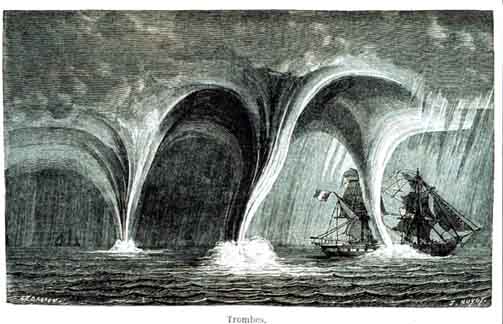
Waterspouts

Waterspouts

Why am I bringing up this odd and complicated book now? No matter how interesting?

I used to read a lot of movie reviews. I always tried to keep up on what was happening in the world of cinema. This was ruining my viewing enjoyment, however. I wanted to get back to that world of simple pleasure when I sat in front of the silver screen (or cathode ray tube [or light emitting diode (or liquid crystal semiconductor [ or tiny cloud of plasma-induced noble gas])]) unknowing about what was going to happen next. So I stopped reading movie reviews until after I had seen a film. I stopped following the pages outlining what was coming out next from what director.

Still, I stumble across bits of information now and then. That Interweb-thing is good for that, isn’t it?

This week I discovered that they are making a big-time, big-budget movie of Cloud Atlas.

It is one of the books that, when I was reading it, I thought, “This thing would be unfilmable.” Apparantly, someone disagrees with my assessment.

It seems it will have two directors – The guy that directed “Lola Rennt” will do the story threads that are set in the past and the Matrix director(s) will do the stuff in the future.

Big time actors too, Tom Hanks, Halle Berry, Hugo Weaving, Susan Sarandon, Jim Broadbent… It appears the actors will be playing more than one character spread across time (have to get your money’s worth out of Tom Hanks).

Well, I’m not sure how this will all play out – the book is unfilmable, really – but it will be interesting. I do hope it gets made. If it is good, it might be great. If it fails, it will be a glorious failure.

Storm

Storm

(whet your appetite) Short works online by David Mitchell

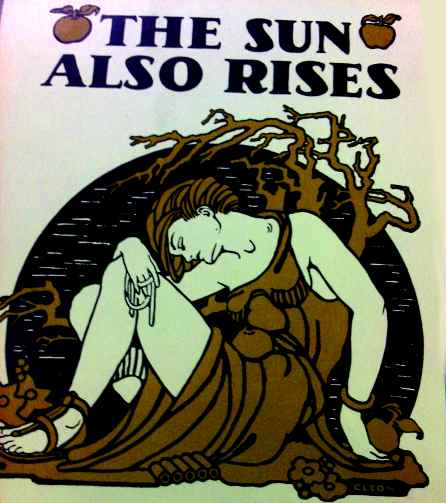
The Sun Also Rises

Sun

The Sun Also Rises

“In bull-fighting they speak of the terrain of the bull and the terrain of the bull-fighter. As long as a bull-fighter stays in his own terrain he is comparatively safe. Each time he enters into the terrain of the bull he is in great danger. Belmonte, in his best days, worked always in the terrain of the bull. This way he gave the sensation of coming tragedy.”

– Chapter 18, The Sun Also Rises, Ernest Hemingway

After another long day at work I drove to Love Field at ten to pick Nick up. He was returning from a few weeks in San Diego and out on a destroyer with the Navy.

While I was waiting at the baggage claim I finished reading Hemingway’s The Sun Also Rises.

As always, I am in awe of Hemingway’s tense terse prose and how he says so much with so little.

I have wanted to read this book ever since I read “The Drifters” by James Michener when I was in high school. There was a little bit of time that everybody was required to read “The Drifters.” The book made a big impression on me at the time, though I don’t remember any of it anymore. The only thing I remember is that the book made me want to go to Pamplona and run with the bulls.

Now I have to decide what to read next. Hundreds of books lie there, beckoning. So little time and so many stories.

Please forgive me. I’ve been thinking a lot about pride and seriousness. I want to work harder and do better on everything I do.

But right now I’m so tired. So I will bid a sweet adieu and trot off to dreamland. I’ll pick it up tomorrow.

Too Much Happiness

Cabbage

I'm afraid to grow up because sometimes it feels it will never be this beautiful again.

I couldn’t sleep last night and I decided to clean up my reading list a bit and finish something I had already started. It didn’t take long to set in on the last story in Alice Munro’s last collection of short stories, Too Much Happiness. This was the long story… almost a novella… that the collection was named after. Too Much Happinesswas addicting and I had to keep reading until I was done, no matter how tired I was or how soon the next day’s work would come.

Alice Munro is a brilliant genius. She is, in my humble opinion, the unquestioned master of her genre. If you read the plot summary of one of her stories, you will scratch your head – it will read as melodrama, or a series of random, unconnected action, or it will seem that nothing much really happens. Her mysterious skill is so great that when you actually read the test it makes sense, draws you in, and takes you on an emotional journey far from your pitiful little room where you sit clutching that tattered paperback.

If I could have one ability – I would choose to be able to do, whatever it is, that she does. She makes seamless connections where none should exist. There is a concept that art is the conveying of something that can’t be done any other way. And that is what Alice Munro does, that is her genius. You can’t really summarize or explain what she writes because it is art of such exquisite subtleness that it has a kind of Heisenberg Uncertainty about it – to explain it is to change it.

The collection has a series of her typical mastery. Thinking about it, I almost want to go read it again.

But that’s not what I want to talk about tonight. I want to discuss that last long story, because it is different than what she usually writes.

The long story, “Too Much Happiness” is the story of a woman traveling across Europe one winter in the last decade of the nineteenth century. She visits a series of people from her past and spends a lot of time on cold trains moving through dreary country thinking about her life.

As I plunged on I realized that this was a real person that I had heard of before. The woman was Sofia Kovalevskaya – the first Russian female mathematician. She had been rumored to be the subject of a Thomas Pynchon novel – though she ended up being only a minor character. A fascinating character with an unusual, varied, courageous, and ultimately tragic life. Given such a dynamic protagonist most authors, writers of lesser vision and talent, would have wrote of the high points of such a person, scribbling in breathless prose her struggles to become a woman of letters in a time and place this was unheard of – her arranged marriage – her wild affairs – her political involvement – her friendship with famous figures of the day: Darwin, Eliot (there is a passage in Middlemarch where her mathematical theories are mentioned), and Dostoevsky.

But Munro spends most of her words simply detailing her journey, the people that she shares her compartment with, the difficulties she has with the changing weather, languages, and currency she has to deal with.

And I don’t know how she does it… but it works. By the end you feel you know Sofia… you want to meet her… and most of all you care about her. The ending is devastating, but not unexpected. It is, after all, a life.

The final sentence notes that there is a crater on the moon named after Sofia Kovalevskaya.

And, that’s that.


Reviews of the Alice Munro Collection Too Much Happiness:

Too Much Happiness

Too Much Happiness

The best-laid schemes

The best-laid schemes o’ mice an’ men
Gang aft agley,
—-To a Mouse, Robert Burns


Furnace

Furnace

I had great plans for the weekend. I even wrote them down – a two page list in one of my Staples Bagasse Composition Books I carry with me always. Two pages! Who the hell am I kidding?

Well, of the projects I wanted to complete, I finished… hmmm… let me count… none.

On Sunday, around noon or so, I was trying to decide whether to go to the library and write (I have a certain table at the Richardson Library I like to work at – the library is open from two to six, which is a nice constrained four hour writing time – it’s shocking how fast the time flies) or to go for a bicycle ride. I decided to kill two birds with one stone and ride my bike to the library.

Table

My favorite table at the Richardson Library.

I made my preparations – packing my Alphasmart Neo (don’t want to ride my bike with my laptop), pens, notebooks, water bottles, clean shirt, towel, and such and sundry stuffins. I put my backpack on and went out into the blast furnace of the garage to get my bike. The front tire was flat.

I stood out in the sun behind the house, found the telltale little white spot where the thorn had penetrated, took everything apart (nasty little thorn, really), patched the tube, put it together, and pumped everything back up.

Maybe a half an hour. I was drenched in sweat.

I had calculated that I would be able to get to the library in the awful heat by moving quickly. The time I spent fixing the tire was too much, though. I rode about a mile and decided it was too risky. The temperature, the sun beating down, the still air… it was all going toxic. By the time I made it home I was beginning to get a little dizzy.

I am too old and way too out of shape for this. All I wanted to do was veg out in a dark cave of conditioned air. The bit of overheated exertion wore me to the bone. At that point I wasn’t even up to driving to the library. I rested a bit, went to eat with the family, and at sunset walked down to Lee’s last softball game. Once the sun is down, it’s a lot more bearable. I think the solar radiation beating down is worse than the superheated air.

I’ve complained about the heat already. And it wasn’t even bad back then, not like now. It’s always hot here in the summer, of course, but this is getting ridiculous. It wears everyone out – it is so hard to get anything done.

Deadlier than the Male

Deadlier than the Male

The only thing I accomplished was to read another bit of Pulp Fiction I had queued up. This one was Deadlier than the Male, by James Gunn. No, this isn’t James Gunn, the science fiction professor that teaches at my alma mater (yes, I took a class from him, but that’s a whole ‘nother story). This James Gunn seems to have not written another novel. Nobody seems to know anything about him. The book was made into a film in 1947 called Born to Kill – which I’ll try to find.

Born to Kill

Born to Kill

It’s an odd, crazy book. I wouldn’t say it was a good book, but it was something. The language is simple, but arresting. The first line – ”Helen Brent had the best-looking legs at the inquest,” pretty much sets the scene. Most noir pulps have a small number of characters, but in this one, every chapter introduces somebody new. They keep arriving faster than they are killed off… until near the end. With each fresh character the story splits until the plot is like a big twisted knot of desperation and evil, stretching from Fresno to Frisco. I had a bit of trouble keeping track of who was who, and a few of the participants seem to simply disappear from the book once their utility wears thin, but the book was short and the story tumbled forward picking up flotsam and jetsam from the sewer of human malice until it all crashed down into the last few pages.

Since I wasn’t up for anything useful I was able to get through the book in one day. Now, I have some more pulp noir stuff in my reading list, but I need to find something different, maybe even something a little uplifting. After reading this one… I feel sort of dirty.

Heat
Heat
 

The Sound of his Horn – by Sarban

The lurid cover art from The Sound of his Horn by Saban

The lurid cover art from The Sound of his Horn by Saban

I finished Erik Larson’s Thunderstruck and wanted something light and easy to read – so I looked through my collection of pulp ebooks and came up with Sarban’s The Sound of his Horn. This was an odd bit of fiction that I had found recommended here and there across the interwebs.

It’s an interesting amalgam – told as a story-within-a-story… it has time-travel science-fiction aspects, alternate history, a possibly unreliable narrator (one of my favorite literary devices), themes akin to a reverse Island of Dr. Moreau, a bit of an unlikely love story, while at the heart it is a “Most Dangerous Game” tale on steroids.

What’s odd about the book is that it is told in a slightly archaic, literary style (I had to use the dictionary quite a bit as I read) but the story is full of lurid, shocking elements that would be at home in the most modern trashy paperback. In the story, the protagonist finds himself thrown a hundred years into a future where the Germans have won World War II. A Teutonic lord rules a massive forested estate where his decadent guests hunt half-naked women costumed as deer or birds. They are captured alive by the hunt and served as after-dinner entertainment trussed up and delivered under giant silver serving-domes.

See what I mean. And that is not the worst of it, by any means.

I really don’t know if I’ve read anything as strangely sophisticated and sleazy at the same time.

In summary – it’s a short novel and more than entertaining enough. It’s well worth reading – if that’s the sort of thing you want. It’ll stretch your mind more than a bit. You can get an ebook copy here or here.

The author, who chose the pen name of Sarban, was John William Wall, a British Diplomat for over thirty years and a published writer for about two. Other than The Sound of his Horn he has a couple collections of fantasy short stories (some ebooks here). He must have been an interesting man, a combination of a sharp mind and a sordid imagination.

Thunderstruck

Marconi antennas at Wellfleet

Marconi antennas at Wellfleet

Creative nonfiction is the use of fictional techniques, such as characterization, conflict, foreshadowing, in the service of a factually accurate narrative. To me, the most important aspect that separates creative nonfiction from, say, journalism or scholarly writing, is the use of scenes. The story is broken up into scenes of varying length and detail, carefully crafted and arranged to affect an emotional result in the reader, while staying strictly within the known facts.

In the many years since In Cold Blood there have been many masters of Creative Nonfiction… Mailer, Wolfe, McPhee spring to my mind immediately… but right now the current master of the genre, in my humble opinion, is Erik Larson.

I read “Isaac’s Storm” a few years ago and was absolutely enthralled. Of course, the fact that I am very familiar with Galveston and the Bolivar Peninsula made the story even more harrowing and effective. For years we vacationed at Crystal Beach on the Bolivar Peninsula and I would imagine the horror of the storm surge inundating the island. I would look at the black iron lighthouse and imagine the poor souls huddling inside as the water rose and the winds howled. I read the book before Hurricane Ike struck and wiped our old vacation haunts off the face of the earth.

Then I read “The Devil in the White City” – which didn’t have the same emotional effect on me – but was actually a better book. It was fascinating in its story (which I knew nothing about) of the fantastic Chicago World’s Fair. This story of man’s best creations on display was contrasted with the darkest depths of human depravity in the parallel story of H.H. Holmes, the country’s “first” serial killer, who set up shop in his “murder castle” constructed only a few blocks from the fair.

The book is mesmerizing.

I went to a lecture by Erik Larson at the Eisemann Center here in Richardson and loved it. He talked a lot about the research he did for his non-fiction. I remember he discussed one sentence in Isaac’s Storm where he described what Isaac Cline saw, heard, and even smelled while he walked from his office to his home the day before the hurricane hit. “People ask me how I know what he experienced on his walk over a hundred years ago,”  He went on to explain that he knew from Cline’s letters he walked home and Larson learned from the maps of the city that there were stables and workshops on the way, and Cline would smell the horses and hear the workers.

It was very impressive.

So now I’ve finished a third Larson non-fiction book, published a few years ago, Thunderstruck. This, like Devil in the White City contrasts a famous accomplishment – Guglielmo Marconi’s successful “invention” of wireless communication, with a horror – Hawley Crippen, the most unlikely of murderers. The two stories are told separately, until the unexpected coincidences of history brought the two together in an unexpected way.

I found the Marconi story the more interesting of the two. The murder was horrific in its details – but the murderer was portrayed as almost a sympathetic character. Marconi was especially interesting in the fact that he didn’t actually invent anything – he never really even understood how radio worked – but he had the single-mindedness, courage, and business acumen to put other people’s inventions to work in a way that made sense and was successful.

And isn’t that the most important thing… really?

Any criticism of the book is merely picking nits. Larson is famous for layering on detail and here, especially in his description of the murderer’s daily life, it piles up pretty thick and gets a little tedious. I would like to have had less information on Crippen’s love life and more on the fantastic, gigantic, wireless installations that Marconi built on both sides of the Atlantic – spending millions of dollars and risking his entire company trying to get Morse code across the sea – never mind that nobody thought it was possible, that undersea cables could already do the job, and Marconi had no idea what he was doing in the first place.

The ultimate irony is that, in an odd way, the murderer was responsible for Marconi’s ultimate success.

So, in short, very good book, put it on your reading list – enjoy yourself and learn something at the same time.

Larson has another book out that I haven’t read – “In The Garden of Beasts: Love, Terror, and An American Family in Hitler’s Berlin.“ Oh, man, that sounds good, doesn’t it?

Early Marconi Radio

Early Marconi Radio

The Compleat Werewolf

The Compleat Werewolf

The Compleat Werewolf

There are too many werewolf stories around these days. And way too many vampire stories. I have not read any of the Twilight series, so I will not denigrate it, I will simply say it doesn’t interest me enough to waste my precious reading time. And I will not even look at a vampire story now – it has been so overdone.

We were talking about this the other evening in our writing group, and my whining brought back to my head a sudden memory of a long time ago. I remembered reading a short story called “The Compleat Werewolf” by Anthony Boucher, a giant in the world of early Science Fiction and mystery type stuff (he was a Science Fiction editor and a Mystery writer). Clearing the cobwebs and thinking hard, I remember I read it as part of a collection – probably around 1970 or so. I remembered bits of the plot: a professor changing from a wolf to a man in front of his class, forgetting he was naked, a bullet splashing off of a wall and the horror of the werewolf when he realized the near miss was silver, and a portly magician demonstrating the Indian rope trip to tragic ends.

Well, a quick Internet search and some library wrangling and I had in my hot little hands a copy of The Compleat Werewolf. I was surprised to find it was written in 1942 – the tale was older than I thought (there is a reference to the forty-eight states in the story). It held up well, though.

The whole basis of the tale is that a werewolf isn’t inevitably evil (though most are) and that, when used with discretion and intelligence, a power like that can be darn useful.

I enjoyed reading the thing. It is more a detective story than anything, though the whole mystery is pretty simple and unravels without much tugging of the sweater string. It is sparsely written and hardboiled enough to go down easy and quickly, but still has a few literary flourishes thrown in. I have to love any tale that includes the phrase, “this fantastic farrago of questions.”

To sum up, The Compleat Werewolf is a yarn. Not entirely serious, not without a wink or two, but a complete story, where a bad guy shoots himself, the hero (wolf) gets the girl (not as he had hoped… but better), and there are practical considerations in spite of supernatural occurrences.

So don’t be afraid to mosey down to your local biblioteca and check out this or some other collection of classic story telling. You might learn a thing or two and have a good time in the meantime.

Vermilion Sands

Vermilion Sands, by J. G. Ballard

Vermilion Sands, by J. G. Ballard

The tree gliders, brilliant painted toys, revolved like lazing birds above Coral D, waiting for the first clouds to pass overhead. Van Eyck moved away to take a cloud. He sailed around its white pillow, spraying the sides with iodide crystals and cutting away the flock-like tissue. The streaming shards fell toward us like crumbling ice-drifts. As the drops of condensing spray fell on my face I could see Van Eyck shaping an immense horse’s head. He sailed up and down the long forehead and chiseled out the eyes and ears.

– J.G. Ballard, The “The Cloud-Sculptors of Coral D”

The Cloud Sculptors of Coral D, By J. G. Ballard

The Cloud Sculptors of Coral D, By J. G. Ballard

When I’m writing I have to be very careful about what I read. Too much aesthetic sensibility, too much style, too many splintering ideas come in through my eyes and fall out of my fingertips. I have to read something that is related/similar/compatible with what I want to do, or it all goes to crap.

Well, it seems to all go to crap anyway, but….

I’m rereading some classic J.G. Ballard short stories right now. I forget sometimes how much I love his stuff. I first encountered J. G. Ballard in the early seventies, in the form of a moldering handful of cheap pulp paperback short story collections borrowed from an informal lending library in Managua. I was devouring this stuff back then, reading almost a book a day and very little of it remains in the cobwebby recesses of my failing brain – but one thing that did stick is Ballard.

I remember “The Cloud-Sculptors of Coral D” in particular – actually I remember the whole world of “Vermilion Sands.”

Vermilion Sands

Vermilion Sands

(somebody else likes it too)

I remember being caught off-guard by the bizarre dystopian decadence of the fading fantastic vacation resort. It was a door into a frightening yet seductive world tilted away from our own at an oblique angle. The human heart has been twisted – but not so much that it isn’t recognizable. It wasn’t until decades later and I read “Empire of the Sun” that I began to understand the source of Ballard’s vision.

Last night in bed, while I was fighting to stay awake, I reread “Prima Belladonna” – a story about a mutant beauty with golden skin and insect-legged eyelashes and a man that sells plants that sing. It turns out that it was his first sold story. I love the idea that he bought a pram with the proceeds.

One of the stories in the collection, “Prima Belladonna”, was the first piece of fiction that l ever published, and I can still remember the thrill of receiving the cheque for £8. At last I was a professional writer, and my wife and I celebrated by using the money to buy our baby son a new pram. Pushing it past the department stores in Chiswick High Street, a hundred ideas in my head, I felt that I had found the philosopher’s stone.

J.G. Ballard, from The Independent, October 24, 1992

I’m in the final stretch of editing my collection of stories – and I am glad that Ballard shares my love of the form.

THE SHORT STORIES that make up this collection were written between 1956 and 1970, and once they were published in a single volume I never returned, regrettably, to this genial playground. By sealing one’s imagination between hard covers one can close the door forever on a still vivid private world. I’m glad that I began my career by writing short stories, when I was free to chase any passing hare in a way that is no longer possible, and without over-committing myself to a single idea. Fiction today is dominated by career novelists locked into their publishers’ contracts like the prematurely middle-aged encumbered by mortgages and pension plans. Irresponsibility, especially the agreeable variety displayed in Vermilion Sands, has a great many neglected virtues.

J.G. Ballard, from The Independent, October 24, 1992

(Emphasis mine)

Vermilion Sands

Vermilion Sands

I don’t know if it was the odd fiction or the electrical fields from the constant lightning booming down from the Texas summer middle-of-the-night thunderstorms outside my window… or nothing at all – that caused a very odd, intense, and complete dream.

I dreamt that I had gone back to college and was moving back into Ellsworth Hall in Lawrence for a year. Everything had changed so much – the front desk gave me a key that was a little sculptural fob shaped like a tiny Picachu. The dorm was surrounded by a maze-like complex of restaurants and entertainment – it was a frustrating navigational feat to simply find the elevators – my room was 1127. I remember that the residence hall had only ten floors.

I felt so old, so out-of-place – like Rip Van Winkle.

Vermilion Sands

Vermilion Sands