Daily Writing Tip 29 of 100, Triage

For one hundred days, I’m going to post a writing tip each day. I have a whole bookshelf full of writing books and I want to do some reading and increased studying of this valuable resource. This will help me keep track of anything I’ve learned, and help motivate me to keep going. If anyone has a favorite tip of their own to add, contact me. I’d love to put it up here.

Today’s tip – Triage

Source – Revision, By Kit Reed

If consistent negative readings and a number of rejections have shaken your faith in a piece of work, then it’s probably time to cut your losses. This doesn’t mean throwing it out. It means putting it away. In the time you spend working on something new, work that’s put aside will either get stronger in your imagination or it will die quietly. Either way, you win.

I have a growing pile of half-written stories. Most of these have outlines with their full plot pretty much planned out. When I started each of these I was enthusiastic, each and every one. I felt that I had an idea that had to be written. But as the page count grew the ideas became stale and eventually spoiled. I said to myself, “What the hell was I thinking?”

Periodically I go back to this list of half-written nonsense in the hope, as the author above suggests, that they will become stronger in my imagination.

They never do.
Daily Writing Tip 28 of 100, Letter From A Place You’ve Never Been

For one hundred days, I’m going to post a writing tip each day. I have a whole bookshelf full of writing books and I want to do some reading and increased studying of this valuable resource. This will help me keep track of anything I’ve learned, and help motivate me to keep going. If anyone has a favorite tip of their own to add, contact me. I’d love to put it up here.

Today’s tip – Letter From A Place You’ve Never Been

Source – Writing Without The Muse by Beth Baruch Joselow

Imagine yourself on a journey to a place you have never visited before. It’s striking! There are so many _________ . And the quality of the ____________ is amazing! You’ve never seen anything that looked like the ___________ . This is a place to write home about. Write a letter to someone you like, telling her all about your surroundings.

I used to collect odd postcards. I’d write fictional messages on the back and send them in the mail to people I didn’t know chosen at random from phone books (this was before the Internet). Simple, cryptic messages.

The sea here is a green the color of the ferns in Aunt Penelope’s (you remember her, I’m sure, Ha!) side garden. Matilda and I sit all day and talk about the handball championships and drink fruity concoctions that Juan brings us on a little tray.

Really wish you were here, though things might be awkward between you and Matilda, because… well, you know.

Love and Sweetest Memories, Sally

Maybe I should try this again? Nobody sends postcards any more – when is the last time you received one, a real one, in the mail?

Sounds like fun – but I haven’t bought a stamp in years.

The Color Of Love And Spanish Mysteries

“Soon it got dusk, a grapy dusk, a purple dusk over tangerine groves and long melon fields; the sun the color of pressed grapes, slashed with burgandy red, the fields the color of love and Spanish mysteries.”
― Jack Kerouac, On the Road

Denton, Texas (click to enlarge)

Denton, Texas
(click to enlarge)

Daily Writing Tip 27 of 100, The Very Very End: The Last Paragraph

For one hundred days, I’m going to post a writing tip each day. I have a whole bookshelf full of writing books and I want to do some reading and increased studying of this valuable resource. This will help me keep track of anything I’ve learned, and help motivate me to keep going. If anyone has a favorite tip of their own to add, contact me. I’d love to put it up here.

Today’s tip – The Very Very End: The Last Paragraph

Source – Beginnings, Middles & Ends, by Nancy Kress

Because the last paragraph of a short story is the power position – and within that position, the last sentence is the most powerful of all. Often – not infallibly, but often – the last sentence or paragraph evokes the theme of the entire story.

My favorite example of the power of the final paragraph and final sentence in a short story is in one of my favorites – Life After High School, by Joyce Carol Oates.

I wrote a blog entry about it years ago – you can read that here. You can read a PDF of the story here.

It is an example of a fantastically well-written work that manipulates the reader into thinking it’s one type of story – then turns you into thinking it’s another. And then the final sentence – and you realize (if you are reading carefully to the end) that it’s something completely different again – full of unexpected horror and meaning.

Read it. All the way through. I dare you.

Oled By Tion

“It’s been a prevalent notion. Fallen sparks. Fragments of vessels broken at the Creation. And someday, somehow, before the end, a gathering back to home. A messenger from the Kingdom, arriving at the last moment. But I tell you there is no such message, no such home — only the millions of last moments . . . nothing more. Our history is an aggregate of last moments.”
― Thomas Pynchon, Gravity’s Rainbow

Denton, Texas (click to enlarge)

Denton, Texas
(click to enlarge)

Daily Writing Tip 26 of 100, The Importance Of Percolation

For one hundred days, I’m going to post a writing tip each day. I have a whole bookshelf full of writing books and I want to do some reading and increased studying of this valuable resource. This will help me keep track of anything I’ve learned, and help motivate me to keep going. If anyone has a favorite tip of their own to add, contact me. I’d love to put it up here.

Today’s tip – The Importance Of Percolation

Source – Beyond the Words by Bonni Goldberg

However you do it, the point of percolation is to let the little cells of the idea gather, divide, and multiply in order to sustain life and energy outside of your thoughts, to coalesce into something that isn’t crushed by written words or blown away by your busy mind.

I am old enough to remember clearly, from the time I was a child to about the time I was in college, that everybody drank coffee (unless it was instant) that was made in percolators. In my mind, mornings are punctuated by the strange hiss and gurgle of hot boiling liquid coursing through the inner mysteries of the percolator to throw itself against that clear bubble on top. The contained brown fountain of hot caffeinated liquid, slowly becoming darker as it circulated again and again. It was a combination of mystery and totem – familiar and unknowable.

Of course, today, in the modern world, we know that a percolator is the worst way in the world to make coffee. You are basically boiling and reboiling the distillate – guaranteeing it will be bitter to the point of being undrinkable without generous dollops of sugar and cream. Of course, in those days, coffee was represented by factory roasted and preground Robusta beans from someplace called Maxwell House – so it didn’t even matter how it was prepared, really.

Yeah, now we know better and we argue over the freetrade country of origin, the coarseness of the grind – the advantages of drip, French Press, cold process, or whatever newest gadget has hit the shelves.

I wonder if anyone still uses a percolator?

This is truly the best of all possible worlds.

Whirl Of Matter In Motion, Like A Patch Of Sand-Storm

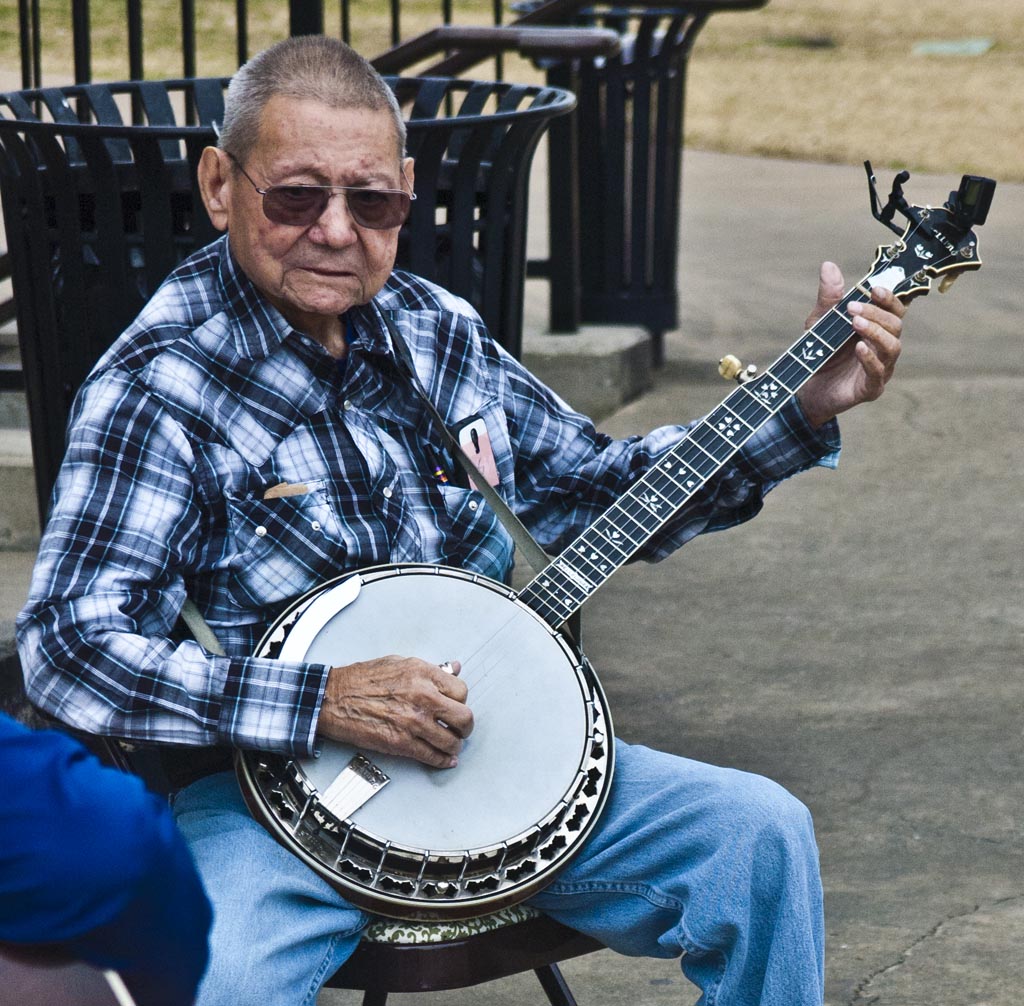
“After supper was over and the toasts had been drunk, the boy Pablo was called in to play for the company while the gentlemen smoked. . . there was softness and languor in the wire strings–but there was also a kind of madness; the recklessness, the call of wild countries which all these men had felt or followed in one way or another. Through clouds of cigar smoke, the scout and the soldiers, the Mexican rancheros and the priests, sat silently watching the bent head and crouching shoulders of the banjo player, and his seesawing yellow hand, which sometimes lost all form and became a mere whirl of matter in motion, like a patch of sand-storm.”
― Willa Cather, Death Comes for the Archbishop

Denton, Texas (click to enlarge)

Denton, Texas
(click to enlarge)

Daily Writing Tip 25 of 100, Hushing the Mind

For one hundred days, I’m going to post a writing tip each day. I have a whole bookshelf full of writing books and I want to do some reading and increased studying of this valuable resource. This will help me keep track of anything I’ve learned, and help motivate me to keep going. If anyone has a favorite tip of their own to add, contact me. I’d love to put it up here.

Today’s tip – Hushing the Mind

Source – Deep Writing by Eric Maisel

The pieces fall into place in an active, hushed mind. You take a deep breath, stilling the universe. Then you take a voluptuous gulp of the mystery residing in that silence. From that gulp you make a world.

There is that feeling – when an entire reality is flowing out through your fingertips into the keys. They rattle like the chattering of a million squirrels. Or something like that…. That is what you are looking for – if nothing else a relief from the squabbling voices of everyday.

A little relief – and, hopefully, so much more.

Nothing Is Connected To Anything

“If there is something comforting – religious, if you want – about paranoia, there is still also anti-paranoia, where nothing is connected to anything, a condition not many of us can bear for long.”
― Thomas Pynchon, Gravity’s Rainbow

Denton, Texas (click to enlarge)

Denton, Texas
(click to enlarge)

Daily Writing Tip 24 of 100, Exquisite Characters

For one hundred days, I’m going to post a writing tip each day. I have a whole bookshelf full of writing books and I want to do some reading and increased studying of this valuable resource. This will help me keep track of anything I’ve learned, and help motivate me to keep going. If anyone has a favorite tip of their own to add, contact me. I’d love to put it up here.

Today’s tip – Exquisite Characters

Source – The Creative Process by Carol Burke and Molly Best Tinsley

The point of all these negatives is this: the heart of a short story, its energy source, is not, or is no longer, the plot. As the editor of one literary quarterly expressed it for would-be contributors, what he responds to in a story above and beyond everything else is “exquisite characterization.” A story is about people before it is about anything else–about human beings, richly rendered in all their quirkiness and typicality, in all their pain and pleasure, weakness and strength, despair and hope.

I had a writing teacher confess that the biggest problem he had was that his characters, “never did what I want them to do.” Isn’t that the ultimate compliment to your own writing – that the characters you have created are so real and interesting that they insist on living out their own lives, no matter what you want them to do. They become real people, not puppets on a string dancing to some literary formula or hackneyed plot device.