“If lightning is the anger of the gods, then the gods are concerned mostly about trees.”
― Lao Tzu

“If lightning is the anger of the gods, then the gods are concerned mostly about trees.”
― Lao Tzu
“The basic difference between an ordinary man and a warrior is that a warrior takes everything as a challenge while an ordinary man takes everything as a blessing or a curse.”
― Carlos Castaneda

My work is not so overtly about movement. My horses’ gestures are really quite quiet, because real horses move so much better than I could pretend to make things move. For the pieces I make, the gesture is really more within the body, it’s like an internalized gesture, which is more about the content, the state of mind or of being at a given instant. And so it’s more like a painting…the gesture and the movement is all pretty much contained within the body.
—-Deborah Butterfield

Hina,
Deborah Butterfield
Modern Art Museum of Fort Worth
All I can do will only ever be a faint image of what I see and my success will always be less than my failure or perhaps equal to the failure.
—-Alberto Giacometti

Four Figures (detail)
Stephan Balkenhol
Modern Art Museum of Fort Worth
“Silence. How long it lasted, I couldn’t tell. It might have been five seconds, it might have been a minute. Time wasn’t fixed. It wavered, stretched, shrank. Or was it me that wavered, stretched, and shrank in the silence? I was warped in the folds of time, like a reflection in a fun house mirror.”
― Haruki Murakami, Dance Dance Dance

Modern Art Museum of Fort Worth
“We keep to our usual stuff, more or less, only inside out. We do on stage the things that are supposed to happen off. Which is a kind of integrity, if you look on every exit being an entrance somewhere else.”
― Tom Stoppard, Rosencrantz and Guildenstern Are Dead

Modern Art Museum of Forth Worth
OF obedience, faith, adhesiveness;
As I stand aloof and look, there is to me something profoundly affecting in large masses of men, following the lead of those who do not believe in men.
—-Walt Whitman, Leaves of Grass, 79 Thought

Adhesiveness (detail)
David Hockney
Modern Art Museum of Fort Worth
Label Text:
David Hockney
British, born 1937
Adhesiveness, 1960
Oil on board
Museum purchase
When David Hockney painted Adhesiveness, he was concerned with creating works that reflected the lessons of modernist abstraction but also contained recognizable imagery. To this end, he began writing on his paintings, utilizing words, letters, and numerals as signposts to their content. This period of Hockney’s work is situated between the Expressionism of Francis Bacon and the emergence of Pop art, which Hockney would help pioneer in Europe and later in the United States.
Adhesiveness is an homage to the American poet Walt Whitman, who used the prenological term first to describe love among men and later to describe an ideal in which not only the States would be bonded, but the world at large could be unified. In the early 1960s Hockney began to allude to his homosexuality in his work, and the symbols he has included in Adhesiveness are clues to this aspect of his life. Whitman, too, was homosexual, and here Hockney borrows from the poet a childlike numeric code for initials, identifying one figure as himself (4.8 = D.H.) and the other as Whitman (23.23) – W.W.). Hockney created a number of compositions at this time that depict personal relationships (real or imaginary), a theme he has explored throughout his career and is now strongly associated with his art.
“At night I dream that you and I are two plants
that grew together, roots entwined,
and that you know the earth and the rain like my mouth,
since we are made of earth and rain.”
― Pablo Neruda, Regalo de un Poeta
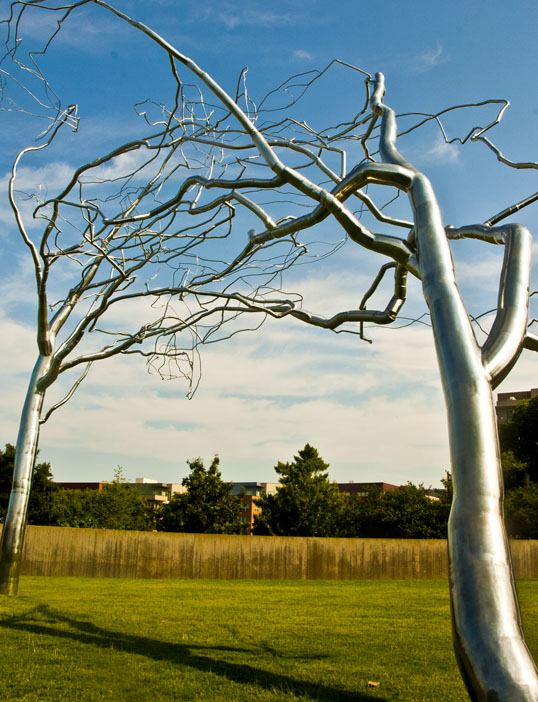
Modern Art Museum of Fort Worth
Conjoined, Roxy Paine
There is a role and function for beauty in our time.
—-Tadao Ando
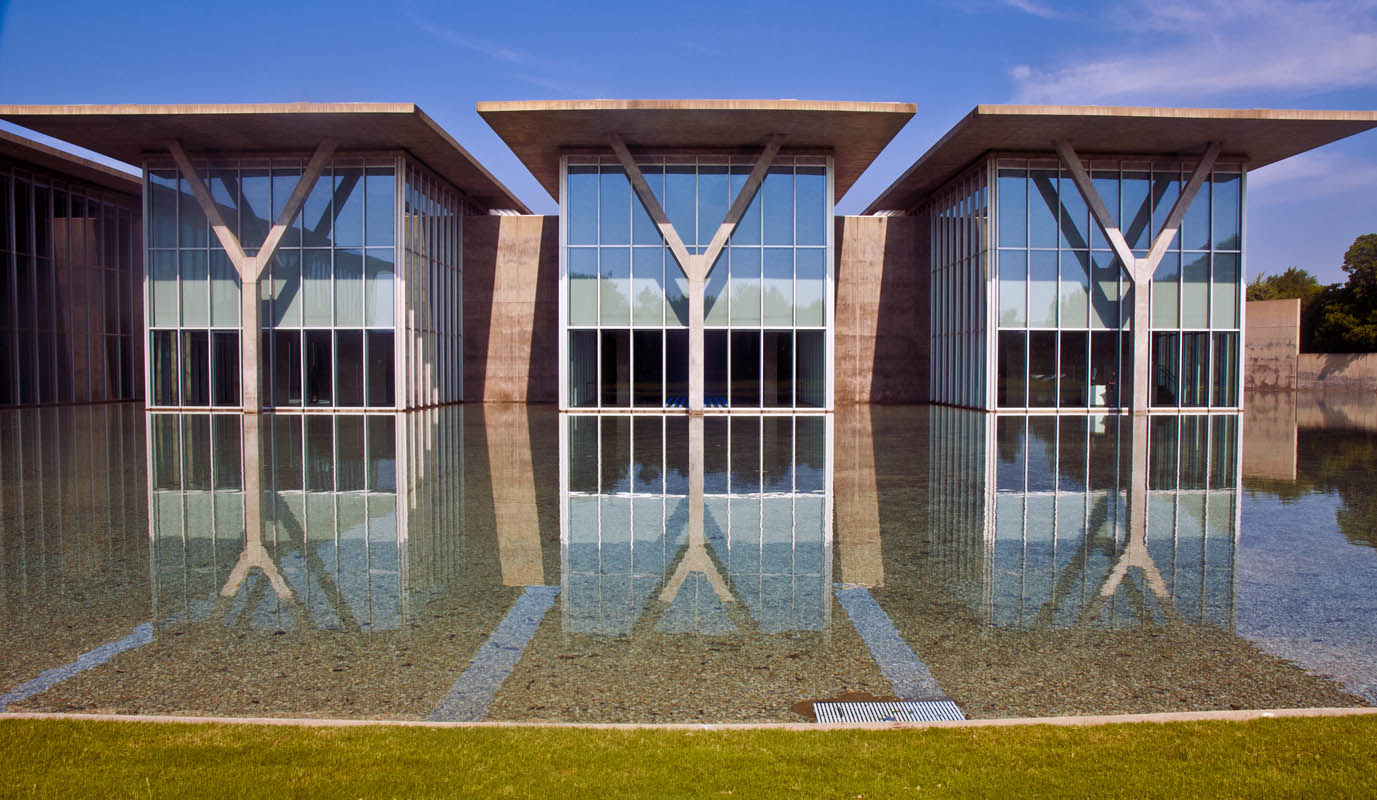
(click to enlarge)
Modern Art Museum of Forth Worth
Tadao Ando, Architect
“Have you also learned that secret from the river; that there is no such thing as time?” That the river is everywhere at the same time, at the source and at the mouth, at the waterfall, at the ferry, at the current, in the ocean and in the mountains, everywhere and that the present only exists for it, not the shadow of the past nor the shadow of the future.”
― Hermann Hesse, Siddhartha

High Water,
Dallas, Texas
 Bill Chance