Short Story day Twenty-Five – The Use of Force

25. The Use of Force
William Carlos Williams
http://www.classicshorts.com/stories/force.html

This is day Twenty-five of my Month of Short Stories – a story a day for June.

I have always thought of William Carlos Williams as a poet. His poem “XXII” (which most people call “The Red Wheelbarrow“) has always been a wonderful touchstone to me – such an example of the power behind a few simple words. I never knew he wrote short fiction. And I really never knew that he was a physician. A biographer said that he, “worked harder at being a writer than he did at being a physician” – apparantly he was pretty good at both.

Does that illuminate today’s very short short story? Is it important that the author knows what he is writing about and in all likelihood is writing almost directly from experience?

That’s a tough question. I imagine that a very talented writer could imagine what it would be like to be a doctor when confronted with a stubborn child – of course, anyone could type out the same words. But the fact that an experienced physician wrote the piece gives it an air of authority that it wouldn’t have otherwise.

Is that important? Is it fair? Is Batman a Transvestite? Who knows?

At first, the story seems to be a musing on the use of power. Is it appropriate to force a human being to do what they don’t want to do? I don’t think that’s the real intent here, though. First of all, it is undoubtably a matter of life and death – diptheria was an often fatal disease then – both for the child and for society in general. Of course it was appropriate for the doctor to force her to give up.

The real point of the story is the doctor’s attitude. He seems to be a good man, a caring man, and is there to save the child’s life, after all. But her insubordination awakens a primitive passion in the doctor, he finds himself wanting to hurt the child.

It’s a fascinating scene, especially in the hands of someone that knows, and someone with the skills with words of William Carlos Williams.

Get me a smooth-handled spoon of some sort, I told the mother. We’re going through with this. The child’s mouth was already bleeding. Her tongue was cut and she was screaming in wild hysterical shrieks. Perhaps I should have desisted and come back in an hour or more. No doubt it would have been better. But I have seen at least two children lying dead in bed of neglect in such cases, and feeling that I must get a diagnosis now or never I went at it again. But the worst of it was that I too had got beyond reason. I could have torn the child apart in my own fury and enjoyed it. It was a pleasure to attack her. My face was burning with it.
—-William Carlos Williams, The Use of Force

Short Story Day Twenty Four – Red Nails

24 Red Nails (Conan the Barbarian)
Robert E Howard
http://www.gutenberg.org/ebooks/32759

This is day Twenty-four of my Month of Short Stories – a story a day for June.

Weird_Tales_Red_Nails

Nearly four years ago, WEIRD TALES published a story called “The Phoenix on the Sword,” built around a barbarian adventurer named Conan, who had become king of a country by sheer force of valor and brute strength. The author of that story was Robert E. Howard, who was already a favorite with the readers of this magazine for his stories of Solomon Kane, the dour English Puritan and redresser of wrongs. The stories about Conan were speedily acclaimed by our readers, and the barbarian’s weird adventures became immensely popular. The story presented herewith is one of the most powerful and eery weird tales yet written about Conan. We commend this story to you, for we know you will enjoy it through and through.
—-From Weird Tales, 1936

A dozen years ago, in February of 2001, I had just finished up a solo camping trip to Big Bend way out in far west Texas. I had a long drive back to the Metroplex, one I had made before. This time, however, I had picked a different route back, one that was slightly longer than usual.

Instead of going north to Interstate 20 and taking it back, I caught 67 through San Angelo and on to Brownwood, then north to the little hamlet of Cross Plains. Once I made it to that small town, I followed a little map that I had scribbled to a tiny house on the west side of town. I stopped, looked at the nondescript wood frame dwelling for a minute, then went back to my car and drove the rest of the way home.

I had wanted to see that house because of the person that lived in it in the 1930s – it was the childhood home, and the place he committed suicide, of Robert E Howard. Even though it looked exactly like a million other old farmhouses all across the Great Plains – I wanted to see this one… to see it, and nothing more.

Like anyone that has been a voracious reader for almost half a century now, I have read my fair share of pulp. Mostly devoured in the form of cheap paperback reprints, I was familiar with Conan, and with Robert E Howard… along with the other writers of depression-era fantastic, gothic, and strange tales – plus their imitators that have continued the tradition still.

But the specific incident that lead me to my stop in Cross Plains had occurred on a cult movie night at the Dallas Museum of Art. I had seen that they were showing a film I had never seen before – The Whole Wide World – an elegiac story of Robert E Howard (played by Vincent D’Onofrio) and his relationship with a girl named Novalyne Price (Renée Zellweger, in one of her first roles).

It was an amazing film and one that almost nobody had seen. It was so representative of the writing life, the desire for creativity and expression, the sad doomed love story, and the insane dreamer pounding out madness for pennies a word. Even the evocation of rural Texas in the depression felt true and fascinating. The representative from the distribution company came out and thanked everyone for seeing it – he said, “We are so proud of this movie and want as many folks as possible to see the film.” Now it’s more available… you should take a look.

I found out that it was based on a memoir by Novalene Price – called One Who Walked Alone – which hadn’t sold many copies. I ordered it from Amazon and (though it really wasn’t particularly well-written) enjoyed it thoroughly.

So here’s a pulp novella from Robert E Howard, Red Nails. Don’t think of Arnold and his movie when you read it… think of the doomed crazy boy hammering away in the back of that little farm house in that little town in Texas… fighting back his demons the only way he can – with a typewriter.

“Five dead dogs!” exclaimed Techotl, his flaming eyes reflecting a ghastly exultation. “Five slain! Five crimson nails for the black pillar! The gods of blood be thanked!”

He lifted quivering hands on high, and then, with the face of a fiend, he spat on the corpses and stamped on their faces, dancing in his ghoulish glee. His recent allies eyed him in amazement, and Conan asked, in the Aquilonian tongue: “Who is this madman?”

Valeria shrugged her shoulders.

“He says his name’s Techotl. From his babblings I gather that his people live at one end of this crazy city, and these others at the other end. Maybe we’d better go with him. He seems friendly, and it’s easy to see that the other clan isn’t.”

—-Red Nails, by Robert E Howard

Short Story Day Twenty-Three – Hunters in the Snow

23. Hunters in the Snow
Tobias Wolff
http://www.classicshorts.com/stories/huntsnow.html

This is day Twenty-three of my Month of Short Stories – a story a day for June.

Tobias Wolff is one of my favorite short story writers. His story In The Garden of the North American Martyrs is one of the best pieces of short fiction ever scribbled out.

I remember one time, years ago, he was giving a talk at the Dallas Museum of Art as part of the Arts & Letters Live series. Well, I’m poor and can’t afford the full price ticket to these lectures, but, for a pittance, you can attend and sit in an auditorium off to the side where the lecture is beamed in on a screen. I was sitting there, waiting with a few other people (the main room was packed) when I looked up and there was Tobias Wolff, walking between the rows talking to us. He said he didn’t think it was fair that we had to sit in the other room and had arranged for an extra row of seats down across the front. We all marched into the big room and saw the live lecture, thanks to the author.

It was better that way.

I’m afraid today’s story is one that I had read before – but had forgotten until I was about a third of the way in. That’s not surprising… I guess Wolff is another writer that I have read, if not everything, then almost all his output.

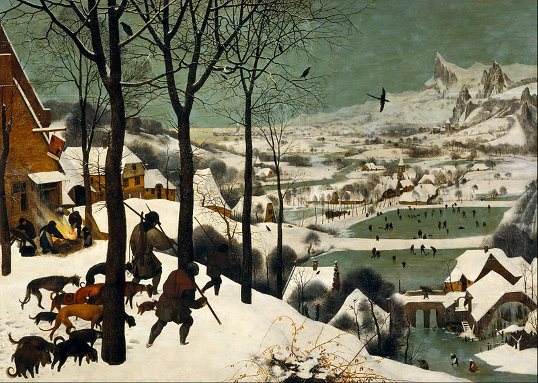
At any rate, it’s a good story, with a few differences from similar modern realistic tragedies. First, the origins of the story is pretty obvious. First, there’s the eponymous painting by Pieter Bruegel.

Hunters in the Snow, by Bruegel

Hunters in the Snow, by Bruegel

The tone of the story is different from the balanced and optimistic winter scene in the painting. A more accurate source of the story is an old joke about a man asking a hunter to shoot his old dog for him, as a favor.

That’s what is so odd and interesting about the story is the juxtaposition of the realistic horror of the situation and the humor that laces the story. It’s an odd combination – sort of like the three stooges, but the blows actually hurt.

Some juvenile delinquents had heaved a brick through the windshield on the driver’s side, so the cold and snow tunneled right into the cab. The heater didn’t work. They covered themselves with a couple of blankets Kenny had brought along and pulled down the muffs on their caps. Tub tried to keep his hands warm by rubbing them under the blanket but Frank made him stop.

They left Spokane and drove deep into the country, running along black lines of fences. The snow let up, but still there was no edge to the land where it met the sky. Nothing moved in the chalky fields. The cold bleached their faces and made the stubble stand out on their cheeks and along their upper lips. They stopped twice for coffee before they got to the woods where Kenny wanted to hunt.

Tub was for trying someplace different; two years in a row they’d been up and down this land and hadn’t seen a thing. Frank didn’t care one way or the other, he just wanted to get out of the goddamned truck. “Feel that,” Frank said, slamming the door. He spread his feet and closed his eyes and leaned his head way back and breathed deeply. “Tune in on that energy.”
—-Tobias Wolff, Hunters in the Snow

Short Story Day Twenty-Two – The Sandman

22. The Sandman
E.T.A. Hoffmann
http://www.fln.vcu.edu/hoffmann/sand_e.html

This is day Twenty-two of my Month of Short Stories – a story a day for June.

When I turned to today’s story, I glanced at the name and the author and it meant nothing to me. I don’t even remember how I chose this story. I decided to do no research and simply dive into the thing blind.

I don’t know what I expected… but I didn’t expect this. From the archaic language and style I realized that it was a classic story, written a long time ago. But man, that bugger was strange. It was an odd bird even by modern standards.

There are two themes going on at the same time, tightly interwoven. The first is a standard science-fiction meme – the idea of a mad scientist making the perfect woman. The second, more subtle and horrifying, has to do with childhood fears echoing down the halls of time, affecting a person’s entire life… it has to do with evil, with the mystery of a secretive father, and with the theft of a child’s eyes.

So I finished and did some research on the author. The story was older than I realized, E.T.A. Hoffman lived and wrote in the early 19th century – this story about a mechanical person is way before its time. I should have recognized the name and would have if I had thought about it. He is famous for several reasons. Three of his stories (including this one) were adapted by Offenbach into the well-known opera Tales of Hoffmann. Another one of his stories was a very odd and disturbing yarn about a young girl and her enchanted toys doing battle with an army of rodents. This was cleaned up a bit by Alexandre Dumas, père. Tchaikovsky used the watered-down version as the basis of a famous ballet – maybe the most famous of all. The Hoffmann story was called, of course, The Nutcracker and the Mouse King.

Hoffmann was the master of several forms of art – in addition to his writing – fiction and non-fiction – he wrote some very influential music and could even draw a line or two.

He was so influential in his time – more people have seen the works derived from his ideas than read the originals. Freud wrote a famous essay – The Uncanny – based upon today’s short story.

The theme of the automaton “ideal woman” created by science is seen again and again, from Fritz Lange’s Metropolis to Weird Science. Blade Runner is especially descended from The Sandman – think of the importance of the eyes.

There is some really odd qualities to the story. Pay attention to the parts that simply don’t make any sense. For example, in the story of Nathaniel’s childhood terror – what do you make about the statement where The Sandman, “seized me so roughly that my joints cracked, and screwed off my hands and feet, afterwards putting them back again, one after the other.” What is up with the telescope? What is its terrible power?

Now I’m going to have to read it again.

It occurred to him, however, in the end to make his gloomy foreboding, that Coppelius would destroy his happiness, the subject of a poem. He represented himself and Clara as united by true love, but occasionally threatened by a black hand, which appeared to dart into their lives, to snatch away some new joy just as it was born. Finally, as they were standing at the altar, the hideous Coppelius appeared and touched Clara’s lovely eyes. They flashed into Nathaniel’s heart, like bleeding sparks, scorching and burning, as Coppelius caught him, and flung him into a flaming, fiery circle, which flew round with the swiftness of a storm, carrying him along with it, amid its roaring. The roar is like that of the hurricane, when it fiercely lashes the foaming waves, which rise up, like black giants with white heads, for the furious combat. But through the wild tumult he hears Clara’s voice: ‘Can’t you see me then? Coppelius has deceived you. Those, indeed, were not my eyes which so burned in your breast – they were glowing drops of your own heart’s blood. I have my eyes still – only look at them!’ Nathaniel reflects: ‘That is Clara, and I am hers for ever!’ Then it seems to him as though this thought has forcibly entered the fiery circle, which stands still, while the noise dully ceases in the dark abyss. Nathaniel looks into Clara’s eyes, but it is death that looks kindly upon him from her eyes.
—-The Sandman, E.T.A. Hoffmann

Short Story Day Twenty-One – Mexican Manifesto

21. Mexican Manifesto
Roberto Bolaño
http://www.newyorker.com/fiction/features/2013/04/22/130422fi_fiction_bolano

This is day Twenty-one of my Month of Short Stories – a story a day for June.

Illustration from the New Yorker

Roberto Bolaño considered himself primarily a poet. For most of his life he was a bohemian vagabond poet, working odd low-end jobs by day and writing poetry by night. Good work if you can get it.

He married in Europe and in 1990 his son was born. At that point he felt responsible for his family and began writing fiction to help pay the bills. Over a short period of time he produced a series of acclaimed novels, collections of short stories, and his magnum opus – 2666, which was published posthumously.

I haven’t read any Bolaño up to this point. I did buy a hardback copy of 2666 – the huge novel (900 pages) sits on the bottom row of my book shelf like a leaden lump of wood pulp; a mysterious Pandora’s box of secret promises, putative wisdom, and unknown wonders locked tight between its covers – only to be opened and released by masses of time, long sleepless evenings, and painful eye strain.

Maybe I should read The Savage Detectives or even the novella By Night in Chile first.

Today’s story Mexican Manifesto, was first published this year in the New Yorker. Since Bolaño passed away a decade ago – I assume this story was found in his papers or computer files.

It is a hazy memory of the narrator, thinking about his youth and the adventures he had with a woman as the two of them explored the world of public bathhouses in Mexico City. He talks about the bathhouses in general and the denizens of the rooms, corridors, and steam. He elaborates on a strange encounter when he and the woman hire a trio – an old man with filthy underwear and two young boys – to provide them with a sexual performance. It doesn’t work out right. Due to his leaky memory, the ethereal nature of the bathhouse, and the clouds of steam that conceal and confuse – it isn’t clear exactly what happened.

The story is a dream or a dreamlike memory or a dream of a memory, or a memory of a dream… or maybe just a half-forgotten recollection mixed up with a fantasy of something that might have happened a long time ago. Youthful adventures tend to warp as time goes by – they become like wisps of steam leaking into the outer chamber of a bathhouse, ghosts of time – they become what they weren’t.

Maybe they never were.

I’ll have to read the story again, and think more about its secrets. I think a key might be the mural described in the first paragraph. It’s in the foyer of their first and favorite public bath, Montezuma’s Gym. I want to figure out what the king sees.

Laura and I did not make love that afternoon. In truth, we gave it a shot, but it just didn’t happen. Or, at least, that’s what I thought at the time. Now I’m not so sure. We probably did make love. That’s what Laura said, and while we were at it she introduced me to the world of public baths, which from then on, and for a very long time, I would associate with pleasure and play. The first one was, without a doubt, the best. It was called Montezuma’s Gym, and in the foyer some unknown artist had done a mural where you could see the Aztec emperor neck-deep in a pool. Around the edges, close to the monarch but much smaller, smiling men and women bathe. Everyone seems carefree except the king, who looks fixedly out of the mural, as if searching for the improbable spectator, with dark, wide-open eyes in which I often thought I glimpsed terror. The water in the pool is green. The stones are gray. In the background, you can see mountains and storm clouds.
—-Mexican Manifesto, by Roberto Bolaño

Short Story Day Twenty – A Telephone Call

20. A Telephone Call
Dorothy Parker
http://www.classicshorts.com/stories/teleycal.html

This is day Twenty of my Month of Short Stories – a story a day for June.

Dorothy Parker is a writer that, deservedly or not, is less famous as a writer as she is famous for being Dorothy Parker. She is known for her wit, her wisecracks, and for her acerbic and slightly warped observations on the life around her.

I think of her primarily as a key member of the Algonquin Round Table. I’m jealous of that. Wouldn’t it be great to have such cool friends? To sit around all day trying to outdo each other in wit and verbal repartee? That would be the life.

But even Dorothy Parker tired of the circle. She said, in later years:

These were no giants. Think who was writing in those days—Lardner, Fitzgerald, Faulkner and Hemingway. Those were the real giants. The Round Table was just a lot of people telling jokes and telling each other how good they were. Just a bunch of loudmouths showing off, saving their gags for days, waiting for a chance to spring them….There was no truth in anything they said. It was the terrible day of the wisecrack, so there didn’t have to be any truth…

I’m not sure if that’s fair. If your goal is to have a large group of writers get together and everyone turn out work like William Faulkner and Earnest Heminglway… well, good luck with that.

Sometimes there is a bitter truth in wisecracks and there are worse ways to waste your life than to spend it in the company of witty friends.

Today’s story, A Telephone Call, is a pleasent little ditty – a first person account of a woman in desperate desire and drowning in existential angst. At first glance, it is a simple tale of a woman begging to God to have her man give her a telephone call. Look closer, though, and you will see it’s more complex and sophisticated than it appears.

Reading what others have said of this story, many write about how young the woman is and they remember when they were that age – as if misplaced desire is a perogative of the youthful. I don’t see it that way. I read it as a woman having an affair with a married man, slightly ashamed of her behavior, but unable to control herself.

I think he must still like me a little. He couldn’t have called me “darling” twice today, if he didn’t still like me a little. It isn’t all gone, if he still likes me a little; even if it’s only a little, little bit. You see, God, if You would just let him telephone me, I wouldn’t have to ask You anything more. I would be sweet to him, I would be gay, I would be just the way I used to be, and then he would love me again. And then I would never have to ask You for anything more. Don’t You see, God? So won’t You please let him telephone me? Won’t You please, please, please?

Are You punishing me, God, because I’ve been bad? Are You angry with me because I did that? Oh, but, God, there are so many bad people –You could not be hard only to me. And it wasn’t very bad; it couldn’t have been bad. We didn’t hurt anybody, God. Things are only bad when they hurt people. We didn’t hurt one single soul; You know that. You know it wasn’t bad, don’t You, God? So won’t You let him telephone me now?
—-Dorothy Parker, A Telephone Call

Short Story Day Nineteen – Eyes of a Blue Dog

19. Eyes of a Blue Dog

Gabriel Garcia Marquez
http://www.classicshorts.com/stories/bluedog.html

This is day Nineteen of my Month of Short Stories – a story a day for June.

Source Figure, by Robert Graham, foreground, We Stand Together, George Rodrigue, background

Source Figure, by Robert Graham, foreground, We Stand Together, George Rodrigue, background

Gabriel Garcia Marquez is one of my favorite writers of all time. One Hundred Years of Solitude was a revelation when I read it decades ago – it is on my desert island list for sure. Love in the Time of Cholera might even be a better book, all around.

My love for his prodigious output of short fiction has never matched that of his epic novels, however. In small doses his Magic Realism (can this style of writing even be done in English? In an American settting?) feels overly precious to me – though his genius is evident even there.

Even though I love his work, if you tell me you can’t get into it… I’d have a hard time arguing. It’s not for everyone. Either it resonates with you or it doesn’t.

Today we have an early short story by him, Eyes of a Blue Dog (originally published in – you guessed it – the New Yorker in 1978). At first the story is confusing… What is going on here? It doesn’t take long to figure out we are in a dream, and the author does a good job of implying the odd geometry of a slumbering illusion.

There are two people in this dream, a man and a woman. They meet in dreams, but can’t connect in real life, because – even though the woman wants to find the man and goes around spreading the phrase “Eyes of a Blue Dog” as a clue to her whereabouts – he can’t remember anything once he wakes up.

It’s a concice example of loneliness. Even when we have found a kindred soul, our passion and hunger are doomed because of the mortal shell we are all trapped within. This theme of the human soul desolate and alone runs through all of his work – despite plenty of life-affirming, entertaining, and hopeful passages.

Now, next to the lamp, she was looking at me. I remembered that she had also looked at me in that way in the past, from that remote dream where I made the chair spin on its back legs and remained facing a strange woman with ashen eyes. It was in that dream that I asked her for the first time: “Who are you?” And she said to me: “I don’t remember.” I said to her: “But I think we’ve seen each other before.” And she said, indifferently: “I think I dreamed about you once, about this same room.” And I told her: “That’s it. I’m beginning to remember now.” And she said: “How strange. It’s certain that we’ve met in other dreams.”
—-Eyes of a Blue Dog, Gabriel Garcia Marquez

http://vimeo.com/6984153

Short Story Day Eighteen – The Landlady

18. The Landlady
Roald Dahl
http://www.nexuslearning.net/books/holt-eol2/collection%203/landlady.htm

This is day Eighteen of my Month of Short Stories – a story a day for June.

Everybody is familiar with Roald Dahl‘s children’s books and the movies made from them: Charlie and the Chocolate Factory (Willy Wonka), James and the Giant Peach, The Fantastic Mr. Fox. What makes his children’s books so good, other than the crackerjack storytelling, is the element of subversive evil that lurks, sometimes just beneath the surface… sometimes a bit above. I think all great children’s literature has this dark side to it – at least anything that’s readable by adults.

Not quite as many people nowadays read his short, adult fiction. In these, he takes the evil and runs with it. His stories are the opposite of a lot of the modern fiction (the New Yorker fiction) that you read. The characters are cardboard, there is no character development, no fancy descriptions or clever word-play. It’s all a simple story, short, spare, straightforward right up the the twist reveal ending.

This sort of thing has fallen a bit out of favor today – which is a shame. As much as I like a complex tale of existential angst, complete with extensive interior monologues – there is something to be said for a quick simple plot. It’s satisfying if done well – it’s hard to do well, and Roald Dahl is the best.

Of course, the other thing is that this sort of work is very well adapted for television, especially the anthology series that were so popular during my childhood (and now can be found all over the internet). Dahl’s stories were the core of the various famous Hitchcock anthology shows, the underrated Tales of the Unexpected, or the forgotten Way Out.

Today, we have The Landlady. It’s a horror story, though you don’t know that until you get to the end. I like stuff like this and would love to be able to write it. It was first published in the New Yorker in 1959… where it would never get a second look today.

One word to the wise: as a chemist I can tell you… if you are drinking tea with a stranger and the beverage smells of bitter almonds, it’s time to leave. If you’ve had as much as a sip – time to call 911.

Billy was seventeen years old. He was wearing a new navy-blue overcoat, a new brown trilby hat, and a new brown suit, and he was feeling fine. He walked briskly down the street. He was trying to do everything briskly these days. Briskness, he had decided, was the one common characteristic of all successful businessmen. The big shots up at the head office were absolutely fantastically brisk all the time. They were amazing.

There were no shops on this wide street that he was walking along, only a line of tall houses on each side, all of them identical. They had porches and pillars and four or five steps going up to their front doors, and it was obvious that once upon a time they had been very swanky residences. But now, even in the darkness, he could see that the paint was peeling from the woodwork on their doors and windows and that the handsome white facades were cracked and blotchy from neglect.
—- The Landlady, Roald Dahl

————————————————————–

Man From the South
http://www.americanliterature.com/author/roald-dahl/short-story/man-from-the-south

If I’m going to put something up by Roald Dahl, I have to link to his story, Man from the South, in case you have never seen it before. I read it years and years ago, and always refer to it as an example of how to control rising tension – building until it becomes almost unbearable. This is true both of the written story and the television versions.

There are three versions on Youtube – one, the classic from Alfred Hitchcock, with Steve McQueen and Peter Lorre. It was also done in 1979 and 1985 – those versions are very good too.

I think I might like the Jose Ferrer version the best (I think it has the best crazy woman).

If you are as big a fan of Man from the South as I am – then you should check out the last segment of an otherwise terrible movie called Four Rooms. It’s a short riff by Quentin Tarantino on the whole deal – with a completely different, very Tarantino ending.

Here’s a clip (complete with money shot):

Short Story Day Seventeen – The Dark Arts

17. The Dark Arts
Ben Marcus
http://www.newyorker.com/fiction/features/2013/05/20/130520fi_fiction_marcus

This is day Seventeen of my Month of Short Stories – a story a day for June.

I’m afraid that Ben Marcus is a writer that I knew nothing about. Sorry. There is so much great stuff and I have to earn a living… and I have to ride my bicycle… and there’s my kids… and sometimes I have to do nothing at all. So I picked today’s story because… well, because it is in the New Yorker. It has the stamp of… the stamp of the New Yorker. It has made it past the gatekeepers.

It’s father’s day today, and I chose to eat lunch at a small Peruvian bakery/restaurant near where Arapaho road makes this funny little jump to the left, right across Highway 75 – an inexpensive area where family owned spots from many places in the world tend to settle. I had the ceviche with corn and sweet potato.

Then I needed about twenty miles on my bike to keep up with my annual goal, so I dropped the story from the New Yorker web site onto my Kindle and headed out. I stopped at my little bench in the Spring Creek bottomland woods (the place I saw the snake) to rest, drink a water bottle, and read the story.

The writing was greatness – little bits of genius strung across the page. The story was very dark – an American young person in Germany on a quest for a cure. He has an autoimmune disease – there is quite a bit of mystery in the story over exactly what is wrong, but I think the protagonist has it right when he says, “An allergy to himself was more like it.” Whether it is autoimmune, or a brain tumor, or that he has finally given up on himself – it doesn’t really matter. It is a lonely doom.

Ben Marcus has a book of short stories coming out – Leaving the Sea – it is now on the list… even though the list is getting too long. Do I have enough time to finish? Of course not – it is getting longer faster than I’m checking them off – and I’m getting older even faster than that.

The nice thing about a story in the New Yorker is that plenty of people have something to say. Be careful though – read the story first… a lot of these folks aren’t as careful about giving away the goodies.


It was Father’s Day, and me being who I am – I could not help but be affected by a story behind the story. Julian is in Europe thanks to funds sent to him by his father. The story implies that this money does not come easily. His mother is gone. There is a conversation between Julian and his father over the phone where he is asking for more money. His father is full of hope – or at least he pretends to be. Julian says, “He should never, until the very second he died, stop knowing that he had a father who would do anything for him. What a crime to forget this. He was a criminal if he ever stopped thinking this for even a minute.”

This broke my heart. I can see his father emptying his 401k, mortgaging the family house, taking a second job on the weekends. I can see him making pancakes that will never be eaten. I can see him doing what needs to be done. I’m sure he has doubts, regrets, fears, the same feelings of doom that are overwhelming Julian. But still he soldiers on, smiling as best he can, doing what needs to be done.

What more can we hope for?

Did everyone else, he wondered, feel listless, strange, anxious, dull, scared—you could pretty much go shopping from a list of adjectives—and did other people just clench their jaws and endure it, without running to the doctor, as he did, again and again?
—-from The Dark Arts, by Ben Marcus

Short Story Day Sixteen – The Ones Who Walk Away From Omelas

16. – The Ones Who Walk Away From Omelas
Ursula K Le Guin
http://harelbarzilai.org/words/omelas.txt

Click to access rprnts.omelas.pdf

This is day Sixteen of my Month of Short Stories – a story a day for June.

The trouble is that we have a bad habit, encouraged by pendants and sophisticates, of considering happiness as something rather stupid. Only pain is intellectual, only evil interesting. This is the treason of the artist: a refusal to admit the banality of evil and the terrible boredom of pain.
—– Ursula K. Le Guin, The Ones Who Walk Away from Omelas

I have been a big fan of Ursula K Le Guin for a long, long time. In high school, in the 70’s, I read The Left Hand of Darkness – which introduced me to the idea of Science Fiction as literature and as social comment.

In 1980, I was sitting around the house one lazy afternoon and happened to check out PBS. They showed a production of Le Guin’s The Lathe of Heaven – which blew me away. I was living in Hutchinson, Kansas and considering a move to Dallas. I recognized a lot of Dallas landmarks in the film. The odd thing is that because of some rights problems with a bit of music the movie was never shown again for decades and the master copy was destroyed – only recently has it resurfaced.

So today we link to a short work of Le Guin. The Ones Who Walk Away From Omelas is a moral parable about a difficult question. Is it worth the happiness of a society if it depends on the utter suffering of one innocent? This theme is addressed in The Brother’s Karamazov and Le Guin herself spells out an essay that William James wrote on the subject.

Or if the hypothesis were offered us of a world in which Messrs. Fourier’s and Bellamy’s and Morris’s utopias should all be outdone, and millions kept permanently happy on the one simple condition that a certain lost soul on the far-off edge of things should lead a life of lonely torture, what except a specifical and independent sort of emotion can it be which would make us immediately feel, even though an impulse arose within us to clutch at the happiness so offered, how hideous a thing would be its enjoyment when deliberately accepted as the fruit of such a bargain?
—-William James, The Moral Philosopher and the Moral Life

The story goes beyond the question, though. After all, the title isn’t The Utopia of Omelas, or The Guilt of Omelas… it’s The Ones Who Walk Away From Omelas. The ones that walk away – how and why are they different? Where do they go? Do they regret their decision? Are they better than the rest? Would they say they were? Would you say they were?

Would you walk away?

Oh, by the way… Omelas? It’s SALEM Oregon backward. Ursula K Le Guin saw it on a road sign in a car mirror. I guess she saw it as she was leaving.

Night falls; the traveler must pass down village streets, between the
houses with yellow- lit windows, and on out into the darkness of the
fields. Each alone, they go west or north, towards the mountains. They
go on. They leave Omelas, they walk ahead into the darkness, and they
do not come back. The place they go towards is a place even less
imaginable to most of us than the city of happiness. I cannot describe
it at all. It is possible that it does not exist. But they seem to
know where they are going, the ones who walk away from Omelas.
—- Ursula K. Le Guin, The Ones Who Walk Away from Omelas

The PBS Lathe of Heaven from 1980. If you live in the Dallas/Fort Worth Metroplex, you will recognize some local landmarks – some of them not here any more.