Short Story Day Twenty-One – Mexican Manifesto

21. Mexican Manifesto
Roberto Bolaño
http://www.newyorker.com/fiction/features/2013/04/22/130422fi_fiction_bolano

This is day Twenty-one of my Month of Short Stories – a story a day for June.

Illustration from the New Yorker

Roberto Bolaño considered himself primarily a poet. For most of his life he was a bohemian vagabond poet, working odd low-end jobs by day and writing poetry by night. Good work if you can get it.

He married in Europe and in 1990 his son was born. At that point he felt responsible for his family and began writing fiction to help pay the bills. Over a short period of time he produced a series of acclaimed novels, collections of short stories, and his magnum opus – 2666, which was published posthumously.

I haven’t read any Bolaño up to this point. I did buy a hardback copy of 2666 – the huge novel (900 pages) sits on the bottom row of my book shelf like a leaden lump of wood pulp; a mysterious Pandora’s box of secret promises, putative wisdom, and unknown wonders locked tight between its covers – only to be opened and released by masses of time, long sleepless evenings, and painful eye strain.

Maybe I should read The Savage Detectives or even the novella By Night in Chile first.

Today’s story Mexican Manifesto, was first published this year in the New Yorker. Since Bolaño passed away a decade ago – I assume this story was found in his papers or computer files.

It is a hazy memory of the narrator, thinking about his youth and the adventures he had with a woman as the two of them explored the world of public bathhouses in Mexico City. He talks about the bathhouses in general and the denizens of the rooms, corridors, and steam. He elaborates on a strange encounter when he and the woman hire a trio – an old man with filthy underwear and two young boys – to provide them with a sexual performance. It doesn’t work out right. Due to his leaky memory, the ethereal nature of the bathhouse, and the clouds of steam that conceal and confuse – it isn’t clear exactly what happened.

The story is a dream or a dreamlike memory or a dream of a memory, or a memory of a dream… or maybe just a half-forgotten recollection mixed up with a fantasy of something that might have happened a long time ago. Youthful adventures tend to warp as time goes by – they become like wisps of steam leaking into the outer chamber of a bathhouse, ghosts of time – they become what they weren’t.

Maybe they never were.

I’ll have to read the story again, and think more about its secrets. I think a key might be the mural described in the first paragraph. It’s in the foyer of their first and favorite public bath, Montezuma’s Gym. I want to figure out what the king sees.

Laura and I did not make love that afternoon. In truth, we gave it a shot, but it just didn’t happen. Or, at least, that’s what I thought at the time. Now I’m not so sure. We probably did make love. That’s what Laura said, and while we were at it she introduced me to the world of public baths, which from then on, and for a very long time, I would associate with pleasure and play. The first one was, without a doubt, the best. It was called Montezuma’s Gym, and in the foyer some unknown artist had done a mural where you could see the Aztec emperor neck-deep in a pool. Around the edges, close to the monarch but much smaller, smiling men and women bathe. Everyone seems carefree except the king, who looks fixedly out of the mural, as if searching for the improbable spectator, with dark, wide-open eyes in which I often thought I glimpsed terror. The water in the pool is green. The stones are gray. In the background, you can see mountains and storm clouds.
—-Mexican Manifesto, by Roberto Bolaño

What I learned this week,April 12, 2013

Travelling Man - sculpture east of Downtown Dallas

Travelling Man – sculpture east of Downtown Dallas

Houston Rising

Why the Next Great American Cities Aren’t What You Think

America’s urban landscape is changing, but in ways not always predicted or much admired by our media, planners, and pundits. The real trend-setters of the future—judged by both population and job growth—are not in the oft-praised great “legacy” cities like New York, Chicago, or San Francisco, but a crop of newer, more sprawling urban regions primarily located in the Sun Belt and, surprisingly, the resurgent Great Plains.

While Gotham and the Windy City have experienced modest growth and significant net domestic out-migration, burgeoning if often disdained urban regions such as Houston, Dallas-Ft. Worth, Charlotte, and Oklahoma City have expanded rapidly. These low-density, car-dominated, heavily suburbanized areas with small central cores likely represent the next wave of great American cities.

Dallas Skyline from the Soda Bar on the roof of the NYLO Southside hotel.

Dallas Skyline from the Soda Bar on the roof of the NYLO Southside hotel.


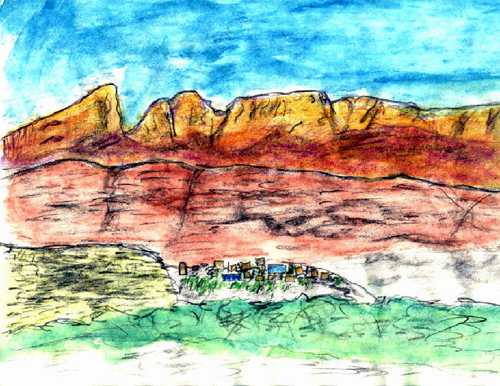
A sketch I made of Boquillas, Mexico, in 2001

A sketch I made of Boquillas, Mexico, in 2001

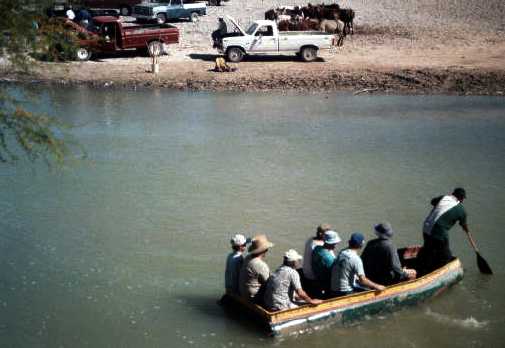
Well over a decade ago, I went to Big Bend, my favorite place on earth, and crossed over to Boquillas, Mexico, to have some tacos and enjoy the international flavor. At that time, you paid a dollar to a guy with a rowboat (with the name “Frijoles” hand-painted on the transom) to get you across the Rio Grande. No passport, customs, or anything like that. It seemed silly, given that the river can be walked when it is low, and there is no real civilization for hundreds of miles in any direction.

After 9/11, of course, this all came to a screeching halt. No more unauthorized border crossing. The village of Boquillas was crippled by the disappearing tourist traffic. What a shame. It was gone forever.

Well, as it turns out, not forever. Now I have to get my passport in order and get ready to make that long drive to West Texas.

South County Bureau report: It’s open! Boquillas welcomes U.S. visitors, officials, media folks.

Boquillas is open! Go — and have a great time — and help our neighbors who’ve waited 11 long years for this day!

Remember to tip your boatman.

Crossing the Rio Grande in 2001

Crossing the Rio Grande in 2001


The 38 Essential Dallas Restaurants, April 2013

13 down, 25 to go.

Three on this list I’ve written about here:

Smoke
Jimmy’s Food Store
Chicken Scratch


Early Adopter Beware: 7 Huge First Gen Products


Has a Seattle Building Discovered the Secret to Making Stairs Irresistible?

Seattle’s $30 million carbon neutral Bullitt Center, billed as the world’s greenest commercial building, will feature what its owner, the Bullitt Foundation, calls an “irresistible stairway” when it opens at the end of the month. The elegant, light-filled escalier offers panoramic views of downtown and Puget Sound. It’s intended to conserve energy and provide physical exercise for occupants. Will it be a lesson to companies trying to get employees to make healthier choices?

We all know climbing stairs is good for us: It’s a good workout and can even save time. In 2011, researchers at a Canadian hospital found that when they had doctors take the stairs rather than the elevator, the doctors saved an average of 15 minutes per workday—and they were required to walk, not run.

But despite the benefits, few office buildings do anything meaningful to encourage stair climbing. Many workplaces have grim, fluorescent-lit, concrete passages hidden away behind fire doors. Some all but prohibit stair use, in part due to post-9/11 security concerns.

The building where I work has very inviting, entertaining, stairs with nice views. However, it was built a while back and does not meet current fire codes. That’s why stairways are so grim – because of the codes that forbid clear openings between floors (because they encourage the spread of fire). I wonder how the Seattle building gets around that problem.

—–

OK… Well, The internet provides the answer. They had to change the codes to build the building.

Bullitt Foundation says Living Building Challenge can only be met after code change

“We were shocked to learn that it is flat-out illegal to build this sort of ultra-green building in any city in America,” says Bullitt Foundation President Denis Hayes. “But Seattle changed its building code to allow super-green buildings to meet performance standards as an alternative to prescriptive standards. We wanted the design flexibility to construct a building that used less than one-fourth the energy of a (standard) code building.”


As Seen on TV: 21 Books From Mad Men


Why You Should Be A Writer


RIP Thomas Kinkade

Nothing but Net: The Citizen Kane of Bad Art

Although lost to us through a regretful combination of valium, alcohol, and Disney dreams, Kinkade’s abrupt end does not, however, signify the end to his ™. A digital immortal, his empire continues to expand post-mortem. Despite failing gallery schemes, his virtual gallery is growing. The “Kinkadian Master Style”, or official imitators, will continue to create new works through his website. Similarly, his impact remains ever present on visual blogs like tumblr. It is on these sites that iterations of his work are always being created. One current meme is to “Kinkade” an image, by adding his copyrighted cottages, or by filling any background with swaths of his paintings. It is unlikely Kinkade would be flattered by these depictions, but imagining the man, he would prefer being ironicized rather than irrelevant.