Distance changes utterly when you take the world on foot. A mile becomes a long way, two miles literally considerable, ten miles whopping, fifty miles at the very limits of conception. The world, you realize, is enormous in a way that only you and a small community of fellow hikers know. Planetary scale is your little secret.
—- Bill Bryson, A Walk in the Woods: Rediscovering America on the Appalachian Trail
The Henge through a bus window.
Three Punches Left
Craig was working late, as he always did. His eyes were tired, achy and blurry from staring at the piles of reports he had to double-check, then type into an endless series of punch cards. The tan cardboard slowly filling long steel boxes to be sent down to the ravenous mainframe three stories down. It was dark outside and he was so worn out he was making more mistakes than correct entries. The bus wouldn’t run too much longer so he shut it all down to take the elevator down the giant steel and glass tower to catch his bus home.
As boring and tough as it was, he was grateful for his job. With gas up to a dollar thirty, the economy had collapsed across the country. Back in Kansas, he had a promotion at work, bought a new car, bought a new house, and had a new girlfriend. Then everything tanked and the company folded, He lost his job, his girlfriend left, and all he had left was debt.
The only places where you could find a job in 1981 were the big Texas cities – fueled by the flood of petrodollars. So he went to all his friends and was able to borrow twenty five dollars for gas and set out south down I35 to look for a job.
But it worked out, he found this job and a crumbling studio apartment on the Belmont Bus line which ran downtown. He had not been able to afford the payments on his car and as soon as they found him it was repossessed.
Craig stood in the darkness looking down the street at the line of buses moving along, stopping every block, getting the last of the worker drones out of the giant buildings. There it was, the Belmont Bus, route #1 – can’t miss it, on its way.
He had a sudden moment of panic – did he have any punches left on his transit card? He bought a card worth sixteen rides – he knew his wallet and pockets were otherwise empty. Sweating, he pulled out the card and breathed a deep sigh when he saw three punches left.
He looked up and saw the open door of the bus looming in front of him. He stepped on and gave the card to the driver for a punch. Then he settled in an empty seat and half dozed off, waiting for the hour-long ride home. A deep pothole lurched Craig awake and he looked out the window to gauge how long it would be until his stop. He had ridden the bus home enough to know the route by heart.
He bolted in his seat when he realized that nothing looked familiar. The area was really sketchy, with groups of young men gathered under the streetlights at every corner. They stared at the bus with faces of violent hate, and Craig was afraid they were looking at him.
When he looked up from his card and boarded the bus, it had been the wrong one. This bus must have passed the Belmont #1 and pulled up to him first.
What neighborhood was he in? What direction was he going? He knew his bus route but not the rest of the city. He walked up to the driver. At least he had two punches left on his card. He could catch a bus back downtown, then another home.
“Uhh, I think I’m on the wrong bus,” he said. “I need to get off and catch a bus the other way, back downtown.”
“Sorry, sir,” the driver replied. “This is the last route of the night. Ain’t nothin’ ‘till five in the morning.”
The next block looked deserted so he got off the bus. He stood there wondering what to do.
There was nothing except to start walking. He could go back along the bus route, follow the signs and stops to downtown, then walk along the Belmont route to get to his apartment. It might be twelve… fifteen miles – he might not make it home until dawn…. If he survived the walk and the night.
“The journey of a thousand miles starts with a single step,” Craig said and started to put one foot in front of the other.
“We’re so self-important. So arrogant. Everybody’s going to save something now. Save the trees, save the bees, save the whales, save the snails. And the supreme arrogance? Save the planet! Are these people kidding? Save the planet? We don’t even know how to take care of ourselves; we haven’t learned how to care for one another. We’re gonna save the fuckin’ planet? . . . And, by the way, there’s nothing wrong with the planet in the first place. The planet is fine. The people are fucked! Compared with the people, the planet is doin’ great. It’s been here over four billion years . . . The planet isn’t goin’ anywhere, folks. We are! We’re goin’ away. Pack your shit, we’re goin’ away. And we won’t leave much of a trace. Thank God for that. Nothing left. Maybe a little Styrofoam. The planet will be here, and we’ll be gone. Another failed mutation; another closed-end biological mistake.”
― George Carlin
The Last Banana
Brenda Sullivan was a beauty queen… or had been a beauty queen once… or an ex-beauty queen. She was crowned Miss Universe. There were representatives from the Moon Colony, Space Station Alpha, and the hollowed-out L2 Lagrange Asteroid. Brenda thought she could really truly claim the title of the most beautiful woman in the universe.
But she didn’t come from offworld – she represented Arkansas. Growing up on the poor side of Little Rock, she never thought she’d be able to leave the planet. But when she married Raef Sullivan they went to the L2 Lagrange Asteroid for their honeymoon.
Raef had made his fortune founding a long series of flashy companies that were very successful in being successful, even if they never seemed to make money… or much of anything else. He knew when to sell his share and to move on and his investors seemed more interested in being involved with a Raef Sullivan enterprise than in actually making any money.
At here wedding Brenda wondered what is was going to be like to be rich beyond imagination and she was happy to find out. She learned from Raef that even if you don’t have to worry about money you still can think about it. Think about it a lot.
One day, Raef called Brenda into his library, “Come look at this!”
An elaborate wooden case sat on the table in the middle of the room. Gold lettering across the lid spelled out the word, “CAVENDISH.”
“What’s in the box?” Brenda asked.
“It’s the last banana.”
“Banana? I thought the fungus destroyed all of them. I haven’t seen a banana in years.”
“I know, that why this is the last one.”
“The last?”
“Yeah, the fungus wiped out almost all of them. For a few years, there were some uninfected farms on isolated island here and there. You could buy them at obscene high prices. But the International Fairness Board ruled that wasn’t fair – and the UN bombed the remaining farms with infected soil. A month ago a single plant was found in an isolated valley on Borneo.”
“One plant?”
“Yeah, and it, of course was destroyed. But someone smuggled out a single fruit.”
“This one?”
“Of course. It’s the last banana.”
“How did you get it?”
The only reply that Raef made was rubbing his thumb and forefinger together.
“How much?”
“More than you can imagine.”
“I don’t know… I can imagine a lot.”
Raef walked over and opened the case. There, in the center, nestled in a little hollow carved out in the shape of a banana and cushioned in red velvet was… a banana. A perfectly ordinary, slightly bruised, curved yellow Cavendish banana.
“Look at it,” said Raef.
“Stare at the last banana long enough and the last banana will stare back at you,” replied Brenda. “Are you going to eat it?” she asked.
“We are going to eat it.”
“Eat the last banana and it will eat you,” Brenda replied. “When?”
“Now.”
“Time flies like an arrow… but fruit flies like a banana,” Brenda said.
“Should we slice it, or eat it as is… take turns?” Raef asked.
“Didn’t Freud say that sometimes a banana is just a banana?”
They lifted the banana out of the case and started to peel it from one end. They passed it back and forth, each taking a bite, taking turns, until the banana was gone.
“How was it?” asked Raef.
“Not bad. Not the best banana I’ve ever had,” said Brenda.
“Maybe we shouldn’t have eaten it. Maybe was should have grown a banana tree,” said Brenda.
“It doesn’t work that way. Bananas are… were all clones. They are not seeds. They are not fertile. That’s why they are extinct. Now they are extinct.”
Brenda looked at the peel on the table. “The last banana peel. The world will be safer now. Not so many slips.”
“Probably not. I’m sure there are ancient things in museums made from banana peels. Native headdresses and such.”
“The absence of the will to live is, alas, not sufficient to make one want to die.”
― Michel Houellebecq
Bois D’Arc (Osage Orange) fruit
Bad Fruit Cup
Craig was going to eat fruit for lunch today. He bought it last night, midnight, on a milk run to the grocery store. They needed milk for breakfast for the kids (they get pissed off if there is no milk) and he realized they were out when he was ready for bed. Therefore, midnight milk run, not an unusual thing. Big city equals 24hr grocery stores.
Today, though, the fruit was bad. Craig opened the plastic tub up at his desk and was met with a nasty slimy smell.
He was hungry, so despite good intentions, it was going to be fast food. There was a long line, a lot of high school kids on their lunch hour already in the seats. One was goofing off so much he fell out of his chair, ice drink flew all over.
He tried to watch people sitting at the other tables. Two women nearby. One entire corner of their table was taken up by a pile of black electronic devices. Pagers, Cell Phones. While they ate they were hooked in, wired up.
Two suited and tied middle aged middle manager types were next to them. One faced Craig and he could understand the manager when he spoke. His partner’s voice was an unintelligible mumble.
“The forklifts, we’re selling ’em faster than we get them in.” “mumble mumble mumble” “First things first, we should fix the spare IBM.” “mumble mumble mumble” “But they didn’t have a backlog” “mumble mumble mumble”
On around, the next table, a cute woman sat, her lunch eaten, reading a paperback. He stared at her as long as he though was appropriate and nobody noticed.
And that’s about it. He ate, and left, to drive across the street to a bookstore. His son had been checking these books out from the School Library; How to Draw 50 Famous Cartoon Characters, How to Draw 50 Dinosaurs, How to Draw 50 Animals . He sits for hours, typing paper spread across the coffee table in the living room, drawing. Sometimes he cheats and traces.
Craig wanted to buy him one of these books today, maybe buy one every week or so, that way he will have some that he doesn’t have to return, that he won’t worry about tearing or getting some crayon in.
And that’s about it. That’s his time off for the day.
The art of art, the glory of expression and the sunshine of the light of letters, is simplicity.
—-Walt Whitman
Lee, trying to pull the ball loose.
Foondball
Craig’s son called him at work – he was home from school and a friend, George. was at the house. He wanted to know how to type on the computer. Craig gave him quick instructions on how to start up Word, how to save his work, and how to print it out when he was done. It turns out his son and George had an idea for a new sport, which they called Foondball and they wanted to type out a list of rules.
When Craig came home he found his desk littered with sheets of notebook paper covered with crude drawings of athletic fields and different dimensions, markings, and goal layouts.
On the screen was their rules for Foondball:
The game can only be played with 6 to 12 players.
You may use your hands to throw the ball and your feet to kick the ball and the goalie may use a hockey stick to block shots taken by the strikers.
The goals are at opposite ends of the playing field the field is 75 yards in length and is about 25 to 30 yards in width
The winner of the most rounds wins the match there are three rounds lasting 20 minutes and 5 minutes of rest between rounds
In the case of a tie the winner will be decided by a 10 minute overtime if no winner is decided then it is a draw
The goals are about- 6 to 7 feet high and 10 to 11 feet wide
The game begins with the thrower throwing the ball and the whacker hitting the ball the seekers catch the ball if the seeker on the whackers team catches the ball he may keep running to the goal if the seeker on the throwers side catches the ball he may run it back and try to score
Each goal is worth two points
If there is a foul the ball goes to the place where the foul was committed and thrown from there.
If a foul is committed within ten yards of the goal the person whom the foul was committed against gets to take a free shot he can throw the ball into the goal or he can kick the ball into the goal
If one team wins the first two rounds of the game then they automatically win the game
At no time during the game is play ever supposed to stop unless a foul is committed
There is a ten minute half time in between the 2nd and 3rd round
If a person scores on a foul then the goal only counts as one point
After a goal the team that scores is to throw the ball and play resumes
Helmets are to be worn
For each team – 1 goalie, 2 whackers, 1 seeker 2 throwers
The goalie may never come out of his 10 foot box
If a player is on concrete he may dribble the with his hands
The player may throw or kick the ball to one of his fellow teammates
Someday, maybe, kids will dream of glory on the foondball field, and trade photos, cards, and stories of who their favorite whackers, throwers, and seekers are.
“We earth men have a talent for ruining big, beautiful things.”
― Ray Bradbury, The Martian Chronicles
A painting I bought at the For the Love of Kettle event at Kettle Art in Deep Ellum, Dallas, Texas. The artist is Jeycin Fincher
Hot Rod On Mars
After a hundred years of terraforming the air on Mars was finally breathable. The colonists had developed their own culture – often seen as odd and ridiculous from the point of view of their friends and relatives left on earth.
One of the most inexplicable cultural oddities was the popularity of hot rods on the red planet. All kinds of replica American muscle cars from the fifties, sixties, and seventies became the ride of choice across Mars.
Craig was very proud of his replica 1970 Dodge Challenger. I was white, like the car in the ancient film, Vanishing Point – one of the few classics that survived the great purge. Craig couldn’t resist though, and had a garish red and blue lightning bolt painted on the room.
But Craig’s testosterone was more powerful than his driving skills – plus he never understood that late-20th century muscle cars were designed for pavement and were dangerous and unstable on cross-country jaunts. The designers never intended their cars to be driven across the rocky plains of Mars.
It was inevitable that he would find a steep ditch and plunge the front end down into the gap, bury it in the dust that filled and hid the furrow. Craig climbed up onto the elevated back end to get a bit better satellite cell reception and decided to stay there as he waited for the star-shaped tow drone to fly to where he was. It was going to be an expensive accident… Maybe he would learn from this.
“Only those who decline to scramble up the career ladder are interesting as human beings. Nothing is more boring than a man with a career.”
― Aleksandr I. Solzhenitsyn, The Gulag Archipelago 1918–1956
The trail runs through some thick woods between the train line and the creek south of Forest Lane. There is a nice rest area built there. This homeless guy was sitting in the rest area, reading and writing in his notebook. We talked about the weather and I helped him find a lost sock.
Zoom
It had been a week since the company had issued new rules saying that employees working from home were required to have their cameras on during Zoom meetings. In addition, everyone was expected to wear AOA – “appropriate office attire.” Since Craig was an Assistant Associate Vice President for Corporate Policies and Procedures that meant a coat and tie. He did not wear pants, of course, and in invisible protest of the new rules he even stopped wearing even the boxer shorts he used to – sitting there in a gray suit and striped tie, naked below the waist.
A typical Zoom call would have fifty or more attendees but only four or five, the same four or five every time, would actually talk. Craig used to leave the meetings and go out for a beer, a walk in the park, or a beer and a walk in the park. He used a mouse jigger – a little USB dongle that would simulate a mouse movement every few minutes – to keep his status light green. If anything important came up he knew the meeting was recorded and he could revisit the content. He never had to.
But now, with the new camera policy he had to actually sit through the things. It was driving him crazy – hours and hours every day of the same farrago of virtue signaling, ass covering, and sucking up to superiors was mind numbing. No work was getting done. Craig had risen to his executive position because of his finely-tuned ability to avoid doing anything – getting credit for other people’s work – and dodging any blame for anything going wrong. Still, these remote working Zoom calls was throwing his uselessness back into his face and he didn’t like it. He preferred honestly goofing off over pretending to be useful
He spent the hours of the camera calls thinking of a way out and finally came up with a plan. A department store near his house was going out of business and selling everything. On a hunch, he drove over there and was able to buy a display dummy from the men’s department. He began to wear sunglasses and a ballcap on the meetings and tried to think about an excuse for this – but nobody ever asked – he doubted anyone even noticed. He stopped shaving and grew out his ragged beard.
A friend of his from college had gone to Mortuary school. He remembered watching the guy learn how to do makeup on model heads, learning how to make a corpse look like life. It creeped Craig out but after all these years it was useful to him. He dropped off the dummy, some photos of himself, and a wad of cash. It only took a few days and the work was done.
Craig lugged the dummy home and dressed in a suit and tie, cap and glasses, and propped in the desk chair – after a tiny bit of blur (a thin streak of Vaseline on the camera lens) the illusion was complete.
As a gift to himself Craig stopped by the big liquor store and bought a half-fridge worth of various craft beers. It would be fun to walk down to the park during meetings and figure out which ones were actually good and which were pretentious shit.
This went perfectly for a few weeks. He developed a route – a walk to a favorite picnic table – where he would sit and sip his brew. The only downside was a homeless guy that would sit at another table a hundred yards away. The guy was wrapped in a dirty blanket, no matter how hot the day was. He was there before Craig arrived and never left while Craig was there. Craig figured the guy would walk up every day from the encampment down where the creek ran into the thick scrub of the river floodplain. Usually they were the only two in this obscure part of the park. The guy never moved or said anything but it still bothered Craig – but even so, this was the most isolated spot, so he grudgingly shared his isolation.
Then one day the guy wasn’t there. Craig looked over and saw him on the ground beside the picnic table. At first Craig thought he must be sleeping, but his position looked uncomfortable – like he had just fallen like that. After he finished sipping his beer, Craig decided he’d better take a look. Sure enough the guy was dead. Cold and stiff. Up close, Craig was shocked at how young he was. What disaster or terrible personal flaw had led someone like that to this ignominious end?
The big question was what to do now? Craig had a vision of a newspaper article, maybe even a short section on a news program about how a dead man was discovered in a public park. Craig was afraid he might be interviewed, photographed, word would get out. He was, after all, supposed to be sitting in from of his camera on a Zoom call – not sipping beer discovering dead homeless guys in a park a short walk from his house. This probably wouldn’t happen, but could he take the risk?
Craig knew right away he couldn’t. He gathered his stuff together and walked home, a little quicker than usual. He dressed (and undressed) and, pausing his camera for a second, switched places with the dummy. As the Zoom meeting droned on, he sat there aggravated.
For the life of him, he couldn’t think of another spot to walk and sip his beer as good as this one, which he would definitely have to give up now.
Twas brillig, and the slithy toves Did gyre and gimble in the wabe: All mimsy were the borogoves, And the mome raths outgrabe.
—-Lewis Carroll
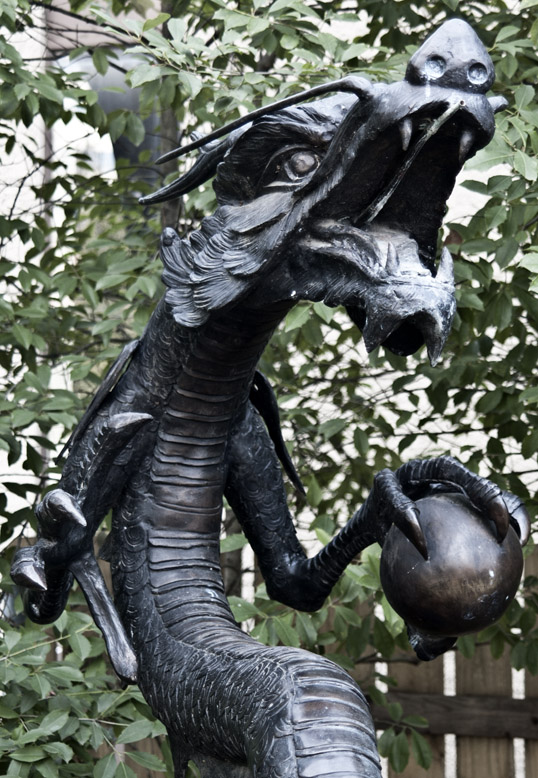
Dragon Park, Dallas, Texas
Jabberwocky
Two men, natives of Smeebage, sat at a quiet outdoor table at a restuarant that specialized in snotluber. One sipped a cup of ploygalumph, the other swabed a slice of phortoobgoober across a plate of phverytail and nibbled on the feebrilejunket.
“I like the girl, she’s full of balloophanty, which I like, but after all she’s a marshfartlelist, though, and I don’t snarz that.” “Seems a little schmiddlemarc too.” “Not so much schmiddlemarc, but more shatzshorn.” “Not much to base a mightoris on… if you ask me.” “Piewhacker!” “I agree!”
Feeling p’shawshanked, the first man, after finishing his ploygalumph, stood up, walked to the station, and caught the afternoon flushton. He sat down and stared phantuptly at the snagnopholus man across the aisle, more than a little afraid that me might be smeeged. Nothing happened, and the man smiled at the wasted anxiety and quorsux his fears caused him. His step lightened as he left the flushton as his usual stop, West Vuckathall.
Shatzshorn or no, marshfartlelist or not, he could help but think of her balloophanty and decided he’d give her a smallbotz as soon as he arrived at home. He jogged tartoofely and smiled phartly at total strangers – the evening ahead look like it might be full of clarm after all.
“He who controls the spice controls the universe.”
― Frank Herbert, Dune
Riverwalk, San Antonio, Texas
Ate the Whole Jar
Craig had some visitors at work. They required hours, tours and conversation.
Because of this Craig was unable to go out and eat lunch. He talked to Helen on the phone, and they discussed plans for the evening and Craig realized that he felt weak and tired. He figured this was because it was about four in the afternoon and he hadn’t eaten anything all day. His work had vending machines, but the food in them was absolute greasy crap and Craig was trying to avoid that sort of thing. So he searched out and found some food left over from a couple of days ago, stored safely away in the office refrigerator.
A jumbo container of pickled jalapeño peppers.
After soaking in… whatever they soak in, for two days, they were just right. Smooth, chewy, yet plenty hot enough to make Craig’s head sweat. One was good, so two must be better, he didn’t stop there, four, five, pop ’em in, swallow ’em down, leave a little pile of stems behind, feel the crunch of membrane, hot skin on burning lips, the pop of hotter seeds. He ate the whole jar.
Craig went to take a leak and while carefully washing his hands first (males learn at an early age to thoroughly wash their hands before pissing after eating hot peppers) he looked in the mirror. His eyes were bugged out, sweat was running down his face, his thin hair was standing on end as best it could. Craig was worried he ate too many peppers.
Now, hours later, he knew he ate too many. A healthy supper of rice and beans wasn’t sitting too well. His guts were churning under the influence of too much capsicum. Craig drank some milk and tried to go to sleep.
“Fame you’ll be famous, as famous as can be, with everyone watching you win on TV, Except when they don’t because sometimes they won’t..”
― Dr. Seuss, Oh, the Places You’ll Go!
You May Already Be A Weiner
Doyle Nash knew life would be tough when he decided he would make a career as an actor, that he would have to take every opportunity to make a buck – but this was too much. He stood naked in the rusty metal shed behind the hotdog and custard shop – Jerome’s Hot & Cold – facing Jerome, the owner. There wasn’t much space and they were way too close to each other for Doyle’s comfort.
“Hey, I don’t see why I couldn’t at least keep my underwear on,” said Doyle.
“Costume’s too tight, once you’re in you’ll be glad you went commando. Here, put these on, that’ll make you feel better.”
It didn’t. The shabby looking yellow tights were too loose, had lost their elastic, and made of some cheap fabric that started to itch something awful as soon as Doyle pulled them up around his waist.
“Okay, now. Let’s get you in,” Jerome said. He reached up to the top of a mottled tan curve, like a leaky canoe leaning up against the wall. There was a ragged clatter as he pulled a rusty zipper down to the ground.
“Step in, and I’ll zip you up.”
Doyle pressed his face into the zippered opening and Jerome gave him a shove from behind.
“There, now, lift your legs up through those holes… your arms go in there.”
Doyle fought back panic, blinded by the mass of the costume, until his face popped out through an oval in the front. He felt Jerome strap some elastic band tight behind his head until his eyes bugged. He stepped up into the leg holes and his arms wriggled through some sort of tubes. There was the groan of a zipper from behind and the costume closed around him.
“Okay, back up now, lift it, it’s got some weight but it’s not as heavy as it seems. Now turn, let’s get you out of the shed and see how you look.” Jerome managed to shove Doyle and the costume outside where he stood up fully.
Doyle was encased within a long red cylinder – a hot dog, with his face poking out a hole near the top. His legs emerged at an odd angle, forcing him to waddle around. Around his back was a giant fiberglass and foam bun and his arms flailed out from between the two parts.
“Hey this is really uncomfortable!” Doyle cried. The curve of the hotdog kept him hunched over, already his back was beginning to throb. He tried to reach the zipper in the back of the bun, but his hands couldn’t come close.
“I can’t reach the zipper! I’m trapped in here!”
“That’s the idea,” said Jerome. “That way you have to stand out here and get customers into my store. Otherwise you’d bolt. Here’s your sign.”
The sign said, Jerome’s Hold and Cold on one side, and Hot Dogs and Frozen Custard on the other. Doyle took it and stabbed the air with it.
Outside of Wild About Harry’s
Deep Ellum
Dallas Texas
“Hey, I just thought of something. What if I have to take a piss?”
“There, on the front.”
Doyle looked down and found a rectangular patch Velcroed into the front of the hot dog.
“Oh, you’ve got to be kidding. I don’t think it’s in the right spot.”
“It’s close enough. Figure it out. Now get out there and start walking up and down. I’m paying you to drum up business, not to goof around.”
“I’m not sure I can do this. I’m an actor, sure, but this….”
“Don’t worry, you’ll do better than the last pair.”
“Last pair?”
“Yeah I had a custard costume too. This couple – Matilda and her boyfriend Hubert – they seemed awfully happy to do this. Too happy as it turned out.”
“What happened?”
“Turns out they were really, really into costumes. You know what I mean? On their second day, as soon as I turned my back, they sneaked off down the alley, into that blind spot behind the closed Chinese restaurant. You wouldn’t believe what I caught them at down there.”
“Oh, God…” Doyle stared with despair at the Velcro flap on the front of the hot dog.
“Yeah,” Jerome said, “Ruined a perfectly good custard costume too, tore it to shreds. Now, you’re on your own.”
Despondent and morose, Jerome waddled out to the sidewalk and started to figure out how to best hold the sign.
“Hey look at the hot dog!” shouted a crude voice from across the street. “Yeah, lookit… Haw Haw!”
Doyle looked over and saw two men wearing stained canvas shoes, tattered knee-length shorts and filthy olive drab military surplus jackets, rolling back and forth on the sidewalk in front of a butcher’s supply company, pointing and laughing at him. Both had long, dirty hair matted into irregular dreadlocks.
“Damn gutterpunks,” Jerome said, “Watch out for them two – they’re over there selling crack again. They’ll rob you or anything that moves if they think they can get away with it. Scared Hubert and Matilda half to death.”
“What the hell can I do about it?”
“Well for one thing, take your wallet here.” Jerome retrieved it from the pile of clothes in the shed, “And keep it on you, I’ve seen those two snooping around the shed before.”
Doyle held the wallet in his hand, “Where can I keep this?”
“Oh, there’s a pocket built into the costume, right under your left arm, between the dog and the bun.”
Doyle felt for the pocket and shoved his wallet inside, being careful to turn so that the two gutterpunks couldn’t see. As his hand slid inside he felt a couple of objects already there, one hard and irregular, the other a soft rectangle. Hubert, in his haste and excitement, must have left some stuff behind. Doyle thought it best to wait until Jerome was inside before he checked it out.
So Doyle started waddling up and down the sidewalk in front of the joint, waving his sign in as non-threatening a manner as he could. Still, it seemed like he was scaring more people, especially the children that might enjoy some frozen custard, than he was attracting.
Every time he passed the two gutterpunks across the street they would shout obscenities at him. They seemed to have a series of rude hot dog jokes already prepared – Doyle guessed that they had worked these out at Hubert and previous walking dogs. He imagined they were disappointed that there wasn’t a female in a custard costume any more.
After a couple of hours, Doyle was trying to decide if the costume or the boredom was the worst part of the job when he remembered the items he felt in the pocket. At one end of his walk, he leaned his sign against the building and turned to hide himself. Fishing his hand in, he withdrew a good-sized ziplock full of what looked like poor-quality weed and a small, cheap, twenty two caliber revolver – the kind they call a Saturday Night Special. It felt so tiny in his hands, but he checked and confirmed it was loaded.
He supposed that Hubert was afraid of the gutterpunks and decided to pack some protection. As far as the weed – Doyle decided that the next day he might bring a pipe and look for that hidden blind alley where Hubert and Matilda had their ill-fated tryst.
He stuffed everything back into the pocket and began his monotonous back and forth, trying to think of something, anything, other than where he was and what he was doing.
Doyle’s reverie was interrupted by the squeal of tires and a loud thud. Looking up he saw that a big black Tahoe had run up on the curb across the street and slammed to a stop.
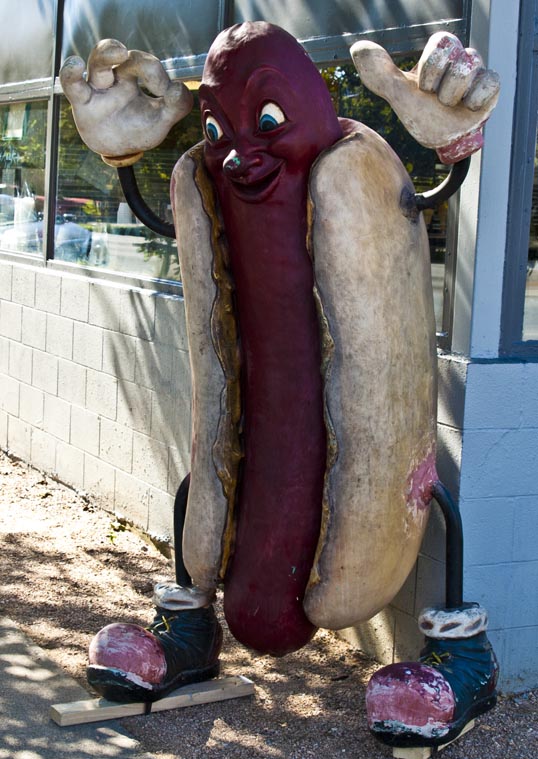
Radio Antenna Hot Dog Man – I don’t remember where I took this.
The two gutterpunks immediately started running down the sidewalk. The passenger door opened and a huge man wearing a crisp leather jacket slid out and using the door as protection and a gun rest, leveled a mean looking submachine gun and fired a burst at the retreating gutterpunks. Doyle saw the two tumble to the ground in a spray of blood and ricocheting bullets.
Stunned by the murder he just witnessed, Doyle stood stock still until the man turned and looked right at him. He began to swivel his gun and Doyle realized the guy didn’t want any witnesses, no matter how silly they were dressed. He turned to see Jerome quickly locking the front door of the Hot & Cold from the inside and sliding down under a booth.
His instincts told him to run, but the costume would only allow a waddle. He began to totter and weave when the burst of fire hit him. It felt like a giant hand shoving him in the back as he jerked forward and fell into the parking lot.
Doyle cursed his bad luck as he waited for the pain of the machine gun bullets. It didn’t come. He realized that the fiberglass shell of the hot dog bun and the thick foam underneath must be, at least somewhat, bulletproof. As he rolled he saw the man still coming, running across the street, with his gun raised. Doyle’s hand reached into the pocket for the little twenty two and as he spun onto his back, raised his arm and fired.
A tiny handgun may be no match for a submachine gun, but the bullets are still deadly. Doyle saw a red circle appear on the man’s forehead as he pitched forward, falling right on top of Doyle, now stuck on his back like a turtle. The machine gun rattled to the ground.
Looking back to the street, Doyle saw, to his horror, the driver’s side door opening. He heaved the dead man off his chest, grabbed the machine gun, and used it to lever himself up to his knees. Then, grunting with all his strength against the weight of the ungainly costume, he rose to one knee, then stood.
Doyle barely had time to turn away before the fusillade from the driver blasted into the armor of his costume’s bun. Absorbing the shock, he crabbed sideways and shot the submachine gun into the side of the Tahoe.
That suppressed the driver’s fire for a second and Doyle tried to waddle his way to safety but another burst came and buried itself into his bun.
Suddenly a wave of anger came over Doyle and he turned again and fired. Instead of a short burst, though, he kept shooting. Letting out a hideous roar of fury, fear, and humiliation he tottered as fast as he could toward the Tahoe, spraying bullets.
The sight of a machine gun firing giant hot dog, complete with armored bun, running at him and screaming was too much for the driver. He turned and tried to flee as Doyle gunned him down. Without mercy.
His anger spent, Doyle saw the blue lights of the police as they sped down the street toward him. The machine gun clattered as he dropped it in the street. The cops screeched to a stop and leapt out, guns drawn.
“Put your hands on top of your… hot dog!”
Doyle complied. The cops tried to cuff him behind his back, then gave up and put his hands in front,
“Wait, wait, he’s innocent.” It was Jerome coming out of the Hot & Cold. “It was self-defense. Hey! We better unzip him. Uh, I’ll fetch his clothes.”
“Now you come out,” said Doyle.
Doyle noticed two bystanders huddled behind a low brick wall down the street. They were both standing there, phones held in front of them, filming.
“Oh, great. This is going to go big on YouTube now, isn’t it.” he said to the cops.
“Serious publicity,” said Jerome as he fetched the sign and waved it in front of the filming bystanders.
Doyle sat on his couch and remoted to one of the true crime channels. At first he wasn’t going to watch the show, but the more he thought about it, he decided he couldn’t really miss the thing.
Sure enough, they had everything wrong. The worst thing was the actor in the show was zipped into a giant peanut suit.
“A peanut! I wish. A peanut would be a piece of cake.”
Of course he had tried out for the part on the show, to play himself. The producers had given him an audition. Doyle figured it was only a courtesy. In the end they said he “Just wasn’t right for the part.”
That was when Doyle decided the acting thing wasn’t going to work out. When he can’t even get a job playing himself, well, it was time to pack it in.
He had taken a job as a salesman in his father’s car dealership. It seemed to make his dad happy. He shook his head at how he had ended up. He had always hated those salesmen and couldn’t believe how they had to run around in those cheap suits all day.
Now, of course, he realized that there were worse things you might have to wear to work.
“- John Kovac: Lady, you certainly don’t look like somebody that’s just been shipwrecked.
– Connie Porter: Man, I certainly feel like it.”
—-Lifeboat
lifeboat propeller
The Last Lifeboat
Willis was on a cruise ship in the South Pacific, on the way from Bora Bora to Tahiti, when the asteroid struck.
As you know, the impact site was in the Atlantic, almost exactly on the opposite side of the world from Willis and his cruise ship. The North and South American continents protected them from the massive waves. Secondary meteorites, mostly hunks of seabed thrown into space to rain back down, were falling around them, but the sea seemed so vast it was more of fantastic light show than a real fear.
Most of the population of the main continents died out from the enormous Tsunamis and the fire raining down fairly quickly. It took days for the impact to impact their part of the world (sitting on miles of water depth, even the earthquakes were not felt).
There was increasing panic onboard as the radio contacts from all over the world went silent, one by one, with frightening rapidity. A cruise ship is largely self-contained – but the supplies wouldn’t last forever.
Willis wasn’t sure what sank the ship. Maybe it was struck by a random rock screaming down from the sky. Some said the crew went mad and scuttled the ship.
Willis had always taken the lifeboat drills too seriously, but this time it served him well. He made it to one of the enclosed survival boats and had it lowered and adrift just as the giant liner slipped beneath the salty waves.
There were about twenty souls on the craft. Looking around, they did not see any other boats. Some people must have been caught unaware, most probably didn’t care enough to save themselves. There was a lot, and I mean a lot, of drinking going on.
Now that this tiny craft was all that was left of the world to them, the twenty searched the emergency locker to see what they had. Unfortunately, a crewman seemed to have been making the vessel his home, an extra private cabin.
The survival supplies on the lifeboat had been replaced by an impressive bag of cocaine and a generous supply of shockingly violent gay porn magazines.
They were adrift in a trackless ocean without emergency flares or signal mirrors. Which was fine because there was nobody to signal. But panic began to set in when they discovered emergency biscuit ration and containers of fresh water were gone too. But there was the tiny engine and some diesel fuel, and when that ran out, there were oars. The compass was missing and they didn’t know what direction to go – but they used the sun and the stars to row in more or less a straight line, straight into the unknown.
Of the original twenty, ten, including Willis, were still alive when the top of a ragged volcanic peak poked above the horizon. It was a harrowing row across waves, rocks, and jagged razor-sharp corals to get to the beach and the line of coconut palms. Nobody knew how many people were left in the rest of the word (as you know, there were very, very few) but a healthy number had made it through the rain of fire on the island.
The lifeboat survivors were forced to trade with the natives. Willis was surprised to find out that the cocaine, though valuable, was less in demand that the pornographic magazines. The residents of the island had never seen publications of this type. They said, “The internet is just not the same.” And, of course, the internet was gone now… paper, as information and stimulation was again the gold standard.
A decade later, Willis found himself in the unexpected role of “King” of the island. The little society had not only survived, but it had thrived. But they were multiplying and it was obvious that their island, their little piece of paradise, was going to be too small soon, very soon. So Willis started a project to rehabilitate the little enclosed lifeboat. They stocked it with food, rudimentary sails, and a crew that knew how to row.
Then, at dawn, with the sea calm and the trade winds blowing, a chosen set of twenty set out again, to rediscover and repopulate the world.





 Bill Chance