“We are all alone, born alone, die alone, and—in spite of True Romance magazines—we shall all someday look back on our lives and see that, in spite of our company, we were alone the whole way. I do not say lonely—at least, not all the time—but essentially, and finally, alone. This is what makes your self-respect so important, and I don’t see how you can respect yourself if you must look in the hearts and minds of others for your happiness.”
― Hunter S. Thompson, The Proud Highway: Saga of a Desperate Southern Gentleman, 1955-1967
C-47 Nose Art, Commemorative Air Force, Wings over Dallas
From my blog (I called it an “Online Journal” then), The Daily Epiphany, Wednesday, March 26, 1997. I used to look at posts from my old blog that were twenty years old. Now… I’m looking at posts I wrote a quarter-century ago.
May I check your oil, ma’am?
I’ve been issued a new lab coat at work. We have to wear flame resistant clothing in the plant, the chemists wear these blue coats instead of uniforms. When mine came it had my name on it. White stitching on a little blue label, “Bill.” The guy who brought it told me that I could cut the label off, but I thought I’d let it be. It’ll help keep the darn thing from getting “borrowed” during the night shift.
I went out to buy lunch, I’m too busy, so I was going to bring it back to eat at my desk. I went out to the little sandwich shop for a “Californian” – avocado, lettuce, cheese, in a pita. It was a nice day, but cool, so I kept my lab coat on. The girl took my order and then said, “The name, it’s Bill isn’t it?” I had a moment of confusion over how she knew my name, suddenly I realized that she read it off my coat. I was yanked back twenty three years, I was a teenager again, working at a gas station, with my first name on my uniform. I looked at the girl behind the counter, she was looking at me with that look, the look you give someone that’s making minimum wage, and will always be making minimum wage.
People used to look at me like that all the time when I was pumping gas. I was in college at the time, only working over the summer or on holidays, but they didn’t know that. I’d usually have school books with me, I’d study between cars, trying to get a jump on the next year. There was a blackboard inside the station, It was usually covered with equations, formulae, but nobody noticed that (or recognized what it was). Occasionally a customer would give me a little lecture, “Son, you need to be thinkin’ about what you’re going to do with your life.” I’d nod my head, ring up their gas (I could gas six cars, remember all six amounts- dollars and gallons, their license tag numbers, and what person went with what car, I’d worked out a mnemonic system, I could gas and charge everyone without asking any questions, only a few people noticed that). Of course I had plans, I was getting an education, this gas station job and its three bucks an hour was a part of it, but only a part.
Of course, after all these efforts, after all my sound and fury, here I am, middle aged, still wearing my name over my breast.
“What is there in our nature that is for ever urging us on towards pain and misery?” ― Mary Shelley, The Last Man
Untitled (Sprawling Octopus Man), by Thomas Houseago
Nasher Sculpture Center
Dallas, Texas
From my blog (I called it an “Online Journal” then), The Daily Epiphany, Tuesday, May 20, 1997
Morning from hell
Last night, driving home, I needed to stop for gas. As I was pulling up to the Texaco a good song (Nightswimming) came on the radio, so I kept driving. I knew I had enough fuel (barely) to get home, I’d buy a tank before work the next day. This was an omen of am impending morning from hell.
Candy and I left for work at the same time; she had the kids to take to school. I walked out to the piece of crap Mazda and turned the key. Nothing. Now this weekend the battery in the van had gone out (as my faithful readers know) and I had left my jumper cables in the van in case the problem was more than the battery. So out of my car I dashed, across the two inches of leftover stormwater covering my yard, around the house in time to see the van’s taillights make the curve from the alley into the street.
No problem, I have a battery charger in the garage; I’ll hook it up to the Mazda, charge the battery, get on my way, worry about what’s wrong later. But the extension cord was too short, it wouldn’t reach halfway across the front yard. My neighbor was leaving for work, she asked if she could help, but she had no jumper cables either. I thought for a minute and realized I have a longer cord up in the attic. I had left it there from the last time I was working on the cable TV. The end of the cord was hanging down in the attic access panel in the garage, I climbed up, grabbed it, and pulled. About two feet of cord came down along with a big wad of fiberglass insulation, but no more.
So I pulled out the aluminum ladder and leaned it up to the hatch. Our house is of the more or less modern construction using roof trusses. Instead of grand beams supporting the roof, leaving plenty of headroom; a truss of 2×4’s fastened by metal plates in fractal triangles fill the attic. Cheap, light, strong, and almost impossible to move through. I’m way too old and fat for the climbing, kneeling, crawling needed to get through the maze of beams. But I had no choice.
I tied a snakelight to a beam and fought my way through; realizing too late that I needed to turn a corner and the flashlight wouldn’t reach. So back I crawled to get the light, twisting it around my neck. I clambered through the dirty labyrinth around the corner clear back to the end of the house where I’d tied the cord to an old lamp I once used to work on the coax; it was caught on some wires. I untied it and began to work my way back to the garage.
I had to stop for a minute to get a grip. I was so frustrated – late for work, a dead car – claustrophobic, stuck in the dirty, hot, cramped attic trying to get a stupid extension cord that may or may not help me get my car started and get to work. I shook for a minute with emotion and paranoia. I felt completely alone; there was no one to help me. It was still only seven thirty in the morning and I had had all the crap I could stand.
But as always, I realized I had no other choice, and continued crawling through the beams back to the garage hatchway, flashlight around my neck, pulling the extension cord with me.
I set up the charger on the long cord and attached it to the terminals. The ammeter showed the battery was low, it quickly went to fully charged; and the car still wouldn’t start. Something wasn’t right. I removed the terminal clamps from the battery and noticed that the posts were black and corroded. Back to the garage for some sandpaper which I tore in little strips. I used these to clean the terminals and the clamps. Presto, the car starts right up. I called in to say I’d be twenty minutes late and drove to the gas station and on in to work.
All day I couldn’t shake that moment of fear and panic in the attic:
Car problems again, I had already lost half a day on Candy’s van, now another battery, those zinc plates soaking in sulfuric acid, the same thing again.
The terrible time pressures, I have to be in to work. I want to sit down, take some time off, I don’t want to go. I’m behind, the clock’s ticking, I can’t be late – primal, childhood images, late late late, sent to the office, walking through the quiet, empty hall, feeling – no being – out of place, looking in through that little window at the kids seated the teacher talking – the dreaded walk from the door to my seat.
Discomfort. Cramped, fighting back the welling claustrophobia, dark, dirty, hot, I have to balance on the edges of the ceiling beams or I’ll crash through the sheetrock, itchy – a world of fiberglass insulation. How did I get here? What the hell am I doing? What sort of terrible mistake is this?
Alone, lonely. Nobody to call. Candy has patients, she can’t leave work, isn’t even there yet. I have to figure this out myself. Once, I want somebody else to handle something. Take care of it. Fix it for me.
And the screwup guilt. Why did I oversleep? Why didn’t I get gas last night? Why didn’t I get jumper cables for the van and Mazda? Why did I leave this extension cord up here in the attic? Why haven’t I cleaned those terminals on a periodic basis?
So I’m a screwup; that’s why I’m being punished . But this is only a random bad day isn’t it? The fates or whatever; are they , out to punish me? To extract payment for every transgression? Or is this paranoia? That’s not important, nobody cares if you’re paranoid. What really matters is if they really are out for you or not, paranoid or no.
Another day.
So lets belly up to the bar, mates. Get that cute barmaid to pour us up some mugs of icy foam. We’ll put our arms on each other’s shoulders and Maria’ll play a tune on the Farfisa while we stamp out the rhythm with our feet on the peanutshells and sing:
We losers, we happy losers – hear us saying; time is passing us by, there’s a party ’round here somewhere, we can hear the band playing
but we’ve lost our invitations. The stuck in the muds, the if only ifs, the full ‘o lamentations.
Don’t laugh now, ’cause I’ll wager you are one too. Don’t ya worry, there’s plenty of room, Plenty of floor, plenty of lager
Distance changes utterly when you take the world on foot. A mile becomes a long way, two miles literally considerable, ten miles whopping, fifty miles at the very limits of conception. The world, you realize, is enormous in a way that only you and a small community of fellow hikers know. Planetary scale is your little secret.
—- Bill Bryson, A Walk in the Woods: Rediscovering America on the Appalachian Trail
The Henge through a bus window.
Three Punches Left
Craig was working late, as he always did. His eyes were tired, achy and blurry from staring at the piles of reports he had to double-check, then type into an endless series of punch cards. The tan cardboard slowly filling long steel boxes to be sent down to the ravenous mainframe three stories down. It was dark outside and he was so worn out he was making more mistakes than correct entries. The bus wouldn’t run too much longer so he shut it all down to take the elevator down the giant steel and glass tower to catch his bus home.
As boring and tough as it was, he was grateful for his job. With gas up to a dollar thirty, the economy had collapsed across the country. Back in Kansas, he had a promotion at work, bought a new car, bought a new house, and had a new girlfriend. Then everything tanked and the company folded, He lost his job, his girlfriend left, and all he had left was debt.
The only places where you could find a job in 1981 were the big Texas cities – fueled by the flood of petrodollars. So he went to all his friends and was able to borrow twenty five dollars for gas and set out south down I35 to look for a job.
But it worked out, he found this job and a crumbling studio apartment on the Belmont Bus line which ran downtown. He had not been able to afford the payments on his car and as soon as they found him it was repossessed.
Craig stood in the darkness looking down the street at the line of buses moving along, stopping every block, getting the last of the worker drones out of the giant buildings. There it was, the Belmont Bus, route #1 – can’t miss it, on its way.
He had a sudden moment of panic – did he have any punches left on his transit card? He bought a card worth sixteen rides – he knew his wallet and pockets were otherwise empty. Sweating, he pulled out the card and breathed a deep sigh when he saw three punches left.
He looked up and saw the open door of the bus looming in front of him. He stepped on and gave the card to the driver for a punch. Then he settled in an empty seat and half dozed off, waiting for the hour-long ride home. A deep pothole lurched Craig awake and he looked out the window to gauge how long it would be until his stop. He had ridden the bus home enough to know the route by heart.
He bolted in his seat when he realized that nothing looked familiar. The area was really sketchy, with groups of young men gathered under the streetlights at every corner. They stared at the bus with faces of violent hate, and Craig was afraid they were looking at him.
When he looked up from his card and boarded the bus, it had been the wrong one. This bus must have passed the Belmont #1 and pulled up to him first.
What neighborhood was he in? What direction was he going? He knew his bus route but not the rest of the city. He walked up to the driver. At least he had two punches left on his card. He could catch a bus back downtown, then another home.
“Uhh, I think I’m on the wrong bus,” he said. “I need to get off and catch a bus the other way, back downtown.”
“Sorry, sir,” the driver replied. “This is the last route of the night. Ain’t nothin’ ‘till five in the morning.”
The next block looked deserted so he got off the bus. He stood there wondering what to do.
There was nothing except to start walking. He could go back along the bus route, follow the signs and stops to downtown, then walk along the Belmont route to get to his apartment. It might be twelve… fifteen miles – he might not make it home until dawn…. If he survived the walk and the night.
“The journey of a thousand miles starts with a single step,” Craig said and started to put one foot in front of the other.
“We’re so self-important. So arrogant. Everybody’s going to save something now. Save the trees, save the bees, save the whales, save the snails. And the supreme arrogance? Save the planet! Are these people kidding? Save the planet? We don’t even know how to take care of ourselves; we haven’t learned how to care for one another. We’re gonna save the fuckin’ planet? . . . And, by the way, there’s nothing wrong with the planet in the first place. The planet is fine. The people are fucked! Compared with the people, the planet is doin’ great. It’s been here over four billion years . . . The planet isn’t goin’ anywhere, folks. We are! We’re goin’ away. Pack your shit, we’re goin’ away. And we won’t leave much of a trace. Thank God for that. Nothing left. Maybe a little Styrofoam. The planet will be here, and we’ll be gone. Another failed mutation; another closed-end biological mistake.”
― George Carlin
The Last Banana
Brenda Sullivan was a beauty queen… or had been a beauty queen once… or an ex-beauty queen. She was crowned Miss Universe. There were representatives from the Moon Colony, Space Station Alpha, and the hollowed-out L2 Lagrange Asteroid. Brenda thought she could really truly claim the title of the most beautiful woman in the universe.
But she didn’t come from offworld – she represented Arkansas. Growing up on the poor side of Little Rock, she never thought she’d be able to leave the planet. But when she married Raef Sullivan they went to the L2 Lagrange Asteroid for their honeymoon.
Raef had made his fortune founding a long series of flashy companies that were very successful in being successful, even if they never seemed to make money… or much of anything else. He knew when to sell his share and to move on and his investors seemed more interested in being involved with a Raef Sullivan enterprise than in actually making any money.
At here wedding Brenda wondered what is was going to be like to be rich beyond imagination and she was happy to find out. She learned from Raef that even if you don’t have to worry about money you still can think about it. Think about it a lot.
One day, Raef called Brenda into his library, “Come look at this!”
An elaborate wooden case sat on the table in the middle of the room. Gold lettering across the lid spelled out the word, “CAVENDISH.”
“What’s in the box?” Brenda asked.
“It’s the last banana.”
“Banana? I thought the fungus destroyed all of them. I haven’t seen a banana in years.”
“I know, that why this is the last one.”
“The last?”
“Yeah, the fungus wiped out almost all of them. For a few years, there were some uninfected farms on isolated island here and there. You could buy them at obscene high prices. But the International Fairness Board ruled that wasn’t fair – and the UN bombed the remaining farms with infected soil. A month ago a single plant was found in an isolated valley on Borneo.”
“One plant?”
“Yeah, and it, of course was destroyed. But someone smuggled out a single fruit.”
“This one?”
“Of course. It’s the last banana.”
“How did you get it?”
The only reply that Raef made was rubbing his thumb and forefinger together.
“How much?”
“More than you can imagine.”
“I don’t know… I can imagine a lot.”
Raef walked over and opened the case. There, in the center, nestled in a little hollow carved out in the shape of a banana and cushioned in red velvet was… a banana. A perfectly ordinary, slightly bruised, curved yellow Cavendish banana.
“Look at it,” said Raef.
“Stare at the last banana long enough and the last banana will stare back at you,” replied Brenda. “Are you going to eat it?” she asked.
“We are going to eat it.”
“Eat the last banana and it will eat you,” Brenda replied. “When?”
“Now.”
“Time flies like an arrow… but fruit flies like a banana,” Brenda said.
“Should we slice it, or eat it as is… take turns?” Raef asked.
“Didn’t Freud say that sometimes a banana is just a banana?”
They lifted the banana out of the case and started to peel it from one end. They passed it back and forth, each taking a bite, taking turns, until the banana was gone.
“How was it?” asked Raef.
“Not bad. Not the best banana I’ve ever had,” said Brenda.
“Maybe we shouldn’t have eaten it. Maybe was should have grown a banana tree,” said Brenda.
“It doesn’t work that way. Bananas are… were all clones. They are not seeds. They are not fertile. That’s why they are extinct. Now they are extinct.”
Brenda looked at the peel on the table. “The last banana peel. The world will be safer now. Not so many slips.”
“Probably not. I’m sure there are ancient things in museums made from banana peels. Native headdresses and such.”
Such is life. It is no cleaner than a kitchen; it reeks of a kitchen; and if you mean to cook your dinner, you must expect to soil your hands; the real art is in getting them clean again, and therein lies the whole morality of our epoch.
—-Honore de Balzac
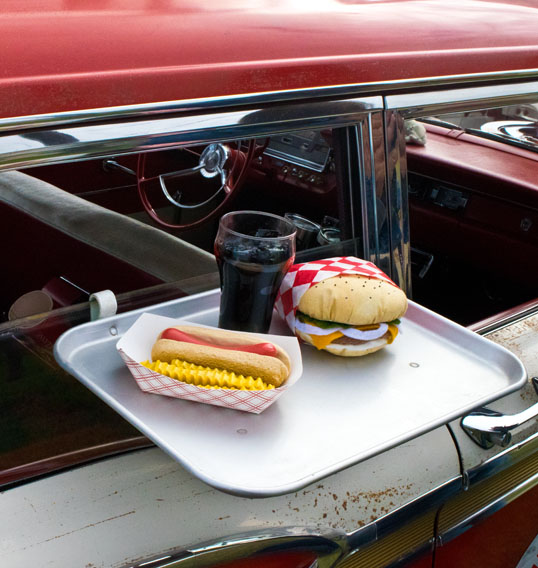
Plastic Food, Car Show, Denton, Texas
From my blog (I called it an “Online Journal” then), The Daily Epiphany, Saturday, February 16, 2002
Cooking on my Birthday
I guess most people want somebody to cook some special meal for their birthday. What I wanted, though, was to cook my own.
Some close friends of ours have started their own catering business. They have leased a storefront and outfitted it with commercial cooking equipment – big ovens and a huge gas stove, giant refrigerator and freezers, and massive stainless steel tables for food organization and preparation. They gave me a key and I went down there the other week to set up their computer and I fell in love with the place. I guess my favorite thing is the commercial gas range – it looks like what the chefs on all the cooking shows use – an acre of massive black iron pan supports with tiny blue pilot lights sprinkling the area. Turn a heavy steel knob and a get-engine rush of gas throws out some serious heat. It’s something you can actually cook on – not like the wimpy weak glowing electric coils in my home kitchen.
When they called and asked what I wanted for my birthday dinner I replied that I wanted to cook in their commercial kitchen. They said sure so I prepared a menu and went down to the Wal-Mart Neighborhood Market to buy my supplies (I won’t shop at Albertson’s any more, even though it’s closer to my house, in protest of their new 1984 Big Brother Card).
I drove down to the place a couple hours early, put a CD in the boom box and started cooking. I made onions cut in half and hollowed out, wrapped with a strip of bacon and stuffed with wilted spinach and a dollop of feta cheese on top. I marinated some sliced fresh mozzarella in sour cream and spices, then melted this over some crusty bread with a slice of tomato and an orange sprinkle of some powdered chile de arbol. For my main course I put chicken breasts, mushrooms, potatoes, white wine, and a fistful of chopped fresh herbs into bags made of carefully folded heavy foil (the basic recipe came from TV, from the Naked Chef) and baked the mess. Candy made a chocolate cake and I added a baby spinach salad.
We had six folks for diner and a sitter for everybody’s kids (we knew there wouldn’t be anything to keep the little ones occupied at the catering place). There weren’t any good places to sit, but there was plenty of wine, so that didn’t matter.
I think the food came out fine (the one thing I didn’t have was a good toaster or a salamander so the bread turned out a soggy – the stuffed onions were too tough, though the stuffing was good), especially the chicken. The foil bag is a great technique to learn. I can imagine baking stuff at home and taking it to a picnic. The foil puffs up like a Jiffy Pop and it’s great when you pierce the package and all that fragrant steam puffs out. Easy clean-up, too.
“The absence of the will to live is, alas, not sufficient to make one want to die.”
― Michel Houellebecq
Bois D’Arc (Osage Orange) fruit
Bad Fruit Cup
Craig was going to eat fruit for lunch today. He bought it last night, midnight, on a milk run to the grocery store. They needed milk for breakfast for the kids (they get pissed off if there is no milk) and he realized they were out when he was ready for bed. Therefore, midnight milk run, not an unusual thing. Big city equals 24hr grocery stores.
Today, though, the fruit was bad. Craig opened the plastic tub up at his desk and was met with a nasty slimy smell.
He was hungry, so despite good intentions, it was going to be fast food. There was a long line, a lot of high school kids on their lunch hour already in the seats. One was goofing off so much he fell out of his chair, ice drink flew all over.
He tried to watch people sitting at the other tables. Two women nearby. One entire corner of their table was taken up by a pile of black electronic devices. Pagers, Cell Phones. While they ate they were hooked in, wired up.
Two suited and tied middle aged middle manager types were next to them. One faced Craig and he could understand the manager when he spoke. His partner’s voice was an unintelligible mumble.
“The forklifts, we’re selling ’em faster than we get them in.” “mumble mumble mumble” “First things first, we should fix the spare IBM.” “mumble mumble mumble” “But they didn’t have a backlog” “mumble mumble mumble”
On around, the next table, a cute woman sat, her lunch eaten, reading a paperback. He stared at her as long as he though was appropriate and nobody noticed.
And that’s about it. He ate, and left, to drive across the street to a bookstore. His son had been checking these books out from the School Library; How to Draw 50 Famous Cartoon Characters, How to Draw 50 Dinosaurs, How to Draw 50 Animals . He sits for hours, typing paper spread across the coffee table in the living room, drawing. Sometimes he cheats and traces.
Craig wanted to buy him one of these books today, maybe buy one every week or so, that way he will have some that he doesn’t have to return, that he won’t worry about tearing or getting some crayon in.
And that’s about it. That’s his time off for the day.
The art of art, the glory of expression and the sunshine of the light of letters, is simplicity.
—-Walt Whitman
Lee, trying to pull the ball loose.
Foondball
Craig’s son called him at work – he was home from school and a friend, George. was at the house. He wanted to know how to type on the computer. Craig gave him quick instructions on how to start up Word, how to save his work, and how to print it out when he was done. It turns out his son and George had an idea for a new sport, which they called Foondball and they wanted to type out a list of rules.
When Craig came home he found his desk littered with sheets of notebook paper covered with crude drawings of athletic fields and different dimensions, markings, and goal layouts.
On the screen was their rules for Foondball:
The game can only be played with 6 to 12 players.
You may use your hands to throw the ball and your feet to kick the ball and the goalie may use a hockey stick to block shots taken by the strikers.
The goals are at opposite ends of the playing field the field is 75 yards in length and is about 25 to 30 yards in width
The winner of the most rounds wins the match there are three rounds lasting 20 minutes and 5 minutes of rest between rounds
In the case of a tie the winner will be decided by a 10 minute overtime if no winner is decided then it is a draw
The goals are about- 6 to 7 feet high and 10 to 11 feet wide
The game begins with the thrower throwing the ball and the whacker hitting the ball the seekers catch the ball if the seeker on the whackers team catches the ball he may keep running to the goal if the seeker on the throwers side catches the ball he may run it back and try to score
Each goal is worth two points
If there is a foul the ball goes to the place where the foul was committed and thrown from there.
If a foul is committed within ten yards of the goal the person whom the foul was committed against gets to take a free shot he can throw the ball into the goal or he can kick the ball into the goal
If one team wins the first two rounds of the game then they automatically win the game
At no time during the game is play ever supposed to stop unless a foul is committed
There is a ten minute half time in between the 2nd and 3rd round
If a person scores on a foul then the goal only counts as one point
After a goal the team that scores is to throw the ball and play resumes
Helmets are to be worn
For each team – 1 goalie, 2 whackers, 1 seeker 2 throwers
The goalie may never come out of his 10 foot box
If a player is on concrete he may dribble the with his hands
The player may throw or kick the ball to one of his fellow teammates
Someday, maybe, kids will dream of glory on the foondball field, and trade photos, cards, and stories of who their favorite whackers, throwers, and seekers are.
“What’s your name,’ Coraline asked the cat. ‘Look, I’m Coraline. Okay?’
‘Cats don’t have names,’ it said.
‘No?’ said Coraline.
‘No,’ said the cat. ‘Now you people have names. That’s because you don’t know who you are. We know who we are, so we don’t need names.”
― Neil Gaiman, Coraline
Waco Downtown Farmer’s Market
Waco, Texas
From my blog (I called it an “Online Journal” then), The Daily Epiphany, Wednesday, October 07, 1998
Hail
I started out for work in the morning just a little bit late, having to rush. Candy, watching the morning news, warned me of impending weather. I glanced at the television as I walked out the door and saw that familiar ominous radar image of the metroplex with an irregular diagonal orange line of thunderstorms slashed across it.
I hadn’t driven very far before fat blobs of rain started slamming into my car. It didn’t look that threatening – no large dark caterwauling thunderheads or blasting cold wind of an advancing squall line. Only the usual gray skies with a few darker patches. There was an occasional rumble or crash of thunder and a bright laser flash, thin crooked line of lightning, however, to indicate more powerful forces at work.
The plop sound of the big soft drops soon took on a strange clicking noise as they struck the steel skin of the Taurus. The water quickly turned to ice. I was caught in an unusual early March, early morning, dawn really, hail storm.
It’s a helpless feeling to sit there, stuck in traffic, as chunks of ice scream across the sky to slam into your vehicle and the cars all around. I looked for a place to pull over and get some shelter from the storm; unfortunately with morning rush hour all available overhangs were quickly snatched up by aggressive drivers in expensive new Sports Utility Vehicles or Dual-Axle Pickups. The gas stations, fast food emporiums or any other structure with a modicum of cover were full before I could even move forward an inch in the backed-up street.
So there was nothing to do except wait in the backup of cars on the road behind the spot where a crew was digging out some potholes and using orange cones to narrow the way from three lanes to two. That caused the slow backup in the left two lanes of good citizens like me, patiently waiting our turns while obnoxious morons in the right hand lane zipped by to asshole their way back into the queue at the very cones themselves, thereby holding everybody up.
Nothing except sit there and hope the ice didn’t get big enough, the wind strong enough, to put unsightly dents in my car. Which it didn’t. It only lasted a minute or two. Although the hail did look fairly large it was soft and misshapen, fluffy; not a very effective weapon. As the spring goes on into summer I’m sure the tornadic thunderheads roaring in out of the great plains will get better at it and have some good damaging hail.
It must have been bad somewhere, though, because, hours later, on the way home from work in the parking lot of the abandoned movie theater near my house (eleven screens, all of them within a couple miles of my house, closed when the new stadium seating 30 theater multiplex emporium opened a few miles south in the long vacant field that for a decade held a single real estate sign “ZONED COMMERCIAL,” off of the interstate loop) had appeared a large white tent open at each end. Cones were set out to direct cars through the open maw of the tent. Next to it was a large recreational vehicle painted a bright blue and white and bearing the brazen logo ALLSTATE – Catastrophe Emergency Response Unit.
So the insurance companies were all ready to start taking hail damage claims. The storm may have been worse in areas near here but it couldn’t have been too bad because I didn’t see anyone queued up for their estimates.
Across the street, in the parking lot of another abandoned theater was a small carnival. Only a few steel rides and a smattering of booths; the bright lights were coming on as the sun set. One attraction was a huge slide, an inflatable structure that looked like a giant cruise ship, listing forward at an acute angle. At the stern, pointing high in the air were two inflatable propellers and, of course, the legend TITANIC.
I turned right, into the neighborhood, putting my back to these omens of disaster and drove on home.
“We earth men have a talent for ruining big, beautiful things.”
― Ray Bradbury, The Martian Chronicles
A painting I bought at the For the Love of Kettle event at Kettle Art in Deep Ellum, Dallas, Texas. The artist is Jeycin Fincher
Hot Rod On Mars
After a hundred years of terraforming the air on Mars was finally breathable. The colonists had developed their own culture – often seen as odd and ridiculous from the point of view of their friends and relatives left on earth.
One of the most inexplicable cultural oddities was the popularity of hot rods on the red planet. All kinds of replica American muscle cars from the fifties, sixties, and seventies became the ride of choice across Mars.
Craig was very proud of his replica 1970 Dodge Challenger. I was white, like the car in the ancient film, Vanishing Point – one of the few classics that survived the great purge. Craig couldn’t resist though, and had a garish red and blue lightning bolt painted on the room.
But Craig’s testosterone was more powerful than his driving skills – plus he never understood that late-20th century muscle cars were designed for pavement and were dangerous and unstable on cross-country jaunts. The designers never intended their cars to be driven across the rocky plains of Mars.
It was inevitable that he would find a steep ditch and plunge the front end down into the gap, bury it in the dust that filled and hid the furrow. Craig climbed up onto the elevated back end to get a bit better satellite cell reception and decided to stay there as he waited for the star-shaped tow drone to fly to where he was. It was going to be an expensive accident… Maybe he would learn from this.
“The Earth is God’s pinball machine and each quake, tidal wave, flash flood and volcanic eruption is the result of a TILT that occurs when God, cheating, tries to win free games.”
― Tom Robbins, Even Cowgirls Get the Blues
Caribbean Sunset
From my blog (I called it an “Online Journal” then), The Daily Epiphany, Wednesday, October 07, 1998
Monarch
After work today I drove over to the health club and had a good, tough workout. It was a gorgeous day and I felt like staying outside for awhile so I drove across Sunnyvale to Lake Ray Hubbard and a little park at the end of Barnes Bridge road. This is the place with the two wooden crosses, I wrote an entry about it back in June.
The two crosses are still there. I was glad to see that someone had repaired Jason Farmer’s cross. From the look of how it was done, it might be the same people working on the other cross.
Michelle Lemay Self’s cross is still kept up with a little plot of plastic flowers. The white wood is covered with messages written in what looks like black magic marker.
Wife, Mother, Daughter
Granddaughter
Sister Beloved
"Friend"

We Don't know you
but visit all the time.
STEF
There is a little line drawn about eighteen inches up from the ground. It is labeled, “Austin’s height when She left him.”
At about three feet there is another line. “Austin’s height, 7/9/98, 2 1/2 years old.”
I
Love U
always
Your Husband
Chris Self
Nearby, in crude but legible hand,
I love you
MOMA
Austin 7/19/98
Along one side was a longer, more ominous message. I present it here as I copied it down, I don’t think it’s my place to make any comment.
For those of U that come
and see this 1 and Lonely cross
I hope u all have took the time
and understand are pain & are loss.
This 1 man I'd Love too c out
here 1 sunny summer day.
So I can end his sorry LIFE,
AND then be on my happy
way to go & tell my loving wife that
he has finally paid.
u know who u are
I'm coming soon.
Gregg
The park is as poorly-developed as always. Some run down playground equipment and an arc of shoddy grass, a bit of woods, along the shore of the lake. I walked on down a path away from the parking lot.
All the lakes in North Texas threatened to dry up with this summer’s drought. The recent deluge has helped, but the lake is still down. Instead of these little cliffs of mud-rock along the shore, there is a little stretch of sand, which used to be lake bottom. I sat along this poor man’s beach and watched the gold sunset sky, the hazy distant opposite shore with its expensive homes and developments. A lone sailboat fought against the waves, a flock of white seabirds dove for fish.
The wind was blowing stoutly and that was enough to build waves from across the big lake. They came rolling in, miniature breakers. With a bit of imagination it was like being at the ocean. It even smelt a little like the sea, mostly because of a mat of drying and rotting seaweed.
I walked on down the curl of the park ’til the stretch of public property ended in a steel barrier and “No Trespassing” signs. Away from the water was a thick grove of trees and a path. I walked back into a little grotto, my legs brushing away last night’s spider webs, nobody had been there all day. I looked up into the trees, still illuminated by the afterglow of the set sun and saw motion. The trees were full of Monarch Butterflies.
It was a beautiful sight. The green and yellow trees, orange sky, red and black flapping wings. The branches were lousy with them, many came fluttering down, disturbed by my approach. They flew in a cloud around me, close enough to reach out and touch.
They must be stopping over on their annual migration. It was an unexpected treat, a special pleasure, to have them decorate this remote speck of shabby forest.
I needed to get home so I walked back to my car. The return drive was slow and fun, I was stuck behind a peloton, maybe thirty riders. A local club was finishing up a ride, trying to get back before dark. I especially liked slowing down on the uphills, watching them all come out of the saddle, black shorts and colorful jerseys, pumping legs and bobbing helmets.
I had worked out hard enough, it had been a long, tough enough day that I was content to sit in the bucket seat and steer, listen to a tape, let them all do the work for once.




 Bill Chance