Sunday Snippet – Punch Card (How I Met Your Grandmother)

I had a writing teacher once that said that ideas were swimming through the air all around us and if you didn’t catch one as it went by, someone else would.

This morning, I caught an idea for a short story and wrote down an outline before I went out for a bicycle ride. There are four scenes, spread out over, say, forty years. The working title for the story is Punch Card (How I Met Your Grandmother).

Here’s the second scene, which takes place in the past (maybe 1975 or so). I’ll write the other three scenes over the next few days – hopefully to take to my writing group. If you want a copy of the first draft when I finish it, send me an email at bill*chance99@gmail.com – except put a period where the asterisk is and the number 57 where the 99 is (take that spammers).

I hated the punch card machine more than anything I had ever hated before. I was a junior, majoring in comparative literature and since I wasn’t in the computer science department I could only use the computer lab after ten in the evening. The giant computer itself took up half of the bottom floor of the building – but nobody was ever allowed to go or even see in there. The other half was filled with a filthy snack bar, lined with rusty autobots that spat out moldy candy bars and bags of stale off-brand potato chips – and a series of dingy rooms filled with hundreds of punch card machines.

I had taken an elective class in Fortran programming because I thought that computers were the future and I was worried about paying rent after graduation. Writing the assigned programs was easy – find the sides and angles of a right triangle, the day of a date, or draw a series of boxes. I could write the code, but I couldn’t punch the cards.

My homework problems had to be punched onto these beige cards – rectangular with one corner cut off. I had to buy a case of the damn things at the beginning of the semester. I couldn’t imagine using all those cards. I didn’t know. Three months later, I had to buy another half-box from some kid in my dorm. I was always a terrible typist and would get nervous, freeze up and hit the wrong letter.

This was worse than a typewriter. You would load a stack of cards into the machine and then it would warm up and start to hum. The heat would rise and the ozone would burn your nose. The keys were big and yellow and had to be shoved hard before the machine would roar and then… “Blam!” it would whack a little tiny rectangle out of the card. A paper flake would fly through the air to join the thick layer of cardstock confetti coating the floor and, magic, a corresponding hole would appear in the card itself.

With the punchcard machine a mistake was a disaster. I never could see that I’d missed a key. Sure, the code printed out along the top of the card but they never put new ribbons in the machines and it was always too faint for me to read. When I had my stack of cards all finished I’d take them into the computer room, wrap them with a rubber band, and shove them through this little wooden door in the wall where they would fall down a chute. You never could even see what was on the other side.

Then it was time to wait. Wait for hours. I’d spend all night there, waiting for my program to run. Then, my output would drop down another, bigger, chute into a pile. Every time an output would drop, all the kids waiting would run in and see if it was theirs. It was horrible.

You see, if your program ran correctly you’d get a few sheets of paper with the code and the answer printed on it but I never did. I’d find my cards still rubberbanded together and clipped to a huge stack of pinfeed folded green and white striped paper. On the top would be a handwritten note that would say something like, “Core Dump, you loser!”

Whenever you made a mistake, even a tiny one, the core would dump and the computer would print out hundreds of pages of gibberish. You were supposed to carefully peruse the printouts and find your error in there somewhere but nobody had time for that. You’d throw the printout in this huge wooden bin, scratch your head, and start looking for your mistake. I have no idea why they wasted all that paper.

Sometimes it would be a mistake in my work, but usually it was a typo in my card punching. I figured out that the little holes corresponded to letters, numbers, or symbols and I punched out a card with everything on it, in order, and I would have to slide the thing slowly over every card I had punched to try and find the mistake.

It was horrible. I would be so tired, my eyes swimming, sitting at that huge punch machine, trying to type. I’d make a mistake and throw the card onto the overflowing trash bins and start again. Even when I made it through a card, I’d be terrified I had made an unknown error and would generate another core dump. It was killing me… but I had nowhere else to go.

Our instructor was always harping on us to put in comment cards. These were punch cards marked in a certain way that they didn’t make the computer do anything, but simply left comments. You were supposed to leave comments about what your code was supposed to be doing or what your variable represented or why you decided to do something the way you did. It was a pain in the ass and I never did it until the teacher started marking my grade down because I had insufficient comments in my code.

So I started putting the comments in, though I never commented on the code. I figured he didn’t really look through everybody’s work for these things and only took the computer’s count of how many comments were in here. Sometimes I’d just gripe… like, “Fortran really sucks,” or “This is too hard,” or “It’s way too late at night to be doing this.”

This got to be pretty boring pretty fast so I switched to some of my favorite Shakespeare Quotes, “As flies to wanton boys, are we to the gods; they kill us for their sport” or “There’s not a note of mine that’s worth the noting,” or “I am not bound to please thee with my answer.” I might make some mistakes punching the comments… but who cared? They would still go through as comments and you could still read them.

Like it was yesterday, I remember the day when I picked up my output and, sure enough, there was the big thick stack of folded paper, another core dump, but instead of a handwritten note, there was a punched card on top of my stack. It was different in that it had been done on a machine that had a fresh ribbon in it and across the top, in crisp, clear, printing, it said, “Funny Comments Ronald. You’re getting close. Ck crd 7 error in do loop – Christine.”

And sure enough, in my seventh card I had hit a capital letter “Z” instead of a number “2.” I never would have seen that.

So I redoubled my efforts at witty, humorous, and obscure quotations for my comment cards. I was reading this huge crazy new book called Gravity’s Rainbow and one day I quoted from it. Stuff like, “You may never get to touch the Master, but you can tickle his creatures.” or “If they can get you asking the wrong questions, they don’t have to worry about the answers,” or “Danger’s over, Banana Breakfast is saved.”

My program ran that time and the card on top said, “A screaming comes across the sky – Christine,” which made me so happy I didn’t stop smiling for a day.

The next program, I added a comment card that said, “Christine, I can’t see you – Ronald.”

And it came back with, “I know, but I can see you. I think you’re cute – Christine.”

So I thought about it and worked up my courage. At the end of a program that I larded with my best quotes from the composition book I carried with me and scribbled in all the time… my commonplace book, I finished with a card that said “Christine, I want to meet you – Ronald.”

All that night I was the first to fight their way in to grab any program that slid down the chute, only to be disappointed again and again as other student’s projects ran before mine. Finally, as the sky was beginning to turn a light pink in the west, my program dropped. On top was a card. I ran back to my dorm room to read it, not daring to look at it anywhere in public.

It said, “Love to Ronald. Snarky’s at six, on Thursday. Don’t be late – Christine.”

Snarky’s was a little chain restaurant off campus not far from the computer building. My heart almost beat out of my chest. Thursday was going to take a long time to get there.
Sunday Snippet – Night Guitar (opening scene)

This week’s snippet is the first scene from the worst short story I’ve written in the last few years. It’s so bad I should simply delete the files and get on with my life, such as it is, but I haven’t done that yet. The mere existence of that pile of silly randomness bugs me like a hangnail and I can’t help but pick at it. I’ve taken it apart and am editing some of the parts that might work sometime and trying to create a creaking framework to hang everything on.

And because I am just too damn tired to come up with anything worthwhile this evening I give you what I’ve written for a opening scene so I can humiliate myself and you can wallow in some shallow schadenfreude before you click away.

Night Guitar

Copernicus Mayhem was the lead singer and guitar player of the band Sweetmeat Valentine. He made damn sure nobody called him anything else. The name his parents had chosen for him was Doug Chandler. But nobody called him that. Not any more.

“Oh, come on Copernicus, please, pretty please, let’s go. I wanna go,” said Serena Twist. She was his West Coast girlfriend, and that was where they were, so she was his girlfriend.

“Oh, babe, I’m beat. This is the first three days off I’ve had in a month. Let’s stay here, the suite’s big and nice, hit some weed, soak in the tub.”

“Hit some weed and soak in the tub? That’s all you wanna do. I’m bored. I’m bored. Let’s go.” Serena had switched her voice into her high sniveling mode – like fingernails on chalkboard. Copernicus knew that he would be giving in, but he wanted to hold out for a minute or two. Have to keep up appearances. He had a sliver of pride left – or he hoped he did.

“What kind of stupid concert is this anyway?” Copernicus asked without any intention of listening to the answer.

“It’s classy. It’s classical. This composer, Tyrone Page, has done a new symphony. It’s never been performed before. You’ve been invited and I want to go. It’s a humongous honor.”

Copernicus had heard of Tyrone Page though he had never actually heard his work. Page was a mystery, an enigma, nobody knew who or where he was.

The scores of Page’s works arrived on the desks of famous conductors at random intervals. Copernicus wondered why he had never heard anything written by the infamous mystery composer… then he remembered. Page never allowed his stuff to be recorded. It had to be heard live. And though the composer was hidden, his lawyers weren’t. Nobody dared put the sound down on tape, or disk, or anything else.

Copernicus was interested. Now, he actually wanted to go; intrigued. It had been a long time since he had felt intrigued.

“Ok, ok, If you want this thing so much, I’ll go,” Copernicus said. “But I want you to call Skinner and make the transportation arrangements. I want a stretch this time, no van. And I want some weed in the car and a bottle of Maker’s Mark. And plenty of ice.”

“Sure honey, I’ll set it up. Thank you, Thank you.” Serena seemed truly grateful.

“Yeah, you do that. And Serena? I’m gonna be hungry when we get back. I want some good room service this time. Not that usual stale crap. Oh, and please change. If this is a big deal like you say, I want you to wear something… something shiny.”

Sunday Snippets

A very busy day today, out and about… I did manage to sit in the Espumoso Caffe in the Bishop Arts District in Oak Cliff and sketch out a short story in my notebook. I meant to type it up when I was home in the evening and let you see it here, but I’ve been hammering away and it’s nowhere near done. I have to drive to Oklahoma City tomorrow to pick up Nick, so I better get some sleep.

All I have for this week, therefore, are three little snips of text, signifying very little. I try to keep on file, well, several hundred little scenes or sketches… mostly culled from the wreckage of failed stories – in the hope that I might be able to use them someday. I pull them out in times of low ambition and massage them, water and fertilize them… see if something roots and grows from the barren cuttings of words.

For example….


The little boy came up out of the water like a sprite from a fountain. He shook the droplets off and watched the tiny rainbows as they flew from his body. He looked down at the dark footprints his wet soles left on the hot concrete – at the space between the toes and curved pads and as he gained speed there was only the toes and the ball, then finally nothing as his skin dried.

A sudden scream of air – a whistle – blown – designed to startle – stopped the boy in his tracks right at the foot of the ladder.

“No Running!” came the simple loud command from high.

The boy shook as he looked up at the voice from the chair – but the speaker was obscured by the bright haloing sun.

He walked carefully the rest of the day, little steps, glancing up at the chair.

That night he ate his dinner and cleaned his plate. Then he copied his lessons from the book onto his blue-lined three-holed paper using his number two lead pencil. He took his evening bath, and – remembering the instructions from his health textbook – combed his hair one hundred times. Finally, he crawled into bed, pulled his blanket up to his neck and quietly, almost silently, sobbed himself to sleep.


He sat on a thin high chair at a narrow bar of blond wood facing the broad windows sipping his drink and watching people drive up outside. Two scruffy guys wearing leather jackets sat smoking and talking – making wide, violent gestures and laughing – at a little table on the sidewalk. He was looking out over their heads. One guy had long stringy dirty hair, balding a little in front. The other had given up and shaved this pate.

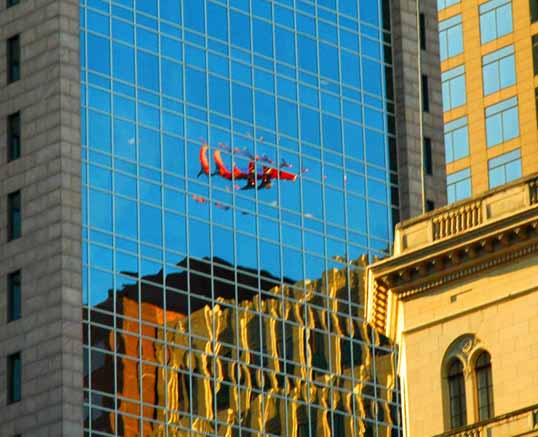
Across the busy intersection was a bank building of white marble alternating in vertical strips with blue reflective glass. It extended up past the top of the windows – he wasn’t sure how tall it eventually was. He glanced up and caught the reflection of an aircraft, an orange and red Southwest passenger jet, crossing the face of the building. It must have been on landing approach over his head; lined up with the bank building’s mirrored windows. The image would jump from one strip to the next, sometimes curved and distorted, sometimes magnified, sometimes shrunk to a pinpoint, depending on the flaw in that particular glass panel. The plane would dance, bend, and jump, flitting distorted and plastic.

He noticed the two guys staring at the dancing plane too. As the reflection disappeared off the left side of the bank they laughed and waved their arms bent in the air in imitation of the flexible jet. They turned and shared a silent smile with him through the window – for a split second.

Until he thought better of it and turned back down to his book.


(click to enlarge)

Paul woke up naked and crusted with what must have been vomit. His brain felt like it had swelled to twice its usual size but was still stuck in the same little head. He thought the pressure might separate his skull along some jagged line, exploding his brain in sweet relief. Every nerve in his body was firing quickly and randomly and the light pouring in from the end of the bridge felt toxic. Paul tried to protect himself by digging deeper under the pile of filthy blankets that was left to him. They weren’t thick enough and Paul was forced to try and figure out what to do. His elbows and knees were scraped bloody and his tongue felt torn on the underside, like it had been half pulled out.

He scrabbled around for his clothes, keys, and wallet and found nothing except a filthy pair of green shorts and a denim jacket that said Big Bambu on the back and a fresh bloodstain coursing across the front. He put those on, wrapped himself in the least-filthy rag he could find for warmth, slid down the concrete slope, and padded barefoot along the trail under the high Interstate overpass back to his car.

He wasn’t really surprised when he found the Chrysler missing. He dug around the camp trying to find anything of value but it had been stripped. The dirty shreds of rags, old shopping carts, and trash were still there as was a dark spot where the night’s campfire had burned itself out cold. But no food, drink, shoes, or anything else of any value remained.

Paul sat and cried for over an hour, until the sun rose and heated the mass of concrete overhead and it felt like a rumbling broiler. He could not figure out how to get home. He considered hitchhiking but couldn’t imagine anyone stopping for a horrible apparition like himself. He couldn’t find any change – not enough for a pay phone, and the thought of trying to panhandle… he couldn’t bear the thought of someone seeing him like that.

Then Paul realized that the creek at the bottom of the interchange was the same drainage system that coursed through his apartment complex. He thought he could follow the way, make the correct turns. He limped down into the stale slow-flowing water, the mud feeling good on his feet, but the filthy liquid stinging his wounded knees and elbows. He noted the direction the water was flowing, turned into it and began trudging upstream.

Sunday Snippet – The Red Tail

A quick first draft I hammered out on a break from work. There may be something here, but I’m not sure what.

Walter ran through the corn. It was higher than his head and he knew he was invisible. The stalks stood thick, but there was room to run between the rows. He realized he still had the gun in his hand and that it was slowing him down, affecting his gait. He raised the gun to his face and realized that it was giving off a burned smell and that the barrel was hot.

He threw the gun away into the corn.

He wanted to start running again, but Walter had lost his way. The high corn hid him but made it impossible to see where he was going. The noon sun was directly overhead and he realized he didn’t even know what direction he had come from.

So he just ran.


When he was a child, Walter Skopsky’s father gave him a gift. He didn’t know it at the time but that moment was to shape the rest of his life. His father was a struggling alcoholic insurance underwriter and was hunched over his desk balancing the family’s meager bank accounts late one evening – trying to finish so he could reach for his second bottle. Walter was out of paper for his school work and was pestering his father for a sheet or two when the old man reached into a drawer and fell upon a pad of graph paper. He threw it and told his son to leave him alone for the rest of the night.

Walter still remembers the cool, green color of the pad, the thick blue and fine red lines crisscrossing in a grid of such heavenly precision – the repeating pattern of the axis implying an infinite steadiness and surety reaching out past the edges of the sheets into infinity to the left and right, back from the past and forward into the future.

It was the most beautiful thing Walter had ever seen.

A shy, nervous, and delicate boy, Walter took refuge in his graph paper. Once he committed something to the Cartesian Predictability on the single plane he felt he had the world under his control.

He was terrified of the long drives his family would take every holiday to West Virgina – to spend time with his mother’s large, diffuse and complex, intertwined family. The visit was a blur of loud and unpleasant confusion to Walter, but the drive up there and back was horrifying. Walter did not have access to accurate statistics on driving fatalities, but he watched the evening news and read the paper. He knew that a lot of people were meeting a gruesome end on the roads. Walter made guesses as to the percentages of deaths per thousand miles of driving and would graph the family voyage along with his estimate of his odds of dying in a fiery crash.

During the trip he would look from the back seat of the car over his father’s shoulder at the odometer and would then retreat and mark their progress on his graph and reduce his estimate of fatality until, pulling into the weed-infested gravel driveway of his aunt’s doublewide, the two lines would move to zero and he could breath easier until it was time for the trip back.

As the years went by Walter became increasingly unsatisfied with his simple linear graphs. The world was getting too complicated. That was when, on a whim, he fished the teacher’s guide to a set of standardized progress tests given out to his entire grade level out of a classroom trash can. He slipped the guide into his notebook and surreptitiously sneaked it home like it was a set of state secrets. That night he removed the clear cellophane from the unread thin pamphlet and devoured it cover to cover. There, he discovered, for the first time, the concept of the bell curve.

The simple curve resonated with Walter and he felt, finally, that he had learned a concept that explained the world to him. At first the librarian dismissed him, but he kept bugging the woman until she led him to an introductory statistics textbook that had a long chapter on the normal distribution. The mathematics were above him, but Walter began to understand the curve itself in its graphical form, with the large number of “normal” points arranged around the center and the two, rare, special, “tails” extended out to either side.

Walter copied the curve onto an entire pad of graph paper and then began to fill in the areas with highlight markers, so he could still see the lines underneath. He used the most common yellow markers on the vast territory of the center hump of the curve. The top one percent of the tail, he colored green and the bottom one, he colored red.

He stared at that upper green tail and swore he would always be in there, no matter what it took. If he couldn’t make it there – he would move on. He entered into a long period of studying. He would graph his test scores and his mid-semester and final grades – making sure he was in that top one percent. Anything less would be represented by a big blotch in that vast yellow mediocrity of the curve and Walter would be up late at night, sweating in his bed, and staring at that mark of self shame.

In English class one day, they read Robert Frost’s “The Road Not Taken” and Walter wrote a long heart-felt essay about how the two roads led to the left and right areas of his beloved bell curve, and the “Road Less Traveled” led to the right-handed, green tail. He even stapled one of his beloved graphs to the back of the paper, carefully labeled with sections of the poem. He let slip a rare grin of self-satisfaction as he handed in his paper, sure that the teacher would be impressed by his understanding of the relationship between statistics and literature.

Walter was mortified when the paper was returned with a “C-” and the notations, “Well written, but does not make sense,” and, “Does not follow instructions.” Tears welled up in his eyes as he made a mark slightly to the left of center in the vast hated yellow land of the bell curve.

He kept staring at that graph… as time and again he kept ending up in that yellow center. It was horribly frustrating and he became more and more discouraged. Walter needed to be there in that green tail – the top one percent. But, try as hard as he could, he kept falling short. Slowly, inevitably, he began to think about the other end of the graph, the red end. The bottom one percent. What would life be like down there?

It was about that time that Walter’s father fell asleep in his car in the garage with the engine running. There was a lot of talk about whether he had done himself in or had simply made another drunken mistake… his last one. Walter didn’t think it made much difference either way.

In the confusion after his father’s death Walter was able to sneak into his parent’s bedroom and find the black plastic case hidden under the shoe stand. Walter’s father had proudly taught his son how to use the snub nose revolver and the two of them had spent some time out in the country, target shooting at whiskey bottles stuck between strands of barbed wire.

The gun was the only possession of his father’s that Walter cared about. He was able to keep it hidden away under his mattress. Nobody ever payed much attention to his room and after his mother disappeared and he was sent to live with his aunt in West Virginia nobody payed any attention to him at all.

Walter had grown into a tall, lanky, quiet youth. He wasn’t too quick, but he was fast, and he had some stamina. At first, he did well in math, which made his teachers like him and the other kids stay even further away.

He was still making his graphs, and his bell curves, but he had stopped coloring in the green tail on the right hand side. His mind began thinking more and more about the red end to the left and began to rejoice as his marks were drifting lower and lower, moving in that direction.

Finally, one summer he decided to take the plunge. He began thinking more and more about a little gas station out on the highway. A dirt road ran to the east from his aunt’s trailer and was separated from the gas station by a wide, flat, corn field. He was tall, fast, and though it was wide he knew he could run across that field in less than five minutes.

A girl from his high school worked out there on the weekends. Her parents owned the place. She was a senior and a cheerleader and everybody knew who she was though Walter was sure she had no idea who he was.

All Walter had to do was wait until the corn had grown higher than his head.


He didn’t know where he was going, but Walter still ran through the corn. His pockets were stuffed with cash which seemed heavier than it should have been.

Walter realized that this must be what it felt like to be down in the red tail of the bell curve. Lost, running, desperate. This wasn’t what he expected but he wasn’t sure if it was what he wanted. He did know that now he was there, down in the red tail, that he was there for good.

Sunday Snippet – Historical Fiction

Today’s bit is from a confused collection of text that I have been working on for a long time. It was intended to be a piece of historical fiction – a form I love to read but have never really had luck writing.

I think I’m going to give up the historical aspects of this story and move it into the present day. That means I can remove everything from the past and tell it as a complete lie. Trying to do proper research and insure historically accurate details and language was more time than I wanted to waste and more energy than I wanted to expend.

The following is the end of what I used to mess with and it will have to go. But I thought I’d let you take a read before I send it up to that great delete key in the sky.


“Up, Up!” For the second time in the last day, someone was shaking me and shouting into my face. “We must go now!” It was my father. He was in such an agitated state I almost didn’t recognize him.

It took me a minute to get my bearings, to remember and start to understand why I was in bed yet still dressed. The clock showed it to be late afternoon. My face ached terribly and I gingerly touched my mouth and cheek, feeling the dried blood, which stained my shirt with an irregular dark streak. Father ignored my awful appearance, threw an old overcoat around my shoulders and dragged me out the front door.

The Beauregards and the Carrolltons were waiting there, on horseback. Carson held the reins of two more steeds, one for me, one for my father. Before we could mount, my father grabbed me roughly by the shoulders and shoved his face inches from mine. His usually deep and reserved eyes were swollen and bulged out, his cheeks red as beets, his hair, once carefully groomed, now dirty and wild. With a disturbed cracking and rising voice that I wouldn’t have believed could have come from that cultivated and meticulous man he screamed into my face.

“Listen! Listen to me. No matter what happens, no matter what they say or what questions they ask… remember, nothing could have been done! It was God’s will… an act of God alone!” “Do you understand.”

He said the last three words not like a question but as a statement of fact. With that I was grabbed roughly and pulled onto a horse and immediately the group rode off along the road. The rain had let up; only a light misting remained of the violent storm. Everyone was silent as we moved along behind the row of cottages. I couldn’t look out at the lake, it was screened from view by the buildings and landscaping, plus I had to pay attention as the horse worked his way through the deeply rutted road, maneuvering around the many small ponds of standing water. Before long we emerged before the bridge over the spillway but instead of crossing it to the dam the others were turning onto the rough path that led away into the woods. I followed.

They all halted and turned, staring out over the lake. I halted my horse and turned also. I’ll never forget the chill that struck all the way to my very core — the horrible sight that my eyes saw from that road.

The lake was gone. The view was so shocking and unexpected it took several seconds for my mind to comprehend what I was looking at.

Above the old waterline, everything was as it always was; the cottages lined up, the big lodge house, smoke still curling up against the light rain from its cluster of chimneys. The boardwalks still ran along the edge, extending out to the fishing and boat docks, which still stood in place. The hills still ran up and away, covered with the green growth of spring, the blue mountain mists still licked down the hollows to the old waterline.

Below this line, however, everything was horribly, horribly wrong. The lake was replaced with an enormous black wound in the earth. To look down, down into the gaping maw of mud, to see small rivulets of filthy water still running down the impossibly steep sides was to stare into the very depths of hell. I couldn’t stand it. I turned my head away and looked over at the dam itself and saw that it too, had simply ceased to exist. The huge earthen wall was represented now by two small, steep hillocks at each end of an immense chasm. The dam had been neatly sliced away entire by the unimaginable force of the water confined behind it.

Instinctively, I looked back at our own cottage. The dock still stood, except now it was perched high in the air, on stilted legs above an obscene slick, barren hillside. My sailboat hung from its mooring line at the bow, dangling in mid air, swinging in the breeze. Something else moved down there, and I had to look closely to make out the Italian workmen, wading down into the mud. They were grabbing the stranded fish, the bass flopping around helpless, and stuffing them into canvas bags.

For one second I felt sorry for myself. Our wonderful cottage, my beautiful boat, the summers all ruined. That instant of self-pity was drowned by a clear voice that welled up from somewhere deep within me, a voice of awful clarity in the confusion. That voice simply asked, “Where did the water go?”

The lake had been several miles long and up to seventy feet deep. Millions and millions of tons of water had rushed out in what must have been little more than minutes, carrying with it the untold tons more of earth and rock that made up the dam itself. I shuddered when I thought of the power of that giant wave, of how it would grow in deadly fury as it rushed down the mountainside, picking up trees, rocks, roadway… any thing that stood in its inexorable path.

I thought of the narrow canyon that carried the stream down off the mountain, the very valley that I had fought my way up the day before. There was nothing along that way to halt or even slow down the wave; it would actually focus the power, help it to build up upon itself.

Finally, I thought of the city of Johnstown far below. It was already flooded, waterlogged, completely at the mercy of the disaster that fell from the mountains above. The remains of the lake would descend upon the town like a falling mountain, a moving mountain of water and debris, a flying, boiling unstoppable wave of violent death.

Finally, I thought of Maggie in her little shack, perched right there on the bank by the water. Right where the Conemaugh River opened up into the doomed helpless hopeless city.

I let out a cry, a shriek like that of a pitiful useless animal and began to shake uncontrollably. An icy coldness held me in a merciless grip. I couldn’t move. My father saw my state and, still muttering “Act of God, nobody’s fault, Act of God” grabbed the reins of my horse and led us all away into the woods along the rough path.

Sunday Snippet – Swallow the Worm

It was in a third floor hotel corridor in Teacup, Mississippi that Kevin Buck met the love of his life. Hurricane Camille had torn open the belly of the Gulf Coast like a giant wind and water driven scythe and flooded what she didn’t wreck. The work and repair crews assembled, coming from all across the center of the continent and careening down in convoys of trucks – blue collar men piling up overtime and setting the world back to right… like they always did.

Kevin needed the money and used some of his last unspoiled connections to hook up with the power crew. His job was to set up a mobile laboratory and test the various oils brought to him by the workers trying to restore burned out or flooded transformers. He’d check for PCBs and then analyze the oil for water content or other contaminants. He could give the workers a pretty good educated guess at what was wrong with the machinery based on the properties of the oil that wrapped and cooled its core.

At the end of each day Kevin would hand write the days lab results in big block letters on thick opaque sheets of paper. He’d clip these to a heavy cylinder and lower that into a bulky machine hooked into a phone line. The cylinder would spin and a little arm would slowly trace its way down the paper – transmitting a crude image back to headquarters over the line. The other workers would sometimes come in and shoot the bull – amazed as they watched the thing spin and move. Every now and then Kevin would have to re-print and re-send a page or two if he hadn’t written large or clear enough the first time.

Kevin had a bachelors in math and a PhD in physics, but tried to conceal his education – especially on the road with the work crews. He liked being with them – liked their simple views, their lack of concern for the future… but especially, he liked the way they drank.

At the end of each day they would gather in the air conditioned interior corridor of the hotel (they rented an entire floor of the small Red Roof Inn) and would share coolers of beer and bottles of stronger stuff.

The women would show up too. Kevin didn’t really understand where they came from or why they were there… divorced women from Teacup or down the road, bored younger girls looking for a way out of town… maybe some professional women willing to ply a little trade on credit. Kevin didn’t pay much attention to them but appreciated the way they livened up the party – gave an edge, a primeval competition to the boasting and drinking.

Then one night… it was very late and Kevin was very drunk… he leaned back, sitting against the plaster wall, feeling the thin cheap carpet through his jeans, and noticed a slim young girl with short ragged dark hair, wearing a white halter top and a tight pair of jeans with the top button undone.

As Kevin watched her she snatched a bottle of Mezcal from a giant man hulking above her. The man was shirtless and covered with a thick layer of dark wiry hair but he was still wearing a bright yellow hard hat. Kevin knew the brand of Mezcal – it was cheap and nasty stuff – illegal in the US but readily available for almost nothing from the legions of workers that swarmed across the border whenever disaster struck.

The girl spun the cap off, stuck the bottle into her mouth and tipped her head straight back. The liquid level was maybe a quarter down and the air bubbled up to the top, making a delicious solvent noise. Kevin watched with his mouth slightly open as the girl held motionless – she must have stuck her tongue in the end of the bottle and plugged it because nothing was running out. The corridor lamps were dim but everyone could see the silvery worm sinking down through the clear liquid. The worm swam back and forth as if it was still alive before it finally tumbled out of sight down the glass neck past the girl’s lips.

She made a gulping sound and a convulsive twitch. Kevin saw a fresh healthy bubble pulse back up through the Mezcal, settling against the flat bottom of the inverted bottle. The girl quickly grabbed the bottle and pulled it from her mouth, flipping it right side up with a wide smile. The worm was gone. The clot of workers standing in a semi-circle erupted into applause… they had never seen anything like that.

“This is the woman I want to spend the rest of my life with,” Kevin said to himself as she took a little bow there outside the hotel room.

Sunday Snippet – Forklift Rodeo

Randall Zaphtig took his daughter Penelope by the hand and led her from the car. They were on a long roadtrip from his ex-wife’s (Penelope’s mother) funeral back to his home in Oklahoma. He had decided not to fly, thinking that the drive would give him time to get reacquainted with his daughter before introducing her to his new wife – her new mother – for the first time. The trip was turning out to be quiet and even more awkward than he had been afraid it would be. He was prepared for tears, but not for the withdrawn, silent, robot-like waif that his daughter had become.

On a whim, Randall left the Interstate at the New Calebtown exit. He turned off almost by habit – he had lived in New Calebtown for his first three years out of school and had worked in the Caleb Brother’s hat factory there as a production engineer.

For some reason, unknown even to him, he had a strong desire to show her the factory he had once worked in. He drove to the plant parking lot by reflex memory but when they both climbed out of the car he saw that the building was no more. All that was left was the cracked parking lot, with mean looking weeds starting to poke up through the fault lines in the asphalt.

Still he took Penelope’s hand and together they walked across to the broken lines of concrete footings that outlined where the factory used to be. Looking down at the parking lot next to that he saw peeling, faded, yet still visible orange lines stenciled in and over the almost invisible now yellow parking demarcations and a strong, long forgotten memory came flooding back, causing him to stumble a little.

The orange lines were from the forklift rodeo. The men in the shipping department took great pride in their ability to move undamaged product out of the door quickly and a great part of that was their ability to drive their forklifts. These were country boys and men, farmers, that had grown up driving trucks and farm equipment not long after they had shed their diapers. Industrial and agricultural machines were in their blood – hydraulic fluid, lubricating grease, and diesel fuel moved under their skin. Driving a forklift at the plant was nothing more than a further fulfilling of their destiny.

The highpoint of their year was the forklift rodeo. There were local, county, and finally State competitions and it was a sad year when somebody from Caleb Brother’s did not place high in the State Finals. A handful had won the competition over the decades and their trophies were displayed proudly in a glass case at the entrance to the office row.

A young hotshot out of college – Randall was expected to referee the factory rodeo. The orange lines were painted on the lot to the exact specifications of the annual contest. They were supplemented by piles of wooden pallets in strategically placed locations to form an obstacle course the contestants were expected to navigate with the heavy trucks, moving forward and backward, fast and slow, picking up, moving and dropping loads according to strict rules and regulations.

Randall had to stand on the dock over the aisle where a contestant would enter with a pallet on his forks, drop the pallet, back out, then turn around, re-inter and retrieve the pallet. He had a checksheet where he would note the proper use of the horn, back-up signal, and whether the driver would turn his head and look for oncoming traffic. He would note the angle of the forks when picking up or lowering, and the height of the forks when moving naked.

There were dozens of details that had to be adhered to and Randall used his checklist to grade the contestants. They would argue later over over whether their heads had turned or if they had looked closely enough or moved too fast backing out. In order to be victorious in the contests, there had to be practice and Randall was assigned to help out with this an hour a day for the month leading up to the Rodeo.

He hated standing out there for hours in the heat watching those men riding the smoke-belching machines, making little tick marks on his forms, and having to argue over every little detail. The men would rib him, especially teasing him endlessly over the fact that he couldn’t do what they did every day. It was humiliating.

Now, decades later, he wondered what happened to those men when the plant closed down. They all had families – sometimes three generations had worked there. Men like that had few options. There wasn’t anything else in New Calebtown for them. Randall had no idea how their families could survive.

He was pulled out of his sad reverie by his daughter. She had been walking along the cracks in the pavement and looking at the harsh spiny nettles that were fighting their way up. A few of them were blooming and she had carefully pulled the flowers off of the sharp stems.

“Here, Daddy, for you,” Penelope said, handing him the bunch of surprisingly colorful blossoms. He held them to his face and was surprised at how sweet they smelled.

“Come on, let’s go,” he said to his little girl, “We’ve still got a ways to go.”

Sunday Snippet – Osage Orange

  • Osage-orange
  • Hedge-apple
  • Horse-apple
  • Bois D’Arc
  • Bodark
  • Bodock
  • Bow Wood
  • Wild Orange
  • Mock Orange
  • Southern Buckhorn
  • Syringa
  • Shittim Wood

When I was riding the DART train Friday night, I saw a poem up on the wall at the Lover’s Lane train station. I couldn’t see if clearly through the windows but it was a sort of list of synonyms for Osage Orange trees (in Texas, they are usually called Bois D’ Arc). There are ubiquitous trees across the middle of the country – they were planted by the millions in hedgerows after the horror of the dustbowl in the thirties to act as a barrier to the wind.

The land used to be divided into neat square mile parcels by these rows of trees. Now, a lot of the hedges are being torn out to get the last square inch of production out of the land.

These trees are fast-growing and scraggly, but thick and strong. They have these weird inedible green fruit that is covered in brain-like convolutions. I thought about the hedges and the trees and their relationship to the land and the people that live there and came up with this little snippet – maybe a story first draft, maybe not.

Osage Orange

Sam spent a lot of time over the summer with his friend Jim. Even though Jim’s father worked at the same advertising firm as Sam’s dad – he lived out in the country in a farmhouse he was leasing. Sam figured out that Jim’s father fancied himself a man of the earth and would wear denim overalls, dirty workboots, and an old weather faded straw hat on the weekends, though he would trade that for an Italian wool suit on workdays and Sam had never seen him do any actual farmwork.

Jim had a big family, with four sisters that were always out and around riding their horses and trying to drive Jim and Sam crazy. Sam was an only child and Jim’s mother would always ask him how his parents could stand being alone. Sam replied with a shrug, but he always thought his parents seemed glad to get rid of him for a week or two out at the farm. They acted like they were about to go on vacation.

Back then, people only had one television per family. Sam’s house had a plastic black and white in the kitchen with silver squares of foil folded around the rabbit ears. At Jim’s farm, they had to put up a big antenna on a pole to get reception out there, but they had a big new color set in a glossy wooden cabinet right in the middle of the living room.

Sam loved Saturday Night at the Movies at Jim’s house. The whole brood would pack into the living room and watch the movie of the week together. Somewhere in the middle of the show a Coca-Cola commercial would come on and Jim’s mother would heave herself up from the couch and waddle into the kitchen to fetch a cold bottle from the refrigerator. She would always do this when a Coca-Cola commercial would come on and had no idea why she was suddenly thirsty.

Jim and Sam would laugh and she would give them a perplexed stare but they never told her what was so funny.

Though Jim’s father only rented the farm house and the outbuildings, the kids pretty much had the run of the farmland in that whole corner of the county. Jim’s sisters would wander with their horses while Sam and Jim would hike. Over a steep ridge to the south of the farm was a big farm tank – a pond larger than most which dotted the country. The water was an opaque green and always contaminated by the cattle that strolled over to drink, but after a short time they spent getting used to the idea, Sam and Jim would swim in the pond, especially on the hot summer afternoons when the water was a welcome respite from the sun and various biting bugs. The bottom was soft mud and would bubble and stink when they walked through it but the water was surprisingly deep and kept cool even on the hottest stretches of summer.

Exploring further they crossed another, even higher and steeper ridge and discovered a construction crew digging out a hedge row of Osage Orange trees.

“They’re going to put in a subdevelopment here. My dad told me,” Jim said.

“That’s cool.”

“No it’s not, my dad says the whole city will grow out this far and swallow up all the farms and land and we’ll have to move farther out.”

Sam thought that would take a long time, but he kept his opinions to himself.

One day, walking up on the construction, the boys found a large pile of wood from the felled threes. The work crew had cut up the hedge and arranged the wood so that it could be hauled off easily. The big trunks were piled in a giant heap next to the big balls of roots, but off to the side the large branches were separated and cut into lengths.

“Hey, Sam, look at this!” Jim said, excited, “We can haul these back to the pond and built a raft.”

“Isn’t that stealing?”

“Nope, they’re going to have to haul this off or burn it anyway, we can take what we want.”

The boys ran back to the farm and returned with rope, their hatchets, and a bow saw. They made rope harnesses and dragged the wood over the ridge and down to their pond. They picked straight pieces but took some big ones. The wood was very heavy, orange in color, and tough. These were the hottest days of summer, the sun beating down. The boys worked together to move their burden, roped in tandem to the logs. Shirtless, they sweated until the salt burned their eyes and with each load completed they would dive into the pond to rinse and cool off.

All day Saturday and Sunday they hauled wood. They wanted this done before the work crew came back on Monday. Jim didn’t think they were stealing anything, but he didn’t want to have to answer any questions.

The rest of the week they worked cutting the logs. The logs they hauled were at least twice as long as they needed so every one had to be cut in half. The Osage Orange hedgeapple wood was strong as steel and hard as fint. Their little Boy Scout Hatchets would skip off the wood and only flake off little splinters with each blow – no matter how sharp they honed the edges. Their bow saw worked a little better and the boys took turn sawing until their hands were covered in blisters.

“This is too much work,” Sam said. “We need a different kind of wood.”

“No, this stuff is like iron, think of how strong the raft will be. It will last forever.”

Sam thought then of the two of them poling back and forth across the pond in their raft, and the image made him smile and gave him the motivation to ignore the pain in his palm and go back to sawing with his blister-covered hands.

After three days of sawing they began lashing the logs together, using the ropes left over from the harnesses they had fashioned the week before. In the movies it had always looked easy to lash together a raft, but they struggled with it. They had to revise their design several times, until they realized the importance of diagonal bracing in keeping their raft from collapsing sideways.

Finally, on Saturday, a full week after they had started, they finished their raft. It wasn’t as beautiful as the one they had filled their minds with, but they were very proud of the amount of work they had put into their creation. The sun was already touching the horizon when they decided to launch the raft.

“Well get it into the water tonight, then come out tomorrow and sail it around,” Jim said.

The two of them took up their places on either side of the raft. They had saved two of the smallest and straightest logs to use as a skid to slide the raft down into the water. Still, it was amazingly heavey and hard to move. The boys reached down deep and summoned up their last drops of adrenaline, closed their eyes, and shoved as hard as they could, working together.

Finally, somehow, the raft slid, gaining speed as it moved down into the green mucky water. With a healthy splash it freed itself from the skid and launched out over the pond. In his young mind, Sam saw a mighty ship leaving the quays and floating out onto the sea. With their feet sinking into the mud in the shallow water at the shore the boys gave a last loud spontaneous simultaneous shout and pushed the raft out towards the center of the pond, already thinking of swimming out there and climbing aboard and enjoying their work as the sun set orange in the west.

The raft moved out and sank like a rock.

“Of course it did,” Jim’s father told the two dejected boys after they had trudged home, “Osage Orange is the hardest, heaviest wood there is, that’s why they use those trees for hedgerows. Especially when it’s fresh and wet, it’s heavier than water.”

He let out a grownup laugh, but the boys didn’t think it was very funny.

Sam was going to go home in two days. He had thought of calling his parents and asking to stay another week. He had wanted to spend it floating around the pond on the raft. Now, though he didn’t want to stay. The boys didn’t hike to the pond the next day like they always did. They even let Jim’s sisters ride them around on the back of their horses, which seemed to make them happy, though Sam had trouble concealing the fact that he was actually scared of the horses.

The next summer, Sam came out to the farm for a few days. Sitting in the back seat while his parents drove him out there, he saw the yellow pine two by fours they were using to build the new homes where the hedgerow used to be. They were in perfect rows and squares, all exactly the same. Jim and Sam talked about walking out there to explore the half built houses, they knew they would have to go by the pond on the way and they couldn’t do that.

Sam kept thinking about the raft slowly rotting into that foul mud at the bottom of the pond and called his parents to come get him two days early. Jim understood this was for the best, and his mother assumed wrongly that Sam for some reason finally missed his own family.

Sunday Snippets

I always carry a notebook and a selection of fountain pens around with me. I would fill Moleskines up too fast, and could not afford them, so I carry Staples Bagasse composition books that I buy by the stack when they are on sale.

A writing teacher once said that ideas float around in the air like little feathers. If you don’t grab it and write it down right away, it will float away on the breeze. Somebody else will catch your idea. That makes sense – many times I’ve recognized something in print that had floated through my head untouched sometime in the recent past. My idea had escaped and been captured, pinned down on paper, by somebody else. He also said not to safe your ideas – don’t be cheap with them – but go ahead and use them as soon as you can. No matter how brilliant you think they are, there will be more to take their place – and these will be better.

So I work hard at grabbing whatever is at hand, usually my notebook, when the ideas come to me and scribble away. These can take a lot of forms – but today I’m talking about little scenes, what I call snippets. These are not fully formed stories or even coherent scenes, but little pieces of story, culled from experience, memory, and mysterious imagination – all mixed together.

These appear in my head, I write them down, and maybe I’ll use them in a story someday. But, for no reason at all, I think I’ll type a few of them down here.

Keep in mind these are completely raw first drafts – they should not be read by the public, not yet, but it is what it is.

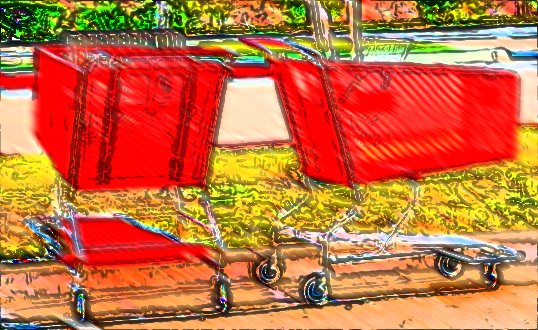
Today, I have four. Two each started by two single objects – shopping carts and bamboo.

First, Bamboo

Men with a hacksaw

I am not generally afraid, even in the big city, and I have spent a lot of time running on the Crosstown Trail without any real fear. But there was that one day, cold and drizzly, with a thick fog rolling in, when I was out there by myself and I began to get a little worried. I came around that bend, you know where it is, where it runs through all that thick brush. It’s like a green tunnel and even though it’s in the middle of the city, it is so quiet and dark it feels like you are out in the middle of nowhere. That’s why I like it so much. But that day…

There were these two guys walking along. They were young and fit, muscular, and menacing. I immediately saw them, luckily before they saw me. They were walking off the trail and when I saw them they were looking into the woods and gesturing. They were looking intently, like they were seeking something or someone. But what really caught my eye is that one of them was carrying a hacksaw – a big, heavy one. It looked like an odd but effective weapon and I realized they were going after something they had spotted in the brush.

I felt my heart skip and a knot pop into my belly and I immediately jumped off of the trail and slid down into this little ditch where they could not see me. Before I left the condo I had decided to leave my phone to charge and so I didn’t have it with me. I hugged the damp, cold earth on the side of the ditch, hoping the two men didn’t see where I was hiding.

I could hear them talking excitedly, but the fog damped the sound and I couldn’t understand. Then, I heard the sawing. It was loud and hollow sounding and my heart kept beating faster and faster. I didn’t hear any screams, so their victim must be dead already. My mind raced with horror as the awful sound kept going. There would be a pause every now and then, and I could hear the men babbling, then it would start back up.

I was about to go crazy with panic when the sawing finally stopped. But then, to my horror, I could hear the footsteps of the men as they walked off and I realized they were going down the trail right towards the spot where I was hidden. When they reached my location, they could look down into the ditch right at me.

As they approached I gathered my feet underneath myself and tried to brace my crouch. My only hope of escape if they saw me was to spring up onto the trail and bolt away as fast as I could. I am a strong runner and hopefully, with the element of surprise, I could escape.

The second I completed my preparations, they were upon me. Now that they were closer, I could understand what they were saying and as I tensed, I heard.

“Oh, these are just perfect.”

“Yes, we can coat them with urethane, not the glossy stuff, it’ll look cheap.”

“And they’ll support the shelves and will have just the look we want.”

I looked up and there the two were. One still had his saw and the other was carrying a load of bamboo under his arms. I remembered, there was a grove of bamboo around the corner… they were cutting bamboo for bookshelves.

There was a loud clatter as the bamboo hit the concrete trail. They had seen me. I was covered with mud and loose leaves from my slide down and must had scared the two men to death to find me crouched in the ditch like that.

There was nothing for me to do but to go on with my plan. I sprung out, stumbled a bit, then picked up speed. I could hear one man screaming as I ran as fast as I could. I looked over my shoulder and saw the other one sprinting to the blue-lighted emergency phone a few feet back down the trail. Why hadn’t I thought about that.

I doubled my speed. Now, instead of racing the two men with the saw, I was trying to get out of there before the cops arrived. I didn’t want to have to explain all that.

Hidden Grove

There is a grove of bamboo off to the side, across a narrow grassy lot, on Peter Scranton’s drive to work. He looked at that bamboo twice a day, about three hundred days a year for fifteen years. “That’s what, about nine thousand times,” Pete said to himself.

Pete had read a book about gardening and the author strongly discouraged planting bamboo because of its unstoppable fecundity and tendency to spread. Once it was in the ground, it was impossible to stop.

The stand that Pete saw would advance a little across the vacant lot, but then retreat. Pete would see bright yellow shoots sprout up with amazing speed. These would always disappear in a few days. Someone unseen was hacking the vegetation back.

One day his car blew a head gasket in a cold rain – rapidly clattering to a steaming stop. He was so discouraged he found himself abandoning the useless old wreck and striding across the little vacant lot. When he reached the familiar stand of bamboo he pushed the strong but yielding stalks apart and buried himself.

He watched his car being towed away and his wife and coworkers walking along the road as he peered out of the thick bamboo. After a day, nobody came by any more, though he saw someone he didn’t know stop and nail a poster with a photograph printed on it on a nearby wooden power pole. He supposed it was a picture of himself, though he didn’t recognize it.

When he was thirsty he found he could bent the bamboo stalks and get a little water to run into his mouth. After the first day he was hungry, but after three days the hunger left him. He watched the new shoots come up in the lot and when the workmen came to cut them back they spotted him lurching around back in the grove, making the bamboo sway, even though there was no breeze.

They had to cut most of the grove down to flush him out. They took Pete away for observation.

Within a season, the bamboo had grown back. You couldn’t tell that anything had happened there.

Next… Shopping Carts

Carts in the Pond

Sometimes, when the weather was warm, he liked to sit beside this little pond in a park near his house. The bank all around the pond was steep but there was a spot where a tree had died and left a flat area ringed by a rock wall that was a particularly comfortable place to sit.

He was sitting there looking across the pond where a sidewalk ran when he spotted a couple of teenagers pushing a shopping cart. There was a grocery store a block away and he could see a single shopping bag in the center of the cart. When they reached the middle of the part of the sidewalk that ran along the pond, one kid reached into the cart and pulled out the bag. The other simply turned the metal cart and pushed it down the steep bank where it hit the water and with a soft hiss, quickly sank beneath the surface. Once it was gone the two kids kept walking, now carrying the bag in their hands. It didn’t look very big.

He was upset at this. He knew the grocery store was losing money and would soon close. The neighborhood would be hurt by the lack of shopping and the image of the big empty box on the corner, the vacant parking lot. Those carts were expensive and those kids were one reason nothing good ever lasted any more.

He thought about yelling something, but they were too far away. He couldn’t even chase them. By the time he rounded the pond they would be long gone. They were too far away for him to even recognize who they were – if he saw them again, he wouldn’t even know it.

So he sat there for a little longer and then walked home. He never went back to the pond again, preferring to stay home and watch television.

Racing With the Wind

Roger and Annette had to rush to the van from the basketball court. Annette ran with her oldest daughter’s hand in her own while Roger carried their young son, barely more than a toddler, in his arms. A huge black angry cloud was building rapidly to the west and the boiling thunderstorm was beginning to kick up a cold fast wind.

As they piled into the van the humid heat of the Texas summer was shoved aside by a blast of cold storm outflow air. The second they settled in, locking the toddler into his car seat and making sure the girl had her belt fastened the wind rose to a howling gale. Dust and leaves rose in a shooting cloud and the van rocked from the power of the wind.

To watch their daughter’s game they had had to park across the street in the lot of a small shopping center. It was anchored by a big hardware store and the wind suddenly began grabbing the hundred shopping carts piled out front and sent them shooting across the lot like rockets, right toward Roger and Annette’s van.

They flew in a wheeled phalanx, upright and racing, some swerving a bit due to a wonky wheel, but most moving with amazing speed. Roger and Annette could do nothing but watch them come. Most were driving in rumbling mass to the south of the van, where they watched them pass, hit the curb, and then tumble out into the street.

A few veered to the left and came close to the van, but thanks to a lucky act of providence, none actually hit them, although some only missed by inches. Roger, Annette, and their daughter sat there helpless, and felt a great relief when the sudden windstorm died down and was replaced by fat, pelting rain. They felt very lucky they had not been hit, though it only would have been a little dent at the worst.

The toddler, of course, thought the whole thing was a blast and laughed as hard as he could as he watched the shopping carts fly by.

What I learned this week, March 23, 2012

I love the idea of local folks still doing this sort of thing. I remember when I was a little kid I’d visit the newspaper office in the tiny town out in the wheat fields where my family was from. He set the paper in linotype and I loved watching the lead letter slugs being made. I remember being amazed at how hot the slugs were when he could pick them up (his hands were so callused).


Your Brain on Fiction

A really interesting article from the New York Times on how reading fiction can improve our minds.

Brain scans are revealing what happens in our heads when we read a detailed description, an evocative metaphor or an emotional exchange between characters. Stories, this research is showing, stimulate the brain and even change how we act in life.

I found these passages particularly provocative:

The brain, it seems, does not make much of a distinction between reading about an experience and encountering it in real life; in each case, the same neurological regions are stimulated.

Keith Oatley, an emeritus professor of cognitive psychology at the University of Toronto (and a published novelist), has proposed that reading produces a vivid simulation of reality, one that “runs on minds of readers just as computer simulations run on computers.” Fiction — with its redolent details, imaginative metaphors and attentive descriptions of people and their actions — offers an especially rich replica. Indeed, in one respect novels go beyond simulating reality to give readers an experience unavailable off the page: the opportunity to enter fully into other people’s thoughts and feelings.

The novel, of course, is an unequaled medium for the exploration of human social and emotional life. And there is evidence that just as the brain responds to depictions of smells and textures and movements as if they were the real thing, so it treats the interactions among fictional characters as something like real-life social encounters.

I have always wondered if reading is a waste of time.

Apparently not.


I don’t know if I agree with the guy’s riding style – and it’s really just a long commercial for a brand of bike tire – but man, what a cool video!

Motivation.


It’s the battery, stupid: The looming 4G smartphone crisis

As more power, faster processor, fancier features are added to smartphones, the battery life becomes less and less. This is the one problem that will limit the post-laptop technological revolution. If your battery doesn’t work, your phone (or tablet) is useless.

The trouble with batteries, as everyone who makes phones will tell you, is that they don’t follow Moore’s Law. Batteries are an ancient technology that depend on chemistry that scientists have already pretty much optimized.

Very interesting article. I wonder if we will see a bifurcation in the phone market, with folks carrying both an old-technology phone for voice and text only (I only have to charge my crappy work Blackberry in my car during my commute) and another smart phone or tablet or in-between form factor (and leave this turned off most of the time) for all the other goodies.


The only way to play guitar


NEWSPAPERS AMERICA’S FASTEST SHRINKING INDUSTRY

“But we make the best buggy-whips in the world!”

Another dinosaur. We subscribe to the newspaper on the weekends so that I can access its digital content.


19 Signs That America Has Become A Crazy Control Freak Nation Where Almost Everything Is Illegal

#1 One California town is actually considering making it illegal to smoke in your own backyard.

#2 In Louisiana, a church was recently ordered to stop giving out water because it did not have a permit to do so.

#3 In the United States it is illegal to operate a train that does not have an “F” painted on the front. Apparently without that “F” we all might not know where the front of the train is.

#4 In many U.S. states is it now illegal to collect rain that falls from the sky on to your own property.

#5 In America today it is illegal to milk your cow and sell the milk to your neighbor. If you do this, there is a good chance that federal agents will raid your home at the crack of dawn.

#6 In Washington D.C. it is illegal not to recycle cat litter.

#7 It is illegal to give a tour of the monuments in Washington D.C. without a license.

#8 In the United States it is illegal to sell natural cures for cancer – even if they work.

#9 In the state of Massachusetts it is illegal to deface a milk carton.

#10 In the state of Alabama, bear wrestling is completely illegal.

#11 In Fairbanks, Alaska it is illegal to give alcoholic beverages to a moose.

#12 In Lake Elmo, Minnesota it is illegal to sell pumpkins or Christmas trees that are grown outside city limits.

#13 There is a federal law that makes it illegal to be “annoying” on the Internet.

#14 If you register with a false name on MySpace or Facebook you could potentially “spend five years in federal prison“.

#15 In Hazelwood, Missouri it is illegal for little girls to sell girl scout cookies in the front yards of their own homes.

#16 All over the United States lemonade stands run by children are being shut down because they do not have the proper permits.

#17 In Florida, it is illegal to bring a plastic butter knife to school.

#18 In San Juan Capistrano, California it is illegal to hold a home Bible study without a “conditional use permit“.

#19 In the city of Philadelphia, Pennsylvania it is illegal to make even a single dollar from a blog unless you buy a $300 business license.