Crack in a Jar

“The poulterers’ shops were still half open, and the fruiterers’ were radiant in their glory. There were great, round, pot-bellied baskets of chestnuts, shaped like the waistcoats of jolly old gentleman, lolling at the doors, and tumbling out into the street in their apoplectic opulence. There were ruddy, brown-faced broad-girthed Spanish onions, shining in the fatness of their growth like Spanish friars, and winking from their shelves in wanton slyness at the girls as they went by, and glanced demurely at the hung-up mistletoe. There were pears and apples, clustered high in blooming pyramids; there were bunches of grapes, made, in the shopkeepers’ benevolence, to dangle from conspicuous hooks, that people’s mouths might water gratis as they passed; there were piles of filberts, mossy and brown, recalling, in their fragrance, ancient walks among the woods, and pleasant shufflings ankle deep through withered lanes; there were Norfolk Biffins, squab and swarthy, setting off the yellow of the oranges and lemons, and, in the great compactness of their juicy persons, urgently entreating and beseeching to be carried home in paper bags and eaten after dinner.”


― Charles Dickens, A Christmas Carol

Laoganma Spicy Chili Crisp – I have almost finished off my first jar.

The other day we had a little bike ride to Four Bullets, a local brewery. It was a good time – shooting the bull and nerding out and enjoying a good beer.

On of my friends asked me if I had heard of Spicy Chili Crisp. I had not and they said that it was fantastic and everybody was talking about it. They sent me a photo on their phone and said, “You have to get this brand, no others.” They said that they had found a jar at a local Asian market – but there was only one jar left.

So I was tooling around the city and stopped in at the Plano location of the Super H Mart. This was the place, a few years ago, that I successfully found some Banana Ketchup. I figured that if any place had it – that would be the place.

After looked around a bit (the store is vast) I found a dozen jars on a shelf – along with a number of other Lao Gan Ma products. All had the same serious owner glaring out from the label:

Most people would recognize a jar of Lao Gan Ma by the stern portrait of Tao Huabi, 74, the legendary godmother and founder of the brand. In the early 1990s, Tao ran a humble food stall in Guiyang, the capital city of Guizhou province. Her crispy chili oil became a crowd favorite and turned into a billion-dollar business. – CBS news


So I bought a jar along with a few favorite Asian delicacies (all non-carb) and went home. I eagerly drove home and scrambled up a couple eggs. I had been told that it was good on everything – even ice cream – but that eggs were a popular vessel for the condiment.

It was delicious. More than delicious, addictive. It is crack in a jar.

It is spicy, of course, but not too spicy… it is just right. I can take more than a bit of heat – but I have ruined a few meals with too-aggressive application of the chili oil they serve in the little containers – but this does not have the nuclear late after-heat of that stuff. It is also very complex – there is a lot going on in that jar.

What is really odd is the texture. It contains chunks (maybe pea sized) of what I guess is fried peppers, giving it a crunch. I guess that’s why they call it spicy chili crisp. Since buying it, I eat that shit on everything – though I can’t eat ice cream.

I polished off the first jar in about a week. Luckily, I discovered the Vietnamese market near my house has the stuff, though in a smaller jar. I did buy some more and even tried an alternate brand as a test.

It was good too, but not as addictive as the Lao Gan Ma. I think Tao Huabi is glaring at me even more because I tried a competitor.
Tex-Mex Food – History and Ingredients

“your body is not a temple, it’s an amusement park. Enjoy the ride.”
― Anthony Bourdain, Kitchen Confidential: Adventures in the Culinary Underbelly

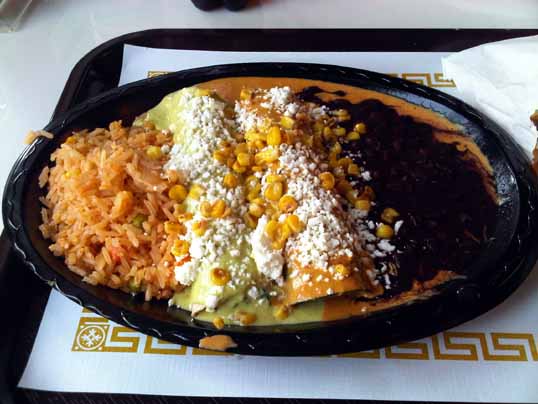
Tex-Mex – Two enchiladas, rice and black beans.

Oblique Strategy: Look closely at the most embarrassing details and amplify them

I don’t eat Tex-Mex food very often. I’ve lived in Texas so long I’m, well… kinda over it. The only time I eat Tex-Mex is when someone is in from out of town. My son is here for the Dallas Marathon this weekend and he wanted some – so we go.

Every neighborhood in Dallas has its own Tex-Mex spot (and its Pho place, and its Barbeque joint, and its greasy burger dive…) and in ours it’s Amigos. I don’t know if Tex-Mex can be called “comfort food” because you can be pretty uncomfortable if you eat too much of it.

One big knock on Tex-Mex is that it isn’t authentic Mexican food. Well, of course it isn’t. Have you ever even been to Mexico? It’s a big, diverse place – there’s no reason that food from the high Sonoran desert would even resemble the seafood from the Yucatan. Mexico’s culinary style and history is more like France’s – very complex and diverse.

Tex-Mex is a regional American cuisine… which happens to be inspired by some of the cooking that came across the Rio Grande.

You can tell you are eating Tex-Mex by the ingredients – stuff that isn’t (or wasn’t) very common in Mexico. These ingredients are: beef, yellow cheese (like cheddar), wheat flour, black beans, canned vegetables (especially tomatoes), and cumin.

Cumin – the main and essential ingredient in Chili Powder – is an interesting example. It’s not a traditional Mexican spice – it’s Indian. Canary Islanders were brought to San Antonio by the Spanish to try to expand the colonization of Texas. The Canary Islanders brought with them a Berber flavor signature — Moroccan food. There was a lot of cumin, garlic and chili, and those flavors, which are really dominant in chili con carne, became the flavor signature of Tex-Mex. It’s very different from Mexican food. Food Critic Diana Kennedy is prone to say that Tex-Mex includes way too much cumin. But if you compare it to Arab food, you suddenly understand where that flavor signature comes from.

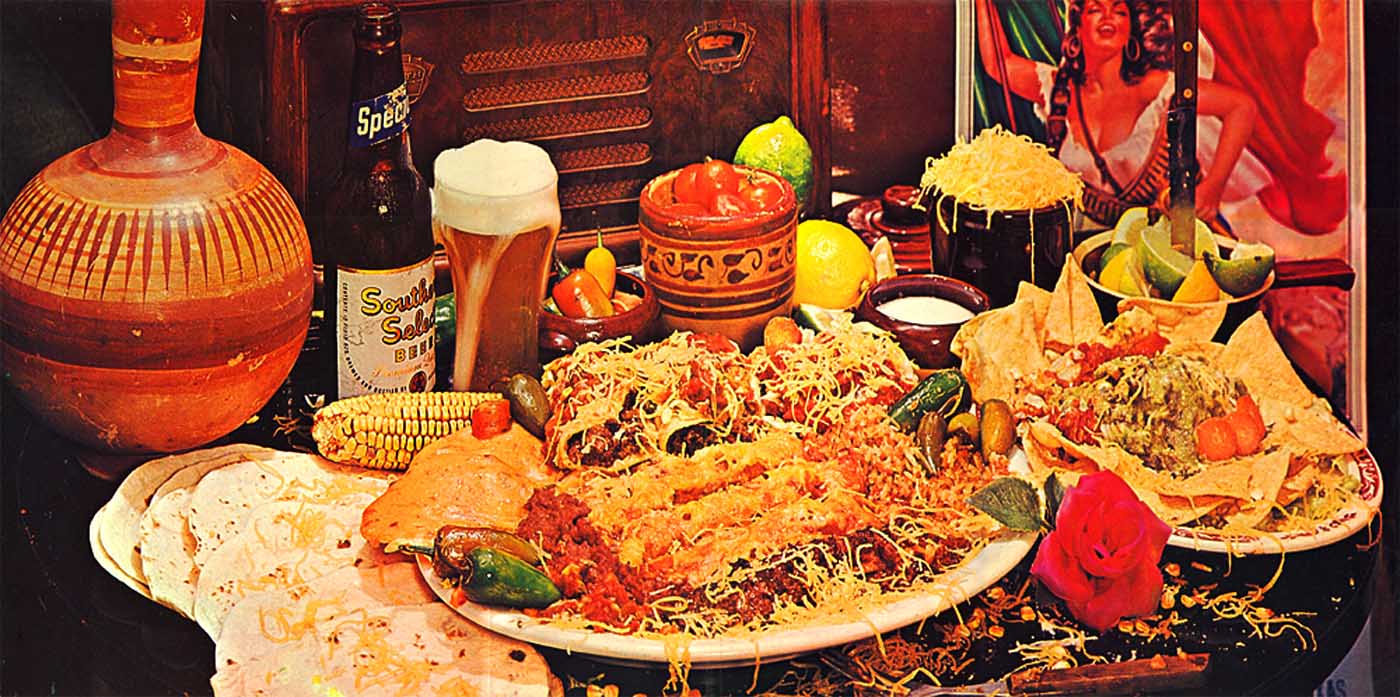
The greatest epic Tex-Mex feast ever photographed. From the gatefold of the ZZ Top, Tres Hombres album
(click to enlarge)

ESSENTIAL TEX-MEX FOODS

NACHOS

Nachos might’ve been invented in Mexico by Ignacio “Nacho” Anaya, but it was only because a bunch of Texan ladies flocked to his restaurant after-hours and asked for a snack. The versions you see around the country today, frequently doused with molten, yellow cheese, are very American.

CHILI CON CARNE

Considered by many to be the quintessential Tex-Mex dish, this tomatoey stew of ground or cubed beef, beans (if you’re not a tried-and-true Texan), spices, chili peppers, and other accoutrements is very much a gringo invention, created by Texan settlers out of widely available ingredients. Actually, it’s based on Northern Native American recipes. Not Mexican.

FAJITAS

Derived from the Spanish word “faja” — meaning “strip” (which refers to the cut of beef they used) — fajitas are wholly a US creation (first mentioned in print in 1971) inspired and informed by the ingredients of Mexico, but not usually found in that country.

PRETTY MUCH ANY “MEXICAN” RESTAURANT FOOD IN AMERICA

Queso dip, chimichangas, the enchilada as we know it… you name it, it’s been Americanized. But that’s not to say that it isn’t still delicious.

THREE CITIES, THREE HISTORIES

When you look at the modern history of Tex-Mex, you get completely different stories from Dallas, Houston, and San Antonio. Each one, of course, claims to be the place where Tex-Mex was invented, perfected, and popularized. They are all three right, and all three wrong.

San Antonio is the closest city to the border and the area that contributed the “Mex” part of the cuisine. It also added the “Combination Plate” to the menu.
An Illustrated History of Tex-Mex

How chili queens from San Antonio and the rise of the combo plate shaped Mexican food’s evolution across the border.

The cuisine grew out of the Rio Grande Valley but came into its own in San Antonio. “In the 1870s, chili queens in San Antonio started becoming nationally and internationally famous. That’s when Tex-Mex started getting on the map of Americans in earnest. From then on, every decade has had a monument to Tex-Mex.”

Tracing the History of Tex-Mex

The growing fame of the chili queens helped San Antonio establish its enduring reputation as the capital of Tex-Mex cuisine.

Dallas seems to be the birthplace of the kings of Tex-Mex restaurant empires. Tex-Mex is primarily a restaurant cuisine, seldom made at home. Everyone in Dallas knows El Fenix, El Chico, and, more recently Mi Concina.

History of El Fenix

Miguel Martinez opened the first Mexican restaurant in Dallas, in 1918. When he opens “Martinez Café” (now El Fenix) he offers only Anglo-American dishes. He develops a new style integrating Mexican flare and offers these dishes to guests, asking for their feedback. Their input was instrumental in perfecting his culinary experimentation and Tex-Mex was born.

The Family Who Sold Tex-Mex to America

In 1928, Adelaida “Mama” Cuellar opened Cuellar’s Cafe in Kaufman. Four of her sons moved to Dallas in 1940 and opened the first El Chico. These two families laid the foundation for Dallas’ flavor profile.

The Elevation of Tex-Mex, Mico Rodriguez

Lard-laden combination plates changed forever once Mico Rodriguez and his partners opened the first Mi Cocina in the Preston Forest Shopping Center in 1991. Rodriguez refined the Tex-Mex experience by using quality ingredients such as expensive cheddar cheese and fresh jalapeños and cilantro.

Houston has an equal claim, including Ninfa’s and the development of the fajita.
The Houston Version of Things:
A six part series – a different history of Tex-Mex…

Pralines and Pushcarts
Combination Plates
Mama’s Got a Brand-new Bag
The Authenticity Myth
The French Connection
Brave Nuevo World