My 99 Cent Manifesto

Press

Press

I am in the home stretch of finishing up the editing and conversion of my book of short stories that I will put out as a Kindle ebook. I’ve been in the stretch run for a while. I’m struggling now with the cover… but mostly I struggle with the fear that putting something out there generates. Nothing to do but plug ahead as best as I can.

I have been thinking a lot about price points – about what I’ll charge for my book when I get it out.

First of all, isn’t it amazing that I’m even getting to decide this? Unpublished, unknown, talentless, loser writers didn’t used to have input on these decisions. The publisher decides.

But publishing, as we know it, is dead. It doesn’t know it yet – though it has a strong suspicion.

The Publishing Industry. I hate it when groups like Publishing call themselves an Industry. (Music Industry, Movie Industry, Television Industry) I’ve worked in Industry and Publishing is not an Industry (Book Printing is an Industry, but you have to go to China to find it). Industry isn’t art – it isn’t creative (not in the usual sense of creativity) Industry is a world of huge heavy smelly machines – a world of maintenance and statistics – it’s a world of hardhats, steel toed shoes, and flame resistant uniforms.

When a group like Publishers call themselves an Industry… they are dead. They have killed themselves. It is only a matter of time. The only thing left is momentum.

Underwood Typewriter

Underwood Typewriter

So I get to write whatever crap I feel like. And you get to read it. That’s not Industry – that’s the future. The question I have left is, “How Much Do I Charge.”

That’s a tough question. The head swims. To decide, the only way is to break it down, make a few options and choose between them. Eliminate the bottom choices, one by one. OK, that works.

The price points of ebooks don’t take long to figure out. They are:

  •  Really Expensive
  • Ten Bucks
  • Two Ninety Nine
  • Ninety Nine Cents
  • Free

The top choice, Really Expensive, is easy to eliminate. I’m nobody. I’m not selling a textbook or legal reference full of knowledge that is extremely valuable to an extremely small group. So, Really Expensive is out.

trs80

TRS80

Now, we are down to the affordable options. Why not free? This is my first ebook – all I’m really interested in is getting it out there. The idea is to get as many readers as possible, and then try and keep them. I have more books (already have enough short stories for another volume, and a novel is not inconceivable – I have a killer first sentence) in the pipeline, and a free teaser would help me spread the word.

Free is tempting, but I don’t think I’ll go that way. There is a question of value. A book is a relationship between an author and a reader. That relationship should/must have some value for it to be real and useful. Free is throwing propaganda leaflets from a bomber’s bay, free is a blog, free is a mimeographed sheet stapled to a telephone pole. These are all good things, important things, but that’s not what I want this time around.

What I want is terribly nebulous but it I feel it has to involve a transfer of value for it to truly occur.

That leaves ten, two ninety nine, and ninety nine cents.

Ten is tempting. That’s what I think an ebook should cost. That’s what I am happy paying for an established author, for something I’m pretty sure I’ll like. For the hours of enjoyment that a good book gives, ten dollars is a fantastic bargain. It even provides a nice return for the author.

But ten dollars is still a lot of money. Especially in this day of terrible tribulations and looming financial collapse a ten dollar purchase is a tough call (or at least it should be). I’m not established, I’m no sure thing, I’m not very good.

Ten dollars is too much.

Now we are down to two options. Two ninety-nine. Or ninety-nine cents.

Two ninety-nine is a great option. That’s the price (more or less) that Amazon kicks the author’s royalty up to 70 percent. My return on a book sold at that point is twice what it would be at only a few cents less. It’s not a lot of money. I feel sure that this is what I’ll charge for my second book, if I live that long.

Three bucks – a hamburger… a drink at happy hour in a bar… a bag of chips… or so. It is an odd amount of money… sort of in between.

Still, two ninety-nine… that’s not an impulse purchase. You have to think about it. It might not be much of a thought, but it is one.

And ninety-nine cents? What’s that? That’s nothing. Click on that link and it’s yours. Don’t even think about it. If it turns out to be crap – so what? You’re only out ninety-nine cents. Less than a dollar. You won’t miss a dollar. You can’t hardly buy anything with a dollar anymore.

Ninety-nine cents. The more I think about it, the more I like it. It’s something, it’s a transfer of value, but otherwise… it’s like a gift from me to you.

It’s like a cheap lottery ticket. Maybe it will be good, maybe not. But if it hits, you’ve got a lot of entertainment for not a lot of money. If it misses, so what? There is even the enjoyment of the momentary fantasy that you’ve found a bargain, something cool that nobody else has. That’s worth ninety-nine cents, right?

Kindle

Call Me Ishmael

I have always loved Kafka. His writing has been a huge influence on how I live my life (God help me). During his life, he published almost nothing. When he died, his final request was to have all his work destroyed (thank goodness, Max Brod decided to ignore his good friend’s dying wish). If Kafka was living in today’s times would he be pumping out ninety-nine cent ebooks? I like to think so. Would anyone be reading them? Probably not.

So there it is. Ninety-nine cents.

I like it.

Stay tuned.

Too Much Happiness

Cabbage

I'm afraid to grow up because sometimes it feels it will never be this beautiful again.

I couldn’t sleep last night and I decided to clean up my reading list a bit and finish something I had already started. It didn’t take long to set in on the last story in Alice Munro’s last collection of short stories, Too Much Happiness. This was the long story… almost a novella… that the collection was named after. Too Much Happinesswas addicting and I had to keep reading until I was done, no matter how tired I was or how soon the next day’s work would come.

Alice Munro is a brilliant genius. She is, in my humble opinion, the unquestioned master of her genre. If you read the plot summary of one of her stories, you will scratch your head – it will read as melodrama, or a series of random, unconnected action, or it will seem that nothing much really happens. Her mysterious skill is so great that when you actually read the test it makes sense, draws you in, and takes you on an emotional journey far from your pitiful little room where you sit clutching that tattered paperback.

If I could have one ability – I would choose to be able to do, whatever it is, that she does. She makes seamless connections where none should exist. There is a concept that art is the conveying of something that can’t be done any other way. And that is what Alice Munro does, that is her genius. You can’t really summarize or explain what she writes because it is art of such exquisite subtleness that it has a kind of Heisenberg Uncertainty about it – to explain it is to change it.

The collection has a series of her typical mastery. Thinking about it, I almost want to go read it again.

But that’s not what I want to talk about tonight. I want to discuss that last long story, because it is different than what she usually writes.

The long story, “Too Much Happiness” is the story of a woman traveling across Europe one winter in the last decade of the nineteenth century. She visits a series of people from her past and spends a lot of time on cold trains moving through dreary country thinking about her life.

As I plunged on I realized that this was a real person that I had heard of before. The woman was Sofia Kovalevskaya – the first Russian female mathematician. She had been rumored to be the subject of a Thomas Pynchon novel – though she ended up being only a minor character. A fascinating character with an unusual, varied, courageous, and ultimately tragic life. Given such a dynamic protagonist most authors, writers of lesser vision and talent, would have wrote of the high points of such a person, scribbling in breathless prose her struggles to become a woman of letters in a time and place this was unheard of – her arranged marriage – her wild affairs – her political involvement – her friendship with famous figures of the day: Darwin, Eliot (there is a passage in Middlemarch where her mathematical theories are mentioned), and Dostoevsky.

But Munro spends most of her words simply detailing her journey, the people that she shares her compartment with, the difficulties she has with the changing weather, languages, and currency she has to deal with.

And I don’t know how she does it… but it works. By the end you feel you know Sofia… you want to meet her… and most of all you care about her. The ending is devastating, but not unexpected. It is, after all, a life.

The final sentence notes that there is a crater on the moon named after Sofia Kovalevskaya.

And, that’s that.


Reviews of the Alice Munro Collection Too Much Happiness:

Too Much Happiness

Too Much Happiness

The best-laid schemes

The best-laid schemes o’ mice an’ men
Gang aft agley,
—-To a Mouse, Robert Burns


Furnace

Furnace

I had great plans for the weekend. I even wrote them down – a two page list in one of my Staples Bagasse Composition Books I carry with me always. Two pages! Who the hell am I kidding?

Well, of the projects I wanted to complete, I finished… hmmm… let me count… none.

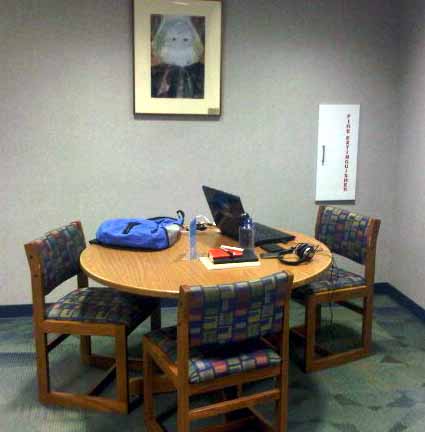
On Sunday, around noon or so, I was trying to decide whether to go to the library and write (I have a certain table at the Richardson Library I like to work at – the library is open from two to six, which is a nice constrained four hour writing time – it’s shocking how fast the time flies) or to go for a bicycle ride. I decided to kill two birds with one stone and ride my bike to the library.

Table

My favorite table at the Richardson Library.

I made my preparations – packing my Alphasmart Neo (don’t want to ride my bike with my laptop), pens, notebooks, water bottles, clean shirt, towel, and such and sundry stuffins. I put my backpack on and went out into the blast furnace of the garage to get my bike. The front tire was flat.

I stood out in the sun behind the house, found the telltale little white spot where the thorn had penetrated, took everything apart (nasty little thorn, really), patched the tube, put it together, and pumped everything back up.

Maybe a half an hour. I was drenched in sweat.

I had calculated that I would be able to get to the library in the awful heat by moving quickly. The time I spent fixing the tire was too much, though. I rode about a mile and decided it was too risky. The temperature, the sun beating down, the still air… it was all going toxic. By the time I made it home I was beginning to get a little dizzy.

I am too old and way too out of shape for this. All I wanted to do was veg out in a dark cave of conditioned air. The bit of overheated exertion wore me to the bone. At that point I wasn’t even up to driving to the library. I rested a bit, went to eat with the family, and at sunset walked down to Lee’s last softball game. Once the sun is down, it’s a lot more bearable. I think the solar radiation beating down is worse than the superheated air.

I’ve complained about the heat already. And it wasn’t even bad back then, not like now. It’s always hot here in the summer, of course, but this is getting ridiculous. It wears everyone out – it is so hard to get anything done.

Deadlier than the Male

Deadlier than the Male

The only thing I accomplished was to read another bit of Pulp Fiction I had queued up. This one was Deadlier than the Male, by James Gunn. No, this isn’t James Gunn, the science fiction professor that teaches at my alma mater (yes, I took a class from him, but that’s a whole ‘nother story). This James Gunn seems to have not written another novel. Nobody seems to know anything about him. The book was made into a film in 1947 called Born to Kill – which I’ll try to find.

Born to Kill

Born to Kill

It’s an odd, crazy book. I wouldn’t say it was a good book, but it was something. The language is simple, but arresting. The first line – ”Helen Brent had the best-looking legs at the inquest,” pretty much sets the scene. Most noir pulps have a small number of characters, but in this one, every chapter introduces somebody new. They keep arriving faster than they are killed off… until near the end. With each fresh character the story splits until the plot is like a big twisted knot of desperation and evil, stretching from Fresno to Frisco. I had a bit of trouble keeping track of who was who, and a few of the participants seem to simply disappear from the book once their utility wears thin, but the book was short and the story tumbled forward picking up flotsam and jetsam from the sewer of human malice until it all crashed down into the last few pages.

Since I wasn’t up for anything useful I was able to get through the book in one day. Now, I have some more pulp noir stuff in my reading list, but I need to find something different, maybe even something a little uplifting. After reading this one… I feel sort of dirty.

Heat
Heat
 

The Sound of his Horn – by Sarban

The lurid cover art from The Sound of his Horn by Saban

The lurid cover art from The Sound of his Horn by Saban

I finished Erik Larson’s Thunderstruck and wanted something light and easy to read – so I looked through my collection of pulp ebooks and came up with Sarban’s The Sound of his Horn. This was an odd bit of fiction that I had found recommended here and there across the interwebs.

It’s an interesting amalgam – told as a story-within-a-story… it has time-travel science-fiction aspects, alternate history, a possibly unreliable narrator (one of my favorite literary devices), themes akin to a reverse Island of Dr. Moreau, a bit of an unlikely love story, while at the heart it is a “Most Dangerous Game” tale on steroids.

What’s odd about the book is that it is told in a slightly archaic, literary style (I had to use the dictionary quite a bit as I read) but the story is full of lurid, shocking elements that would be at home in the most modern trashy paperback. In the story, the protagonist finds himself thrown a hundred years into a future where the Germans have won World War II. A Teutonic lord rules a massive forested estate where his decadent guests hunt half-naked women costumed as deer or birds. They are captured alive by the hunt and served as after-dinner entertainment trussed up and delivered under giant silver serving-domes.

See what I mean. And that is not the worst of it, by any means.

I really don’t know if I’ve read anything as strangely sophisticated and sleazy at the same time.

In summary – it’s a short novel and more than entertaining enough. It’s well worth reading – if that’s the sort of thing you want. It’ll stretch your mind more than a bit. You can get an ebook copy here or here.

The author, who chose the pen name of Sarban, was John William Wall, a British Diplomat for over thirty years and a published writer for about two. Other than The Sound of his Horn he has a couple collections of fantasy short stories (some ebooks here). He must have been an interesting man, a combination of a sharp mind and a sordid imagination.