“Time flows in the same way for all human beings; every human being flows through time in a different way.” ― Yasunari Kawabata
Tony Bones
detail
From my old online journal The Daily Epiphany – Saturday, November 28, 1998
Thank goodness, you forget
Nick and I were hiking, we were somewhere along a trail between here and there. I wasn’t sure how much farther we had to go. “I’m tired, Dad!” he’d complain. I’d carry Nick on my shoulders for awhile, then he’d want down. He’d walk and say, “My feet hurt! My legs are tired!”
Not too far along after that we popped out where the trail crosses a road, we knew where we were, found it on the map. Nick said, “Now it doesn’t seem so far.” I told him that was always how it was. When you’re in the middle of it, it seems so difficult, so long, so far. But after you’ve done it, you forget how hard it was.
That’s it isn’t it? How many times every day do we get to the point where we don’t know if we can take it any more, if we can take another step. But we do, we stick it out. Later, we forget how bad it was. Thank goodness.
It can be anything. For me it’s usually screaming, misbehaving kids. The constant din, the whining, the griping, the demanding grates and wears ’til I simply don’t know if I can stand another second. I do stand it though. Later when they’re asleep they look so calm, beatific, I forget how tired and angry I was earlier.
Or people asking me to fix stuff. I get to the point that if one more person comes to me with their busted doo-dad or gizmo, confident that I can fix it, I’m afraid I’ll flop on the floor screaming. Their TV’s won’t get the channels they want, their computers won’t do what they want them to, the reports (written by someone else) don’t print in the right order. I have to drop my own work, time that is precious to me, and supplicate myself to their problems. When the solution isn’t as simple as they want, they blame me, as if it was me that put them in the predicament in the first place. The worst is, they insist that I act like I care.
I get through it somehow, then I forget.
When I was younger, I used to dream that someday this would drop away, that the way would suddenly become clear and the daily struggles would become easier. Now I know that this is life, this is what it is. Every day, every hour, something difficult, frustrating, humiliating, presents itself, demands to be attended to. Again and again, all the time, worn out, tired, bored, struggling.
When you get through it, when you reach the road you forget the pain, only remember the little victories.
“We live as we dream–alone….” ― Joseph Conrad, Heart of Darkness
The attack of the garish, gaudy Evil Dream Hippies
My Friends Dream and I Just Sleep
I dream of winning the lottery and spending the rest of my life traveling the world, going to exotic locations. I will send postcards. A reliable, discrete research company supplies me with lists of names – some random, others carefully chosen as perfectly ordinary, lonely folks from forgotten towns. I go forth each day and buy local postcards full of beautiful sunsets, mountain ranges, masterpiece-filled museums, famous tourist landmarks, castles, palaces, or a tableau of local fishermen or washerwomen toiling under the tropical sun.
Sitting in the office corner of my expensive hotel suite, or possibly a table by the pool, or even an overstuffed booth in a smoky bar I write the postcards. Something carefully simple and familiar, a message that carries an implied sequence, like a bit of daily conversation between close friends.
“Hi, we ate fish with mangoes today, the sea here is like a turquoise table.”
“The skiing is rough this year, the snow thin and icy.”
“Pierre sends his love, he has been bedridden – I believe it was some bad clams.”
Then I sign the postcards with a scribble I have carefully practiced. It is obviously a name – but one of ambiguous nature. Is it Barton?, or Charles? or is it Deborah? or Denise?
The address and the salutation (Dearest Sue… Henry, old friend) are printed very carefully, though. I don’t want the card to be misdelivered; even though its recipient is someone I don’t know.
Sometimes the messages are a little more personal, something beyond, “Wish you were here.”
“I sill think of the look in your eyes the moment we parted every day of my life.”
“No beautiful sunset will replace the ache in my heart when we are apart.”
Maybe a hint of a physical relationship; a small treat for the postal workers, delivery men, or local snoops to read as the card passes by, uncovered for public knowledge.
“As I stretch out on the sun-drenched sand I can feel the warmth of your body as if still pressed against mine.”
I imagine the postcards being delivered – puzzled looks, tossing and turning, forgotten corners of memory relit and poured over, the consulting of an Atlas. My hope is that in a certain small percentage of recipients the card will root and grow – flower into a fully imagined memory… false, yes, but strong too. After all – there is the postcard; there is the evidence.
Maybe, with time, the exotic imagination will become truth, a cherished memory, a wonderful story for the Grandkids.
Many people may even have experienced – or may still be experiencing – languishing without really even knowing what it is or why they’re feeling that way
I have been out of school for almost half a century – and I still have nightmares about final exams. I wake up shaking, in a cold sweat, and it takes me minutes to realize I don’t have to do that any more – haven’t for many decades.
Radicals have always known that the family is the biggest obstacle to achieving their goals. Regardless of their political leanings, cult leaders, utopians, and radical political movements have all done their best to undermine the family and replace it with some other fundamental social unit.
As the sun set the sculptures began to glow. This one is one of the largest (about 20 feet tall) and most dramatic works… called “The Sun.” When I first saw it, I thought it was all yellow and red glass, but some kids were looking closer and you can see that there are actually many colors in there.
“Nothing in the world is more exciting than a moment of sudden discovery or invention, and many more people are capable of experiencing such moments than is sometimes thought.”
Two astrophotographers have just dropped what they call “the most ridiculously detailed picture” of the Moon – the result of a painstaking, neck-craning effort roughly two years and over 200,000 frames in the making.
Rachel Harrison
Moore to the point
City Hall Plaza
(click to enlarge)
This map created something of a stir when I posted it on social media, in part because its claims are so counter to conventional wisdom in many instances. An enlarged version is available here.
Amanda Popken on the Dallas Cycle Style Seersucker Ride
“Code is not like other how-computers-work books. It doesn’t have big color illustrations of disk drives with arrows showing how the data sweeps into the computer. Code has no drawings of trains carrying a cargo of zeros and ones. Metaphors and similes are wonderful literary devices but they do nothing but obscure the beauty of technology.” ― Charles Petzold, Code: The Hidden Language of Computer Hardware and Software
“He walked out in the gray light and stood and he saw for a brief moment the absolute truth of the world. The cold relentless circling of the intestate earth. Darkness implacable. The blind dogs of the sun in their running. The crushing black vacuum of the universe. And somewhere two hunted animals trembling like ground-foxes in their cover. Borrowed time and borrowed world and borrowed eyes with which to sorrow it.” ― Cormac McCarthy, The Road
Caribbean Sunset
The Last Sunset
Oscar and Matt were neighbors and had been for five years. Their wives had made friends with each other right from the start – meeting every morninh walking their dogs while their husbands were at work – but the two men hardly knew each other.
When the news came in, both wives were out of town – they had gone to Vegas for a girl’s weekend, leaving the husbands on their own. Oscar and Matt met out in the front yard, talking calmly while the world came apart around them. They could hear gunshots all around the neighborhood, cars were screaching around the corners, and so many people were simply standing in their yards screaming obscenities or nonsense wails. Neither of the two men were prone to panic or losing their minds – so they both wandered outside and said hello to each other.
“Sara said Mary talked to you,” said Oscar.
“Yeah, I called before the cell service went down. They both want to come home, but there is no way they can make it until tonight. We said goodbye as best we could.”
“Same thing here. She was losing it when the system went down. I feel awful, but can’t think of anything I can do.”
The two men looked out over their neighborhood. Columns of smoke were rising from burning homes and the volume of gunfire and screaming was increasing.
“Well, what do we do now?”
“It looks like we’d both better get the hell out of here, I don’t want to get shot in my own yard. Why don’t we head out, up to the mountains. I know a fire road out of here that won’t have anyone one it – we head up there all the time for overnight camping trips. We can take my four by.”
“That sound good. I’ve got a casserole Mary made before she left, it’s pretty good. We can get out and have something to eat.”
“I’ve got a bag of weed and a bottle of good single malt. Take your pick.”
“Shit, both. Why not?”
“Yeah. Well, I’ll bring the truck around. What else do we need?
“Nothing, nothing. What did they say… four hours left?”
“Yeah that’s about it. Let’s get going.”
Oscar brought the truck around while Matt went in to get the casserole, plates, and forks. He climbed in as Oscar drove by and looked over the whisky and weed in the console.
“You got papers?”
“There’s a little pipe and a lighter in the glove box. Go ahead and light up if you want?”
“Is that a good idea?”
“What the hell? You think anyone gives a shit?”
“Nah. Don’t know what I was thinking.”
They smoked in silence as Oscar drove through the neighborhood and then turned onto a gravel fire road that Matt had never noticed in all the years he had driven past that part of town. The road rapidly began to gain altitude, winding past the creek that tumbles down from the high country above. After only two hours of driving they turned again and powered through a mountain meadow and a rocky clearing that opened up with a view of the city below framed with the tall forest trees.
“Jesus, what a beautiful spot,” said Matt. “I never knew this was up here.”
“Nobody does,” replied Oscar. “Sara and I stumbled on this spot a few years ago, my company surveyed the new fire road and I came out and explored it. We kept it as secret as we can. It’s been a great getaway for us. Only two hours of driving and you might as well be on the moon.”
“Well, I sure as hell am glad we’re not down there any more.” Matt gestured out at the city. The sun was getting close to the horizon but the fading light illuminated huge clouds of smoke rising from the city.”
“The whole thing is burning down. Shame,” said Oscar.
“Doesn’t really matter, does it?”
“Nope. Unless they are wrong.”
“Could they be wrong?”
“Well, I guess anything is possible. But I don’t think so.”
“Now how are they sure? The radiation beam? They call it a gamma ray burst.”
“The tacheons. I read all about it online before the ‘net went down. Those are tiny particles, very hard to detect, they go through everything like nothing was there. But there are huge detectors, some down in mines, one under the ice in Antarctica, under the ice. This morning they detected this huge, mammoth tacheon pulse. Every detector, everywhere. The only explanation was an oncoming gamma-ray burst from a nearby star. A burst powerful enough to end all life on earth.”
“But how to the… tacheons? Get here before the gamma rays? Don’t those move at the speed of light?”
“Yeah, but the tacheons go out first. When the star supernovas they send out the tacheons right before, like 12 hours ahead of the gammas. That gives us… maybe and hour left.”
“Shit, how are they so sure? They could be wrong?”
“They don’t seem to be. At any rate we’ll know in an hour or so. Hey, lets break out that bottle.”
“Ok. Shit, I forgot to grab glasses.”
“No matter, we can drink out of the bottle.”
Matt picked the bottle up, spun off the cap, and threw it off into the woods.
“Well, I lost the cap, now we’ll have to drink the whole thing.”
The two men sat there watching the last sunset, passing the whisky bottle back and forth. As the sky went from orange to dark purple, a single star began to glow, brighter and brighter, until it was light again, as light as a gray day. The atmosphere far above them began to ionize, spreading waves of color, all colors of the rainbow, including some that the two men had never seen.
“That’s the most beautiful thing I’ve ever seen,” said one of the men.
One planet is 30% larger than Earth and orbits its star in less than three days. The other is 70% larger than the Earth and might host a deep ocean. These two exoplanets are super-Earths – more massive than the Earth but smaller than ice giants like Uranus and Neptune.
In one of the emails Oliver Burkeman, author of Time Management for Mortals, sent out to his subscribers, he talked about how we typically treat our to-do lists like buckets that we need to empty every day.
The problem, Burkeman observes, is that the to-do list is a bucket that never entirely empties. As we clear some tasks out, others are added in. It’s like the Magic Beer Floating Faucet Fountain that they used to sell at Spencer’s back in 1990, along with black lights and bags of reindeer poop.
“A new social type was being created by the apartment building, a cool, unemotional personality impervious to the psychological pressures of high-rise life, with minimal needs for privacy, who thrived like an advanced species of machine in the neutral atmosphere. This was the sort of resident who was content to do nothing but sit in his over-priced apartment, watch television with the sound turned down, and wait for his neighbours to make a mistake.” ― J.G. Ballard, High-Rise
Downtown Dallas, Texas
When I moved to Dallas, many moons ago, in 1981 – the city center was in a building boom (one of many). Reflective glass hi-rise buildings rose all around me as I walked from the bus stop to my work everyday. I’d go out onto the streets for lunch, eat greasy Chinese food in a little park (if the weather was bearable), and look up at the construction high overhead.
I was fascinated at how many glass hi-rises had curtain walls that were sawtooth-shaped. It easy to figure out why. That shape gives a large number of corner offices – which are loaded with prestige and command a premium price.
For the proletariat eating their egg rolls on the street – they also have cool reflections.
Nightswimming deserves a quiet night The photograph on the dashboard, taken years ago Turned around backwards so the windshield shows Every streetlight reveals the picture in reverse Still, it’s so much clearer I forgot my shirt at the water’s edge ― REM, Nightswimming
Nancy Best Fountain, Klyde Warren Park, Dallas, Texas
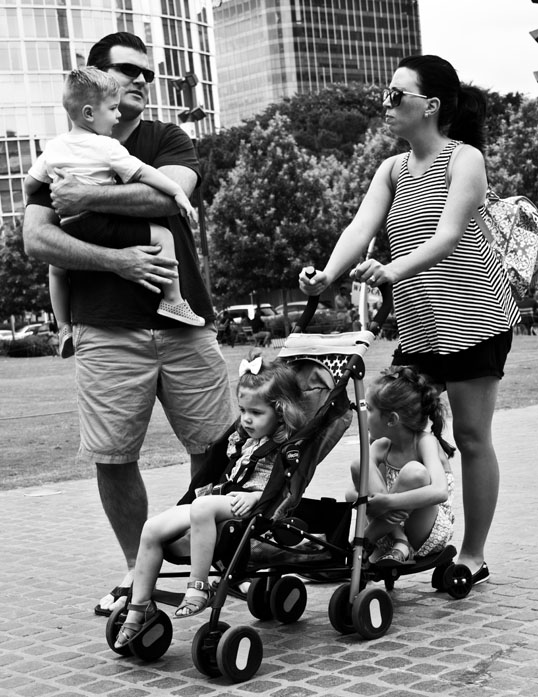
On Friday the Dallas Photowalk folks had a sunset photowalk planned at Klyde Warren Park here in Dallas. I took the DART train down there – which was good because the traffic was horrific. We met up at six or so, walked around, took some photos of people taking salsa dancing lessons and then walked down to the new Nancy Best Fountain at the East End of the park.
At sundown the light and sound show surrounding the fountain began. The water shot high in the air and the kids danced around in the water like they were actually having a good time.






 Bill Chance