Sunday Snippet – Forklift Rodeo

Randall Zaphtig took his daughter Penelope by the hand and led her from the car. They were on a long roadtrip from his ex-wife’s (Penelope’s mother) funeral back to his home in Oklahoma. He had decided not to fly, thinking that the drive would give him time to get reacquainted with his daughter before introducing her to his new wife – her new mother – for the first time. The trip was turning out to be quiet and even more awkward than he had been afraid it would be. He was prepared for tears, but not for the withdrawn, silent, robot-like waif that his daughter had become.

On a whim, Randall left the Interstate at the New Calebtown exit. He turned off almost by habit – he had lived in New Calebtown for his first three years out of school and had worked in the Caleb Brother’s hat factory there as a production engineer.

For some reason, unknown even to him, he had a strong desire to show her the factory he had once worked in. He drove to the plant parking lot by reflex memory but when they both climbed out of the car he saw that the building was no more. All that was left was the cracked parking lot, with mean looking weeds starting to poke up through the fault lines in the asphalt.

Still he took Penelope’s hand and together they walked across to the broken lines of concrete footings that outlined where the factory used to be. Looking down at the parking lot next to that he saw peeling, faded, yet still visible orange lines stenciled in and over the almost invisible now yellow parking demarcations and a strong, long forgotten memory came flooding back, causing him to stumble a little.

The orange lines were from the forklift rodeo. The men in the shipping department took great pride in their ability to move undamaged product out of the door quickly and a great part of that was their ability to drive their forklifts. These were country boys and men, farmers, that had grown up driving trucks and farm equipment not long after they had shed their diapers. Industrial and agricultural machines were in their blood – hydraulic fluid, lubricating grease, and diesel fuel moved under their skin. Driving a forklift at the plant was nothing more than a further fulfilling of their destiny.

The highpoint of their year was the forklift rodeo. There were local, county, and finally State competitions and it was a sad year when somebody from Caleb Brother’s did not place high in the State Finals. A handful had won the competition over the decades and their trophies were displayed proudly in a glass case at the entrance to the office row.

A young hotshot out of college – Randall was expected to referee the factory rodeo. The orange lines were painted on the lot to the exact specifications of the annual contest. They were supplemented by piles of wooden pallets in strategically placed locations to form an obstacle course the contestants were expected to navigate with the heavy trucks, moving forward and backward, fast and slow, picking up, moving and dropping loads according to strict rules and regulations.

Randall had to stand on the dock over the aisle where a contestant would enter with a pallet on his forks, drop the pallet, back out, then turn around, re-inter and retrieve the pallet. He had a checksheet where he would note the proper use of the horn, back-up signal, and whether the driver would turn his head and look for oncoming traffic. He would note the angle of the forks when picking up or lowering, and the height of the forks when moving naked.

There were dozens of details that had to be adhered to and Randall used his checklist to grade the contestants. They would argue later over over whether their heads had turned or if they had looked closely enough or moved too fast backing out. In order to be victorious in the contests, there had to be practice and Randall was assigned to help out with this an hour a day for the month leading up to the Rodeo.

He hated standing out there for hours in the heat watching those men riding the smoke-belching machines, making little tick marks on his forms, and having to argue over every little detail. The men would rib him, especially teasing him endlessly over the fact that he couldn’t do what they did every day. It was humiliating.

Now, decades later, he wondered what happened to those men when the plant closed down. They all had families – sometimes three generations had worked there. Men like that had few options. There wasn’t anything else in New Calebtown for them. Randall had no idea how their families could survive.

He was pulled out of his sad reverie by his daughter. She had been walking along the cracks in the pavement and looking at the harsh spiny nettles that were fighting their way up. A few of them were blooming and she had carefully pulled the flowers off of the sharp stems.

“Here, Daddy, for you,” Penelope said, handing him the bunch of surprisingly colorful blossoms. He held them to his face and was surprised at how sweet they smelled.

“Come on, let’s go,” he said to his little girl, “We’ve still got a ways to go.”

Sunday Snippet – Osage Orange

  • Osage-orange
  • Hedge-apple
  • Horse-apple
  • Bois D’Arc
  • Bodark
  • Bodock
  • Bow Wood
  • Wild Orange
  • Mock Orange
  • Southern Buckhorn
  • Syringa
  • Shittim Wood

When I was riding the DART train Friday night, I saw a poem up on the wall at the Lover’s Lane train station. I couldn’t see if clearly through the windows but it was a sort of list of synonyms for Osage Orange trees (in Texas, they are usually called Bois D’ Arc). There are ubiquitous trees across the middle of the country – they were planted by the millions in hedgerows after the horror of the dustbowl in the thirties to act as a barrier to the wind.

The land used to be divided into neat square mile parcels by these rows of trees. Now, a lot of the hedges are being torn out to get the last square inch of production out of the land.

These trees are fast-growing and scraggly, but thick and strong. They have these weird inedible green fruit that is covered in brain-like convolutions. I thought about the hedges and the trees and their relationship to the land and the people that live there and came up with this little snippet – maybe a story first draft, maybe not.

Osage Orange

Sam spent a lot of time over the summer with his friend Jim. Even though Jim’s father worked at the same advertising firm as Sam’s dad – he lived out in the country in a farmhouse he was leasing. Sam figured out that Jim’s father fancied himself a man of the earth and would wear denim overalls, dirty workboots, and an old weather faded straw hat on the weekends, though he would trade that for an Italian wool suit on workdays and Sam had never seen him do any actual farmwork.

Jim had a big family, with four sisters that were always out and around riding their horses and trying to drive Jim and Sam crazy. Sam was an only child and Jim’s mother would always ask him how his parents could stand being alone. Sam replied with a shrug, but he always thought his parents seemed glad to get rid of him for a week or two out at the farm. They acted like they were about to go on vacation.

Back then, people only had one television per family. Sam’s house had a plastic black and white in the kitchen with silver squares of foil folded around the rabbit ears. At Jim’s farm, they had to put up a big antenna on a pole to get reception out there, but they had a big new color set in a glossy wooden cabinet right in the middle of the living room.

Sam loved Saturday Night at the Movies at Jim’s house. The whole brood would pack into the living room and watch the movie of the week together. Somewhere in the middle of the show a Coca-Cola commercial would come on and Jim’s mother would heave herself up from the couch and waddle into the kitchen to fetch a cold bottle from the refrigerator. She would always do this when a Coca-Cola commercial would come on and had no idea why she was suddenly thirsty.

Jim and Sam would laugh and she would give them a perplexed stare but they never told her what was so funny.

Though Jim’s father only rented the farm house and the outbuildings, the kids pretty much had the run of the farmland in that whole corner of the county. Jim’s sisters would wander with their horses while Sam and Jim would hike. Over a steep ridge to the south of the farm was a big farm tank – a pond larger than most which dotted the country. The water was an opaque green and always contaminated by the cattle that strolled over to drink, but after a short time they spent getting used to the idea, Sam and Jim would swim in the pond, especially on the hot summer afternoons when the water was a welcome respite from the sun and various biting bugs. The bottom was soft mud and would bubble and stink when they walked through it but the water was surprisingly deep and kept cool even on the hottest stretches of summer.

Exploring further they crossed another, even higher and steeper ridge and discovered a construction crew digging out a hedge row of Osage Orange trees.

“They’re going to put in a subdevelopment here. My dad told me,” Jim said.

“That’s cool.”

“No it’s not, my dad says the whole city will grow out this far and swallow up all the farms and land and we’ll have to move farther out.”

Sam thought that would take a long time, but he kept his opinions to himself.

One day, walking up on the construction, the boys found a large pile of wood from the felled threes. The work crew had cut up the hedge and arranged the wood so that it could be hauled off easily. The big trunks were piled in a giant heap next to the big balls of roots, but off to the side the large branches were separated and cut into lengths.

“Hey, Sam, look at this!” Jim said, excited, “We can haul these back to the pond and built a raft.”

“Isn’t that stealing?”

“Nope, they’re going to have to haul this off or burn it anyway, we can take what we want.”

The boys ran back to the farm and returned with rope, their hatchets, and a bow saw. They made rope harnesses and dragged the wood over the ridge and down to their pond. They picked straight pieces but took some big ones. The wood was very heavy, orange in color, and tough. These were the hottest days of summer, the sun beating down. The boys worked together to move their burden, roped in tandem to the logs. Shirtless, they sweated until the salt burned their eyes and with each load completed they would dive into the pond to rinse and cool off.

All day Saturday and Sunday they hauled wood. They wanted this done before the work crew came back on Monday. Jim didn’t think they were stealing anything, but he didn’t want to have to answer any questions.

The rest of the week they worked cutting the logs. The logs they hauled were at least twice as long as they needed so every one had to be cut in half. The Osage Orange hedgeapple wood was strong as steel and hard as fint. Their little Boy Scout Hatchets would skip off the wood and only flake off little splinters with each blow – no matter how sharp they honed the edges. Their bow saw worked a little better and the boys took turn sawing until their hands were covered in blisters.

“This is too much work,” Sam said. “We need a different kind of wood.”

“No, this stuff is like iron, think of how strong the raft will be. It will last forever.”

Sam thought then of the two of them poling back and forth across the pond in their raft, and the image made him smile and gave him the motivation to ignore the pain in his palm and go back to sawing with his blister-covered hands.

After three days of sawing they began lashing the logs together, using the ropes left over from the harnesses they had fashioned the week before. In the movies it had always looked easy to lash together a raft, but they struggled with it. They had to revise their design several times, until they realized the importance of diagonal bracing in keeping their raft from collapsing sideways.

Finally, on Saturday, a full week after they had started, they finished their raft. It wasn’t as beautiful as the one they had filled their minds with, but they were very proud of the amount of work they had put into their creation. The sun was already touching the horizon when they decided to launch the raft.

“Well get it into the water tonight, then come out tomorrow and sail it around,” Jim said.

The two of them took up their places on either side of the raft. They had saved two of the smallest and straightest logs to use as a skid to slide the raft down into the water. Still, it was amazingly heavey and hard to move. The boys reached down deep and summoned up their last drops of adrenaline, closed their eyes, and shoved as hard as they could, working together.

Finally, somehow, the raft slid, gaining speed as it moved down into the green mucky water. With a healthy splash it freed itself from the skid and launched out over the pond. In his young mind, Sam saw a mighty ship leaving the quays and floating out onto the sea. With their feet sinking into the mud in the shallow water at the shore the boys gave a last loud spontaneous simultaneous shout and pushed the raft out towards the center of the pond, already thinking of swimming out there and climbing aboard and enjoying their work as the sun set orange in the west.

The raft moved out and sank like a rock.

“Of course it did,” Jim’s father told the two dejected boys after they had trudged home, “Osage Orange is the hardest, heaviest wood there is, that’s why they use those trees for hedgerows. Especially when it’s fresh and wet, it’s heavier than water.”

He let out a grownup laugh, but the boys didn’t think it was very funny.

Sam was going to go home in two days. He had thought of calling his parents and asking to stay another week. He had wanted to spend it floating around the pond on the raft. Now, though he didn’t want to stay. The boys didn’t hike to the pond the next day like they always did. They even let Jim’s sisters ride them around on the back of their horses, which seemed to make them happy, though Sam had trouble concealing the fact that he was actually scared of the horses.

The next summer, Sam came out to the farm for a few days. Sitting in the back seat while his parents drove him out there, he saw the yellow pine two by fours they were using to build the new homes where the hedgerow used to be. They were in perfect rows and squares, all exactly the same. Jim and Sam talked about walking out there to explore the half built houses, they knew they would have to go by the pond on the way and they couldn’t do that.

Sam kept thinking about the raft slowly rotting into that foul mud at the bottom of the pond and called his parents to come get him two days early. Jim understood this was for the best, and his mother assumed wrongly that Sam for some reason finally missed his own family.

Sunday Snippets

I always carry a notebook and a selection of fountain pens around with me. I would fill Moleskines up too fast, and could not afford them, so I carry Staples Bagasse composition books that I buy by the stack when they are on sale.

A writing teacher once said that ideas float around in the air like little feathers. If you don’t grab it and write it down right away, it will float away on the breeze. Somebody else will catch your idea. That makes sense – many times I’ve recognized something in print that had floated through my head untouched sometime in the recent past. My idea had escaped and been captured, pinned down on paper, by somebody else. He also said not to safe your ideas – don’t be cheap with them – but go ahead and use them as soon as you can. No matter how brilliant you think they are, there will be more to take their place – and these will be better.

So I work hard at grabbing whatever is at hand, usually my notebook, when the ideas come to me and scribble away. These can take a lot of forms – but today I’m talking about little scenes, what I call snippets. These are not fully formed stories or even coherent scenes, but little pieces of story, culled from experience, memory, and mysterious imagination – all mixed together.

These appear in my head, I write them down, and maybe I’ll use them in a story someday. But, for no reason at all, I think I’ll type a few of them down here.

Keep in mind these are completely raw first drafts – they should not be read by the public, not yet, but it is what it is.

Today, I have four. Two each started by two single objects – shopping carts and bamboo.

First, Bamboo

Men with a hacksaw

I am not generally afraid, even in the big city, and I have spent a lot of time running on the Crosstown Trail without any real fear. But there was that one day, cold and drizzly, with a thick fog rolling in, when I was out there by myself and I began to get a little worried. I came around that bend, you know where it is, where it runs through all that thick brush. It’s like a green tunnel and even though it’s in the middle of the city, it is so quiet and dark it feels like you are out in the middle of nowhere. That’s why I like it so much. But that day…

There were these two guys walking along. They were young and fit, muscular, and menacing. I immediately saw them, luckily before they saw me. They were walking off the trail and when I saw them they were looking into the woods and gesturing. They were looking intently, like they were seeking something or someone. But what really caught my eye is that one of them was carrying a hacksaw – a big, heavy one. It looked like an odd but effective weapon and I realized they were going after something they had spotted in the brush.

I felt my heart skip and a knot pop into my belly and I immediately jumped off of the trail and slid down into this little ditch where they could not see me. Before I left the condo I had decided to leave my phone to charge and so I didn’t have it with me. I hugged the damp, cold earth on the side of the ditch, hoping the two men didn’t see where I was hiding.

I could hear them talking excitedly, but the fog damped the sound and I couldn’t understand. Then, I heard the sawing. It was loud and hollow sounding and my heart kept beating faster and faster. I didn’t hear any screams, so their victim must be dead already. My mind raced with horror as the awful sound kept going. There would be a pause every now and then, and I could hear the men babbling, then it would start back up.

I was about to go crazy with panic when the sawing finally stopped. But then, to my horror, I could hear the footsteps of the men as they walked off and I realized they were going down the trail right towards the spot where I was hidden. When they reached my location, they could look down into the ditch right at me.

As they approached I gathered my feet underneath myself and tried to brace my crouch. My only hope of escape if they saw me was to spring up onto the trail and bolt away as fast as I could. I am a strong runner and hopefully, with the element of surprise, I could escape.

The second I completed my preparations, they were upon me. Now that they were closer, I could understand what they were saying and as I tensed, I heard.

“Oh, these are just perfect.”

“Yes, we can coat them with urethane, not the glossy stuff, it’ll look cheap.”

“And they’ll support the shelves and will have just the look we want.”

I looked up and there the two were. One still had his saw and the other was carrying a load of bamboo under his arms. I remembered, there was a grove of bamboo around the corner… they were cutting bamboo for bookshelves.

There was a loud clatter as the bamboo hit the concrete trail. They had seen me. I was covered with mud and loose leaves from my slide down and must had scared the two men to death to find me crouched in the ditch like that.

There was nothing for me to do but to go on with my plan. I sprung out, stumbled a bit, then picked up speed. I could hear one man screaming as I ran as fast as I could. I looked over my shoulder and saw the other one sprinting to the blue-lighted emergency phone a few feet back down the trail. Why hadn’t I thought about that.

I doubled my speed. Now, instead of racing the two men with the saw, I was trying to get out of there before the cops arrived. I didn’t want to have to explain all that.

Hidden Grove

There is a grove of bamboo off to the side, across a narrow grassy lot, on Peter Scranton’s drive to work. He looked at that bamboo twice a day, about three hundred days a year for fifteen years. “That’s what, about nine thousand times,” Pete said to himself.

Pete had read a book about gardening and the author strongly discouraged planting bamboo because of its unstoppable fecundity and tendency to spread. Once it was in the ground, it was impossible to stop.

The stand that Pete saw would advance a little across the vacant lot, but then retreat. Pete would see bright yellow shoots sprout up with amazing speed. These would always disappear in a few days. Someone unseen was hacking the vegetation back.

One day his car blew a head gasket in a cold rain – rapidly clattering to a steaming stop. He was so discouraged he found himself abandoning the useless old wreck and striding across the little vacant lot. When he reached the familiar stand of bamboo he pushed the strong but yielding stalks apart and buried himself.

He watched his car being towed away and his wife and coworkers walking along the road as he peered out of the thick bamboo. After a day, nobody came by any more, though he saw someone he didn’t know stop and nail a poster with a photograph printed on it on a nearby wooden power pole. He supposed it was a picture of himself, though he didn’t recognize it.

When he was thirsty he found he could bent the bamboo stalks and get a little water to run into his mouth. After the first day he was hungry, but after three days the hunger left him. He watched the new shoots come up in the lot and when the workmen came to cut them back they spotted him lurching around back in the grove, making the bamboo sway, even though there was no breeze.

They had to cut most of the grove down to flush him out. They took Pete away for observation.

Within a season, the bamboo had grown back. You couldn’t tell that anything had happened there.

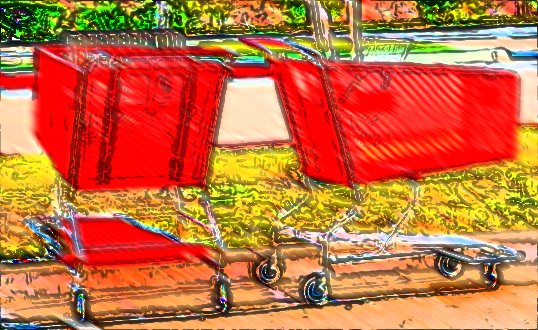
Next… Shopping Carts

Carts in the Pond

Sometimes, when the weather was warm, he liked to sit beside this little pond in a park near his house. The bank all around the pond was steep but there was a spot where a tree had died and left a flat area ringed by a rock wall that was a particularly comfortable place to sit.

He was sitting there looking across the pond where a sidewalk ran when he spotted a couple of teenagers pushing a shopping cart. There was a grocery store a block away and he could see a single shopping bag in the center of the cart. When they reached the middle of the part of the sidewalk that ran along the pond, one kid reached into the cart and pulled out the bag. The other simply turned the metal cart and pushed it down the steep bank where it hit the water and with a soft hiss, quickly sank beneath the surface. Once it was gone the two kids kept walking, now carrying the bag in their hands. It didn’t look very big.

He was upset at this. He knew the grocery store was losing money and would soon close. The neighborhood would be hurt by the lack of shopping and the image of the big empty box on the corner, the vacant parking lot. Those carts were expensive and those kids were one reason nothing good ever lasted any more.

He thought about yelling something, but they were too far away. He couldn’t even chase them. By the time he rounded the pond they would be long gone. They were too far away for him to even recognize who they were – if he saw them again, he wouldn’t even know it.

So he sat there for a little longer and then walked home. He never went back to the pond again, preferring to stay home and watch television.

Racing With the Wind

Roger and Annette had to rush to the van from the basketball court. Annette ran with her oldest daughter’s hand in her own while Roger carried their young son, barely more than a toddler, in his arms. A huge black angry cloud was building rapidly to the west and the boiling thunderstorm was beginning to kick up a cold fast wind.

As they piled into the van the humid heat of the Texas summer was shoved aside by a blast of cold storm outflow air. The second they settled in, locking the toddler into his car seat and making sure the girl had her belt fastened the wind rose to a howling gale. Dust and leaves rose in a shooting cloud and the van rocked from the power of the wind.

To watch their daughter’s game they had had to park across the street in the lot of a small shopping center. It was anchored by a big hardware store and the wind suddenly began grabbing the hundred shopping carts piled out front and sent them shooting across the lot like rockets, right toward Roger and Annette’s van.

They flew in a wheeled phalanx, upright and racing, some swerving a bit due to a wonky wheel, but most moving with amazing speed. Roger and Annette could do nothing but watch them come. Most were driving in rumbling mass to the south of the van, where they watched them pass, hit the curb, and then tumble out into the street.

A few veered to the left and came close to the van, but thanks to a lucky act of providence, none actually hit them, although some only missed by inches. Roger, Annette, and their daughter sat there helpless, and felt a great relief when the sudden windstorm died down and was replaced by fat, pelting rain. They felt very lucky they had not been hit, though it only would have been a little dent at the worst.

The toddler, of course, thought the whole thing was a blast and laughed as hard as he could as he watched the shopping carts fly by.

A&P

One of my favorite short stories of all time is John Updike’s A&P. If I could do anything – I wish I could write like this:

Text of A&P

Go ahead – read it now. It’s not very long – it won’t take up much time.

I read this story in college. For a chemist, I took a lot of literature classes. Most of them were honors level courses – and looking back, I didn’t get much out of them. They were very intellectual and were interested in ferreting out symbolism and deconstructing the text… and now, decades later, I realize they completely missed the point of what we were reading. My fiction writing classes were worse than useless; they set my writing ability back so far I’m only now, in my fifties, beginning to unlearn the false dreck violently stuffed into my young head.

After having exhausted my allotted supply of honors courses, I tacked on an ordinary English class – The Art of the Short Story. Basically, we cranked through a textbook that contained one hundred classic stories and wrote three papers or so a week. Our instructor was intimidated by the classroom setting so we met in a bar, talking about literature while we drank cheap yellow 3.2 beer from schooners, listening to each other’s conversation, and watching rivulets of condensation run down the thick glass.

This was a revelation. There was none of the vicious oneupmanship of the honors classes or the viscous boredom of the scholarship. It was true, lively banter where everyone was able to bring a different point of view along with some fresh ideas.

I’m sure I wrote an essay on A&P, but don’t remember what my angle was. I was working at a gas station over break back then and I remember really liking the paragraph where Updike writes about the sounds an old-fashioned cash register makes. He had it exactly right.

I go through the punches, 4, 9, GROC, TOT — it’s more complicated than you think, and after you do it often enough, it begins to make a lttle song, that you hear words to, in my case “Hello (bing) there, you (gung) hap-py pee-pul (splat)”-the splat being the drawer flying out.

The other day, after all these years, I discovered a short film version of the story. You should be able to watch it at this link – courtesy of SPIKE TV of all things:

A & P

I’m a little ashamed to admit that I stumbled across  this short looking up information on the new Three Stooges Movie. The guy in the short will play Larry in the Stooges movie, and, of course, you remember the actress that plays the girl, Queenie, from Road Trip.

I’m glad that they made this short. I am very glad I saw it. However, like any time a visual representation is made about a piece of literature that was important to you, I’m disappointed at some of the changes they made in the presentation.

The video doesn’t really fit my impression of the story… I think it’s the cutsie music. Or maybe the Ipswich accents.

The short story is edgier than the video suggests.

I didn’t like the scene where he imagines meeting Queenie at the party (though I suppose they had to pad it out somehow). It makes the story more of a romance fantasy, or a poor boy/rich girl story… which it is not. It is a much more fundamental conflict at work here – an elemental question of values.

And worst of all, all though the short has no qualms about presenting the protagonist’s internal dialog in voice over, it leaves out the last, most powerful bit. I’m talking about the last half of the last sentence of the story. The internal dialog that contains the horror of the story. The voice over says his stomach fell, but it doesn’t say why.

The story does.

I look around for my girls, but they’re gone, of course. There wasn’t anybody but some young married screaming with her children about some candy they didn’t get by the door of a powder-blue Falcon station wagon. Looking back in the big windows, over the bags of peat moss and aluminum lawn furniture stacked on the pavement, I could see Lengel in my place in the slot, checking the sheep through. His face was dark gray and his back stiff, as if he’djust had an injection of iron, and my stomach kind of fell as I felt how hard the world was going to be to me hereafter.

how hard the world was going to be to me hereafter.” I still remember reading these words in college and the fear that they struck in me.

Sunday Snippet, Corner Kick

I was playing half the games. I’d play the first half, and then I’d sit down so that Wilma could get her turn. Wilma was a big girl; sort of shapeless. Nobody else could ever remember her name. I don’t know if she was a little slow in the head, or maybe only really, really, shy. At our age there isn’t much difference between the two. I don’t know why she played soccer. Probably her parents made her – like most of us. During the games she never even kicked the ball. She would stand around looking miserable, usually with her arms crossed. I guess it should have made me mad that I had to sit on the bench while she stood out there, useless, but I didn’t care. That’s probably why the coach always made me sit instead of any of the other girls.

You see, this was a recreational league. The rules said that everybody got to play at least half of the game, no matter what. Our team really sucked. All the girls that were any good had left a year earlier – they had gone off to play in the select leagues. That is where the teams get to choose who they wanted and the girls’ parents paid thousands of dollars so they could practice every day and go to tournaments in Europe and stuff like that. That’s not what we did. We were the girls nobody wanted.

We played on terrible fields in some rundown city park in some scary neighborhood. The girls on the select teams got the good fields, the ones with lights and smooth, level, grass.

The weather was always awful. It would be cold and rainy at first, then in the summer it would be so hot you couldn’t even think straight. The ground would dry out and split open like a tomato in the sun. There would be these big cracks and if you stepped in one, even if you didn’t break your ankle, all these crickets would come swarming out. It was really gross.

One game, the first one of the spring season, was really cold. It had been raining for days, the field was a muddy mess and the temperature wasn’t much above freezing. There was this big brown puddle in one corner of the field and Brenda tried to kick the ball when she slipped and fell in. It was weird – she completely disappeared. Who knows how deep that puddle was but for a few seconds there was no Brenda, only that brown water. Suddenly she came out, shooting up and out like a rocket. Brenda was a tough girl, never took anything from anybody, but she came out of that cold water crying like a baby. Her mother wrapped her in a blanket and took her away sobbing. She went home.

Some of the girls teased her about it the next week, but I didn’t like the look of that cold brown water and I knew how she felt.

Our coach last year, coach Barracha, would make us roll around in the mud before the games. He said, “I don’t want you girls afraid to get your uniforms muddy.” He had named the team River Plate. The other girls couldn’t understand why we were named after a plate. It seemed like an odd name to me too, but Coach Barracha was from Uruguay and I found that was the name of a famous river, and soccer team, from down there, so I guess that was OK. Coach Barracha was way too serious for our team. We lost every game and only scored two goals all season. At first he would get madder and madder every week until he finally gave up. When the season ended he didn’t even come to the Pizza party.

I was happy because I figured with no coach, there would be no team and I wouldn’t have to play this year. But then all the parents got together and convinced Eleanor’s Dad, Mr. Wiggins, to be the coach. That was terrible. Mr. Wiggins, like Eleanor, to tell you the truth, is kind of crazy. He renamed the team The Blue Squealers, which has to be the most embarrassing thing in the world. After giving us that terrible name, he pretty much did nothing. I guess that was all right; we weren’t going to get any better no matter what he did, and I guess he figured he might as well cut his losses.

With all the good players going to the select teams you would think that the other teams in our recreational league would suck as much as we did but no such luck. You see there were all these poor kids, these Mexican girls, who couldn’t afford to join the select league but still they lived for soccer. Their teams had Spanish names with the word futbol in them. They would beat the crap out of us, week after week.

Actually, when I was setting on the bench in the second half of these games I like to watch some of these girls play, even when they were thrashing my team. A lot of them were just small and fast and relentless, swarming and pushing, but a few were real artists. They could run and move and make the ball spin this way and that without even looking at it. Their game was a thing of beauty and for a second you could forget that you were sitting on a splintering bench in a run-down park watching kids trying to give a damn about a game that meant nothing.

Believe it or not, that year we had a good player. Really, her name was Missy Higgins. She was tall and fast and she said she had been playing soccer since, “I was in diapers.” Missy had been on a select team but now was faced with the humiliation of playing with us.

The girls talked about her all the time when she wasn’t around. They all said that she had been kicked off her select team because she had been caught drinking with some college boys while they were out of town on a tournament. That seemed to make sense to me, but I listen to the parents talk when I sit on the bench and I heard her mother say she had to quit select soccer because was having knee problems after a growth spurt and needed to get stronger before she could try it again.

At first I thought this was an excuse, because her parents must have been ashamed because of the drinking, but I watched her play and even though she was really good, a ten times better player than anyone else on the team, she was obviously in pain. She would grimace and groan, though nobody other than me seemed to notice. One game, she tried to make a sharp cut right in front of me on the bench, to keep the ball from rolling out of bounds, and her knees gave out and she tumbled onto the ground. I heard her mutter, “I’m a cripple,” as she pulled herself back up.

You would think that our team would be good with a girl like that but it didn’t really make any difference. First of all, soccer isn’t that kind of a sport. One player can’t make up for a whole team of suck. None of us could ever really make the ball go where we wanted it to. When we kicked it the ball would go squirting off somewhere else, usually spinning like crazy. It was kind of fun, trying to guess where the thing was going to end up. So we couldn’t actually pass the ball to Missy, even though we wanted her to have it and we tried all the time.

It didn’t take the other teams long to figure it out too. The other coaches would put two girls on Missy all the time, usually one big girl pushing on her from behind and a little quick one darting around in front. It must have been really frustrating for Missy, especially since that meant somebody else didn’t have anyone defending them, but good luck with that. When Wilma was playing the other teams would ignore her completely.

Missy tried really hard on defense, too, but it didn’t do much good. If the other team had the ball they would always kick it wherever Missy wasn’t at.

Still, Missy would usually score one goal almost every game. I remember her getting the ball and kicking a spinning arching shot that bent around the other team and sneaked in a top corner of the goal. The goal keeper stood there with her mouth hanging open. It was a thing of beauty.

In the end, though, all Missy could do is get us so we would lose, say, seven to one,

The time I sat on the bench I’d watch the girls on the other team, I’d watch Missy, and I’d watch the parents – our parents and the ones on the other team. Every game they would come trooping out of their trucks lugging their folding chairs and line up along the field. The other teams’ parents would bring air horns or wooden clacker things to make noise to cheer on their girls. They would jump up and yell at the referees and cheer for their kids. Our parents looked like they were waiting to get dental work done. They would clap halfheartedly at the beginning of the game but once the inevitable slaughter began they would go calm.

Sometimes, I would spot a little metal flask moving between some of the parents. Coach Wiggins hardly ever said a thing, though he would at least stand and pace through the game. He looked lost. I think I saw Brenda’s dad pass him that little flask once or twice, but I’m not really sure about that.

Wilma’s stepmother brought her to the games. Since Wilma played while I sat, I could watch her. I thought that her stepmother would at least watch or cheer a little, but she never did. She was a lawyer and would talk on her bright red cellphone or text away on her little Blackberry during the whole game. Some times she would do both; wedge her phone against her shoulder under her ear while she texted away with both thumbs.

Finally, it was the last game of the season. It was against the other team from the suburbs. They were called the DeeFeeters and they sucked almost as much as we did, though you would never know it from how cool they thought they were and how loud their parents would yell. They even had a father that would bring this big apparatus that had a tripod and a pole that he would crank up into the sky with a video camera on top. He had to film every minute like it was the Super Bowl or something. I hated those people.

Like I said, though, that team sucked almost as much as we did and even though they had scored two quick goals, they must have got lazy and Missy scored a goal and then Brenda tried to kick a pass and it spun and wobbled and bounced into the goal. The game was almost over and I was sitting on the bench getting excited that if we were lucky we might get out of there with a tie. You can have ties in soccer and it would be cool to not lose for once.

Well, there were only a couple minutes left and Missy was trying really hard and the other team kicked it past the line so we had a corner kick. Missy always took the corner kicks; she was the only one that could kick the ball all the way to in front of the goal. Missy went out and set everything up, Coach Wiggins always let her; she knew lots more than he did about what to do and what was going on.

From the bench I watched her take Wilma by the arm and move her away from everybody else, far away from where the ball sat by the little flag in the corner. It sort of made me mad; it looked like Missy was moving Wilma away from the action so she couldn’t screw anything up more than it already was. This wasn’t fair, no matter how bad and weird Wilma was she still deserved to be in the middle of things. It was strange though, nobody else was paying attention, they were all moving around and pushing against each other but I saw Missy saying something to Wilma, whispering in her ear. She was shorter and had to stand on her tip toes to get her lips close to Wilma’s ear.

Then Missy took Wilma’s shoulders and moved her – sort of almost pointing her in a certain direction, and then pulled her crossed arms down and making her hold them down at her sides. Then Missy walked across to the corner and took her kick.

I had noticed all year that Missy was getting stronger and her knees were hurting her less as the weeks went by. She ran up and kicked the crap out of that ball.

The kick arced up like a rainbow, going higher and farther that anyone had guessed, flying completely over the bunch of girls shoving at each other in front of the goal. It came curving down and, like a sniper shot, hit Wilma square in the chest. It fell to the ground right in front of her and for a split second Wilma stood there petrified, staring at the ball, but then she seemed to shake for an instant and stepped forward and kicked the thing.

Of course, nobody was anywhere near her and the goalie was completely out of position so the ball bounced a couple time and ran up against the back of the net. Everyone looked stunned except Missy who was jumping up and down and screaming. I couldn’t believe it, she knew exactly what she was going to do and she did it… perfectly.

I turned on the bench to Wilma’s stepmother, who hadn’t seen a thing. She was looking away and was talking into her phone.

“Um, Mrs…. Um… Wilma’s Mom?” I didn’t know her last name. “Wilma just scored a goal.”

She said something sharp into the phone, snapped it closed and then frowned and turned to me, “Oh God! What has she done now?”

“Oh, no, ma’am. It was a good thing. She scored a goal. I’m afraid you missed it.”

She stood there with her mouth hanging open, holding her phone in one hand and her Blackberry in the other, turning and staring at all the girls jumping and hugging Wilma in a big clump. I don’t think she ever really figured out what happened.

It would be a better story, I guess; if we had gone ahead and won the game, that Wilma had kicked the winning goal in our only victory. I’m afraid, though, there was too much time left and the goal really pissed the other team off and they scored three goals in the last five minutes and we lost five to three. I don’t care though, that goal was a thing of beauty.

I will always remember watching that goal from the bench. I think I would rather watch something like that than actually score an ordinary goal myself. It’s good to know that every now and then there is a perfect thing in this world. Also, as long as I live, I’ll think about and wonder what Missy said to Wilma when she whispered to her, standing there holding her shoulders, right before she kicked the corner. I wish I knew; I wish I had heard it.

That was my last soccer game. After the season I thought about what would be the best time to hit them up and one afternoon, when they were in a good mood, I went to my parents and begged them not to make me play another season. They went along with it, but I had to promise to sign up for band next year.

I’m thinking, maybe the flute.

Sunday Snippet – Abandoned Hamburger

To catch the train home from work, Wilbur Jamison had to walk through an underpass beneath a busy thoroughfare to reach the platform. A train pulled in as he started down the stairs into the urine scented concrete tunnel – he knew he would just miss this one and have to wait for the next. A handful of young men vaulted the fence – baggy pants and all – and dashed through the honking cars to make the train. Wilbur wouldn’t… couldn’t vault and dash – he would have to wait.

There were two metal seats at the place where the train doors would open in a half hour. Wilbur plopped down on one to catch his breath after struggling up the steep concrete stairs from the underpass tunnel.

The other seat had a hamburger on it. Wilbur looked around to see if it belonged to anybody – there was no one on his side of the platform (the train had left only seconds before, after all). He was alone except for some man in a P-Diddy T-shirt and the most ridiculous pair of embroidered and bejeweled denim shorts he had ever seen. The man was screaming into a cell phone on the other side – across the tracks – waiting for a northbound.

The hamburger on the seat next to Wilbur sat in the exact center of a round foam plate. It had one generous, neat, semi-circular bite taken out of it. Wilbur figured it had been abandoned when a train pulled up – eating is not allowed on public transport. It appeared to be a plain hamburger. Nothing, no lettuce, tomato, pickles – not even a stain of ketchup or mustard – was visible in the exposed edge of the missing crescent. Wilbur thought that there could, however, be a thin careful application of unknown condiments in the center, hidden by the bun.

Wilbur considered getting up and throwing the food into the trash container a few feet farther down the platform. He thought of himself as being socially reliable and liked to think about doing small acts of responsibility and kindness unacknowledged by the rest of the world.

He thought about this, but before he could gather the momentum to get up and move another commuter, a large man accompanied by a young girl, pushed the plate and the hamburger off the metal seat, swatted the air a few times and then sat down with a grunt. Wilbur was surprised; he had not seen the man and girl walk up.

Wilbur frowned. The man had not properly disposed of the hamburger and plate – it was now wedged under the frame of the large advertising sign behind the little seat. He didn’t like this lack of concern on the part of his fellow commuter, but he didn’t say anything. He pulled a dog-eared paperback out of a jacket pocket and began to read until his train came and he boarded.

Two train stops down the line, a woman climbed on board and sat down on the bench next to Wilbur. She was wearing thin, ill-fitting black slacks and some sort of ratty brown striped Rayon uniform/smock. She had a black plastic visor with the white initials “WH” painted on it. Her large yellow plastic badge said “WAFFLE HOUSE – MARLENE.”

She had been smoking on the platform when Wilbur had spotted her out of the train window. She had leaned over and snuffed the cigarette out on a light pole and now that she was seated on the train had pulled out a weathered pack of Camels from somewhere and was carefully replacing the half cigarette back in the pack.

She had to concentrate to get the Camel into the package while the train was accelerating away from the platform and starting to sway. She scrunched up her face paying attention to her task and that brought out a tight maze of small wrinkles framed by her thin short blonde hair and the black plastic eyeshade. Wilbur felt he could read this labyrinth – thought he could see the echoes of decade after decade of struggle – of desire and disappointment – of unwilling denial that mirrored his own.

Wilbur had never spoken to a stranger on the train before, but after five minutes the pressure became too great. He became deathly afraid that she would get off at the next stop and he would never see her again.

“Uhh, Hi Marlene… I’m Wilbur,” was the best he could muster.

“Oh, How did you know my name? Do I know you?” She looked confused.

“No,” he said, gesturing to her badge.

“Of course,” she said with a little chuckle, “I forgot. Pleased to meet you.”

So they chatted until Wilbur’s stop. She was getting off the night shift, he was starting the day. They shook hands as Wilbur stood to leave.

It wasn’t hard for Wilbur to find the Waffle House close to Marlene’s train stop. It was even easier to learn her schedule and to time his commute so he was on the train waiting for her. He started getting to the station extra early, letting a train or even two go past, waiting for the proper time. He would make sure the seat next to him was open, no matter how crowded the car was.

Marlene began looking forward to seeing Wilbur waiting on the car. Every now and then she would be late getting out of work or the schedules would slide and Wilbur would catch the wrong train and they would miss each other. Wilbur would go through the day in a dark funk and Marlene would have a hard time sleeping that day, though she had worked third shift for most of her life, whenever that happened.

They traded favorite paperbacks, Marlene started bringing Wilbur lunches from the Waffle House, and finally Wilbur summoned enough courage to ask her out to a movie. He had a car, a nice one, really, though it had a lot of miles on it. He only took the train to work to save on parking.

Marlene slept while Wilbur worked so their schedules worked out pretty well together. They would go to a couple of movies on the weekends and try for a nice dinner on Wednesdays.

Wilbur decided to ask Marlene to his house for dinner after a movie one weekend. His only son lived in Japan and had stopped even writing to him years before and nobody other than himself had set foot in his house in the decade since his wife had passed away. He asked a neighbor for a recommendation and hired a woman to come in to clean the place. He kept a simple, neat house, that fit in with all the others in the suburb, but not one that was spotless. He had never learned how to do that.

He drove to Marlene’s second floor studio apartment to pick her up. She appeared at the door carrying a small overnight bag. Wilbur was so nervous and excited during the movie that he never could remember what they saw.

Later that night, not long after he had brought her to his house, Marlene silently removed her clothes.

“Well, here it is,” she said with a combination of regret, excitement, and acceptance.

Wilbur gasped. She looked as if a bite had been taken off the top part of her body – a pink arc from one shoulder across the tops of her breasts on up to the other shoulder. Another arc cut across her legs – from one hip down to mid-thigh and then curving back up to the other hip. Everything else between these two arcs, her entire torso, was completely covered in complex colorful, dense, intertwined tattoos.

“Oh my God!” It escaped his lips before he could get control of his amazement.

“I’m sorry – I should have said something… I should have.”

“No, no, Don’t apologize. I think they… it’s… you’re the most beautiful thing I’ve seen… in a long, long time.”

“I’m sure you’re wondering where, why… well… it was like….”

“No! Stop! Don’t tell me. I don’t want to know. I don’t ever want to know. Don’t ever tell me.”

Marlene shrugged. She seemed more than a little relieved.

“Fine with me,” she said.

Eventually, Marlene quit her job at the Waffle House and gave up her apartment, moving in with Wilbur. The neighbors barely noticed. It took her a while to get used to a usual schedule, sleeping at night, after having worked third shift for so long, but she was glad to work at it.

Wilbur had saved up a lot of vacation over the years and they began to travel. They started out with weekend driving trips close to home and gradually worked up to international voyages. They particularly liked traveling by cruise ship – Marlene enjoyed the shore excursions and Wilbur preferred the luxury on the boat.

Wilbur liked to lie next to Marlene and trace the intertwined designs across her skin, to try and separate each one out. He would make up little silly stories about each one and Marlene would laugh at his imagination. A few times she wanted to tell him the real story about her tattoos but Wilbur would not let her say anything. They were a mystery and he wanted to keep it that way. They were his mysteries and he liked the thought of having something so wonderful and strange belonging to him alone.

Marlene was almost as alone as Wilbur, but not quite. She had a beloved old aunt that lived in Toledo, Ohio. Marlene received word that her aunt had fallen sick and she went up there to tend to her. She was gone for two months and Wilbur missed her terribly, but they talked on the phone every night, and that made it better.

Finally, Marlene’s aunt regained her strength and she flew back home. Wilbur met her at the airport and they drove home. Wilbur carried her luggage into the house.

“I’ve got something to show you,” Wilbur said.

“Oh, you didn’t have to.”

“I’ll give you the present I bought for you later, but this is different, it’s something I did while you were gone.”

“Something you did?” Marlene was confused, and a little nervous.

Wilbur turned his back on Marlene and pulled his shirt off over his head. There, angling across his back, was a large, complex red dragon. Marlene knew ink like that could not be done in one visit, knew that Wilbur must have been waiting for her to be gone for an extensive time to get this dragon done. She also knew how much it must have hurt.

It was an expert job; the colors were bright and the detailing crisp. The dragon was a Japanese design, she had seen it before. The dragon was long and scaled, with several pairs of legs, and it was curved around, almost tying itself in knots. It seemed to pulse and seethe across Wilbur’s back. She moved in to look closer and snapped on a bright lamp to see better. The dragon was holding something – something clamped firmly in its foremost claws.

“The dragon is holding something,” she said.

“It sure is.”

She looked even closer. “Is that a hamburger? A hamburger with a bite out of it?”

“It sure is,” Wilbur said.

Sunday Snippet – The Iceberg

(click to enlarge) "Approaching Storm" by Claude-Joseph Vernet, Dallas Museum of Art

The river was teeming with plump fish. Today would have been a good catch. The storm blowing in from the sea will put an end to that. Dorothy came down with baby Aaron to warn us, wearing her favorite red dress. She’s holding him as he squirms, he wants to play with the fish. John and I are down on the rocks working, trying to get the day’s catch gutted and put up before the rain starts, while the rest pull in the nets. A stray dog is barking as Donna fights with the mule, the animals know what’s up and want to go home now, instead of helping us with our load.

A sudden flash startles me and I look up to see a giant bolt of lightning scream down at an angle from the glowering cloud. It strikes the city, golden in the distance. The sky has darkened leaving the cream limestone of the city’s domes and towers to almost glow in the last free rays of sunlight. A while later the thunder careens down the valley, distant booming echoes coming off the giant rocky crag of Gray Mountain behind the city and from the walls of the canyon itself.

Above me, high on the canyon walls is the Duke’s estate. New luxurious stone buildings built around the ancient ruins of a ruined castle. Since the Duke built the new tollbridge by the city, his fortune has increased tenfold. A lone figure, one of the Duke’s men, looks down, high overhead from the old ivy-covered tower. He is probably watching the boats; some nobles were out for a day on the river and were caught by the sudden wind. They are heading back in their carriage, leaving the boatmen to struggle with their craft.

The storm is building, piling up upon itself, towering overhead like an angry giant. The wind whips even wilder, I can smell hard rain approaching, the flashes of lightning come faster now. My excitement is beginning to be tainted by fear; the old highway back to the city runs along the canyon bed, under the stone arch; and even with the mule helping with the nets the storm will be strong upon us before we reach the bridge. The tumbling cataracts here in the last stretch before the sea can rise up quickly, many travelers have been engulfed, with their destination in plain sight.

I look at Dorothy and little Aaron, Donna and the mule, the netmen; all looking to me for guidance. I should have known this storm was blowing up, should have stopped work sooner, should….


Jim was jolted out of his reverie my something moving across his field of vision. Something thin, dark; something slinky, something sexy. He felt her in his gut even before he even really figured out what had startled him. The young woman walked by between his bench and the painting; his head turned to follow as she passed on by the big oils of landscapes and ocean scenes down the room and back several hundred years to painted scenes of Christ on the cross.

She was wearing a short black dress, black stockings, and her long dark hair poured over her shoulders. Her face… her skin was as pale as a cold egg. She carried a little notebook and a thick textbook; she must be here with a college class. She was young and thin and tall, moved with a nervous jumpy weightless ease, flitting along from painting to painting like a colt.

Jim stood from the bench and let out an audible sigh. It was time to go findShelby. He preferred the old masters, paintings that looked like something, art that told a story. He had been sitting on a padded bench in front of a Claude-Joseph Vernet painting, “Approaching Storm” for over half an hour.

His wife liked the modern stuff. He knew what gallery she’d be in. With another sigh he set off.

………………………………………………………..

MODERN AMERICAN ARTS DIGEST —– AUGUST 13, 2013

ELMORE SPENCER – AN ARTIST WATERS HIS ROOTS

—————————————————

Elmore Spencer has climbed the mountain of the art world. From a child prodigy that startled adults with his sketching skills at the age of six to a celebrated student of the Paris art schools to a meteoric rise to the jet-setting toast of the New York Art Society, Spencer has had it all.

Instrumental in founding the “New Realism” school, he then rejected this return to “Painting that looks like something” and veered off into innovative artistic experiments that challenged the border between art and observer, maintaining his success and popularity through it all.

Now, he struggles with a return to his roots, to maintain the connection with his audience that he feels his decades of success have cost him. The conflict of the avant-garde and the traditional, realistic and symbolic, is at the heart of what Spencer is up to now.

“It’s been a long road, but I’ve been lucky,” Spencer said in a recent interview, “To others its seems like a climb, a rise, but to me it feels like a spiral, the further I go, the more times I return to the same places.”

His newest installation in the Checkwith Gallery of the Kooning museum communicates that duality in Spencer’s own way. A large room in the gallery has been darkened, a dual-sided screen has been installed in the center of the room, along with two digital television projectors and a powerful sound system.

A film plays on this screen; a man walks from the murky distance, approaching the screen in slow motion. The man stands for a minute, then, on one side of the screen a small flame appears at his feet. The flames slowly grow until the man in engulfed. Finally he disappears in a massive wall of fire.

On the other side of the screen the same man is assaulted by drops of water falling from high overhead which increase in frequency and volume until they become a torrent falling. The water slows and stops and the man is gone.

Meanwhile the speaker system booms out the sound of water falling, the sound of roaring flame. It is interesting to note that both sounds are the same.

The film installation is work of art in itself, many, if not most, visitors assume that it is the artwork. With his playful genius, Spencer has visualized this darkened room as a controlled setting for his real art. He has constructed a series of twelve sculptures, to be placed into the area on a rotating basis.

One sculpture is a pair of lovers, constructed of modern materials, rugged and realistic. They sit on a bench in the darkest corner of the film room, they are only visible during the peak of the flame portion of the film, illuminated by the fire on the screen. They are locked in a kiss, an embrace, his hand is slipped inside her shirt, hers rests on his thighs. The museum receives dozens of complaints on the days this sculpture is set out.

Another sculpture is a mechanical museum guard. He stands inside the room. When the guard is present the film is turned off. Infrared proximity sensors pick up any patron that enters the room; and after a delay, the ersatz guard plays a recording, “I don’t know, they’re supposed to have turned the film on by now.”

Some of the sculptures placed in the room are designed to look at home there, others, such as the murder victim, placed in the corner with a knife protruding from his back like from a cheap detective movie, are obviously intended to shock or annoy. On certain days nothing is placed in the room, leading to a scene where patrons in the know walk around examining each other, trying to determine what is real and what isn’t.

Spencer has even been known to spend a day in his own installation, sitting on a bench with his famous sketchpad, drawing the reactions of the observers. This has been so successful; he has taken to walking around the museum sketching patrons looking at art.

“As artists we live for the people that look at our work, really. We never think about them, or study them, or try to incorporate their lives into the art itself. I want to change that…….”

………………………………………………………..

“Shelby,Shelby!”

She turned from the painting, a huge panel covering most of the wall, hand painted with extreme skill to look like a blow-up of an article from a art magazine, to see her husband standing there.

“What do you want?”

“It’s time to leave.” Her husband looks at his watch. She thinks he always is looking at his watch.

“I’m not finished reading this.”

“What the hell is that? What’s it supposed to mean? Might as well go home and read the paper.”

“It’s by Spencer, My Life, it’s called. I haven’t decided what it means yet.”Shelbyfelt anger welling up in her throat. She’s known James, her husband, her love, since they were children and had been angry many times over the many years, but nothing like lately. She could feel a fight coming on, a mean and nasty fight, and one with no resolution.

When they were young, when they were first married they would argue, like all newlyweds, like all friends. It would end quickly, though, with both giving in. The next day the argument would seem so silly.

Now, though, they fight, and the fights never end. They taper off into silence and simply flare up again at the next conflict, the next insult. She could feel the heat rising, like a hot nut right under her sternum.

“Come on!” Jim said, placing his hand on her arm, “We have things to do.”

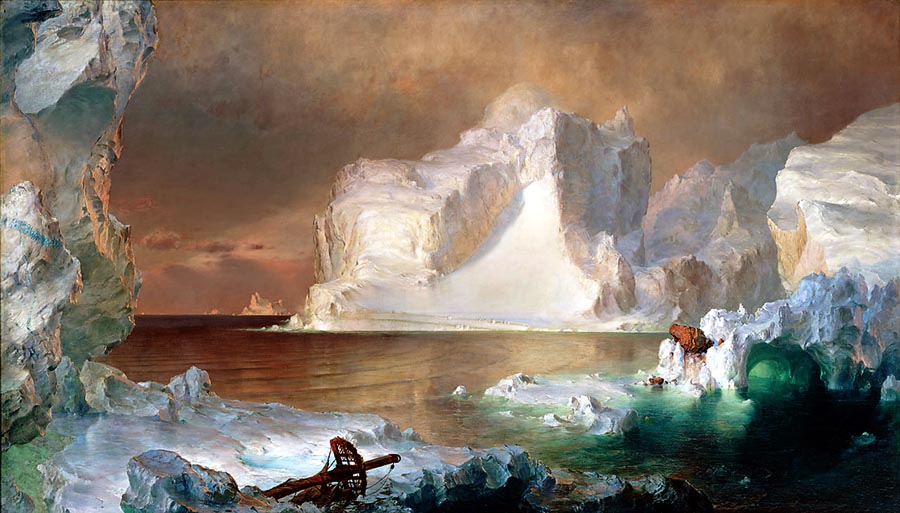
Shelbywanted to explode, but the twentieth century gallery at the Kooning museum was not the place to have a knock-down, drag-out, so she walked stiffly in silence, stewing. They passed through room after room, moving back in time towards the rear entrance until they reached an area dominated by a huge landscape painting; the most famous work in the museum. It was a scene of icebergs, a giant white slope, begging for footprints, a brown and purple timeless sky. The ice in the foreground was littered with debris, a shattered mast, a glacier torn boulder. The ice rose in craggy veined cliffs all around pierced by an emerald green frozen tunnel, a mystery. The calm sea was disturbed only by circular waves radiating out from some unseen event.

She could not stand it any more, she was so furious.Shelbypulled away and sat quickly down on the circular bench. Jim sat down beside her, staring wide-eyed. Pulling in her anger, she started to speak.

“Jim I…”

“Excuse me, folks,” said a man they hadn’t noticed. He was gray-haired, wearing old jeans and a long-sleeved shirt. He was sitting on the floor, leaning against the wall under a Thomas Dougherty landscape, a large sketchpad resting on his knees. “Do you mind sitting there for a while, I’d like to draw the two of you. If you don’t mind.”

Jim stammered, “Well, we have…”

“Sure, go right ahead,”Shelbyinterrupted.

“Alright then, umm. turn toward each other a little, now look at me…. Fine, why don’t you hold her hand a little…. That’s right.”

He started in drawing right away. Working with colored pencils and some charcoal and a bit of an eraser. Jim and Shelby felt nervous; the fight, their day quickly forgotten.

“Ummm… try to relax, why don’t you tell me a story. Tell me about when you first met.”

“Well,” Jim started.Shelbywas surprised that he spoke up so soon. She was getting ready to talk, but he beat her to it.

“We met in junior high school, seventh grade, we were both thirteen. She sat if front of me inEnglish class. I remember, I loved her from the first moment I saw her. I thought she was the most beautiful thing I had ever seen. Our teacher was old, he would lean on a podium and lecture us all class long. The room was too small, our desks were crammed together, her seat backed right up against my desk. All I would do is sit there and stare atShelby’s hair. Her blonde hair. Sometimes she’d wear it down and it would fall in cascades right in front of me. Sometimes she’d wear it up, like a golden seashell, a yellow spiral. Sometimes in one ponytail, sometimes two, it didn’t matter. That was my favorite hour of every day, to sit in that hot crowded room and look atShelby’s hair. I felt like I could do this forever, for the rest of my life.”

Shelby and Jim sat there then and talked. They talked of old times, when they were young and when they started dating. They talked of old friends. They talked of their first apartment, of their first house, of the cars they had bought together, of the meals they had cooked, of the vacations they had taken. They forgot about the artist, ignored him until he finished. He put his pencils back into a little wooden case.

“Done.”

“Well, can we see it?” they asked together.

“See it? You can have it.”

“Really?”

“Really”

He handed them the paper and thanked them simply. The artist walked around the corner and was gone.

The drawing had the iceberg painting in the background. Carefully done in colored pencil and pastel chalk it was amazingly detailed and accurate. He must have been working on it for hours. The painting, or, rather the drawing of the painting faded in an oval spot near the center. He drew only around the edges, leaving a blank spot, waiting as he drew for someone to come along and fill it.

Shelby and Jim now occupied the oval. She gasped as she saw it. It was a life-like drawing, done mostly in pencil and charcoal, cross-hatch and shades of gray, only a hint of color added. Detailed. It was realistic except that they both were drawn naked.

Jim looked at the drawing of his wife’s breasts, at their intertwined hands. Shelby, at her husband’s naked body. She was shocked when she noticed that the artist had drawn in the patches of hair across Jim’s chest exactly right. The lower right corner had a quickly scribbled “ES.”

They suddenly noticed that over a dozen people surrounded them. They must have walked up to watch the famous artist work, but Jim and Shelby had not even noticed. Embarrassed by the gathering crowd pointing to details on the sketch, they rolled up the drawing, and headed out to their parked car. They held hands as they walked,Shelbyleaned her head on Jim’s shoulder as he drove.

They spent some money to have the print professionally framed and mounted at a shop across town that handled fine art works. Never really comfortable with the nudity, they couldn’t hang it in their living room. The framer recognized the signature, told them it would bring in tens of thousands of dollars, especially with the story of the sitters. He recommended a gallery. Even though they could really use the money, Jim and Shelby couldn’t sell it. It meant too much to them. They did hang it, in their bedroom, next to the closet.

For many decades, until the days of their death it was the last thing the saw at night when they went to sleep, the first thing in the morning when they woke up.
 

(click to enlarge) "The Icebergs" by Fredrick Church, Dallas Museum of Art

Getting ready for NanoWriMo

Underwood Typewriter

Underwood Typewriter

November is approaching rapidly and I have the usual annual decision to make. Do I do NanoWriMo?

One thing is nice this year. Usually November is a nasty busy month for me at work, which makes getting the time… and especially the energy, up for the fifty thousand words extremely difficult. This year, October is the tough month and November will be easier – except for the first week. The first week is brutal – so I’ll have a slow start but should be able to catch up. I have to take some vacation time, so maybe I can even go on a bit of a writing trip.

As you may have guessed by now, I am going to give it a go. (my Nanowrimo page) I have tried four times and made it once. The other three I wrote myself into a corner and couldn’t get out. They weren’t total losses – I still had a few tens of thousands of words that I might be able to use someday. Probably not. Crash and burned NanoWriMo paragraphs are hoarder houses of writing – piles of useless mouldering crap that seemed useful once, but really needs to be chucked into the dumpster out on the front yard.

I will say the one year I made it was a bigger thrill than I thought it would be. That year I picked a novel idea that I knew had no dead ends. It was an old man, caught in a life-or-death situation, reminiscing about his life during lulls in his struggle. I knew that if I was stuck I could always come up with another memory.

When my word processor said I had hit the fifty thousand words, I uploaded it and discovered that by the official count, I was still about ninety five words short. It was amazingly difficult to write one more little cluster of paragraphs at eleven fifty on the last night. I almost couldn’t squeeze it out.

So this year, my idea to avoid the dreaded dead end plotting is to develop the ideas ahead of time. I want to have about a hundred scenes listed out so all I have to do is write each one, five hundred words or so each, and then I’m done. No possibility of sliding off into the ditch.

The other day I saw The Tempest at the Wyly theater in downtown Dallas. I had seen it before, but I was still impressed. What I think I will do is update the basic plot lines of this last Shakespeare play to modern times. I’m tentatively making Prospero a deposed drug kingpin named John Prosper. Starting from that point, most the other characters start falling in line.

I’m working on Ariel… that is a key character. Setting too…. Maybe an actual island is doable… maybe in a lake. Do I want a supernatural element? Haven’t decided that yet.

Of course, I won’t follow the Shakespeare plot too faithfully. For example, somebody, probably more, will have to die. I do have my writing station set up nice… one less excuse.

So much writing. So little time. Wish me luck.

My secretary setup

One place where the magic happens

My 99 Cent Manifesto

Press

Press

I am in the home stretch of finishing up the editing and conversion of my book of short stories that I will put out as a Kindle ebook. I’ve been in the stretch run for a while. I’m struggling now with the cover… but mostly I struggle with the fear that putting something out there generates. Nothing to do but plug ahead as best as I can.

I have been thinking a lot about price points – about what I’ll charge for my book when I get it out.

First of all, isn’t it amazing that I’m even getting to decide this? Unpublished, unknown, talentless, loser writers didn’t used to have input on these decisions. The publisher decides.

But publishing, as we know it, is dead. It doesn’t know it yet – though it has a strong suspicion.

The Publishing Industry. I hate it when groups like Publishing call themselves an Industry. (Music Industry, Movie Industry, Television Industry) I’ve worked in Industry and Publishing is not an Industry (Book Printing is an Industry, but you have to go to China to find it). Industry isn’t art – it isn’t creative (not in the usual sense of creativity) Industry is a world of huge heavy smelly machines – a world of maintenance and statistics – it’s a world of hardhats, steel toed shoes, and flame resistant uniforms.

When a group like Publishers call themselves an Industry… they are dead. They have killed themselves. It is only a matter of time. The only thing left is momentum.

Underwood Typewriter

Underwood Typewriter

So I get to write whatever crap I feel like. And you get to read it. That’s not Industry – that’s the future. The question I have left is, “How Much Do I Charge.”

That’s a tough question. The head swims. To decide, the only way is to break it down, make a few options and choose between them. Eliminate the bottom choices, one by one. OK, that works.

The price points of ebooks don’t take long to figure out. They are:

  •  Really Expensive
  • Ten Bucks
  • Two Ninety Nine
  • Ninety Nine Cents
  • Free

The top choice, Really Expensive, is easy to eliminate. I’m nobody. I’m not selling a textbook or legal reference full of knowledge that is extremely valuable to an extremely small group. So, Really Expensive is out.

trs80

TRS80

Now, we are down to the affordable options. Why not free? This is my first ebook – all I’m really interested in is getting it out there. The idea is to get as many readers as possible, and then try and keep them. I have more books (already have enough short stories for another volume, and a novel is not inconceivable – I have a killer first sentence) in the pipeline, and a free teaser would help me spread the word.

Free is tempting, but I don’t think I’ll go that way. There is a question of value. A book is a relationship between an author and a reader. That relationship should/must have some value for it to be real and useful. Free is throwing propaganda leaflets from a bomber’s bay, free is a blog, free is a mimeographed sheet stapled to a telephone pole. These are all good things, important things, but that’s not what I want this time around.

What I want is terribly nebulous but it I feel it has to involve a transfer of value for it to truly occur.

That leaves ten, two ninety nine, and ninety nine cents.

Ten is tempting. That’s what I think an ebook should cost. That’s what I am happy paying for an established author, for something I’m pretty sure I’ll like. For the hours of enjoyment that a good book gives, ten dollars is a fantastic bargain. It even provides a nice return for the author.

But ten dollars is still a lot of money. Especially in this day of terrible tribulations and looming financial collapse a ten dollar purchase is a tough call (or at least it should be). I’m not established, I’m no sure thing, I’m not very good.

Ten dollars is too much.

Now we are down to two options. Two ninety-nine. Or ninety-nine cents.

Two ninety-nine is a great option. That’s the price (more or less) that Amazon kicks the author’s royalty up to 70 percent. My return on a book sold at that point is twice what it would be at only a few cents less. It’s not a lot of money. I feel sure that this is what I’ll charge for my second book, if I live that long.

Three bucks – a hamburger… a drink at happy hour in a bar… a bag of chips… or so. It is an odd amount of money… sort of in between.

Still, two ninety-nine… that’s not an impulse purchase. You have to think about it. It might not be much of a thought, but it is one.

And ninety-nine cents? What’s that? That’s nothing. Click on that link and it’s yours. Don’t even think about it. If it turns out to be crap – so what? You’re only out ninety-nine cents. Less than a dollar. You won’t miss a dollar. You can’t hardly buy anything with a dollar anymore.

Ninety-nine cents. The more I think about it, the more I like it. It’s something, it’s a transfer of value, but otherwise… it’s like a gift from me to you.

It’s like a cheap lottery ticket. Maybe it will be good, maybe not. But if it hits, you’ve got a lot of entertainment for not a lot of money. If it misses, so what? There is even the enjoyment of the momentary fantasy that you’ve found a bargain, something cool that nobody else has. That’s worth ninety-nine cents, right?

Kindle

Call Me Ishmael

I have always loved Kafka. His writing has been a huge influence on how I live my life (God help me). During his life, he published almost nothing. When he died, his final request was to have all his work destroyed (thank goodness, Max Brod decided to ignore his good friend’s dying wish). If Kafka was living in today’s times would he be pumping out ninety-nine cent ebooks? I like to think so. Would anyone be reading them? Probably not.

So there it is. Ninety-nine cents.

I like it.

Stay tuned.

What I learned this week – August 5, 2011

I’ve been fighting through some nasty bouts of writer’s block and finding help where I can.

How to Overcome Writer’s Block

By SUSANNAH BRESLIN

From Forbes Magazine

Stuck on what to write?

Try something different.

The only way to beat writer’s block is to write your way through it.

TIP #1: Write anything.

A decade ago, a friend of mine told me I had to stop writing short stories and write a novel. I’ve spent the last 10 years trying to do just that. I’ve had agents, finished drafts I decided I didn’t like, and given up on more than one occasion.

TIP #2: Forget everything else.

A few years ago, based on the first 30 pages of my novel, I was signed by a big Hollywood talent agency. That led to me pitching an HBO drama sort of based on my novel to Mark Wahlberg’s production partner and ended not long after that.

Eventually, I decided to forget agents, publishers, and pretty much every dream I ever had related to the novel other than making it into something I liked.

TIP #3: Never give up.

I finished that draft earlier this year, but then I got stuck in the revisions.

One problem with writing is that it is a solitary act.

Also, writing a novel is a marathon, and I am a sprinter.

TIP #4: Do what scares you.

In order to deal with my rewriter’s block, I decided to revise my novel in public. This requires a daily act of bravery. Every day, I post a revised section of my novel on a blog I set up to do just that. (The blog is here. The novel starts here.)

TIP #5: Write what you know.

My novel is about a federal agent looking for a missing adult film star. (This is what I know.)

As far as overcoming a block, this is what’s working for me.


The battle over our constitutional protections has now reached the point where our god-given right to hang huge plastic bull testicles from our trailer hitches is being threatened.

Truck Nutz Hooters

Truck Nutz Hooters

From Fox News

On July 5, Virginia Tice, 65, from Bonneau, S.C. pulled her pickup truck into a local gas station with red, fake testicles dangling from the trailer hitch. The town’s police chief, Franco Fuda, pulled up and asked her to remove the plastic testicles.

When she refused, he wrote her a $445 ticket saying that she violated South Carolina’s obscene bumper sticker law.

David Hudson, a First Amendment attorney and scholar, says laws banning these types of decals, emblems or bumper stickers are problematic, but often someone just hasn’t challenged them.

Hudson believes Tice and her lawyer can make a good case the South Carolina law is “unconstitutionally vague and unconstitutionally broad, and it violates the First Amendment.”

Hudson detailed many cases where law enforcement officials cited individuals for the content of their bumper stickers, and in the majority of those cases, a judge tossed them out because “the First Amendment protects a great deal of offensive expression.”

Hudson also cites the Supreme Court’s opinion that “the government may not prohibit the expression of an idea simply because society finds the idea itself offensive or disagreeable.”

Read More

I’m not too happy this case is going to court … it is sure to result in a hung jury.

Here in Dallas, the question has been asked and answered.


I learned that there is a way to cook pasta that looks really good and really easy. Unfortunately, it takes a pot that I can’t afford.

Alain Ducasse - Pasta Pot

Alain Ducasse - Pasta Pot, by Alessi

From the New York Times:

Alain Ducasse and the designer Patrick Jouin have created a pasta pot for Alessi that perfectly shows off Mr. Ducasse’s pasta-cooking method.

First the pot: it is slope-sided stainless steel with a mirror finish. The well-balanced cast aluminum handle stays fairly cool and serves as a nesting place for the melamine spoon that fits it. The flat lid has a steam vent, and the set comes with a melamine trivet for stove-to-table service. A recipe booklet is included. It is $238 at the Alessi store in SoHo at 130 Greene Street (Prince Street) and at the new store that opened two weeks ago at 30 East 60th Street.

Now for the pasta: Mr. Ducasse said he learned this all-in-one technique from traditional olive oil makers in the Ligurian region of Italy. Instead of boiling pasta, making a sauce and combining them, he sautés aromatics, including garlic and onion, in the pot, stirs in the pasta, then slowly adds stock, so the pasta absorbs the liquid and softens. It is an effective method, like making a risotto, that takes about 20 minutes for delicious results. The starch in the pasta, which is not discarded in boiling water, thickens the stock, making a lush sauce. The process is for short macaroni cuts like penne, not spaghetti.

——–

But there is hope, my friends. I think I can make this recipe in a Dutch Oven. Man, looking at this is making me hungry.


More Pasta Information. From Malcolm Gladwell, the genius, via the TED network (which is chock-a-block with interesting lectures and… stuff, thanks, Carrie).

Malcolm Gladwell on Spaghetti Sauce

To a worm in horseradish, the world is horseradish.


I think I know what’s wrong. We’re all stuck in an Army Ant Death Spiral.