“War must be, while we defend our lives against a destroyer who would devour all; but I do not love the bright sword for its sharpness, nor the arrow for its swiftness, nor the warrior for his glory. I love only that which they defend.”
― J.R.R. Tolkien, The Two Towers
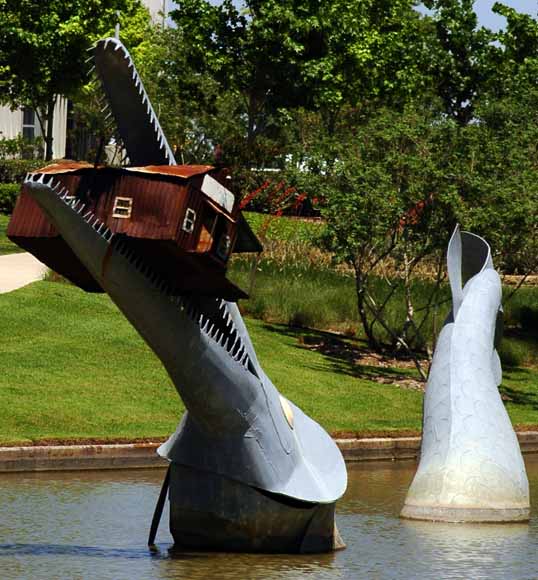
M41 Walker Bulldog
Liberty Park
Plano, Texas
War of the Carpet
There is a war occurring on the carpet tonight. An army of Batmans and Gargoyles are advancing from their living room headquarters around the shelving unit and down the hall. Opposing this formidable armed force is an equally menacing horde of Spidermans and Teenage Mutant Ninja Turtles. Their base is the guest bathroom which they have fortified with overturned plastic tubs, their former abodes. The generals of the two forces are two giants, each hundreds of feet tall in the measurement of these miniature fighters. The two deadly opponents, brothers, provide the strategy, tactics, rules of engagement, motive force, and most important, sound effects. Their parent assumes the role of Florence Nightingale, because every couple of minutes they are brought some wounded soldier whose missing part must be reattached.
The vehicles of these battling hordes are a motley collection. Eighteen wheelers, plastic airplanes, horses, cows, dinosaurs, conveyances of all ages, and of unmatched scales. Even a little space shuttle does its wartime duty. The generals are now calling for the “Secret Weapons” – yelling and running as the big guns are brought out of their hiding places under the couch and behind the toilet. The Batmobile advances toward the Gotterdammerung occurring in the hallway as a model police car leaves the bathroom, some sort of CHIP chip inside is yelling “Call 911” as the miniature siren wails and the LED’s flash.
“Time for SECRET WEAPON NUMBER TWO” comes the new call. Two more giant plastic tubs are overturned revealing two plastic F-14’s – one for each army, one red, one blue. The slaughter is witnessed by a giant dog, who sits in the corner with his slobbery tennis ball, forlornly staring at the generals, trying to get them to play fetch with him (don’t feel bad for the dog, the generals played with him for half an hour earlier, he’d play fetch 24 hours a day if he could).
Suddenly, a break in the carnage! The generals negotiate a sudden truce. After a bribe of bagels and chocolate milk the warriors retire to watch television.
Wouldn’t it be nice if we stayed this way. All we would have to do in Ukraine is send over some Hershey’s and the newest Disney release.
“The leaves were sun-baked lizards, stirring towards the sea that churned its chain of silver snakes, which would, if given half the chance, coil round, pull him out of this urban setting, vomit him on dry land.” ― Ann Quin, Berg
Renner School House desks.
From my blog (I called it an “Online Journal” then), The Daily Epiphany, Saturday, June 8, 2002
Trash
It was getting hot, really sticky and humid, as I walked around the point and stumbled into the mother lode. Working my way south along the shore I hadn’t found much; but here there was a north-facing shore and with the summertime hot southerly Texas wind all these cans and bottles were massed up – blown across Sunset Bay from the popular family picnic spots on the other side. Everything was mixed up in the big round clumps of grass that protect the shore or hidden in the gobs of bright green seaweed – mostly aluminum beer cans plus plastic soda bottles, thin Red Bull cans, and a plastic quart of oil.
I fell into a routine as I worked along the shore. I’d use the grabber-a wooden pole with a little swivel handle that pulled on a thin rod that worked the flimsy pair of plastic-coated jaws on the far end-to grab the cans and bottles and lift them out of the vegetation. I’d line them up on the steep bank, upside down – so the lake liquid inside, brown and green, would drain out. After a few minutes I’d return, pick up the aluminum cans for the blue bag, everything else in the black.
Across the cove I could see a group doing the same thing. They had a long aluminum pole with what looked like a net on the end and a whole swarm of kids running around with trash bags. Two guys in kayaks slid by moving into the thick vegetation of the inner cove itself, looking for floating tires and other crap, I suppose.
The ducks and geese that live there were getting pissed off at all this commotion, after convincing themselves that I didn’t have any stale bread to throw out. The circled and clucked and clacked and gave me the Evil Eye. A mother and five ducklings arced out of a hiding place behind a clump and swam off into a more protected part of the cove. Off to my left was a more open field lined with trees. A photographer was wandering around gazing up into the trees, looking for an artistic shot of the limbs, and eyeing me every now and then. I could tell he had no idea what I was up to. Past him, a couple had set up easels along the treeline of the thick bottomwoods, protected by a stretch of swampy ground. They were painting away, sometimes walking back and forth to see each other’s work. I wanted to work my way over to them and see what they were doing; but the wet ground kept me away. There was plenty of trash where I was anyway.
On past the painters was a colorful clot of balloons arcing over the road at a finish line. Lanes were set up, tables of water bottles, a big yellow elapsed time indicator, and an ambulance – set up and open with oxygen bottles, gurney, and a couple of bored-looking paramedics in blue uniforms. When I first arrived a flashing police car had escorted the winning runner through and now the rest of the race was streaming by.
I’ve always been jealous of runners. Not of how they look, but of the fitness needed to do these races. Even when I was in good shape and riding my bike a lot I couldn’t run. I was a strong swimmer and thought about triathlons (God, that feels like so long ago) but my ankles and feet couldn’t hold up to the running. The constant pain of shinsplints was more than I could take.
An older woman runner went by, her safety-pinned race number flapping in the warm breeze. She was hoofing it as fast as she could with the finish line finally in sight, making a loud guttural huf huf huf as she ran. I turned back to the water and poked at another clump of lake grass that was making a tinkling, metallic sound as the waves washed over it and pulled a goodly mass of cans out from under the blades.
The cleanup was supposed to last until eleven, but it didn’t take me long until both my bags were bulging full. I was getting really overheated – most everybody had worn shorts and T-shirts but I wanted some protection from the nasty trash juices and fetid lake water so I had worn jeans and a long-sleeve shirt. I was spattered with brown mud thrown off when I pulled cans out of the lake – so I guess I had made the right decision. After putting my bulging trash bags (black for trash, blue for recyclables) in the proper spot I walked back north to the Bathhouse Cultural Center where I had parked my car.
A younger guy and his cute girlfriend were walking the other way, carrying trash grabbers like me. Their bags were still stuck in their pockets. “Having any luck?” I asked. “Nothing,” the guy said. “Well, I’ve already been by here,” I said. “You must have done a good job, there’s no trash left,” his girl said. “Usually there’s stuff along here in the clumps of grass,” he said,” most people don’t want to get that close to the lake.” “Keep going,” I said, “Around the point there should be plenty to pick up.” I felt for the guy; I could tell he felt diminished by the fact that somebody had beat him to his favorite trash spot and cleaned it out before he could get to it.
The second Saturday of each month an organization called For The Love of the Lake sponsors a trash pickup of the lake. I’m going to make that a regular thing for me – I’ve spent so much time at White Rock over the years it’s not too much to give a little back.
I’ll spend my Saturday morning picking up trash. Once you go to school and get a real job – knock yourself out to be successful – whatever the hell that means – you end up doing the stuff that you dedicate your life to avoiding, for fun. You buy a car and spend your leisure time walking, running, or riding a bike. You buy a big house and spend your free time doing yard work, carpentry, or plumbing. I always worried that if I didn’t work hard I’d end up as a janitor – picking up trash.
And now, a short piece of autobiography for today:
“In every outthrust headland, in every curving beach, in every grain of sand there is the story of the earth.”
― Rachel Carson
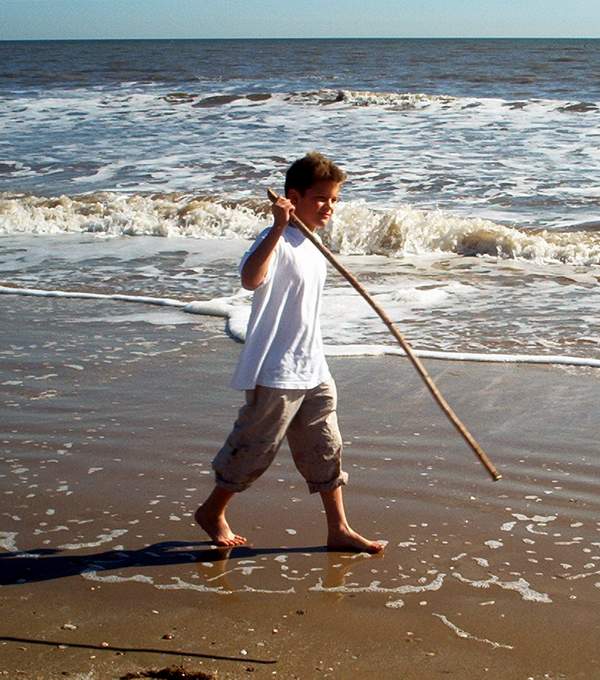
Lee walking in the surf at Crystal Beach. I checked my old blog entries – this was December 29, 2002.
From my blog (I called it an “Online Journal” then), The Daily Epiphany, Saturday, April 22, 2000
Out of Shape
Daingerfield State Park has a beautiful little lake at its center. The deep forest comes right down to the shore making the water look like a little cup of crystal in the greenery. It is lined with little coves covered in the green disks of lily pads. These were blooming with giant white explosions of water flowers. There is a swimming area marked off with a couple of foam buoys and a wooden platform floating out in the middle of the lake.
It was barely warm enough to swim and we spent a good part of the days sitting on the shore or throwing tennis balls for the Giant Killer Dog, while Nick swam. He would paddle out to the platform and climb up, pace back and forth, shivering in the cool breeze, until he was rested enough to swim back. He is so skinny it hurts sometimes to look at him.
The concession was open for the weekend and they had paddle boats for rent. Somewhere I have a photo album with a picture of a paddle boat I rented as a child. It was an elaborate all-steel affair, two torpedo shaped pontoons, a high bench seat, bicycle style pedals and a chain transmission to a real, visible paddle and a steering wheel. Today, paddle boats aren’t as well made. They are plastic and foam, bright molded-in colors, low-slung, a bent pipe with wooden pedals directly driving a completely enclosed paddle assembly. They are steered with a little pipe sticking up behind the seats.
Still, Nick wanted to rent one, so we paid our seven dollars and put on the ubiquitous red life vests, tattered and moldy-smelling, marked S, M, or L with fading Magic Marker. The boat was a bit too big for him and too small for me, making for inefficient propulsion. I am in such bad shape, my legs burned terribly as soon as we moved away from the dock. I could only paddle for a few minutes before I’d have to give up and take a rest. It took us what seemed like a long time to move across the lake (although we never completely used up our rented hour).
The breeze was light and the lake was even more beautiful from the center. Nicholas said, “Everything is blue or green, the only colors.” He pointed out how tall the forest was, it undulated into the distance, up from the water, and you couldn’t tell where the real hills were or where the trees were simply tending to be taller or shorter. Ducks and geese floated around looking for handouts. Black turtles sunned themselves on logs in the center of the lily pad seas, plopping into the water to swim away, sticking their heads out to peer out at us if we paddled too close.
When we looked down into the calm water with the sun at our backs we could see shafts of yellow and green extending downward, pulsing with the gentle waves. The trick of perspective made the water look miles deep, cold and clean.
Even with my legs burning, the sun heating up the uncomfortable clumsy life jacket, it was a pretty nice way to spend an hour and seven dollars.
When we reached shore, the kids shot some baskets at a hoop above the parking lot and hooted around in the playground for awhile. I examined some immature bald cypress trees growing in the shallow water and decided, for sure, that I was given an incorrect tree for my front yard. It is definitely a pine and not a cypress.
Nick, Candy, and The Giant Killer Dog drove back to the campsite while Lee wanted to walk back with me along the trail – a bit of a shortcut as opposed to the park road.
“Let’s race them!” Lee shouted, and took off along the trail.
It’s true, that in your mind’s eye, you see yourself as you were when you were… maybe sixteen years old. I could see myself running down that trail with Lee. I couldn’t do it. A few hundred yards and I was out of breath, side splitting, slowing to a walk. The MiniVan made it back to the campsite before Lee and I did.
“Remember to look up at the stars and not down at your feet. Try to make sense of what you see and wonder about what makes the universe exist. Be curious. And however difficult life may seem, there is always something you can do and succeed at. It matters that you don’t just give up.” ― Stephen Hawking
Sign on storefront.
Scientist
Craig walked down the hall past a room full of kids playing video games, one of them asked him, “Are you really a scientist?” “Yes, I suppose I am.” “See, I told you,” said Tom, Craig’s son. “What kind?” asked his friend. “Well, I’m a chemist… do you know what that means?” “Nope.” “Well, I study what happens when you mix things and heat them in certain ways, sort of.”
That’s not a very good answer, he knew. There isn’t a very good way to explain what chemistry is to a kid that doesn’t know what a chemical is. Thinking about it later, Craig should have explained what kind of chemist he was and what his job entailed. He sat down in the TV room to chill for a minute and think about science and what it meant to him.
On the tube was a little documentary. They showed some stuff about Stephen Hawking. Hawking was talking about understanding black holes, the Big Bang, the moment of creation. He talked about grasping the way the universe came into being and said, “and then we will know the mind of God.”
Then, after a commercial break, the documentary changed to a story about a guy that made robots, little six legged guys that imitated life in strange ways. The robot guy said something about robot making maybe being a man thing – men can’t make life, so robots are as close as they get. He discounts that, though, because there are more women than men in his lab.
Craig thought about the creating life thing. Then he thought about Frankenstein. Then about science and knowledge and curiosity.
Creating life isn’t the thing. Any moron can create life. The folks in the trailer park seem to be creating plenty. Or think about a pumpkin seed. Is it alive? Two pumpkin seeds, one live, one not – can you tell the difference?
The important quest isn’t to create life, but to understand it. To somehow know more about the miracle, how it works, where it is going.
“A girl should be two things: classy and fabulous.”
― Coco Chanel
“Where justice is denied, where poverty is enforced, where ignorance prevails, and where any one class is made to feel that society is an organized conspiracy to oppress, rob and degrade them, neither persons nor property will be safe.”
― Frederick Douglass
Fountain at Galatyn Park, Richardson, Texas
From my blog (I called it an “Online Journal” then), The Daily Epiphany, Tuesday, December 01, 1998
Illustrated Woman
After work, Candy took the kids down to the school for some function, I drove off to the club to work out.
Now, don’t think I’m exercising as an excuse to watch other people. I’m serious about this, I’m working hard; but the first part of my program is to do a half hour on the stepper. There isn’t much to do for thirty minutes except look around at the other folks working out.
I try to do the stepper right. I stand as upright as possible, keeping my weight on my feet, using my hands only for balance. A couple machines down some guy was flopped over forwards, resting his chest on the control panel, his arms on the handles. His entire weight was supported there, his blue spandex-covered butt stuck up in the back. I don’t think he’s gets any exercise that way and it must be killing his back.
In front of the steppers, past the always-busy treadmills is a warm-up area, where people do their stretching. This club is a pretty serious place, not a lot of socializing, and although there is a wide variety of customers, a lot of serious bodybuilders hang out there.
I couldn’t help but notice one woman on the mat bending herself around, stretching. Tall and thin, almost gaunt, wearing wire-rim glasses and medium length blonde hair pulled into a ponytail. She wore white shorts, a gray athletic bra-top, black workout shoes and weightlifting gloves. She must have had some Yoga training, those were serious stretches. She stood, feet far apart, and keeping her torso and legs straight and locked bent over and touched her cheek to the inside of each calf. Then she rolled around and tapped the back of her head on the padded floor between her feet.
What caught my eye wasn’t her extraordinary flexibility, it was her tattoo. Not a small, ordinary tattoo, but a big design. She was illustrated. The illustration was a vine, I guess a climbing wild rose. I thought I could make out red blossoms and maybe even thorns among the thick green leaves. It started as a spiral tendril between her breasts and grew into an arc over her left shoulder. It continued down her back in undulating curves and finally ended… well, I couldn’t really tell exactly where it ended.
I’m not ordinarily a big fan of tattoos, but I liked this one. It looked like a real part of her, not some odd design picked out in a drunken haze and buzzed in on an ankle in a whim. Jeez, though, that must have hurt. A good two or three square feet of skin under that electric needle.
I finished my stepper and walked some laps to cool down before I started working on the weight machines. Down on one end of the club is the free weight area where the serious bodybuilders work. One woman was sitting, doing concentration curls with a dumbbell. The biceps on her arm literally popped out like a hank of thick cords, you could almost see every muscle strand. She was like a sculptor in flesh. The sculptor and the sculpture too. Slow carving with sweat and plates of steel.
For the most part, the men down there had unmarked skin. I had never noticed before, though, that over half of the women had large complex tattoos. Abstract patterns across their bellies. One had a tiger looking out of its lair drawn across her shoulder blades.
I thought back to something I heard on TV as a child, during the Olympics, I suppose it was the 1968 games in Mexico City. The announcer was talking about the East German women’s swimming team. She said something like, “The Communist Bloc girls have a big advantage over the American women because they have a weight lifting program. American women won’t lift weights because they are afraid they will look too manly .”
Thirty years ago. It’s odd that I remember that from so long ago; I have no idea why it made such an impression. Things have changed a bit since then, though, haven’t they.
And now, a piece of flash fiction for today:
Relax Said the Nightman by Melissa Llanes Brownlee
“No live organism can continue for long to exist sanely under conditions of absolute reality; even larks and katydids are supposed, by some, to dream. Hill House, not sane, stood by itself against its hills, holding darkness within; it had stood so for eighty years and might stand for eighty more. Within, walls continued upright, bricks met neatly, floors were firm, and doors were sensibly shut; silence lay steadily against the wood and stone of Hill House, and whatever walked there, walked alone.”
― Shirley Jackson, The Haunting of Hill House
The Headlines Screamed, Baithouse Disappears
From my blog (I called it an “Online Journal” then), The Daily Epiphany, Wednesday, January 16, 2002
Spreading north
I’m continuously amazed at how the Dallas-Fort Worth Metroplex is vomiting itself northward, spreading across the cotton fields and mesquite scrublands like a virulent plywood fungus.
The houses are enormous, stuck right up next to each other, and virtually identical. Cheap brick veneer, wooden shake shingles, monstrously large bathrooms, two-story entryways, full of odd corners of wasted space.
The streets are full of smells of cut pinewood, wet concrete, and hot asphalt. Even in the winter, the Texas sun beats down unhindered by any trees to bake the brick and kill the fresh-laid sod. You never see any residents out on the streets or sidewalks – I have to imagine there are sometimes children behind the eight foot wooden privacy fences enclosing a tiny polygon of ex-prairie – sometimes I can see a piece of custom-made play equipment sticking up over the fence. The only humans ever visible in the new suburbs are crews of Mexican workers cutting grass or building walls. Sometimes they have leaf blowers – though I have no idea where any leaves would come from.
The eternal question is, of course, who lives in these things. Did a crack dealer and his stripper girlfriend save their money, get married, clean up and move to the suburbs? Did some guy invent the battery-powered inside-the-egg egg-scrambler and spend his millions gleaned from late night television advertisements on that brand spankin’ new house and shiny black SUV?
As long as I have a want, I have a reason for living. Satisfaction is death.
—-George Bernard Shaw
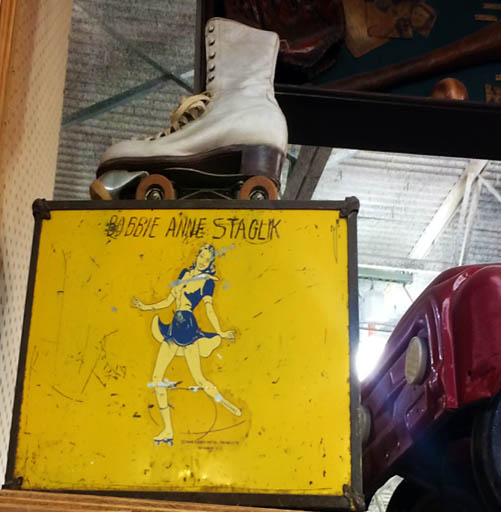
Display at main Half-Price Books, Dallas, Texas
Fingertips
Why is it that I can never remember to file the goldenrod copy to the archive folder and send the yellow to accounting?
My fingertips have an aversion to Manila folder thin cardboard, little tabs, alphabetical order.
There was a time when I looked forwards to phone calls something good exciting and sexy usually now it’s only someone wanting something plain and difficult.
I feel the beesting at my belt the rattling shock of the vibrating pager, interrupting lunch or thought, or peace, even when I’m not wearing it.
Piles of paper, drawers of folders carefully ordered, fall inward, collapsing, smothering, horrible weight. Chaos, where is your freedom? feeling, surprise, standing naked in the rain.
I see the mind of the 5-year-old as a volcano with two vents: destructiveness and creativeness.
—-Sylvia Ashton-Warner
Lee at the playground
Energy
Kidsquest Playground
What energy source drives them? Spinning tops arms and legs akimbo, rushing up down and around. bark chips, pea gravel, stained wood
High pitched cries the wet smell of recent rain orange-topped billow iron-headed clouds flee lightning-cored to the east and north.
Climbing ropes and old tires wooden construction – simple pine becomes what fairy castle, little brothers what fearsome enemy to flee and chase, caught and escape again.
Areas of damp sand paper cup molds careful tunnels volcano hills populated by plastic soldiers and Lilliputian dreams shaped by tiny Giant Hands.
Slides straight and slides twisting swings and chains pumping pumping jumping moment of childhood weightlessness come down to earth too soon.
Parents in shorts with that bent over head stare watch down at toddlers grubbing on the ground making sure the stuff stays out ‘o their mouth.
One Mississippi, Two Mississippi, Keep your eyes closed! Three Mississippi, Four Mississippi, Five, Six, Seven, EightNineTen, Ready or Not! Here I Come!
“and everything burned in blue, everything a star”
― Pablo Neruda, 100 Love Sonnets
Unique Forms of Continuity in Space, by Umberto Boccioni, Cole and Blackburn, Dallas, Texas
Burning Fuse
Life is a spark – a flame traveling along a long fuse. The spark can’t see very far ahead. Until right before the very end it doesn’t have any idea of how much fuse is in front of it – only how long is the trail of ashes left behind.
The process of life is burning the hopes and dreams of the future – burning a raw fuse and leaving behind the ashes of memories. Hopes and dreams converted into memories. A one-way process… inevitable. This is the tragedy of the world. How much would we give if we could do the opposite? Convert memories into hopes and dreams. It’s impossible.
And what happens at the end? The fuse doesn’t know. Only that the spark will go out.
“We are all alone, born alone, die alone, and—in spite of True Romance magazines—we shall all someday look back on our lives and see that, in spite of our company, we were alone the whole way. I do not say lonely—at least, not all the time—but essentially, and finally, alone. This is what makes your self-respect so important, and I don’t see how you can respect yourself if you must look in the hearts and minds of others for your happiness.”
― Hunter S. Thompson, The Proud Highway: Saga of a Desperate Southern Gentleman, 1955-1967
C-47 Nose Art, Commemorative Air Force, Wings over Dallas
From my blog (I called it an “Online Journal” then), The Daily Epiphany, Wednesday, March 26, 1997. I used to look at posts from my old blog that were twenty years old. Now… I’m looking at posts I wrote a quarter-century ago.
May I check your oil, ma’am?
I’ve been issued a new lab coat at work. We have to wear flame resistant clothing in the plant, the chemists wear these blue coats instead of uniforms. When mine came it had my name on it. White stitching on a little blue label, “Bill.” The guy who brought it told me that I could cut the label off, but I thought I’d let it be. It’ll help keep the darn thing from getting “borrowed” during the night shift.
I went out to buy lunch, I’m too busy, so I was going to bring it back to eat at my desk. I went out to the little sandwich shop for a “Californian” – avocado, lettuce, cheese, in a pita. It was a nice day, but cool, so I kept my lab coat on. The girl took my order and then said, “The name, it’s Bill isn’t it?” I had a moment of confusion over how she knew my name, suddenly I realized that she read it off my coat. I was yanked back twenty three years, I was a teenager again, working at a gas station, with my first name on my uniform. I looked at the girl behind the counter, she was looking at me with that look, the look you give someone that’s making minimum wage, and will always be making minimum wage.
People used to look at me like that all the time when I was pumping gas. I was in college at the time, only working over the summer or on holidays, but they didn’t know that. I’d usually have school books with me, I’d study between cars, trying to get a jump on the next year. There was a blackboard inside the station, It was usually covered with equations, formulae, but nobody noticed that (or recognized what it was). Occasionally a customer would give me a little lecture, “Son, you need to be thinkin’ about what you’re going to do with your life.” I’d nod my head, ring up their gas (I could gas six cars, remember all six amounts- dollars and gallons, their license tag numbers, and what person went with what car, I’d worked out a mnemonic system, I could gas and charge everyone without asking any questions, only a few people noticed that). Of course I had plans, I was getting an education, this gas station job and its three bucks an hour was a part of it, but only a part.
Of course, after all these efforts, after all my sound and fury, here I am, middle aged, still wearing my name over my breast.
“What is there in our nature that is for ever urging us on towards pain and misery?” ― Mary Shelley, The Last Man
Untitled (Sprawling Octopus Man), by Thomas Houseago
Nasher Sculpture Center
Dallas, Texas
From my blog (I called it an “Online Journal” then), The Daily Epiphany, Tuesday, May 20, 1997
Morning from hell
Last night, driving home, I needed to stop for gas. As I was pulling up to the Texaco a good song (Nightswimming) came on the radio, so I kept driving. I knew I had enough fuel (barely) to get home, I’d buy a tank before work the next day. This was an omen of am impending morning from hell.
Candy and I left for work at the same time; she had the kids to take to school. I walked out to the piece of crap Mazda and turned the key. Nothing. Now this weekend the battery in the van had gone out (as my faithful readers know) and I had left my jumper cables in the van in case the problem was more than the battery. So out of my car I dashed, across the two inches of leftover stormwater covering my yard, around the house in time to see the van’s taillights make the curve from the alley into the street.
No problem, I have a battery charger in the garage; I’ll hook it up to the Mazda, charge the battery, get on my way, worry about what’s wrong later. But the extension cord was too short, it wouldn’t reach halfway across the front yard. My neighbor was leaving for work, she asked if she could help, but she had no jumper cables either. I thought for a minute and realized I have a longer cord up in the attic. I had left it there from the last time I was working on the cable TV. The end of the cord was hanging down in the attic access panel in the garage, I climbed up, grabbed it, and pulled. About two feet of cord came down along with a big wad of fiberglass insulation, but no more.
So I pulled out the aluminum ladder and leaned it up to the hatch. Our house is of the more or less modern construction using roof trusses. Instead of grand beams supporting the roof, leaving plenty of headroom; a truss of 2×4’s fastened by metal plates in fractal triangles fill the attic. Cheap, light, strong, and almost impossible to move through. I’m way too old and fat for the climbing, kneeling, crawling needed to get through the maze of beams. But I had no choice.
I tied a snakelight to a beam and fought my way through; realizing too late that I needed to turn a corner and the flashlight wouldn’t reach. So back I crawled to get the light, twisting it around my neck. I clambered through the dirty labyrinth around the corner clear back to the end of the house where I’d tied the cord to an old lamp I once used to work on the coax; it was caught on some wires. I untied it and began to work my way back to the garage.
I had to stop for a minute to get a grip. I was so frustrated – late for work, a dead car – claustrophobic, stuck in the dirty, hot, cramped attic trying to get a stupid extension cord that may or may not help me get my car started and get to work. I shook for a minute with emotion and paranoia. I felt completely alone; there was no one to help me. It was still only seven thirty in the morning and I had had all the crap I could stand.
But as always, I realized I had no other choice, and continued crawling through the beams back to the garage hatchway, flashlight around my neck, pulling the extension cord with me.
I set up the charger on the long cord and attached it to the terminals. The ammeter showed the battery was low, it quickly went to fully charged; and the car still wouldn’t start. Something wasn’t right. I removed the terminal clamps from the battery and noticed that the posts were black and corroded. Back to the garage for some sandpaper which I tore in little strips. I used these to clean the terminals and the clamps. Presto, the car starts right up. I called in to say I’d be twenty minutes late and drove to the gas station and on in to work.
All day I couldn’t shake that moment of fear and panic in the attic:
Car problems again, I had already lost half a day on Candy’s van, now another battery, those zinc plates soaking in sulfuric acid, the same thing again.
The terrible time pressures, I have to be in to work. I want to sit down, take some time off, I don’t want to go. I’m behind, the clock’s ticking, I can’t be late – primal, childhood images, late late late, sent to the office, walking through the quiet, empty hall, feeling – no being – out of place, looking in through that little window at the kids seated the teacher talking – the dreaded walk from the door to my seat.
Discomfort. Cramped, fighting back the welling claustrophobia, dark, dirty, hot, I have to balance on the edges of the ceiling beams or I’ll crash through the sheetrock, itchy – a world of fiberglass insulation. How did I get here? What the hell am I doing? What sort of terrible mistake is this?
Alone, lonely. Nobody to call. Candy has patients, she can’t leave work, isn’t even there yet. I have to figure this out myself. Once, I want somebody else to handle something. Take care of it. Fix it for me.
And the screwup guilt. Why did I oversleep? Why didn’t I get gas last night? Why didn’t I get jumper cables for the van and Mazda? Why did I leave this extension cord up here in the attic? Why haven’t I cleaned those terminals on a periodic basis?
So I’m a screwup; that’s why I’m being punished . But this is only a random bad day isn’t it? The fates or whatever; are they , out to punish me? To extract payment for every transgression? Or is this paranoia? That’s not important, nobody cares if you’re paranoid. What really matters is if they really are out for you or not, paranoid or no.
Another day.
So lets belly up to the bar, mates. Get that cute barmaid to pour us up some mugs of icy foam. We’ll put our arms on each other’s shoulders and Maria’ll play a tune on the Farfisa while we stamp out the rhythm with our feet on the peanutshells and sing:
We losers, we happy losers – hear us saying; time is passing us by, there’s a party ’round here somewhere, we can hear the band playing
but we’ve lost our invitations. The stuck in the muds, the if only ifs, the full ‘o lamentations.
Don’t laugh now, ’cause I’ll wager you are one too. Don’t ya worry, there’s plenty of room, Plenty of floor, plenty of lager






 Bill Chance