The Girl With the Dragon Tattoo – 2011

Christmas evening is always a good time to go out to a movie. Candy, Lee and I went to see a family feel-good film,  The Girl With the Dragon Tattoo.

I had not read the book(s), nor seen the 2009 Swedish film (though I have now started the Swedish version on Netflix and have put the books in my queue, after I get some required reading done).

I very seldom go out to see films anymore – which is odd, since that was a big part of my life for so very long. One reason is that the very act of moviegoing has changed. Like so much of modern life it has become a mass phenomenon, an act of the herd instinct. The local mall grandstand seating googleplex is now the standard – thousands run through the entertainment machine – extracting money and delivering a couple of hours of tepid entertainment.

It has been so long this is the first time I noticed that the refreshment stands manned by local teenagers are being replaced by large touchscreens attached to complex vending machines.

Movie going to me has been a solitary, or at most an activity for two. Sitting there in the dark, peering at the screen, lost in the story. Now, the place is always packed for the hot new release and people keep streaming in after the film starts, wandering up and down the steep stairs looking for nonexistent empty seats. Their travels are framed by a constellation of smart phones lit up by audience members getting in some text messaging while the movie begins.

I even miss the endless silly static advertisement cards that used to rotate by during the interminable wait before the film started while cheesy music played over some pitiful portable picnic player. They were blurry slides for local clothing stores, Italian restaurants, or used car dealers. Now, the advertisements that run during the slack times are loud, slick and have better CGI production qualities than the movies themselves.

At any rate, I get over my old-fartedness and the movie starts. And it was good.

The direction, acting, cinematography was all top-notch. As you have been hearing, Rooney Mara as Lisbeth Salander is a revelation. I think the whole film can be summed up in the split-second look on her face when Mikael says to her, “I want you to help me find a killer of women.” Daniel Craig does not have as splashy a part – but his performance is every bit as important – and much more subtle. His character has an inner core of goodness wrapped in a clock of confusion. Mikael Blomkvist is smarter than he thinks he is – and that is hard to portray.

I think I approached the film in the right frame of mind. The book is a complex whodunit and there is no way they can get all that stuff up on the screen. So I paid no attention to the “mystery” at all. The guilty person is one of a set of candidates, and it didn’t really matter to the emotional heart of the film which one it was. I simply let the detectives detect.

She is watching the detectives
“Ooh, he’s so cute”
She is watching the detectives
When they shoot, shoot, shoot, shoot
They beat him up until the teardrops start
But he can’t be wounded ’cause he’s got no heart

Long shot at that jumping sign
Invisible shivers running down my spine
Cut to baby taking off her clothes
Close-up of the sign that says “We never close”
He snatches at you and you match his cigarette
She pulls the eyes out with a face like a magnet
I don’t know how much more of this I can take

She’s filing her nails while they’re dragging the lake

—-Watching the Detectives, by Elvis Costello

After a school of red herrings swim by and the hairy McGuffin fades from importance, there will be a revelation, the hero will be rescued at the last moment, and a twist that you should have seen coming (I did) will appear as if by magic. All boilerplate. We’ve been here before. Hitchcock did it best a half-century ago, so let it fall from the screen.

What makes the film work are the characters and the relationships – and that is what I concentrated on. The film is really not about a locked-door murder on an ice-bound island, it is about Lisbeth Salander and her struggle, against all odds, to become a human being. You see, they tell you that in the English title. The Swedish title (Män som hatar kvinnor – “Men Who Hate Women”) is more descriptive about the plot, but not the heart, of the story.

A couple quibbles… First, I really didn’t like the scene that played over the opening credits. It was slick, expensive, and visually impressive – black oil-like viscous CGI liquid splashing all over everything while Karen O sings her version of Zepplin’s “Immigrant Song” – but it had nothing to do with the rest of the movie. The music was fine – I would have preferred simply wintry shots of bleak Scandinavian scenery. That would have fit the mood better. What we saw was simply showing off.

The movie struggles with the awkward construction of the novel. The two main characters don’t even really meet (well, one meets the other, but not the other way around) until the film is about half over. This works fine in print, but feels disjointed on the screen. You want to say, “Just get on with it.”

There at the end too, the international finance part, seemed a bit out of character to me. I understand the revenge motive, and the desire to help out “my friend,” but still, it was a little much. Again, I thought it was showing off.

Still, quibbles aside, I enjoyed the film and look forward to the books, and the Swedish version, and the sequels, and the Swedish sequels, and the inevitable spinoffs (HBO series?)….

Oh, the motorcycle was way cool.

This long trailer contains a few spoilers. Also, watching it right after seeing the movie – I can notice the subtle censoring of the trailer (necessary). I have a rule, I don’t wear clothing with words on it (I don’t like being an unpaid advertisement – well, except for my employer… they give me shirts for free) but the black t-shirt Lisbeth Salander is wearing when Mikael first shows up at her place has a pretty cool saying on it (it’s blotted out in the trailer).

WordPress Blogs on the film (a small selection, here’s how to find them):

New Book of Mountains and Seas

One of the hidden gems down in the Dallas Arts district is the Crow Collection of Asian Art.

I was working in the Cotton Exchange building in downtown Dallas (the Cotton Exchange is gone now – they blew it up a couple years after I left) while they were building the skyscraper tower of the Trammell Crow Building. The construction site was visible from the windows of our office suite. I watched the steel skeleton climbing up and up – watched the workers scrambling over the latticework of girders. I watched the granite and reflective glass being raised and affixed to the building’s outer skin.

There is always a connection with a building that I watched go up. Since I saw it stretched out in time from the inside out – I feel I know all of its secrets. I know the shortcuts the architect made to get the outer shape. I saw the ventilation, plumbing, and elevator shafts carved out of the interior.

At one time the walkway around the base of the building contained an amazing collection of European sculpture and was one of my favorite places. The sculptures have been removed – and there is the promise to replace them with Asian pieces.

Behind the office building, on a floor level below, facing Flora street across from the Nasher Museum is the Crow Collection of Asian Art. Trammell and Margaret Crow have been collecting Asian art since the 1960’s and built the museum under a pavilion in back of the office tower. It is a small but effective museum, and a welcome addition to the other museums and performance venues in the Dallas Arts District – helping the area move towards the tipping point of becoming a well-known destination. In addition to exhibiting pieces from the permanent collection – the Crow Museum has developed a reputation for hosting impressive visiting temporary exhibitions.

Oh, one more thing. Admission to the museum is free.

A free museum is viewed in a different way than one that you have to pay to get in the door. Instead of making a big deal out of it – preparation and anticipation – you tend to simply wander in and take a relaxed view of the wonders within. I like it.

I have a confession to make – this time that I walked in to the museum it wasn’t because I had heard of some revelatory amazing exhibition or even that I felt the need for peaceful contemplation of a thousand years of artistic production.

I had to pee.

There are not a lot of public restrooms in a big city downtown. The homeless tend to take over and destroy any facilities that are open to anyone. So I decided to duck into the Crow Museum to use their restroom. Since I am a person that likes to meet their obligations – even though I should be able to use the bathroom and leave, there have been many times I’ve been to the Crow to see their art and not used the bathroom – I felt obligated to at least take a quick walk through the galleries.

I walked into the big room past the gift shop and found that it had been emptied. There was a bench in the center of the room and three digital projectors were shining on a long wall. The effect was that of a widescreen film being shown in a bare wooden room – very clean and beautiful. One guy was sitting at one end of the bench – I walked over and sat down on the other.

At first the film was showing some credits and bits of poetry while the soundtrack played some electronic music. It was very peaceful, but not much too it and after a few minutes I wondered, “Is this it?” It was an interesting thought – all this space and technology used to simply throw a few words on the wall along some jangling sounds. I began to wonder if it was an elaborate joke.

It wasn’t. I had come in right at the credits at the end. Soon the presentation looped back to the beginning and the real show began.

This was a film by Qiu AnXiong, an artist from Shanghai. The exhibition was called Animated Narratives and consisted of a two-part video installation called New Book of the Mountains and Seas, along with paintings associated with it.

The video started with a hand drawn animation of waves on the sea, then moved to a pastoral landscape. Soon, a farm appeared to grow on the land like an organic thing. The farm quickly grew to a village and then a walled town. Civilization continued to grow in an organic way – with fantastic animals taking the place of oil rigs, pumps, transportation, and warcraft. Everything grew and grew, with many scenes reminiscent of recent events, but warped into a strange surreal organic landscape. The Middle East (or something resembling it) is ravaged by oil production, the terrorists strike in a version of 911 even more surreal than reality, and then the inevitable disaster and destruction obliterated everything.

The film was in black-and-white and appeared to be animated ink drawings. After walking around and looking at some of the paintings, it was clear that it is actually paint on canvas. The artist overpaints as he photographs his work and generates the animation that way.

I really enjoyed the film and its presentation. You really have to see in it in its carefully constructed widescreen format to appreciate the work, but if you can’t make it to the Crow:

Here’s an online version (wait through the ads). I’m not sure how long this will be online.

Here’s another link to a version of the piece.

If that link doesn’t work for you, here’s about three minutes of the film. This section is near the end, and it does not do justice to seeing it live.

I enjoyed it enough to come back a couple days later and take a look at part two. This is another widescreen video set up in the mezzanine two floors higher up in the museum. It’s another animated work, this time concerning mad cow disease, genetic programing, biowaste disposal, environmental catastrophe and man’s eventual fate among the stars.

I couldn’t find the whole thing, but here is a bit of part two.

Don’t be afraid to wander into a museum, more or less unplanned. I should do this more often. I should not be so cheap to be afraid to do this even when I have to pay for it.

The Debt (2007)

I saw the trailers for the new movie “The Debt” and wanted to see it. After I saw this review, I really wanted to see it:

The movie has Helen Mirren in it, so it has to be good.

…. Movie Trivia Question…. What movie does Helen Miren’s character (one of my favorites) say, “Anall Nathrach – Uthvas Bethuud -Dothiel Tienve,” or something like that? (who knows how that is spelled?) If you don’t know the answer to this one, shame on you.

The only problem is that I don’t get to the theater much anymore – we’ll see what I can do.

But, in the meantime, Peggy found out that there is an earlier version of “The Debt” – It is an Israeli production done in 2007. I wanted to see it, see it before I go to the recent one.

So I checked Netflix… no luck. Not in the libraries… not even on Amazon… the disk doesn’t seem to be available in a North American version (though that will probably change soon, with the remake out).

So, when you can’t get something anywhere else… you go to the getting place. I did, and I got it. Had to go back for the subtitles.

If the remake is half as good as the original, it is a great movie. A movie that makes you think… and a tense little thriller to boot.

I’m not sure how faithful the remake is to the Israeli original – but from the trailers it looks pretty darn faithful. The scar on Helen Mirren’s face is more pronounced than in the original (I like the subtlety here, actually) but it’s in the same spot.

I wonder if the actual method of capturing the Nazi (I’m not giving anything away here) in the remake is the same as the original? It’s… umm… original and very harrowing. I don’t know if they will have the courage to put a scene like that in a mainstream Hollywood production. I’ll have to see….

Ooops. I just rewatched the review above carefully. It is the same. What do you know. This truly is the best of all possible worlds.

So you go see it… the original or the new one… whatever. Think about it.

High-Rise

“Later, as he sat on his balcony eating the dog, Dr Robert Laing reflected on the unusual events that had taken place within this huge apartment building during the previous three months.”

—- Opening Line, High-Rise, by J. G. Ballard

It’s getting tough to decide on the next book to read. While I was considering the options I came across a few interesting articles comparing and contrasting the fiction of the late J. G. Ballard and the recent London riots.

I have been a fan of Ballard’s work for decades. It didn’t take me long to decide to dive in, especially when I discovered a copy of one of his classic works, one that I had never read, High-Rise.

About forty years ago, Ballard wrote three hyper-real novels about the relationships between society, technology, urban life, disaster, sex, and the monsters of the id. I have already read the excellent, interesting, and underrated Concrete Island and the infamous Crash. So I decided to complete the hat trick.

There are three minor characters and also the hero of High-Rise. The point of view circulates among Dr. Robert Laing, a medical school instructor that seems to be fleeing from the responsibilities of being a real doctor – Richard Wilder, a maker of documentaries that becomes overly attached to his video camera, and Anthony Royal, an architect that lives in a luxurious penthouse apartment.

These three live in a single forty-story condominium tower. It’s a brand-new building, part of a series of skyscrapers going up in a half-built complex on the outskirts of London. The three characters are representatives of the three classes in the building… that map out to their height above the ground. Wilder is from the second floor, where the lower classes live – although in this case they aren’t actually poor – they are made up of airline pilots, stewardesses, and television workers – wealthy enough all in any other setting. The middle part of the building, the largest section, from the shopping mall on the 10th floor up to about the swimming pool on the 35th and are represented by Laing- all professionals and respected members of the city at large.

Only the super-wealthy business tycoons occupy the top floors. At the very apex is Royal, who is credited with designing the building, though in reality, he only did the children’s playground on the roof and a few elevator lobbies.

The hero, the true protagonist is the building itself. It has a life and evil all its own… you can almost hear it speaking.

Pretty quickly, it becomes obvious that all is not right in this brave new world. There are obvious frictions between the three classes which spill out when the children of the lower floors try to use the swimming pool on the upper levels. The real trouble begins with parties. The innocent hedonism quickly becomes out of control, with plenty of illicit sex and bottles being thrown from balconies.

The three classes start out going to war with each other, complete with raiding parties and running battles over which group controls the important resources, such as the elevators and the garbage chutes. This is no Marxian polemic, however, and the three groups quickly lose their cohesion until it’s floor against floor, then small groups of apartments, then… well… let’s just say, things don’t end well.

Which, of course, is how I like it. I really enjoyed the book.

Ballard writes about such horrific descents into evil and madness with an almost geometric precision and symmetry. The building is designed just so, the cars are parked in a careful order, the balconies are arranged so everyone can see into everybody else’s’ business… once you think about it, the horrific events are not only understandable, they are inevitable.

It’s the sort of thing someone that had spent his childhood in a Japanese prisoner of war camp might have written.

A film is being made of the book, done by the director that made Cube – an interesting horror film with the best idea for efficient use of a simple filming set ever made.

He seems to be doing the film with the tower set in the middle of an ocean. I’m not sure if that is a good choice – one of the most interesting aspects of the novel is how, as things became worse and worse in the high rise, the residents became more and more insular, until they became, by choice, completely cut-off from the outside world. Also, in the book, there are more high-rises going up. Laing watches the one in front of his apartment being finished and then occupied. Near the end, he sees power going off in several floors over there – it is implied that the same horror that has infected his tower is spreading to the next. Set the building out in the ocean and you lose these details.

But… little concern. I’ll still go see the thing. I doubt if they can come up with a way to give it a happy ending. At least I hope not.

The Lion, the Witch, and the Wardrobe

I have been on a quest for nice writing spots around the Dallas Fort Worth Metroplex.

Saturday afternoon, I pounded out some paragraphs at White Rock Coffee on Northwest Highway, one of my favorite locations, but began to suffer from caffeine overdose and hunger, so I headed West.

My destination was the newish Whole Foods at Northwest and Highway 75. This neighborhood is an old stomping ground for me, but it has changed completely in the last few decades. Five years ago, we headed down early one morning to watch them implode a giant glass office building from the parking lot of the NorthPark shopping center across the highway. I have seen some implosions in my day, but the sight of the mirrored glass rippling from the shockwaves in the dawn’s early light before tumbling down in a cloud of dust and glass shards was something to behold.

Implosion

The implosion of North Park Three

And now, like a concrete Phoenix, a massive tony development has risen from the rubble. There are a series of condominium towers surrounding a vast expanse of parking garage. There is retail scattered across the pavement on a couple levels – with the huge Whole Foods grocery store at the center.

I knew they would have wifi and something to eat, so I headed there to get a salad and tea (eleven dollars) and sit out front, enjoy the colors of the crepuscular sky over the sea of parked cars.

But on the way there, I drove behind another one of my favorite old stomping grounds, the big Northwest Highway Half-Price books. I don’t go there as much since I started reading so much on my Kindle – but it is still a great monument to bibliophilia. As I passed behind, I saw a huge section of the parking lot coned off with a large semicircular inflatable something rising up. One side of the thing was pure white and very reflective. It didn’t take much thinking to figure out what it was.

I had read that they were showing free movies in the parking lot this summer, and today must be one of the days. I checked in at Whole Foods and surfed over to the Half-Price website and found that, sure enough, The Lion, the Witch, and the Wardrobe would be showing at eight forty-five.

The timing was perfect. I finished my food, finished my writing, and moseyed across Greenville just as the movie was beginning.

I had seen it before and wasn’t a huge fan, but the price was right. Like everyone that has had kids in soccer, I carry a variety of folding chairs in my trunk, so I was prepared. There was a crowd there, not a huge crowd, but more than a few. Looking around I was the only person that actually went to the film alone.

LWW

Oh, the kids were so cute....

It was hot, but not too hot. The city put out a lot of noise, but the organisers had a powerful sound system, so we could hear the movie. Every now and then a headlight would illuminate the screen, but it went away soon enough.

I was able to get into the movie. Always up for some Tilda Swinton.

The Ice Queen

Tilda Swinton wasn't as cool as she was in Orlando, but she was the best thing in the movie.

I had a good time. Unfortunately, this is the last movie of the year on the schedule, but I bet they will do it again next summer. I think I’ll be there.

Lisa Picard is Famous

Lisa Picard is Famous

A scene from Lisa Picard is Famous. She is calling in sick because she has a callback for an Advil Commercial. She is all about the method acting.

A long time ago I walked by the television and saw a bit of a movie that caught my eye. It was a mockumentary, done by Griffin Dunne (I always think of him as the actor that ruined  After Hours) about a struggling wannabe actress named Lisa Picard. The film was Lisa Picard is Famous and I always wanted to see the rest of it.

Today it came around in my Netflix little read envelope. I wasn’t in the mood for a lighthearted romp, but I didn’t have anything else to do so I watched it.

It has its interesting points – mostly concerning the Helsenberg Uncertainty Prinicple and how it relates to documentary film-making – also how uncomfortable and awkward famous actors can look when walking through poorly-thought-out cameo appearances. Don’t ask to borrow Sandra Bullock‘s cell phone when you’re at the post office, by the way.

I did like Lisa Picard’s first big break – a starring role in a controversial racy Wheat Chex commercial. This brought out the usual Pornographic Cereal protesters and a lot of welcome publicity but in the end, the only result was a rash of unofficial websites with her head poorly photoshopped onto naked bodies and an unfortunately narrow typecasting into sexy breakfast scenes.

Most of the film was a series of embarrassing failures while her gay friend reached a comparative level of success with his excruciatingly earnest off-off-broadway one-man tighty-whitey show.

I guess what I’m saying is that the film as a whole did not have the charm of the random little snippet. I suppose that is true for a lot of one-joke mockumentary films – it’s hard to maintain the attitude for the whole shebang. Especially if the amps don’t go up to eleven.

I’m also getting a little exhausted with films proclaiming how difficult the life of an actor is. Try being a chemist sometime. Your margin for error is a lot lower and you don’t get to go to any parties.

All in all though, it wasn’t a total loss. Watching the end credits, I discovered the key grip was named Radium Cheung – what a great name! I have to write that one down and use it on a character sometime.

Cloud Atlas

Where are you right now?
In my hut in my back garden in West Cork.

 Where do you write?
Here, at my desk; in my notebook, in an armchair; on planes.

How do you write?
By recording in words the scenes that are workshopped and staged in my imagination.

What keeps you writing?
My addiction to it.

Who do you write for?
Me, and the rest of the world. Nobody else.

—- David Mitchell, in Untitledbooks

Cloud Atlas

Cloud Atlas

What is my favorite book? What is the best book I’ve read? —These are unanswerable questions. There are so many and my opinions at the very top shift over time like sands in the wind or shadows in my memory.

Still there is an upper stratum. This is occupied by fossilized memories of hours, days, sometime years spent poring over pages of labyrinthine structure, subtle metaphor, and deep, thick, and complex prose. This is the land of Pynchon, the landscape of Mason & Dixon, V, and, most of all Gravity’s Rainbow. That book took me twenty five years to read… and it was worth every second.

It is the land of Moby Dick, of Infinite Jest, of House of Leaves.

It is the land of Cloud Atlas.

If you catch me at the right time, I’ll tell you that Cloud Atlas is the best book I’ve read. Other times I’ll tell you it’s my favorite book. Rarely does a single entity spend time in both positions – as far as I’m concerned, that’s great praise.

David Mitchell’s Cloud Atlas is a complex book and one with a unique structure – but it’s not hard to read. The structure is very carefully planned out, logical, and executed with panache – not like the shambling monstrous recursive story of Gravity’s Rainbow.

The book is a collection of six different story threads. The first half of the book the stories are half-told, in chronological order. It starts in the South Pacific, in 1850, in a sort of Melvilish, three-stooges version of a whaleless Moby Dick. The story then jumps to 1931 where a bankrupt musician tries to scam himself back into a state where he can feed himself and love again. Then it leaps to California in the 70’s with a thriller set at a nuclear plant.

At this point the stories move into the future, starting with a publisher trapped in a nursing home. We then switch to a dystopian future where the clones begin to rebel. Finally, we arrive in the unknown distant future where mankind has thrown off or lost its technological skin and is back to telling tales around the campfire.

Here, the book turns and goes back, working its way through the same stories again for their second half denouement, in reverse order, until we are left back in the 19th century South Pacific.

What is the connection between these diverse threads? You will have to read the book to find out.

Does this scare you? Will you avoid this tome in favor of the newest vampire mystery? Shame on you. Or not. Whatever. It is definitely the kind of thing you will like, though, if you like that kind of thing.

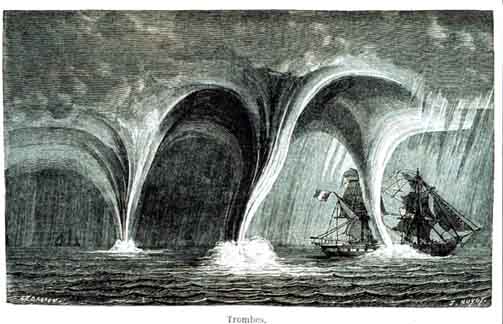
Waterspouts

Waterspouts

Why am I bringing up this odd and complicated book now? No matter how interesting?

I used to read a lot of movie reviews. I always tried to keep up on what was happening in the world of cinema. This was ruining my viewing enjoyment, however. I wanted to get back to that world of simple pleasure when I sat in front of the silver screen (or cathode ray tube [or light emitting diode (or liquid crystal semiconductor [ or tiny cloud of plasma-induced noble gas])]) unknowing about what was going to happen next. So I stopped reading movie reviews until after I had seen a film. I stopped following the pages outlining what was coming out next from what director.

Still, I stumble across bits of information now and then. That Interweb-thing is good for that, isn’t it?

This week I discovered that they are making a big-time, big-budget movie of Cloud Atlas.

It is one of the books that, when I was reading it, I thought, “This thing would be unfilmable.” Apparantly, someone disagrees with my assessment.

It seems it will have two directors – The guy that directed “Lola Rennt” will do the story threads that are set in the past and the Matrix director(s) will do the stuff in the future.

Big time actors too, Tom Hanks, Halle Berry, Hugo Weaving, Susan Sarandon, Jim Broadbent… It appears the actors will be playing more than one character spread across time (have to get your money’s worth out of Tom Hanks).

Well, I’m not sure how this will all play out – the book is unfilmable, really – but it will be interesting. I do hope it gets made. If it is good, it might be great. If it fails, it will be a glorious failure.

Storm

Storm

(whet your appetite) Short works online by David Mitchell

Hot Patootie Bless My Soul

Well, the other day I requested the Rocky Horror Picture show on my Netflix Queue so Lee could see it. It didn’t take long to get here.

Rocky and Lee

Rocky and Lee

Sunday evening Candy, Lee, and I settled down in Club Lee to watch the DVD on his 65 inch screen. It was the first time had seen the movie outside of a theater.

I have seen RHPS at least fifty… maybe as many as a hundred times. The first time was in 1976  – not long after it came out. I saw it at the student union at the University of Kansas. It was getting some buzz, but it wasn’t the midnight sensation it became only a few years lately. Somebody mentioned it was an up-and-coming avant-guarde item, so a few of us trooped on down. I was unimpressed and barely remember anything about the film. It was definitely the “British” version though, because I do remember the final song “Superheroes” – which was cut out of the American midnight releases because it was considered too much of a downer ending. At any rate, I guess I can feel a tiny bit of pride at being one of the first folks to actually see the silly thing.

Then, over the next few years, I saw the movie, like everybody else, in the movies at the midnight shows. Over and over again. Sprayed with squirt bottles, huddling under a newspaper, pelted with toast, yelling at the screen, screaming at the dancers in their costumes.

Then, later, in Dallas, I was able to see the stage version a couple of times. Back then I was expert at finding plays in small theaters and scoring front-row seats. The actor playing Frankenfurter sat in my lap at one show. His leather jacket reeked terribly – the show had been running for weeks and I’m sure it hadn’t been washed. These plays were influenced by the success of the movie and used plants in the audience to yell out the proper lines at the proper times.

My favorite has always been, “Oh no, not Meatloaf again!” at the horrific climax of the dinner scene.

Lee seems to have liked the movie – though it is pretty stupid out of its native habitat (though I had forgotten how actually good the music was).

My Favorite.

Let’s do the time warp again.

The Lookout

When everything is as confused as I am right now, something as simple as a Netflix disc queue becomes a source of mystery as the red mailers arrive with unknown contents. I tear open the paper and see the Tyvek envelope with its circular burden and read the little label. I have no idea why this has been sent to me – no memory of searching and adding – though I must have done it.

Tonight was “Lookout” – the great plains noir starring Joseph Gordon-Levitt as a night janitor in a bank. He suffers from dain bramage – sort of Memento light.

I didn’t really want to watch it all that much – I have plenty else to do. But I can’t send it back unwatched (that is something not to be done – a modern day sin) and I need to clear my queue so I can get my next disc. This weekend, I ordered The Rocky Horror Picture Show and moved it to the top of the queue. This is not for me, of course. I have seen Rocky Horror… maybe a hundred times. I have never seen it on video – I’m sure it’s pretty crappy on the small screen, it has to been seen in a crowded midnight theater. I’ve seen the live stage play twice- which is the best way to see the thing.

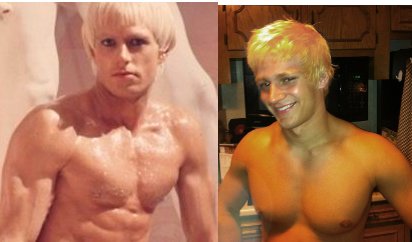
I ordered it for Lee. He has decided that blondes have more fun, and has bleached his hair. It started out sort of a ruddy gold, but with some work he has it at platinum now.

Several people have told him he looks like Frankenfurter’s Monster, Rocky, from the eponymous musical horror picture show extravaganza. He’s never seen it and asked me what was up, so I’ve ordered it.

Rocky and Lee

Rocky and Lee

I don’t know… do you think there’s a resemblance here?

At any rate, on to The Lookout. After all the weird crap I’ve been seeing lately, it was nice to see a well-done, professionally made, predictable noir thriller.

I remember when I was a youngster and living in Kansas we used to, every now and then, drive out, way out in the country after midnight along the arrow-straight sand roads between the wheat fields with our lights out. These roads are gridded out every mile from there to hell and back. You could speed up until you could feel the tires starting to float on the sand the tiniest bit. The drive would then be as smooth as fresh asphalt.

The thing was, once you turned the lights out your eyes would get used to the dark and you could see everything clearly by moonlight. The colors were gone, everything was a ghostly blue, a silent timeless featureless landscape screaming by.

We could see good enough to see if there was a combine stalled in the road, I guarantee it.

It was cool… except for one thing. I always had the fear, though the odds against it were astronomical, that someone might be doing the same thing, coming in the other direction.

Anvil!

Anvil!

Anvil!

I’m trying to get everything back into some sort of order (back? Like it ever was) but it seems hopeless. I did a twenty minute idea Pomodoro and easily filled four pages with stuff I need to get done. Even my Netflix is out of control. I have disks hidden under unread books and my queue is so overgrown and unwieldy that when a movie arrives, I stare at it in confused disbelief, wondering why I put it on there in the first place. Still, if it comes, I have to watch it… don’t I? I mean, you can’t just send them back, unseen.

Anvil

Album Cover - Metal to Metal by Anvil

So today, I sat down at my secretary and watched a Netflix disk, Anvil! The Story of Anvil. I have no idea why I requested it, no memory of where I heard of it, but it was good…. very good.

It is a documentary of a heavy metal band, Anvil, formed by two nice Jewish boys from Toronto. They had a tiny taste of some hair band success in the eighties, are cited as an influence on some much more successful bands such as: Megadeth, Slayer, Anthrax, and Metallica, but otherwise have been toiling in obscurity (not relative obscurity… but real obscurity) for thirty years since.

Lips, the lead singer, delivers catering packages to small schools, the drummer, Robb Reiner (not Meathead… not the director) appears to work odd construction jobs – the other, less senior band members seem to be homeless people.

Forever the victim of bad breaks and worse management – they take vacation and go on a disastrous five week tour of Europe culminating in a grand concert in Transylvania where 174 people show up at a venue that holds ten thousand. They never get paid for anything. Their dysfunctional tour manager completely wrecks everything up – but back home after the tour they still play at her wedding reception (of course, she married the guitar player).

The movie plays a lot like a real-life Spinal Tap – even to the “Big in Japan” finale. There are some obvious nods to the famous mockumentary – if you look close, there is even an amp that “Goes up to eleven.”

They struggle in futility. Lips says, “One of the main reasons that Anvil hasn’t really gone anywhere is that our albums have sounded like crap.” Robb Reiner shows some talent as a painter. I like his landscapes… but am not a big fan of his study of a German ledge toilet. Lips tries to make an extra buck as a telemarketer at a shady sunglass company run by a fan of the band, but he realizes he is too nice a person to sell crap over the phone.

What makes Anvil! worth watching is the human side. These two guys have stuck it out for thirty years of abject failure in their careers and still are hammering it out. I think the point where you realize the humanity contained in the story is the scene where Lips’ older sister loans them the money to go to England and record their thirteenth album. It’s really their last chance, she knows it’s going to fail (and I’m sure she can’t really spare the cash) but she also knows she has no choice. He may be a loser heavy metal wannabe in his fifties… but he’s still her little brother.

Anvil Album Cover

Anvil Album Cover