“Our heads are round so thought can change direction”
― Allen Ginsberg

Woman listening to a poetry reading by Mad Swirl – at The Independent Bar and Kitchen, Deep Ellum, Dallas, Texas
“Our heads are round so thought can change direction”
― Allen Ginsberg
Woman listening to a poetry reading by Mad Swirl – at The Independent Bar and Kitchen, Deep Ellum, Dallas, Texas
“God creates out of nothing. Wonderful you say. Yes, to be sure, but he does what is still more wonderful: he makes saints out of sinners.”
― Søren Kierkegaard, The Journals of Kierkegaard

Bob Crawford, in Easy Slider restaurant, Deep Ellum, Dallas, Texas
We ran into Bob Crawford, arguably the most famous man in East Dallas while getting a bite in Easy Slider in Deep Ellum. It was good to see him back.
Many think the ultimate enemy of the bicycle is the car, but the reason cars are so dangerous is simply the false perception that our streets and roads are made for driving and nothing else. It is the complete dismissal, whether conscious or unconscious, of any other practical way of getting around. It is the lack of understanding that cars are one of many forms of transit, albeit by far the most popular one. It is the lack of respect for bikes as a viable vehicle for traveling to where you need to go.
…
Seeing bikes as transit machines, like cars only slower, is an important mental hurdle for non-cyclists to overcome. It is no different than choosing a pickup over a sedan, a sub-compact versus an SUV, or a luxury car over a coupe. It is simply another way to get from point A to point B, with advantages and disadvantages. The sooner we all accept this fact, the sooner we will begin to open our eyes to a multitude of transit options for our cities that truly benefit everyone.

Stylish bike rider, French Quarter, New Orleans
When drawing a street on a plan, you start with a centerline and offset it on two sides. It is quite literally a line connecting two places with a certain width. This width is almost always determined by an engineer who is trying to match an algorithm for how many lanes are needed for the cars that will drive down this street, and how many utilities will need to comfortably fit here. Instead, we should think about streets and all their various uses—as places for gathering, finding our way, living more healthfully, with nature, and with each other… and build from there.
For portrait photographer Robert Kalman, the art form is all about people. He has traveled across continents to document people in their environments – whether the streets of New York and Paris or rural villages in Central America. And one timeless Nicaraguan village has, over the years, continued to draw him back.
Since his first trip to Larreynaga, Kalman has returned at least five times to document the lives of villagers there.
Right now, I am really enjoying the new Twin Peaks on Showtime. I am a huge fan of David Lynch – but if you say you hate everything he has done, I can’t argue with you.
It’s not easy to rank every Lynch movie, not least of all because of the director’s cult status. Lynch fans aren’t playing around, and debates can get heated (especially when it comes to Dune or Fire Walk With Me). And then there’s the fact that every movie is so jaw-droppingly different. There are certainly recurring “Lynchian” elements, which David Foster Wallace defined as “a particular kind of irony where the very macabre and the very mundane combine in such a way as to reveal the former’s perpetual containment within the latter.” More obviously, there are certain visuals you look for when watching a Lynch movie: red lips, a hallway, long red curtains, a highway at night, a stage lit by a single light. Then there’s that feeling that comes with certain Lynch movies—and lingers; that unshakable dread of being in someone else’s dream (or nightmare).

Downtown Dallas, Texas
I worked downtown in the early 80’s and one of my favorite things was watching the skyscrapers go up. I was surprised at how different the construction methods were for different buildings.
The 1980s gave Dallas most of its skyline, with more towers popping up than any time in the city’s history.
Along with the tall buildings came a few tall tales.
Three skyscrapers from Klyde Warren Park, Dallas, Texas
Striking new skyscraper in downtown Dallas will be tallest in decades
“The new Amli tower is significant because it will create a true mixed-use environment at the highest level,” said Johnny Johnson with Cushman & Wakefield, which markets the Fountain Place offices to tenants. “The energy sparked by the pedestrian experience will enhance the complex and everything that surrounds it.
“It will make Fountain Place an even more desirable place to be.”
Downtown Dallas
What an interesting idea! Wish I had thought of that.

Dancers, Arts District, Dallas

Reflecting Pool, Arts District, Dallas, Texas
(Click To Enlarge)
Hall has spearheaded a new endeavor titled “Through the Lens: Dallas Arts District.” It’s a call to action for “professional photographers, emerging photographers, mid-career photographers and students” to start snapping their shutters. The goal is to create a body of work that captures “a glimpse of the life and vibrancy that defines the Dallas Arts District,” whose 20 square blocks will become the photographers’ tableau.
Bethan, Patio Sessions, Arts District, Dallas, Texas
I’m a big fan of three of these: The Soda Bar, Bar Belmont, and 32 Degrees. Gonna have to check out the rest.

Dallas Skyline from the Soda Bar on the roof of the NYLO Southside hotel.

The view of Downtown Dallas from the Belmont Hotel

The view of the Belmont from the porch at Smoke – Dallas skyline in the background.
“Every morning was a cheerful invitation to make my life of equal simplicity, and I may say innocence, with Nature herself.”
― Henry David Thoreau, Walden

Modern Art Museum of Fort Worth
“Stories, like people and butterflies and songbirds’ eggs and human hearts and dreams, are also fragile things, made up of nothing stronger or more lasting than twenty-six letters and a handful of punctuation marks. Or they are words on the air, composed of sounds and ideas-abstract, invisible, gone once they’ve been spoken-and what could be more frail than that? But some stories, small, simple ones about setting out on adventures or people doing wonders, tales of miracles and monsters, have outlasted all the people who told them, and some of them have outlasted the lands in which they were created.”
― Neil Gaiman, Fragile Things: Short Fictions and Wonders
Monolithic Dome Institute, Italy, Texas
“Freedom is just chaos with better lighting”
― Alan Dean Foster, To the Vanishing Point

Waco, Texas
“If not us, who? If not now, when?”
― John F. Kennedy

Near the grassy knoll, Dealey Plaza, Dallas, Texas
“Grown-ups never understand anything by themselves, and it is tiresome for children to be always and forever explaining things to them”
― Antoine de Saint-Exupéry, The Little Prince

Window sign, Tattoo Parlor, Deep Ellum, Dallas, Texas
“We should meet in another life, we should meet in air, me and you.”
― Sylvia Plath

Chico y Chica de la Playa, sculptor: Victor Salmones, McCasland Sunken Garden, Dallas Arboretum

Frack Yea!
Nowadays we are constantly confronted by a screen demanding our attention; whether this is our computers, phone, television sets or a film, street ads or an ecosystem of ads, becoming distracted is easier than ever before, and the attention required to solve a problem or to find innovative solutions is a rare and fleeting moment.
However, this might be precisely because we are used to feeling guilty for not being more creative, or because we do not pay more attention: according to large body of research, creativity is more closely connected to daydreaming and dispersion than with the intellectual effort of paying attention.
A masterpiece of universal knowledge, the Tarot is a mirror that looks directly into the eye of the soul.
In the cult film, The Holy Mountain, filmmaker, poet, and magician, Alejandro Jodorowsky said: “the Tarot will teach you how to create a soul.” Did all of us not come into the world with a soul, our own, ready-made? But to ask about the nature of the soul in these abstract terms is a theological and speculative problem and one toward which little progress can be made. But to ask any individual and earthly soul is to open a door onto a passage along which the Tarot will help one to move.
The Tarot is an ancient game of cards, most likely created, anonymously, during the 14th century. Jodorowsky doesn’t hesitate to call it “an encyclopedia of symbols.” But during the 20th century, the use of Tarot became popular thanks to the printing of massive editions of the Tarot of Marseilles or the Raider-Waite deck. These cards don’t have fixed meanings, but are related and visually associated with one another based on the lives and experiences of both the seeker and the reader (i.e.; the person doing the reading).
It seems as if the decline in the cellular health of muscles associated with aging was “corrected” with exercise, especially if it was intense, says Dr. Sreekumaran Nair, a professor of medicine and an endocrinologist at the Mayo Clinic and the study’s senior author. In fact, older people’s cells responded in some ways more robustly to intense exercise than the cells of the young did — suggesting, he says, that it is never too late to benefit from exercise.
from Wikipedia
In fiction, a MacGuffin (sometimes McGuffin or maguffin) is a plot device in the form of some goal, desired object, or other motivator that the protagonist pursues, often with little or no narrative explanation. The specific nature of a MacGuffin is typically unimportant to the overall plot. The most common type of MacGuffin is a person, place, or thing (such as money or an object of value). Other more abstract types include victory, glory, survival, power, love, or some unexplained driving force.
The MacGuffin technique is common in films, especially thrillers. Usually the MacGuffin is the central focus of the film in the first act, and thereafter declines in importance. It may reappear at the climax of the story but sometimes is actually forgotten by the end of the story.
The use of a MacGuffin as a plot device predates the name “MacGuffin”. The Holy Grail of Arthurian Legend has been cited as an example of an early MacGuffin, as a desired object that serves to advance the plot. In the 1929 detective novel The Maltese Falcon, a small statuette provides both the book’s eponymous title and its motive for intrigue.
The name “MacGuffin” was originally coined by the English screenwriter Angus MacPhail, although it was popularised by Alfred Hitchcock in the 1930s, but the concept pre-dates the term. The World War I–era actress Pearl White used weenie to identify whatever object (a roll of film, a rare coin, expensive diamonds, etc.) impelled the heroes, and often the villains as well, to pursue each other through the convoluted plots of The Perils of Pauline and the other silent film serials in which she starred.
Almond-milk drinkers, for years, have exhibited a special sort of self-righteousness, based equally, I think, on the impressive nutritional profile of their chosen nut and the hardship they endure to consume it. (It is thin, weak, balky in a foamer—this from personal experience.) Soy milk, the most fiercely partisan might have argued, was for people who enjoyed having their endocrine systems disrupted, or who worked for Monsanto, while cow milk was for gluttonous torturers. Coconut, hazelnut, cashew, hemp milks: distant sirens, usually encountered in punitively expensive hand-pressed blends at places that consider macchiatos tacky and instead offer cortados and Gibraltars. Even as the big companies got involved and managed to make almond milk creamy, thick, and voluminous, the movement kept its puritanical edge.
Doug Denton runs Homeward Bound, Inc. — a non-profit agency that helps people overcome addiction. He said most panhandlers aren’t homeless, and that giving them money is likely just enabling their addictions. “Just assume you’re buying drugs for them,” Denton said. He says in many cases there are people controlling the corners, adding, “The organizers of these rings are supplying the drugs and alcohol and reaping the profits.”
These are the rules.
I didn’t make them up. These are inalienable truths, a part of the divine spectrum of unquestionable constants that hold our universe together.
There might be those who feel deeply offended by some of the wisdom contained herein but I must insist that it is firmly in your interest to understand that the rules are quite infallible and with the greatest of respect, if you take issue with this doctrine, you are very probably a massive douchebag and it is thus all the more important that you adhere to these rules lest you reveal yourself as such.
Now read and obey.
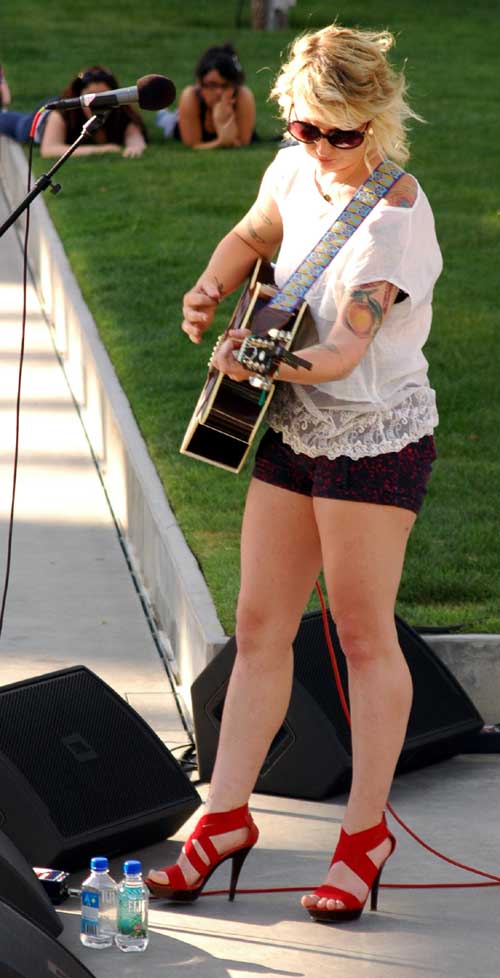
Madison King at the first Patio Session

Deep Ellum

Courthouse Jam
Denton, Texas
(click to enlarge)


 Bill Chance