For a long time, I have had an idea that, when I was silly enough to say it out loud, received more than its share of derision. The idea is a theory I have had concerning the question of why has crime been falling so much in the last decades.
The most famous (and controversial) theory is from Steven Levitt and John Donohue – the Freakonomics Guys – they famously said that the drop in crime is mainly caused by the legalization of abortion in the US – so on and so forth. It is an unsettling theory, though a compelling one.
So I read Freakonomics and found the book to be well written and thought provoking, though I found their crime theory to be not completely convincing. I may have missed something, but they did not close the loop in my mind – they showed plenty of correlation, but failed to indicate causation.
Correlation does not prove causation. Never. Read and remember that. Very few people – and nobody that appears on television understands that simple sentence.
So, what is my theory of the drop in crime?
I have been saying for a long time (years before Freakonomics) – as a matter of fact, I predicted it before it really happened – that a large portion of the drop in crime can be attributed to the removal of lead from gasoline.
You see, for years I have had access to sampling results (some done by me) of lead in both emergency release situations (spills, waste sites, industrial pollution) and in background, “ordinary” locations and situations. Over those years I was repeatedly shocked at the elevated levels of lead near highways, especially in urban areas, and at the blood levels of lead in animals and humans living in those areas. These levels were regularly high enough to expect noticeable behavioral effects. While leaded gas was still being sold, I would talk about how I thought that was one environmental hazard that was more serious than anyone thought (and there were plenty of others that I thought/think weren’t/aren’t so important). When the tetraethyl lead anti-knock compounds were formulated out, I felt that we would see an improvement in behaviors from the populations (mostly densely urban) that were exposed to lead residues fairly quickly as the lead dissipated.
Nobody took my rantings seriously. I had one female actually tell me, “That is so typical, for a man to blame something like the drop in crime on some chemical.”
That didn’t make me very happy. My response was, “Well, I think it’s a typical response for a man that has had years of access to large numbers of lead sampling results and who has studied the dangers and effects of lead exposure to the point of doing work on protecting elements of the population from the possible effects of heavy metal poisoning.” She gave me a very dirty look and refused to talk to me any more. It’s no surprise I could never get dates.
I’m not sure what she objected to… was it my refusal to acknowledge the importance of unicorn saliva in making the world a friendlier place? This was before the Freakanomics book, so it couldn’t be a pro-choice argument (though that is a slippery slope point of view that nobody, rightly so, would touch with a ten foot pole). Now, I am very aware of the, “If all you have is a hammer, everything begins to look like a nail,” principle, and concede that there is a lot of that at work, but that still doesn’t mean I was wrong.
You see, unlike most people, and all pundits and politicians, I looked at the data first – then made predictions from the data – then tested this against reality. There is a huge difference between operating from data first and doing what the pundits and polititians do – coming up with some cute theory that you can benefit from and then searching for data to support it.
Well, now that I’ve dug up all this dirty laundry, what is the point? Someone else has come up with the same idea. After all these years, the New York Times has come out with an article that agrees with my point about lead levels and crime rates. There is a detailed study (pdf) that talks about it.
Of course, there are already articles that contradict the theory and I’m sure we will see more.
So what do I think? More importantly, what do I think now?
As I get older and more experienced (and more muddled and more cranky) I have come to believe the disconnect between correlation and causation is even more tenuous that we think. I’m beginning to believe that it is only under very rare and special conditions that we can even talk about causation in a confident way. I think that chaos (mathematical chaos, not philosophical chaos) rules almost everything we do – feedback loops, sensitivity to initial conditions, and unintended results are the norm, not the exception. I think that we are fooling ourselves when we think we know what’s going on and why.
So after decades of thought and research – why do I think that the crime rate is decreasing? Is Batman a transvestite? Who knows? I think the important thing is to remember to enjoy the walk in the evening that we were too scared to take a decade ago.
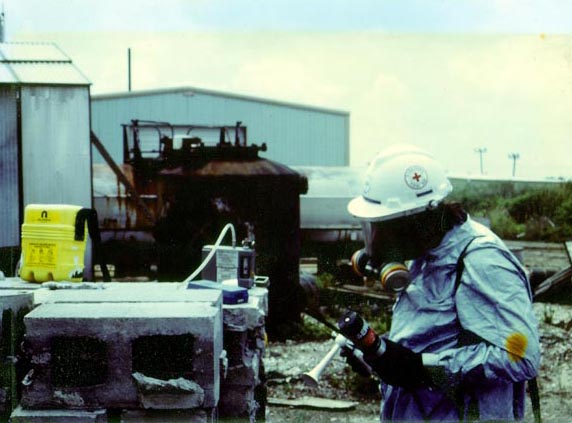
Here is an old, bad photo of me working on the Geneva Superfund Site in South Houston, Texas. Circa 1983. It's no wonder I couldn't get dates.


 Bill Chance