Cloud Atlas

Where are you right now?
In my hut in my back garden in West Cork.

 Where do you write?
Here, at my desk; in my notebook, in an armchair; on planes.

How do you write?
By recording in words the scenes that are workshopped and staged in my imagination.

What keeps you writing?
My addiction to it.

Who do you write for?
Me, and the rest of the world. Nobody else.

—- David Mitchell, in Untitledbooks

Cloud Atlas

Cloud Atlas

What is my favorite book? What is the best book I’ve read? —These are unanswerable questions. There are so many and my opinions at the very top shift over time like sands in the wind or shadows in my memory.

Still there is an upper stratum. This is occupied by fossilized memories of hours, days, sometime years spent poring over pages of labyrinthine structure, subtle metaphor, and deep, thick, and complex prose. This is the land of Pynchon, the landscape of Mason & Dixon, V, and, most of all Gravity’s Rainbow. That book took me twenty five years to read… and it was worth every second.

It is the land of Moby Dick, of Infinite Jest, of House of Leaves.

It is the land of Cloud Atlas.

If you catch me at the right time, I’ll tell you that Cloud Atlas is the best book I’ve read. Other times I’ll tell you it’s my favorite book. Rarely does a single entity spend time in both positions – as far as I’m concerned, that’s great praise.

David Mitchell’s Cloud Atlas is a complex book and one with a unique structure – but it’s not hard to read. The structure is very carefully planned out, logical, and executed with panache – not like the shambling monstrous recursive story of Gravity’s Rainbow.

The book is a collection of six different story threads. The first half of the book the stories are half-told, in chronological order. It starts in the South Pacific, in 1850, in a sort of Melvilish, three-stooges version of a whaleless Moby Dick. The story then jumps to 1931 where a bankrupt musician tries to scam himself back into a state where he can feed himself and love again. Then it leaps to California in the 70’s with a thriller set at a nuclear plant.

At this point the stories move into the future, starting with a publisher trapped in a nursing home. We then switch to a dystopian future where the clones begin to rebel. Finally, we arrive in the unknown distant future where mankind has thrown off or lost its technological skin and is back to telling tales around the campfire.

Here, the book turns and goes back, working its way through the same stories again for their second half denouement, in reverse order, until we are left back in the 19th century South Pacific.

What is the connection between these diverse threads? You will have to read the book to find out.

Does this scare you? Will you avoid this tome in favor of the newest vampire mystery? Shame on you. Or not. Whatever. It is definitely the kind of thing you will like, though, if you like that kind of thing.
Waterspouts

Waterspouts

Why am I bringing up this odd and complicated book now? No matter how interesting?

I used to read a lot of movie reviews. I always tried to keep up on what was happening in the world of cinema. This was ruining my viewing enjoyment, however. I wanted to get back to that world of simple pleasure when I sat in front of the silver screen (or cathode ray tube [or light emitting diode (or liquid crystal semiconductor [ or tiny cloud of plasma-induced noble gas])]) unknowing about what was going to happen next. So I stopped reading movie reviews until after I had seen a film. I stopped following the pages outlining what was coming out next from what director.

Still, I stumble across bits of information now and then. That Interweb-thing is good for that, isn’t it?

This week I discovered that they are making a big-time, big-budget movie of Cloud Atlas.

It is one of the books that, when I was reading it, I thought, “This thing would be unfilmable.” Apparantly, someone disagrees with my assessment.

It seems it will have two directors – The guy that directed “Lola Rennt” will do the story threads that are set in the past and the Matrix director(s) will do the stuff in the future.

Big time actors too, Tom Hanks, Halle Berry, Hugo Weaving, Susan Sarandon, Jim Broadbent… It appears the actors will be playing more than one character spread across time (have to get your money’s worth out of Tom Hanks).

Well, I’m not sure how this will all play out – the book is unfilmable, really – but it will be interesting. I do hope it gets made. If it is good, it might be great. If it fails, it will be a glorious failure.

Storm

Storm

(whet your appetite) Short works online by David Mitchell

The Lookout

When everything is as confused as I am right now, something as simple as a Netflix disc queue becomes a source of mystery as the red mailers arrive with unknown contents. I tear open the paper and see the Tyvek envelope with its circular burden and read the little label. I have no idea why this has been sent to me – no memory of searching and adding – though I must have done it.

Tonight was “Lookout” – the great plains noir starring Joseph Gordon-Levitt as a night janitor in a bank. He suffers from dain bramage – sort of Memento light.

I didn’t really want to watch it all that much – I have plenty else to do. But I can’t send it back unwatched (that is something not to be done – a modern day sin) and I need to clear my queue so I can get my next disc. This weekend, I ordered The Rocky Horror Picture Show and moved it to the top of the queue. This is not for me, of course. I have seen Rocky Horror… maybe a hundred times. I have never seen it on video – I’m sure it’s pretty crappy on the small screen, it has to been seen in a crowded midnight theater. I’ve seen the live stage play twice- which is the best way to see the thing.

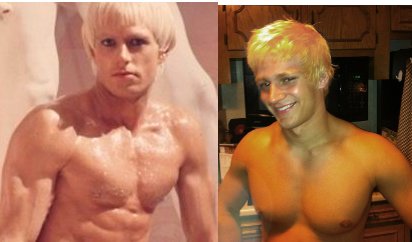
I ordered it for Lee. He has decided that blondes have more fun, and has bleached his hair. It started out sort of a ruddy gold, but with some work he has it at platinum now.

Several people have told him he looks like Frankenfurter’s Monster, Rocky, from the eponymous musical horror picture show extravaganza. He’s never seen it and asked me what was up, so I’ve ordered it.

Rocky and Lee

Rocky and Lee

I don’t know… do you think there’s a resemblance here?

At any rate, on to The Lookout. After all the weird crap I’ve been seeing lately, it was nice to see a well-done, professionally made, predictable noir thriller.

I remember when I was a youngster and living in Kansas we used to, every now and then, drive out, way out in the country after midnight along the arrow-straight sand roads between the wheat fields with our lights out. These roads are gridded out every mile from there to hell and back. You could speed up until you could feel the tires starting to float on the sand the tiniest bit. The drive would then be as smooth as fresh asphalt.

The thing was, once you turned the lights out your eyes would get used to the dark and you could see everything clearly by moonlight. The colors were gone, everything was a ghostly blue, a silent timeless featureless landscape screaming by.

We could see good enough to see if there was a combine stalled in the road, I guarantee it.

It was cool… except for one thing. I always had the fear, though the odds against it were astronomical, that someone might be doing the same thing, coming in the other direction.

Anvil!

Anvil!

Anvil!

I’m trying to get everything back into some sort of order (back? Like it ever was) but it seems hopeless. I did a twenty minute idea Pomodoro and easily filled four pages with stuff I need to get done. Even my Netflix is out of control. I have disks hidden under unread books and my queue is so overgrown and unwieldy that when a movie arrives, I stare at it in confused disbelief, wondering why I put it on there in the first place. Still, if it comes, I have to watch it… don’t I? I mean, you can’t just send them back, unseen.

Anvil

Album Cover - Metal to Metal by Anvil

So today, I sat down at my secretary and watched a Netflix disk, Anvil! The Story of Anvil. I have no idea why I requested it, no memory of where I heard of it, but it was good…. very good.

It is a documentary of a heavy metal band, Anvil, formed by two nice Jewish boys from Toronto. They had a tiny taste of some hair band success in the eighties, are cited as an influence on some much more successful bands such as: Megadeth, Slayer, Anthrax, and Metallica, but otherwise have been toiling in obscurity (not relative obscurity… but real obscurity) for thirty years since.

Lips, the lead singer, delivers catering packages to small schools, the drummer, Robb Reiner (not Meathead… not the director) appears to work odd construction jobs – the other, less senior band members seem to be homeless people.

Forever the victim of bad breaks and worse management – they take vacation and go on a disastrous five week tour of Europe culminating in a grand concert in Transylvania where 174 people show up at a venue that holds ten thousand. They never get paid for anything. Their dysfunctional tour manager completely wrecks everything up – but back home after the tour they still play at her wedding reception (of course, she married the guitar player).

The movie plays a lot like a real-life Spinal Tap – even to the “Big in Japan” finale. There are some obvious nods to the famous mockumentary – if you look close, there is even an amp that “Goes up to eleven.”

They struggle in futility. Lips says, “One of the main reasons that Anvil hasn’t really gone anywhere is that our albums have sounded like crap.” Robb Reiner shows some talent as a painter. I like his landscapes… but am not a big fan of his study of a German ledge toilet. Lips tries to make an extra buck as a telemarketer at a shady sunglass company run by a fan of the band, but he realizes he is too nice a person to sell crap over the phone.

What makes Anvil! worth watching is the human side. These two guys have stuck it out for thirty years of abject failure in their careers and still are hammering it out. I think the point where you realize the humanity contained in the story is the scene where Lips’ older sister loans them the money to go to England and record their thirteenth album. It’s really their last chance, she knows it’s going to fail (and I’m sure she can’t really spare the cash) but she also knows she has no choice. He may be a loser heavy metal wannabe in his fifties… but he’s still her little brother.

Anvil Album Cover

Anvil Album Cover

Casting the Runes

The other night, I couldn’t sleep, walked out to the living room couch, and switched on the television. Hoping to find something relaxing I cruised the digital cable channels (a bad habit of mine) until I stumbled across a movie about to begin, way up in the five hundreds, that looked interesting.

It was called Curse of the Demon (British title Night of the Demon [better, huh]) and was supposed to be a minor classic of British horror filmmaking. Though it is very British in style, it starred Dana Andrews. Whenever I hear that actor’s name I think of the line from The Rocky Horror Picture Show, “Dana Andrews said prunes gave him the runes, but passing them used lots of skill“. I didn’t make the connection at first.

The Monster from Curse of the Demon

The Monster from Curse of the Demon

Thankfully, the movie didn’t take long to get going; in the first few scenes a man walking down a road at night is pursued by a demon that knocks down some handy power lines and then tears the poor victim to pieces. The final few seconds of the rubber mask looking thing was silly in a late-night television sort of way, but the first appearance of the demon was really excellent and chilling, brilliant.

The movie continued and it was good. Very well done, very British, dated a little, but not too much… just right actually. Exactly what I wanted to see. I was relaxed, watching when something really caught my ears. It was during the mandatory seance/hypnosis scene (Mandatory in all quality black and white horror films) when the man under the trance suddenly shouted out, “It’s in the trees… It’s coming!” It’s always fun when you unknowingly stumble across the source of a sound sample from a familiar and beloved piece of music. That clip, “It’s in the trees… It’s coming!” is, of course, the opening sample from Kate Bush’s Hounds of Love. Greatness.

After the film ended (complete with Hitchcockian maneuvering over a slip of paper in a train compartment and a final appearance of the demon as comeuppance) I was interested enough to do some snooping of my own. I found that the film was loosely based on a short story, Casting the Runes by M. R. James. That, of course, helped me realize that Dr. Frankenfurter’s lyric, “Dana Andrews said prunes gave him the runes, but passing them used lots of skill” was taken from the film/story.

I checked the Richardson Library and found they had a book of James’ short stories with Casting the Runes, so I checked it out. The short story is creepier than the movie, by necessity more trim and compact, with a couple of efficient horrifying scenes (the kid’s party, the mouth with teeth under the pillow). I later found an online version of the story here.

It's in the trees! It's coming!

It’s in the trees! It’s coming!

Late night black and white British horror movie, sampled by Kate Bush for her classic album, referenced in Rocky Horror, inspired by slick little short story sitting on my library shelf – one of the thousands upon thousands of unknown books… in the SF section no less. Now it’s time to go to bed.

A really well done YouTube Video Combining scenes from Night of the Demon with Kate Bush’s Hounds of Love.

Big Man Japan

Another review of a movie you (probably) will never see.

Why do I do this? Everyone in the world is out waiting in line to see the last Harry Potter film (I’ve only read one of the books and seen two and a half of the films) while I’m holed up with my laptop when I should be asleep and here I am watching another WTF stranger than strange bit of Netflix Streaming. The last two movies I’ve seen (and, more important, written about) have been Quintet (a candidate for worst movie ever) and now, Big Man Japan.

I know its a cult hit – but I’ve never met anyone that admitted to actually seeing Big Man Japan. I don’t even know how I came across it – probably fell into some webpage that mentioned that it was on Netflix and I couldn’t resist.

Now, I used to see a lot of film and read a lot of movie reviews. The problem is that too many reviews, especially written ones, simply outline the plot of the film in detail and that ruins the whole thing, doesn’t it? So I quit reading reviews until after I had seen a film. My idea is to go in blind, sit there knowing nothing, my brain an empty vessel to receive the cinematic genius unfettered by previous knowledge or expectation. The only problem is that about the time I decided on this course of action I ran out of money and time and hardly ever get to see anything anymore. Anything except when I lose my mind and stay up all night to watch weird stuff like “Big Man Japan.”

Therefore, I don’t want to talk too much about plot details. It would be interesting to see this film without knowing anything at all. It would be interesting, but you’d be pissed at me because I made you waste almost two hours of you precious life on this weird shit. So I guess, as a public duty, I should provide fair warning.

You see, the first third of the movie is a documentary-type exploration of Masaru Daisato, a middle-aged long-haired Japanese loser. His wife has left him and he scrapes by in a cluttered place eating rice and dehydrated seaweed. He carries one of those little folding umbrellas everywhere. Cryptically, he says he likes the umbrella and the seaweed because, “It only gets big when you want it to.”

Everybody hates this guy, they stare, they throw garbage into his yard, and spraypaint insulting graffiti wherever he goes. His wife has left with his daughter, there is a rusting swing set peeking out from the bags of trash outside his house.

He talks about his job. He makes about 5,000 a month (five thousand what… I don’t know) and wishes he made 8,000. He says that there isn’t as much business as there used to be. Though he doesn’t work much, he can’t travel. He has to be on call all the time. He seems to have a problem with the United States for some reason.

About a half-hour in we find out what his job is. He is a hero. They clamp electrodes to his nipples and shoot thousands of volts into his body and he grows into a huge, hairy, chubby guy with a bad haircut and a piece of pipe for a club. Then he goes out and fights giant monsters.

These monsters are tearing up Japan like Godzilla, except that nobody seems to care much about it and nobody seems to get hurt. The monsters are strange, disgusting, bizzaroids with strangely human faces (one has to keep flipping his combover as he tears buildings up by their foundation). The fights are filmed, but they air on television at two in the morning and the ratings are terrible. His agent tries to find sponsors to plaster advertisements on his chest and back to bring in an extra income – but he is so incompetent, cowardly, and unattractive the sponsors are hard to find and harder to keep.

The Strangling Monster

The Strangling Monster

Okay, this sort of thing goes forward, getting odder and odder (I’m leaving a lot out, trust me), until the final climax occurs and then, I’m warning you about this, the whole thing really veers off into truly WTF (and I don’t mean Win The Future) land. It’s pretty stunning, really. I’ve never seen anything even remotely like this. All through the movie you can’t help but wonder how serious the movie maker is. Is this a somewhat serious exploration of Japanese Culture, Capitalism, Monster Movies, Religious Ceremony, Ramen Noodles, Asian Pop Culture, Ozu, our treatment of the Aged, Reality Television, Fame, Heroism, and many other issues… or is this simply a big joke thrown in our face.

The last part of the film leaves no doubt.

It’s sort of genius, really, in a sort of sick, ridiculous, and annoying way. The only problem is that by that point I had actually come to care about Masaru Daisato. The scene where he takes his pixelated daughter to the zoo is heartbreaking. I wanted him to find redemption. I wanted him to defeat his enemies and win the girl.

And that is what the film ultimately skewers – the viewer’s expectations.

Does watching strange stuff like this stretch the mind, or is it only a lonely excuse for killing some time when I should be sleeping, waiting in line at Harry Potter, or out drinking?

Oh, one last thing. Peggy wrote the other day about remakes. It appears that a Hollywood studio has bought the rights to remake Big Man Japan. Or will it be a reboot?

Big Man Japan

Big Man Japan, ready to transform.

The movie answers one long-nagging question. When the hero grows to monster size, where does his clothes come from? In Big Man Japan it is answered. A trunk with a pair of giant purple nylon underwear inside follows the hero around. Before he is juiced up to giant size, the shorts are raised up by a winch onto two poles and the hero stands inside these, so when he grows, he he attired.