Lisa Picard is Famous

Lisa Picard is Famous

A scene from Lisa Picard is Famous. She is calling in sick because she has a callback for an Advil Commercial. She is all about the method acting.

A long time ago I walked by the television and saw a bit of a movie that caught my eye. It was a mockumentary, done by Griffin Dunne (I always think of him as the actor that ruined  After Hours) about a struggling wannabe actress named Lisa Picard. The film was Lisa Picard is Famous and I always wanted to see the rest of it.

Today it came around in my Netflix little read envelope. I wasn’t in the mood for a lighthearted romp, but I didn’t have anything else to do so I watched it.

It has its interesting points – mostly concerning the Helsenberg Uncertainty Prinicple and how it relates to documentary film-making – also how uncomfortable and awkward famous actors can look when walking through poorly-thought-out cameo appearances. Don’t ask to borrow Sandra Bullock‘s cell phone when you’re at the post office, by the way.

I did like Lisa Picard’s first big break – a starring role in a controversial racy Wheat Chex commercial. This brought out the usual Pornographic Cereal protesters and a lot of welcome publicity but in the end, the only result was a rash of unofficial websites with her head poorly photoshopped onto naked bodies and an unfortunately narrow typecasting into sexy breakfast scenes.

Most of the film was a series of embarrassing failures while her gay friend reached a comparative level of success with his excruciatingly earnest off-off-broadway one-man tighty-whitey show.

I guess what I’m saying is that the film as a whole did not have the charm of the random little snippet. I suppose that is true for a lot of one-joke mockumentary films – it’s hard to maintain the attitude for the whole shebang. Especially if the amps don’t go up to eleven.

I’m also getting a little exhausted with films proclaiming how difficult the life of an actor is. Try being a chemist sometime. Your margin for error is a lot lower and you don’t get to go to any parties.

All in all though, it wasn’t a total loss. Watching the end credits, I discovered the key grip was named Radium Cheung – what a great name! I have to write that one down and use it on a character sometime.

Anvil!

Anvil!

Anvil!

I’m trying to get everything back into some sort of order (back? Like it ever was) but it seems hopeless. I did a twenty minute idea Pomodoro and easily filled four pages with stuff I need to get done. Even my Netflix is out of control. I have disks hidden under unread books and my queue is so overgrown and unwieldy that when a movie arrives, I stare at it in confused disbelief, wondering why I put it on there in the first place. Still, if it comes, I have to watch it… don’t I? I mean, you can’t just send them back, unseen.

Anvil

Album Cover - Metal to Metal by Anvil

So today, I sat down at my secretary and watched a Netflix disk, Anvil! The Story of Anvil. I have no idea why I requested it, no memory of where I heard of it, but it was good…. very good.

It is a documentary of a heavy metal band, Anvil, formed by two nice Jewish boys from Toronto. They had a tiny taste of some hair band success in the eighties, are cited as an influence on some much more successful bands such as: Megadeth, Slayer, Anthrax, and Metallica, but otherwise have been toiling in obscurity (not relative obscurity… but real obscurity) for thirty years since.

Lips, the lead singer, delivers catering packages to small schools, the drummer, Robb Reiner (not Meathead… not the director) appears to work odd construction jobs – the other, less senior band members seem to be homeless people.

Forever the victim of bad breaks and worse management – they take vacation and go on a disastrous five week tour of Europe culminating in a grand concert in Transylvania where 174 people show up at a venue that holds ten thousand. They never get paid for anything. Their dysfunctional tour manager completely wrecks everything up – but back home after the tour they still play at her wedding reception (of course, she married the guitar player).

The movie plays a lot like a real-life Spinal Tap – even to the “Big in Japan” finale. There are some obvious nods to the famous mockumentary – if you look close, there is even an amp that “Goes up to eleven.”

They struggle in futility. Lips says, “One of the main reasons that Anvil hasn’t really gone anywhere is that our albums have sounded like crap.” Robb Reiner shows some talent as a painter. I like his landscapes… but am not a big fan of his study of a German ledge toilet. Lips tries to make an extra buck as a telemarketer at a shady sunglass company run by a fan of the band, but he realizes he is too nice a person to sell crap over the phone.

What makes Anvil! worth watching is the human side. These two guys have stuck it out for thirty years of abject failure in their careers and still are hammering it out. I think the point where you realize the humanity contained in the story is the scene where Lips’ older sister loans them the money to go to England and record their thirteenth album. It’s really their last chance, she knows it’s going to fail (and I’m sure she can’t really spare the cash) but she also knows she has no choice. He may be a loser heavy metal wannabe in his fifties… but he’s still her little brother.

Anvil Album Cover

Anvil Album Cover

Quintet

Some say the world will end in fire;
Some say in ice.
—- Robert Frost

Ok, I’m going to write about a movie you will never see. I can’t really call it a review – the movie sucks so much and in such an interesting and ambitious way that it isn’t really reviewable. I knew it sucked – had known it sucked for decades. That doesn’t mean I didn’t want to see it. That doesn’t mean I didn’t enjoy watching it (Maybe I did, maybe I didn’t).

I’m not sure why I even bothered to watch it. Or why I even bother that it exists. I could write about a fictional movie. You’re not going to see this one anyway – so who cares if it actually exists. If nobody except me sees a movie-does it even exist?

This movie that you aren’t going to see is called Quintet and it stars Paul Newman and is directed by Robert Altman. When I think of science fiction dystopian film making… I always think of Robert Altman. It was made in 1979 – a year after I graduated for the last time.

Quintet

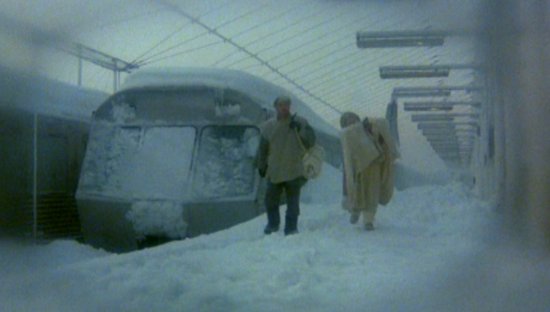
A scene near the begining of Quintet. Don't think I blurred the edges of the frame for artistic effect - I didn't. The whole movie looks like that. They must have used a gallon of vaseline on the lenses.

Back then I used to love to read the movie reviews in Time magazine. I think I enjoyed reading the reviews more than seeing the movies. Remember, this was long before the Internet – information was scant then. You tended to believe what you read.

Now we know better.

So I read the reviews of Quintet. It was a big deal – Paul Newman, Robert Altman, all-star international cast. With all this going for it, with all this at stake, it couldn’t suck. But it did. They didn’t really come out and say that – but we all knew how to read between the lines.

I bought my first television cable in about 1980. That was when HBO was still called Home Box Office. Quintet was on, but I only saw a few minutes of it. It actually looked like something I might enjoy – odd, eccentric, but entertaining in a quirky sort of way.

I was wrong.

Now, all these decades later, we have Netflix – and I’m able to watch this old chestnut in the privacy of my own laptop.

1979 were pre-global warming days – when it was assumed the world would end in ice, not fire. In the film, ice has taken over and the world is about to freeze solid. Everyone has given up and is waiting around to die. Paul Newman arrives from the wilderness – the prototypical outsider of the dystopian tradition – with a young pregnant wife. This should be a big deal – but nobody cares about anything. They go on playing this game, Quintet, and the losers get slaughtered and literally fed to the dogs.

ext for the image, e.g. “The Mona Lisa”

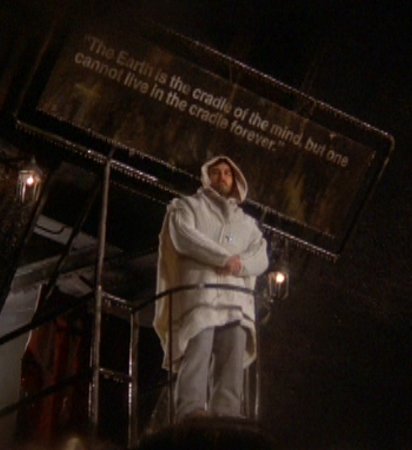
"The earth is the cradle of the mind, but one cannot live in the cradle forever." What the hell does that mean? I suspect very little.

The only interesting character is killed off thirty minutes in.

The move has a languid pace and an interesting frozen broken down look – but in the end, nobody gives a damn about anybody.

So why should we?

Another scene from Quintet

Paul Newman and Fernando Rey enjoying a hearty drink together. At least the beer is cold.

Kick-Ass and Gregor Samsa

The other evening I finally found time to watch the 2010 movie Kick-Ass on Netflix streaming.

I’m not going to write a review of it, though I did enjoy the film. It’s the kind of thing you will like if you like that kind of thing.


I’d like to talk about a bit of the film, a single scene, and why it’s there.

This all has to do with believability – with generating the proper suspension of belief in the viewer. It’s a real problem for a writer. If he’s writing about vampires, or magic, or little prepubescent girls who massacre criminal goons like the rest of us swat flies; you have to find a way to get the reader/viewer to buy in to your own little personal fantasy.

An example – many, many years ago I took a (useless) fiction writing class in college. I wrote a character sketch modeled on a person that I knew well. The other members of the class rejected (rightfully so) my work because it, “wasn’t believable.” I objected to their rejection, explaining, “But.. but it has to be believable, it’s true!”

I didn’t understand the difference between believability and truth (the class was useless because it didn’t explain this to me, I had to figure it out myself a decade or so later). That’s the big advantage non-fiction has over fiction – non-fiction simply has to be true… it doesn’t have to be believable. Fiction, on the other hand, is always a pack of lies, but it has to be believable lies. That is much more difficult than simply telling the truth.

The key to believability is to make a deal with the reader right up front. If you tell your audience immediately, at the very beginning, then they will willingly suspend their disbelief and go along with you. They will gladly accept all the blood-drinking, invisibility spells, and jet-packs with Gatling guns, even though they know it is impossible in the real world, as long as you have told them this is what you are going to do. Be honest, be upfront, and they will gladly go along for the ride.

The best example of this?… easy, Gregor Samsa. You know, Kafka, The Metamorphosis, one of the greatest opening lines in all of literature.

As Gregor Samsa awoke one morning from a night of uneasy dreams he found himself transformed in his bed into a gigantic insect.”

There it is. The only question is what kind of insect. Some translations use “Cockroach,” but if you read the rest of the story carefully it is obvious that he is not a cockroach, but something like a round dung-beetle, about the size of a large dog….

But I digress…

It is, of course, thankfully impossible to have some bad dreams and wake up squirming in your bed, late for work, and wondering where those extra legs and that jointed carapace has come from. But yet, that doesn’t take away from the emotional impact of poor Gregor and his hopeless predicament. We read on without any question and with nary a concern that the story never explains how this has happened (Was he bitten by a radioactive dung beetle? A Slytherin curse gone horribly wrong?).

The answer is that Kafka has made a deal with us in the first sentence. He has stated the rules (Gregor Samsa, giant vermin, no explanation, hang on) and we accept them or stop reading right there with no harm done.

 It is critical that this is done right away. In the course of the story we learn a lot about Gregor’s life before his transformation. Kafka could have written the story with a handful of pages illustrating Gregor’s gray existence, pre-vermin, and then sprung the change on, say, a third of the way through.

That would suck. We would hate it. We would think that the author made a cheap turn and changed the story from a drab description of hopelessness to a supernatural tale of witchcraft or something. He would have to explain why that had happened or we would throw apples and then toss the tome in the garbage.  But since Kafka knew to strike his bargain while the iron is hot, a classic is born.

Gregor Samsa

Well, what the hell does all this have to do with Kick-Ass?

The movie does the same thing.

When you read reactions to the movie, surprisingly, the biggest complaint isn’t the murderous little girl, the buckets of blood, or the feel-good ending. People complain that the movie made a right turn partway through. They gripe it starts out as a typical light teenage angst comedy, with a nerd struggling to be more than he has been, trying to get the hot girl, doing stupid stuff. After a bit of this it changes completely into… what it changes into.

These people weren’t paying attention.

Like Kafka, the screenwriter(s) told everybody, right at the beginning, exactly what was going to happen. They made a bargain with us (if we saw it) and that’s why the subsequent activities, while shocking, shouldn’t come as a complete surprise – they fit neatly into the bargain that is struck, we were warned.

Remember the first scene? Maybe you don’t. It’s an interesting bit. It has nothing to do with the rest of the movie. The single character is never mentioned again. I think the action takes place after the rest of the story has run its course and has no relationship with anything else that happens.

The Credit Clouds part – a man wearing a superhero outfit stands at a corner protrusion of a high office building. Far below, bystanders watch as he spreads bright red wings and then fearlessly pitches forward, head first, winged arms outstretched, plummeting toward the sidewalk at increasing speed. The heroic music swells as the crowd of onlookers smiles, cheers, and claps as the hero moves faster and faster.

Then, with a loud thump, he crashed into a Taxi, crushing it, and killing himself instantly. The real hero, in voiceover, explains that this is a person with a mental problem and has nothing to do with the rest of the story.

Watch it here.

And there it is. The movie will be an exploration of everyman’s fascination with the Superhero myth, and how, when put to the test, the hero will be found wanting, with horrible and inevitable death the only possible result.

The entire movie in a nutshell. The violence. The sick humor. The theme of innocence lost in the face of a monstrous and dangerous world filled with evil.

Pay attention. You were warned.