Sunday Snippet, Emprise by Bill Chance

“As for me, I am tormented with an everlasting itch for things remote. I love to sail forbidden seas, and land on barbarous coasts.”

― Herman Melville, Moby-Dick or, the Whale

Sailboats on White Rock Lake, Dallas, TX

Emprise

The thing is, in an isolated tiny town like New Solace, thrown out there lonely in the ice cold windswept plains, there weren’t very many opportunities to meet someone that you might desire. Anyone was lucky to find one. Stan and Emilia were lucky, but there was no other choice. Since they were infants, born on opposite sides of town yet less than a mile away, seven days apart, it was assumed they would grow up to be a couple. Not because of any imagined or real compatibility of their personalities, but because there simply was nobody else.

They married the day after they graduated from high school. Neither of them had ever seen the ocean so for their honeymoon they went to a warm, humid coastal town and decided never to go back to New Solace, even if it was home and they were needed at harvest time.

Stan found work stocking the shelves at a hardware store and Emilia worked in the grade school cafeteria, making huge pots of mashed potatoes and gravy. “Gravy?” she’d ask the children in front of her as they moved through the line with their trays with the already-filled ladle in her hand. They would make fun of her accent that had floated a thousand miles down from the far north. She came home from work hours before Stan and one day, she was waiting for him in front of their apartment building.

“Come walk with me, I’ve bought something,” she said. They had always been very proud of their apartment, although it was too small, cheap, and rundown… it was only a block from the ocean. There was a litter-spoiled bit of beach and a small marina – as cheap and rundown as their apartment. Emilia led Stan to the marina and asked him to close his eyes.

“What? I don’t want to fall off the dock.”

“Don’t worry, I’ve got your arm.”

They walked out over the water and then Emilia let Stan open his eyes. There was a moldy looking sailboat, resting at a slight angle in the water, tied to the Marina with old, greenish ropes.

“What do you think?” she said.

“What does this have to do with us?”

“I bought it,” she said, “While you were at work. Don’t worry, it was a great deal, we can afford it.”

“But what?”

“It’s a Catalina 22, a very common boat. We can fix it up, parts are available and cheap. We can go on an adventure.”

And that’s what they did. Stan was very handy with tools and had a nice discount at the hardware store where he worked. He scraped and painted and varnished and replaced. It was a lot of work and took almost a year but slowly the boat began to look like a shiny new vessel. Emila wasn’t very good with her hands and she figured her part was the planning stages. She was constantly looking up destinations and strategies. After consulting a bulky thesaurus she announced they would name the boat “Emprise.” Stan made a note to himself to look word up and see what it meant – but he never did.

“I think we need to sign up for sailing lessons,” said Stan.

“Naw, we don’t need that.”

“I think we do, they are available at the yacht club,” said Stan.

“Why? All that stuff is available online.”

The boat was gleaming, supposedly seaworthy, and almost finished. Stan took a few days off for the final touches. The afternoon was warm and he was exhausted when he fell asleep in the small cabin. He woke feeling the boat moving in an odd way and stuck his head out up and looked around. All he could see was waves. The sails overhead were out and Emilia was at the tiller grinning from ear to ear.

“While you were asleep, I decided to take ‘er out.”

“Where are we going?”

“I figured we’d do a loop, find an anchorage for the night.”

“But you don’t know what you’re doing!”

“It’s simple.”

But it wasn’t. Emilia wasn’t even sure how to read the compass – it wasn’t nearly as stable as it was in the instructional videos she had watched. The wind kept switching directions and getting stronger and stronger.

“Did you check the weather?” asked Stan.

“Why? Not a cloud in the sky.”

“There is now.”

They never found an anchorage and had to sail blindly into the night. In the pitch blackness the wind and waves rose and rose until they were caught in a full-fledged storm. The hot rain poured down and the warm sea flung itself up until the boat felt like it was being ground to pieced between the two and propelled by the wind over the edge of the world. Stan was beyond terrified and resigned to death several times. Luckily, in the darkness he could not see the eternal grin plastered across Emilia’s face and he would misinterpret her whoops of joy as cries of terror.

Stan woke to the morning heat of the rising sun to the confusion of feeling an odd texture under his body. He realized it was sand and he had been thrown onto a beach next to the broken sailboat.

“Stan, wake up!” Emilia was walking around, seemingly no worse for wear.

“We’re on an island,” she said. “I thought I’d let you sleep. I’ve been walking around, and it looks like there’s a house a bit down the shore. There’s smoke coming out of the chimney.”

Stan had never felt such a weary pain in every bone as he hauled himself up and walked with Emilia to the house about a mile from where they boat had floundered.

They knocked on the door and an older woman answered right away.

“Come on in, I have some coffee and breakfast,” she said as if they were expected.

The woman was Alice and she had lived on the island for ten years, five alone, since her husband has passed away. They walked together down the beach and looked long and hard at the boat but it was beyond salvage.

“Shame,” Alice said. “It looked like such a nice little boat. Can’t be helped, though.”

“But what can we do now?” asked Stan.

“Well, for one thing, you can stay here as long as you need to, or want to. I can use a handyman to keep up with repairs, the yahoos that come out from the mainland are all useless or thieves. There’s plenty of room. Plenty to eat. I can use some company.”

“Sounds great,” said Emilia.

“But we were looking for an adventure,” said Stan.

“But, you see, there are more ways to have an adventure than to go off across the world,” replied Alice.

Sunday Snippet, Hummingbird by Bill Chance

“The haft of the arrow had been feathered with one of the eagles own plumes. We often give our enemies the means of our own destruction.”

― Aesop

Trinity River Audubon Center, Dallas, Texas

Hummingbird

There was this old, old guy – he was my neighbor and my landlord. I rented half of a duplex and he lived by himself in the other half and owned the whole thing.

We used to talk in the back. It was a covered carport back there and I set up all of my weight lifting iron under the overhang by the alley. I’d spend a couple hours each day out there jacking steel and he’d waddle up when I was finishing for a chat.

He talked about how his wife and kids were killed in a car accident years ago. He said they had a really nice house but he couldn’t stand living there because it reminded him too much of them. He sold it and bought the duplex, “So that it would bring in a little money.”

I think he bought the duplex because he was lonely. Fine with me, I didn’t mind the chat and the rent was cheap.

The old guy was weird. He kept the yard immaculate. He had this ancient aircraft-carrier sized car that he hardly ever drove. It sat there so long that one day when he decided to drive it to the station and put some gas in it he came back in a panic.

“I’ve forgotten where the gas cap is!” he told me.

I looked at the model and year and went to the internet.

“It’s behind the left rear brake light, the left when you are facing the front. The light swings to the side.”

He was grateful for the help and amazed that I could find that out on my phone.

He was always buying hummingbird feeders and putting them all over the back of his half of the house. Some looked like bulgy flowers, some like bottles, some like dishes. He’d fill them with sugar water or red powdered stuff he bought. He did this for years and never, ever saw a hummingbird. It was crazy.

Then one day, I was pumping iron and he came out all excited. He could barely contain himself.

“I saw one,” he said.

“One what?”

“A hummingbird.”

He died the next day. He collapsed on his front walk going out to get the mail. I was at work, a neighbor saw him. They said he was probably dead before he hit the pavement. I guess it was good he snuffed it out front like that – if he had died in his sleep God knows how long it would have been before anyone would have checked on him. I know I wouldn’t have.

Still, I felt bad. I read about his funeral and thought about going. I was nervous because I figured there would be nobody else there. He always talked about how he had nobody left. Then I decided to go anyway. There was a handful of us… the lawn guy, the neighbor, his lawyer, some strange woman standing off by herself….

It was a graveside service. As they lowered the coffin, we saw it. It was amazing. It was like a cloud or a column of smoke, but multi colored. And it moved on its own. Flowing and pulsing, changing shape, growing round then stretching out. The lawyer said something about “Murmuration.” I had never heard that word before… I thought it had something to do with the sound (now I know better, I Iooked it up) which was more like a high-pitched buzzing that a murmur.

It was on the news, it was in all the papers, someone shot a video and it went viral. There were interviews with experts, professors, zoo people and they all were perplexed. Nobody had ever seen hummingbirds behave like that before. Literally millions of them had come from miles and miles to form that huge cloud.

“I have never seen hummingbirds cooperate in a social way,” one expert said, “Especially when you take into consideration that there were several different species involved.”

None of them made the connection that the birds were in a changing formation, a performance, over the cemetery.

The lawyer told me there was a will and that the old man had left me the duplex. I’ll rent the other side out, and get the lawn guy to keep the landscape up really nice; he gave me his card at the funeral. I went next door and collected all the hummingbird feeders and moved them to my side.

I have to make up barrels of sugar water now. Hundreds of those birds show up every day.

Sunday Snippet, The Meano Tower by Bill Chance

“My peak? Would I even have one? I hardly had had anything you could call a life. A few ripples. some rises and falls. But that’s it. Almost nothing. Nothing born of nothing. I’d loved and been loved, but I had nothing to show. It was a singularly plain, featureless landscape. I felt like I was in a video game. A surrogate Pacman, crunching blindly through a labyrinth of dotted lines. The only certainty was my death.”

― Haruki Murakami, Dance Dance Dance

Bronze cattle drive, Central Park, Frisco, Texas

The Meano Tower

Theo crawled through another long plastic tube, suspended high in the air. It was too narrow for comfort, designed for people much younger than him. He paused, slowed by something that smelled bad, stale, rank. He wondered what it was until he realized it was him. Theo had been crawling through the maze of tubes and little rooms for so long that he had sweated through his clothes and stunk in the still air of the tubes.

It seemed like a long time ago that he had brought his two kids to the newest craze in children’s amusements, the Nossos Adventure Labyrinth. They paid at the door and were given matching numbered wristbands.

“It’s a safety feature,” the scrawny teenager in a bilious uniform said, “A child can only leave with an adult that has a matching wristband.”

Properly labeled, they all walked through the gigantic cube to the entryway at the center. Theo marveled at the complexity of the overhead mass of interlocking passageways, mesh-sided rooms, and aerial ball-pits that rose high and filled the place. Everything was hung from the ceiling, high above, by thick steel struts. It shook with the weight of children moving through the construction. There was one entrance at the center where kids were pouring through the plastic arch and several exits at the end of brightly colored slides disgorging children, who would run to the center and repeat.

His two kids disappeared into the massive throng and Theo retreated to the “Quiet Room” off to one side. It was glassed-in, elevated, soundproof, and guarded by a sign that said “No Children Allowed.” This was the retreat from the insanity for harrowed parents – Theo realized that this room was the attraction that drew the adults – the ones that paid for everything.

Theo settled into an overstuffed chair, let out a sigh of relief, and began thumbing through a magazine that sat on a side table, “Luxury Yachting.” He knew he would never own a yacht, never even have the opportunity to be on a yacht, but he could dream. His relaxation was interrupted by a loud rapping on the window right next to him. Startled, he realized that his kids, Daevin and Icobod had piled up all the foam exercise pads, climbed on top, and were beating on the window.

Aggravated, Theo walked down the stairs from the Quiet Room and demanded an explanation.

“You need to climb into there with us,” said Daevin.

“We’re scared,” said Icobod.

“The kids say there is something in there,” continued Daeven.

“They call it the Meano Tower,” said Icobod.

“That’s crazy, go back in and play.”

“Please, dad. Come in with us. We’re scared.”

Theo thought for a minute, looked for a sign that said, “No Parents Allowed in the Tubes,” and didn’t find one – so he gave in. He even admitted to himself that it might be a little bit of fun. They never had anything like that when he was a kid. His father with his famous dignity would never stoop to doing something childish like that and if it was something his father wouldn’t do – then it must be worth doing.

He crawled into the entrance and tried to keep up with his two kids as the tunnels rose up and up. There were little mesh-walled rooms with padded floors and Theo would rest in those, catch his breath, while troops of excited kids moved through in different directions.

Other rooms, connected by the plastic tunnels were full of colorful, hollow, plastic balls. The sign out front said, “All Balls Washed Continuously.” He saw how pipes in the bottom of the pits would suck plastic balls out and down through clear tubes to a central machine that sprayed the balls with water in a big transparent hopper, then dry them in a stream of air before sending them back in a second set of tubes to drop down through the ceiling of the ball pit rooms. It was like a giant circulatory system, with clear plastic arteries and veins moving round plastic corpuscles back and forth.

He watched this hypnotic cycle through the mesh of one of the rooms until he realized he had lost his children… or rather they had run off and left him.

Calling their names he worked his way around and across the tangle of spaces, looking for the both of them. He was also looking for one of the plastic slides so he could get down and out – but didn’t have any luck with that either.

Theo had no idea of how long this went on. Finally, the number of other kids that moved through the spaces began to thin out frighteningly fast, until he was practically alone. He yelled out through the mesh of the rooms but nobody seemed to hear him. Finally, the lights went out, leaving Theo in a dim, dark, panic.

He had no idea where his kids had gone. They could not leave without him and his matching wrist band – though the scraggy teenager at the entrance didn’t seem like the most secure of guards. How could they leave him? How could they not miss him? Then he thought of how complex, massive, and high the place was, how loud, and realized one adult, unexpected in the tubes, might easily go unnoticed.

Theo finally stopped in one of the rooms and gave up. His elbows were torn and pained from all the crawling and he was sweaty, hungry, and out of breath. As he sat there, hunched over, he thought about what the kids had said. What was the Meano Tower? Kid’s imaginations are so vivid.

But then he heard the roaring. And it began to get louder, and he feared, closer.

Sunday Snippet, Long Fall by Bill Chance

“I shall remain on Mars and read a book.”

― Ray Bradbury, The Illustrated Man

Mural, covered by “For Rent” sign Deep Ellum Dallas, Texas

Long Fall

Elissa told her counselor that she dreamed of falling – dreamed of it all the time.

“I’m falling from a great, great height.”

“Well, dreams of falling are very, very common.”

“I know.”

“Are you afraid?”

“No, of course not. No matter how far I fall in my dream it won’t be nearly as far as I’ve fallen in real life.”

“You’ve fallen in real life? How far?”

“All the way from Mars.”

“Mars? The planet?”

“Yes, it is my home. I slipped and fell one day and kept falling, through the atmosphere, through the millions of miles of empty space, and ended up here, on earth.”

The counselor scribbled pages of mad notes.

I knew Elissa because she hired me to cut her lawn. She said her neighbors had told her to hire someone to cut the lawn and one of them suggested me. I cut a handful of lawns in her neighborhood, but nobody was like her. Not at all. She told me what her counselor asked and what her answer was.

“Why do you see a counselor?” I asked.

“I feel… alienated.”

“Why do you feel alienated?”

“Probably because I’m an alien.”

She would watch me cut the lawn and get down on her hands and knees and look at the sliced ends of the blades of grass.

“Doesn’t it hurt them?”

“No, I don’t think so. Grass – in its natural state – is designed to be snipped off. Animals eat it and then fertilize it in turn. This sort of takes the place of a natural occurrence.”

“We don’t have grass on Mars.”

I asked her why nobody ever saw anybody or any signs of life on the red planet.

“There are rovers there now,” I said.

“I know. It’s a pain in the ass. We are very shy. Even though we live underground, we have to sweep up our footprints in the dust.”

“Are you nervous about the helicopter?”

“It’s not very big. It’s more of a toy. But someday we will have to do something.”

“What will you do?”

“Something.”

That’s as much as Elissa will tell me. I’m only the guy that cuts the lawn, after all.

Sunday Snippet, Freshman Physics by Bill Chance

“I am now 33 years old, and it feels like much time has passed and is passing faster and faster every day. Day to day I have to make all sorts of choices about what is good and important and fun, and then I have to live with the forfeiture of all the other options those choices foreclose. And I’m starting to see how as time gains momentum my choices will narrow and their foreclosures multiply exponentially until I arrive at some point on some branch of all life’s sumptuous branching complexity at which I am finally locked in and stuck on one path and time speeds me through stages of stasis and atrophy and decay until I go down for the third time, all struggle for naught, drowned by time. It is dreadful. But since it’s my own choices that’ll lock me in, it seems unavoidable–if I want to be any kind of grownup, I have to make choices and regret foreclosures and try to live with them.”

― David Foster Wallace, A Supposedly Fun Thing I’ll Never Do Again: Essays and Arguments

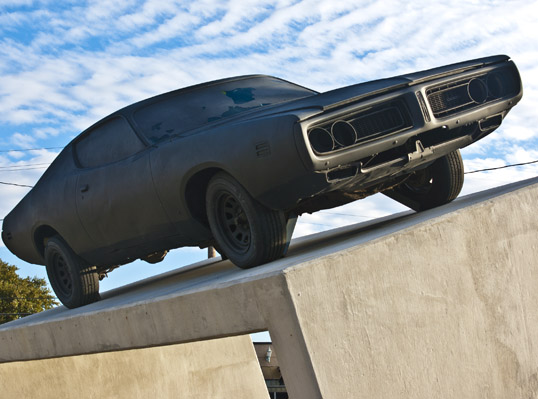
Design District Dallas, Texas

Freshman Physics

Fifty years later, Eugene remembered Professor Viper.

“You have to understand the difference between velocity and acceleration. Velocity is always positive, at least in the direction of motion, but acceleration can be positive or negative. You can be moving in one direction, very fast, but accelerating in the other direction.”

“Imagine you are in a Mustang, with a big supercharged V8, screaming down the road. But you swing the wheel, skid around backwards, and start smoking your tires. You are still moving, your velocity, down the road, but you are facing, and accelerating in the other.”

Eugene remembered perking up at this.

First, what a completely insane analogy. Professor Viper must have been some sort of car freak. Eugene wasn’t – he didn’t even have a driver’s license, let alone a car. It was like listening to an alien speak in English, but an alien way of looking at the world.

Second, well, he had done the same thing the night before. He had gone out for beers with a bunch of people and drank too much, stayed out too late. That was why he was nodding off in the lecture… until Professor Viper made the crazy analogy. Eugene and Martha has staggered out from the bar at closing time with all their friends and they had started piling into the car they had come in.

Eugene was worried because the driver had really been throwing them back. Then he spotted Frank, a quiet guy from the floor below – he barely knew, getting into his own car a couple parking spots down. He looked steadier than the others.

“Martha, let’s ride with Frank instead,” he said to his girlfriend.

“Why? We barely know him.”

“I think he’s sober.”

He was wrong. Frank was totally smashed. It was just that he was quiet and better at standing without swaying. But behind the wheel, he was a terror. His car was that heavy Midwestern hopped-up American hunk of steel and was very fast and very loud.

Eugene remembered sitting and sliding on the front bench seat with Martha between him and Frank as they roared down the street. They swerved through and intersection and skidded around in a three sixty with Frank and Martha screaming in drunken glee as the headlights swung in a wide arc and illuminated the terrified faces of the people in the other cars.

Somehow they avoided hitting anything and made it back in one piece. Eugene swore he would never get in a car with Fran and would always check his driver out and never ride with a drunk again. There was a lifetime of cabs in front of him and he was fine with that.

And now, the very next day, Professor Viper was talking about skidding and velocity and acceleration. It was all too much.

Class ended and Eugene walked up the hill to the dormitory where he and Frank lived. He called Martha and she said she might come over later, she was tired and hung over. There was a knock on his door and Matt, another friend that lived on Frank’s floor, came in.

“Hey Eugene, I wanted to tell you something.”

“What?”

“It’s Frank. I was talking to him. And he said he was going to steal Martha from you. He met her last night, you both rode back with him and he really likes her. He says he’s going to get her from you.”

“Really?”

“Yeah.”

“Jeez, what should I do?”

“I don’t know. I just wanted to warn you.”

And that’s what happened. Frank had that car and Eugene didn’t even have a license. He didn’t have a chance.

The two of them were married their Junior year and at graduation, Martha was eight months pregnant.

The three of them stayed in town after graduation, why go anywhere else? Fifty years. Frank and Martha split up in a few years and Frank left the state. Eugene never talked to Martha again, but the town wasn’t that big and he heard about her every now and then. Last year he discovered that she was not only a grandmother, but a great grandmother.

“Let’s see,” Eugene thought to himself, “A mother for twenty years, then a grandmother for twenty more… a grandmother at forty then a great-grandmother at sixty-something…” The math was easy. He was thinking about this, stretched out in his hospital bed, when the machine on the stand to his right gave a chime and made a whirring noise.

The dose moved down the tube into the needle on the crook of his arm and everything went warm and fuzzy and the half century old memories that seemed so crystal clear went away. Eugene shook his head to try and bring them back. He wondered if they ever would return.

“The degree of slowness is directionally proportional to the intensity of memory. The degree of speed is directionally proportional to the intensity of forgetting.”
― Milan Kundera, Slowness

Sunday Snippet, Witness Protection by Bill Chance

“It is forbidden to kill; therefore all murderers are punished unless they kill in large numbers and to the sound of trumpets.”

― Voltaire

Rusted with Gun Deep Ellum Dallas, Texas

Witness Protection

Nile Franks had always wanted to be a G-man. He read stories of the FBI when he was a kid and dreamed of the badge, the gun, and the mysterious respect. Nile was a handsome, athletic and smart kid and was able to work relentlessly toward his goal.

After college he worked at a crime lab in his home state for a few years, until he was able to apply as a special agent. He was not able to make it into the FBI, but the Federal Marshals were hiring, so he decided to go that route.

He spent a few years in routine warrant execution and drug property seizure work. He kept to the straight and narrow, despite the temptations of corruption and received his notice of promotion to the Federal Witness Protection Program.

Nile received training in document production (since this was a Federal Program, they could issue new Social Security numbers and cards, even state driver’s licenses), witness relocation, and protection. After he finished his training and passed his exams, he was transferred to the department, where he met his supervisor.

“Well, Franks, welcome aboard,” Elmer Wynn said to him.

“Thank you sir,” Nile replied, “I am sure I’ll be able to do the job as required.”

“How was your training?” Wynn asked. “Do you have a pretty good idea about what we do?”

“Very clear sir, it was quite comprehensive.”

“Well, forget about it. The training we give is a bunch of shit. We don’t do anything like that at all.”

“Really?” Nile was shocked, what could possibly be different?

“Really. You realize that all the people in the program are actually criminals? The worst of the worst. And they are all snitches. That makes them the worst of the worst of the worst.”

“Well, yes, I know that. But… Well, sometimes… We have to deal with… for the better good.”

Wynn snorted. “For the better good? Exactly.”

There was a long pause while Wynn looked Nile up and down.

“You know Franks, if you don’t want to do this job you need to leave, leave now, before I go any further.”

Nile was stunned. What the hell was Wynn talking about? But he had come too far already.

“No, sir, I do want to do this job.”

“Alright then. Now, Franks, do you think it’s strange that in this day and age, with everything connected together, with cameras everywhere, with privacy a thing of the distant past… Don’t you think it’s strange that we are able to make one person disappear without a trace and another brand new one appear out of thin air?”

“Well, I know the job is difficult….”

“Difficult my ass… it’s impossible. And our budget. It’s cut every year. Year after year.”

“Well, OK, but….”

“But what? Shit, things were getting so much out of control, a few years ago, we were losing our clients, we couldn’t hold it together. We had to do something. For example, in the next room, a very secure soundproof room is a New Jersey developer. He made a fortune building projects all over the state. His biggest expense, more than concrete or steel or labor, was bribing every official from the zoning board to the governor. He said, ‘that’s just how things work.’ Every mobster on the east coast is looking for him. They know we have him. What do you think the odds are that we can get him anywhere safely?”

“He can go out west.”

“Out west? You gotta be kidding me. There is no ‘out west.’ Time has sped up and space has disappeared. We will work our asses off and spend our whole budget and he won’t last a year. And he doesn’t deserve a year.”

“What can we do?”

“Do? We figured it out. It’s simple, really. Cheap, foolproof.”

Wynn reached into a desk drawer and removed a service Glock, checked the chamber, and set the gun down on the desk between them.

“He’s in the next room, take care of it.”

“What? That’s insane!”

“No it isn’t. He’ll disappear – just like he’s supposed to. We have it all arranged. Nobody will know, nobody will suspect, everybody will think we did our jobs perfectly. We can spend the travel budget on ourselves. You every want to go to Seattle? It’s nice this time of year.”

“That’s impossible. I would never do such a thing.”

“That’s what they all say. I’ve heard it before. About a third of the agents they send us really can’t do it. But of course, we can’t have that. We can’t have anyone knowing the truth.” Wynn picked the Glock back up.

“What do you mean? You’d kill me?”

“I told you to think hard before we had this conversation. We’re the Federal Government. We know how to make people disappear. Anyone. It’s your choice. Right now. Him or you.”

Wynn placed the Glock back down on the desk. Nile picked it up and turned it around in his hand.

He knew what he had to do. He had no choice.

Sunday Snippet, Freight Elevator by Bill Chance

“When the elevator doors open there is only one other person inside it, a homeless man with electric blue sunglasses and six plastic grocery bags filled with rags. “Close the doors, dammit,” he yells as soon as we step inside. “Can’t you see I’m blind?”

…….

From the back, the homeless man shoves between us, his bounty rustling in his arms. “Stop yelling,” he shouts. though we stand in utter silence. “Can’t you tell that I’m deaf?”

― Jodi Picoult, My Sister’s Keeper

Dallas, Texas

Freight Elevator

“Well, are you ready to call it a night?”

“Not really.”

“Do you want to go to an after hours bar or something?”

“Not really.”

“I’ve never been to where you live. Can we go to your place?”

“I still live with my parents, you know that. Their apartment is tiny, I sleep on a futon in my mother’s sewing room. I’ve never been to where you live either. You live alone. We have to go there.”

“But my apartment is… really small.”

“Is it clean?”

“Of course. But…”

“It’s big enough then.”


I had always wanted to live in the center of the city… on the island itself. I was tired of feeling like an outsider, a tourist. But rents were so high and I never had and will never have any money. For a year I rode that interminable train ride, rocking elbow to elbow with the other strap-hangers. I would look through the rental listings, hoping, hoping. Finally….

Walking to meet my new prospective landlord past the block after block of tents filling the sidewalk, most a bilious purple-orange color. The government has spent untold millions on buying thousands of tents to “solve” the homeless problem and distributed them – surprised when they were snapped up and the population living on the streets blossomed even more. I looked at the rows of nylon and filth and wondered if I could do that. I have camped a lot over my life but never on a sidewalk beneath the glass canyons of downtown. A lot of valuable parking was taken up by bathroom trailers provided by the city that had necessities and showers, but still….

The address on the listing was a huge hulking brick building. It looked like an ancient factory, divided up into a filing cabinet of tiny living spaces. There were very few windows and only one door. I was repelled at first, but realized that a place at this affordable price was not going to be in a new shiny glass tower with a grid of balconies repeating up into the sky. This was my dream, but it was going to be modified by the real world.

“You are right,” the rental agent said, “this used to be a factory. I have no idea what they made here, but whatever it was, it was huge, as you will see.”

We walked through a maze of sheetrock walls, obviously thrown up to divide some massive assembly room into a warren of rented cubicles. We arrived at a wall that was taken up by a giant steel vertical door with a peeling number “1” stenciled onto it. Of to one side was a single simple round button with an upward facing arrow. The rental agent pushed this. There was a heavy shuddering and a low loud metallic groan. After a minute of this the door slowly raised up, revealing a shallow space delineated off by a translucent plastic divider. In the middle was an ordinary door, with a peephole. It was labeled 1-12 A.

“Well this is it,” the rental agent said. She took out a key and unlocked the door.

“I don’t understand.”

“Like I said, the factory made huge, giant, heavy, something-or-others. They moved them up or down on this gigantic freight elevator. Other than the stairs, it’s the only way to reach the upper floors in this part of the building. Since it was now being used for pedestrians most of the elevator was wasted space. We built this partition and were able to rent out the area behind it. Come on in, take a look.”

“The walls are metal mesh?”

“The back and side walls, yes. But beyond them are only concrete. There is actually a kind of window in back between every two floors. It lets in a nice light as you go past.”

“It moves?”

“Of course it does. All the other residents us it to get up and down. But there is the partition and a locked door.”

“The partition doesn’t look all that opaque.”

“Oh, there’s enough for privacy. And you can make as much noise as you want. You can play music. Folks on an elevator don’t care about that.”

“I see the stove and ‘fridge. But no sink. And no bathroom.”

“On eleven you have access to an old janitor’s closet. A big sink, and we put in a shower and toilet. It’s yours. Your door key fits. Just go up to eleven, get off, down the hall, one left, then a right. I’ll show you.”

“I don’t know if I can live in a place like this. It goes up and down. People at the front all the time. It’s crazy.”

“It’s cheap.”

“It’s the only place I can afford.”

“I’ve heard that before.”


Well, it turns out she loved my apartment. She liked the feeling of going up and down so much that, late at night, when the other people were all home asleep she’d go out the front door and push all the buttons. That would keep my place moving for a while. She loved watching the concrete walls slowly shift up and down.

She crawled out of the hatch on top and put plants on the window sills so she could watch those go by. She bought a watering can with a long spout so she could drip water through the mesh into her plants as we moved past them.

The only problem is that she likes to make a lot of noise in bed when she think people are in the elevator up front. She rearranged the lamps so that we sometimes throw obscene shadows on the translucent wall. It bothers me a little but nobody’s complained yet.

As a matter of fact I think she likes this tiny apartment more than me. If we broke up, I’m afraid she would throw me out.

And I’ll never find another place I can afford.

Sunday Snippet, Morning Routine by Bill Chance

To sleep: perchance to dream: ay, there’s the rub;
For in that sleep of death what dreams may come
When we have shuffled off this mortal coil,
Must give us pause: there’s the respect
That makes calamity of so long life;

—-William Shakespeare

Dealey Plaza, Dallas, Texas

Morning Routine

Gregory had not always been an organized person. He lived most of his life in a haphazard desultory way, never sure of what came next. When his wife told him, “I can’t live like this any more,” left for California with the twins and moved in with the lawyer she had met online, he realized he had to get his shit together.

He went to seminars and read piles of books. He listened to podcasts and hired a personal organizer. He decluttered. He downsized and organized, planned and simplified. Most important of all, he made up routines.

By setting up routines he eliminated personal choice in what he did. It was a way to battle back against his natural tendency to chaos. If he could put reality into a series of carefully thought out and designed checklists he could keep disaster at bay. Gregory decided he wanted life to be smooth and planned – all risk and decision eliminated.

His personal organizer gave him a series of printed forms that fit into a binder which covered every possible aspect of every day. She helped him brainstorm, fill out the checklists, then edit and extend them until every hour of every day was planned out ahead of time and he didn’t have to decide what to do next – it was all in black and white. He discovered that once he had settled on a routine he didn’t have to look at the paper any more. It was seared into his memory and after a few days it ripened into an irreversible habit.

The alarm on Gregory’s phone beeped at six AM and after one and only one tapping of the snooze he hopped out of bed to begin his morning routine. He drank the ice water he had placed in an insulated steel tumbler on his nightstand the night before. He moved to the tatami mat next to his bed and did a short series of stretches with a foam roller. He checked the clothes that he had chosen before he went to bed and laid them out on the bed. Then it was into the bathroom. He pushed the electric shaver around on his face and then flossed. He started the water in the shower to allow it to warm up as he brushed his teeth. Then into the shower.

In the old days, he would luxuriate under the hot water, leaning against the tile as the warmth poured over him, enjoying the feel of the droplets against his skin. Thoughts of the day before, the day coming up, and strange random memories from far in his past would joust in his mind for a few split seconds of attention. His wife would get angry because he would waste so much time in the shower and use up all the hot water. Not any more. He washed himself quickly and efficiently, using a minimum of time and cleaning products.

Stepping out, he dried himself with a clean towel hung on a hook. Then he used a small hand towel kept by the mirror to clear a spot in the fogged glass so he could groom his hair with the comb kept in the holder right at hand. A stick of deodorant came out of a handy drawer – it was the only item in there – and he was done in the bathroom

He stepped naked back into his bedroom and sat in a chair he had placed next to the spot where he had laid out his outfit for the day. He had only one task left before he could get dressed and head out for the day.

Next to the chair was a small, sturdy table with a lacquered wooden box and a kitchen timer. The box had a combination lock built in and he moved the numbers to the proper setting. He twisted the timer to seven minutes and opened the heavy lid of the wooden box. Gregory lifted a Glock 19 9mm pistol out of the box, slid a full magazine into the gun, then pulled back on the slide – charging a shell into the firing chamber. He thumbed the safety so that the gun was ready to fire.

Gregory reversed the gun, stuck his thumb into the trigger guard, and then slid the barrel into his mouth. He closed his eyes and sat there, still, listening to the ticking of the kitchen timer. He felt the steel of the barrel between his teeth and ran his tongue around the opening at the end. He tasted the oily residue on the Glock and smelled the slight smoky odor left over from the last time he took the gun to the range. He breathed in through his nose and out through his wedged-open mouth, feeling his breath pass between his lips and the body of the gun.

His mind went to the decision he had to make, the one he made each day. Hamlet had said it best, “To be or not to be, that is the question.” Two columns appeared in his mind – the endless stream of checklists to navigate or the dark splotch of blood against his bedroom wall. The “strings and arrows,” or “that sleep of death.” Sitting there, clean and naked, with the Glock in his mouth, he could think clearly and dispassionately as he summed up the columns in his mind. Some days the decision was a close one.

But today, the timer gave off its little “ding,” and Gregory removed the Glock from his mouth. He turned the safety, removed the magazine, cleared the round and pushed it back into the cartridge. It wasn’t Saturday, so he didn’t clean the gun but simply wiped the saliva off with a cloth and replaced the gun, magazine, and cloth back in the wooden case, closed the lid, and randomized the numbers. Gregory put on the clothes that he had set out and walked through the door into another day.

Sunday Snippet, Swallowed by Nostalgia by Bill Chance

“being alone never felt right. sometimes it felt good, but it never felt right.”

― Charles Bukowski, Women

Klyde Warren Park, Dallas, Texas

Swallowed by Nostalgia

Craig was never very outgoing, never comfortable around lots of other people. He was surprised when he found himself married with two twin children. Then, all of a sudden, he was alone again, his ex-wife and kids out on the West coast, with a new husband and father.

Still, he had his friends. Not a lot of them, but the ones he had were close. He had his activities, his clubs, his scheduled events. Craig never felt like the center of the crowd, but he was there. He didn’t initiate a lot, but people would contact him, offer up events and activities, and he would go along.

As he grew older, he slowed down a bit, still not outgoing, but not a hermit by any means.

And then the pandemic hit… and it all went to shit.

One day, Craig realized he had not been out of his apartment in almost three weeks. His food was delivered, either cooked or groceries. Every day he’d collect his Amazon boxes – everything he needed and more. It was a reflex to search and click “buy now.” Craig felt like a cave man hunting woolly mammoths with a mouse, keyboard and credit card. After a while he turned the camera off on his work Zoom meetings and would usually nap during the long ones. Nobody seemed to notice.

He ordered blackout curtains for his windows and the highest rated noise-cancelling headphones. Sometimes he’d wear the phones without music, even though his place was quiet – simply to kill off any potential interruptions.

This went on, month after month and Craig began to go mad.

The present became more and more gray and blurred, but the past became crystal and colorful. Events from decades before floated up through his memory and wedged themselves into his consciousness. Especially things he regretted – not stuff that he did, but things that he didn’t do. These errors of omission, vacuums of courage, kept flashing in his mind.

The time a girl at a club gave him her number and he didn’t call… the job offer he turned down… the friends that went to an exotic location and he decided not to go with them…. All these and countless more kept coming back to him. In his mind, though, he went ahead and took the plunge. In his imagination he called the girl, took the job, went along. And reaped the reward.

But then, later, he would realize what had really happened, where he was, and who he had become. Sleep became something he feared, not because of nightmares but because of these triumphant dreams where he corrected the mistakes he had made. And this made the morning even more gray, even more useless.

His health provider kept sending him messages about the vaccine, but he ignored them. Why get the shot? He never left his apartment, was at no risk to himself or anyone else. He didn’t care anyway – if it killed him, it killed him.

Then one morning, after a long vivid dream of driving across the country in a sports car that he had decided not to buy once he woke up and scheduled his shot. It might stop the dreams. He left his place for the first time in months and was surprised at how easy it was to negotiate the paperwork and get the jab in the arm. He actually looked forward to the second, couldn’t wait until the three weeks were up.

It was a beautiful day when he got his second shot – the air with a bit of a chilly breeze but the sun out and hot – cutting through the cold. On a whim, he stopped in a park on the way back.

It was full of people, very few wearing masks. They were in groups, grilling, playing volleyball, kids running around, old folks walking, even a keg of beer next to a boom box (he guessed that the park rules were being bent after such a long time away).

He parked and walked the sidewalk on the circular drive looking at all the people. Live people. Noise. The chatter and music rose up. The smell of charcoal lighter and barbecue sauce. The feel of the cool breeze and hot sun.

It was back. He was back.

Sunday Snippet, Aliens Abduct Cheerleaders by Bill Chance

““You’re the hunter, the warrior. You’re stronger than anyone else here, that’s your tragedy.”

― Anne Rice, The Vampire Lestat

Sunset High School Cheerleaders

Aliens Abduct Cheerleaders

There are a few people in this world that everyone would consider to be a BADASS. Navy jet fighter pilots, gangsters, hitmen, boxers, bullies, Seal Team Six, high voltage repairmen… that sort of thing. Within that world of people that are badass there are a few that are REALLY BADASS. Think of a bell curve representing the amount of badass someone has – that right hand bit of tail and you have the badass people. Spread that out and you get another curve – to the right of it, the second derivative – and these are the most badass of the badass.

If you meet one of these people (and you better hope you never do) you probably would not even recognize their badassness – at least not right away. There is a saying among the super-badass, “They that do the mostest, talk the leastest.” They will never, never, ever talk about how badass they are. No tales of derring-do, no boastful bluster, no bombastic braggadocio. They are comfortable in their skin, confident in their abilities.

This is a small group, but among them are a handful of the most badass of the badass of the badass. These are the people that keep the badass of the badass up at night, send shivers down their spine. I’m not sure I know about all these people but I know six of them and I doubt there are very many more.

Who is more badass than these six? There is only one. He is not only the most badass person on the planet, he is an order of magnitude beyond; he is so badass that the word almost ceases to have meaning; he is made of pure badass.

He is Spencer Bowman.

Bowman carries an old fashioned pager. It only beeps – doesn’t even display the number calling. He may be the only person in a first-world country that still carries a pager like that.

One day, it beeped. Bowman stomped on the pager, shattering its plastic case, then dropped its remains off the first overwater bridge he came to. He drove his perfectly nondescript and average car to a working class suburb outside of DC and parked in front of a Speedometer Repair Shop in a run-down strip mall. He nodded at the middle aged receptionist and pressed a hidden button. A section of wall opened up and a stainless steel elevator appeared. The walls of the car had slits and Bowman nodded at them, knowing that an unseen man with a machine gun was behind each one.

At the bottom, deep underground, Bowman walked down a bare concrete corridor and pushed open a heavy steel blast door. Beyond was an ordinary drab government-issue office, with a bespectacled man at a desk. Not even Bowman knew what government agency ran this operation. It was so secret and dark it didn’t even have an acronym. Bowman suspected that not even the man behind the desk knew for sure who he worked for.

“Bowman, glad to see you again, have a seat,” said the man at the desk.

“What do you need me for?” was all Bowman said.

“You don’t waste much time, do you,” the man replied.

Bowman said nothing, not even a nod. It wasn’t really a question anyway.

“Well,” the man said, “aliens are stealing cheerleaders.”

“Really?”

“Really. Not just here, all over the world, though, of course the United States leads the world in Cheerleaders and most of the kidnappings are here. The total number isn’t huge, but it’s enough to worry… well, worry the people that know you.”

“And you want me to?”

“Find out why.”

“Maybe it is for breeding stock. There was a movie about that.”

“Probably not. They have mostly been taking female cheerleaders. But there have been a few male ones too. Actually, the ratio is pretty much the same as the total cheerleader population.”

“So, find out why. Anything else?”

“Well, it would be nice if you could get some back. If you can.”

The man handed Bowman a tiny, encrypted USB drive. Bowman already knew the password. And that was it.

There was a surprising amount of information on the drive. Enough for Bowman to figure out a couple of starting points. The government had a lot more data on the recent plague of UFO sightings than the public had been allowed to see. After a month of work, a series of educated guesses, and using some of his more exotic contacts, Bowman was able to figure out where the Alien’s base of operations was – an abandoned water pumping station in Dallas, Texas. The Aliens had a complex, subtle, and deep series of security measures protecting their base which Bowman was able to methodically and completely penetrate.

The Aliens resembled human beings in general, and their advance agents had established an odd cult of bizarre plastic surgery that made them able to… if not fit in, at least pass with their origins unguessed. Bowman reached the leader of the Alien mission with a maximum of stealth and a minimum of violence. They faced each other across an odd seven legged table lit by the unsettling greenish light of the Alien’s home planet.

“Spencer Bowman,” said the Alien mission leader.

“You know me,” said Bowman. Again, it was not a question.

“Of course, our knowledge of your society is more extensive than your own.”

“But why cheerleaders?”

“We need warriors.”

“Cheerleaders? Why not trained military? Or ninjas? Or snipers? Or at least gang bangers?”

“We are so very far advanced technologically that your crude killing methods are no longer relevant. Our weapons need a very specific and subtle mix of physical and mental capabilities and proclivities to operate efficiently. The Earth Cheerleading corps possess these qualities in greater accuracy than any other group we have found in any of the major galaxies.”

“But you can’t just kidnap people.”

“Kidnap? Oh you don’t understand. We present our proposal and they come along if they want.”

“But what if they refuse?”

“What if? Nothing. They return to their life.”

“What if they talk?”

“What if? Would any one believe them? Nope, they would end up a joke in the tabloids. And that’s the thing.”

“What?”

“Nobody has refused. No one. The call of destiny is strong. This is their purpose, they are perfect intergalactic warriors and when this is pointed out – the call is irresistible.”

Bowman knew he had the information he needed and it was time to escape. He turned away from the alien leader and fled out the door, taking every element of the situation in and avoiding the obvious traps. He was confident in his ability to get out of the alien headquarters unscathed and deliver his message to the government.

But Bowman was not prepared for what waited for him in the corridor beyond. There was Amber from the San Luis Obispo Wildcats in her red and blue uniform. She carried a Light Antimatter Laser Cannon and a Neutrino Shield. Next to her was Jeff from the Iowa City High School tumbling squad with a Quantum Saber glowing in his palms. Behind them stood their commander Crystal from The University of Virginia with a Superstring Grenade… just in case.

The fight didn’t last long. Withing a few seconds Bowman was reduced to a series of grotesque smears along a few feet of corridor. The Alien cleaning robot immediately emerged from a hidden closet and began scrubbing at the gore.

Spencer Bowman was without peer in the ranks of earth’s BADASS. But he was completely outclassed by Amber, Jeff, and Crystal, Intergalactic Warriors.