Daily Writing Tip 36 of 100, Don’t Warm Up Your Engines

For one hundred days, I’m going to post a writing tip each day. I have a whole bookshelf full of writing books and I want to do some reading and increased studying of this valuable resource. This will help me keep track of anything I’ve learned, and help motivate me to keep going. If anyone has a favorite tip of their own to add, contact me. I’d love to put it up here.

Today’s tip – Don’t Warm Up Your Engines

Source – The 38 Most Common Fiction Writing Mistakes by Jack Bickham

Such static or backward-looking approaches to fiction are probably lethal in a novel, and are certainly fatal in a modern short story. Readers today – and that of course includes editors who will buy or reject your work – are more impatient than ever before. They will not abide a story that begins with the author warming up his engines. If a setting needs to be described, it can be described later, after you have gotten the story started. If background must be given the reader, it can be given later, after you have intrigued him with the present action of the story.

Back in the day, classic literature didn’t have to do that. You remember the tomes you read in school that would spend page after page on backstory and description before anything remotely interesting would happen.

I used to pride myself on getting through this. It was true that the payoff at the end was usually worth the work up front.

But now I’m getting too old. I don’t have enough time left for all this. I used to always finish every book I started. Now, though, if I’m not into it within the first few pages – that’s all she wrote.
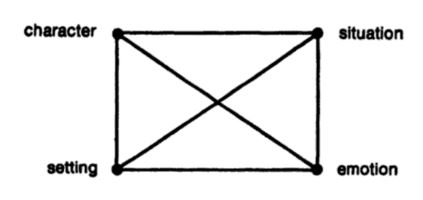
Daily Writing Tip 35 of 100, The Quadrangle: Character, Setting, Situation, Emotion

For one hundred days, I’m going to post a writing tip each day. I have a whole bookshelf full of writing books and I want to do some reading and increased studying of this valuable resource. This will help me keep track of anything I’ve learned, and help motivate me to keep going. If anyone has a favorite tip of their own to add, contact me. I’d love to put it up here.

Today’s tip – The Quadrangle: Character, Setting, Situation, Emotion

Source – Creating Short Fiction by Damon Knight

quad

This time, let’s say, you’re thinking about an orphan who has found a loaded revolver in a garbage can. That’s an intriguing situation, but you have no idea where to go from there.

Try making a list of four things the orphan might do next. If you write down the first four things you think of, maybe they come out something like this:

  • Hold up a liquor store
  • Kill somebody
  • Kill himself
  • Throw the gun away

Now cross out all four. Think of the fifth solution, the one that is not obvious.

Suppose your fifth solution is:

  • Give it to somebody

All right, to whom dies he give it? Out of the silent half of your mind an image swims up: a woman who is being abused by her husband.

Now you have a sense of what the emotional charge of the story will be. (If you don’t feel any strong emotion about this ending, it’s the wrong one; find a sixth solution, or a seventh.)

I like the idea of throwing out the first four, or more, obvious ideas to try and find the one, true story.

Daily Writing Tip 34 of 100, The Open-ended Writing Process

For one hundred days, I’m going to post a writing tip each day. I have a whole bookshelf full of writing books and I want to do some reading and increased studying of this valuable resource. This will help me keep track of anything I’ve learned, and help motivate me to keep going. If anyone has a favorite tip of their own to add, contact me. I’d love to put it up here.

Today’s tip – The Open-ended Writing Process

Source – Writing With Power by Peter Elbow

The open-ended writing process is at the opposite extreme from the direct writing process. It is a way to bring to birth an unknown, unthought-of piece of writing-a piece of writing that is not yet in you. It is a technique for thinking, seeing, and feeling new things. This process invites maximum chaos and disorientation. You have to be willing to nurse something through many stages over a long period of time and to put up with not knowing where you are going. Thus it is a process that can change you, not just your words.
***
To begin the sea voyage, do a nonstop freewriting that starts from wherever you happen to be. Mosyt often you just start with a thought or a feeling or a memory that seems for some reason important to you. But perhaps you have something in mind for a possible piece of writing: perhaps you have some ideas for an essay; or certain characters or event are getting ready to make a story. You can also start by describing what you wish you could end up with. Realize of course that you probably won’t. Just start writing
***
Keep writing for at least ten or twenty or thirty minutes, depending on how much material and energy you come up with. You have to write long enough to get tired and get past what’s on the top of your mind. But not so long that you start pausing in the midst of your writing.
Then stop, sit back, be quiet, and bring all that writing to a point. That is, by reading back or just thinking back over it, find the center or focus or point of those words and write it down in a sentence.
***
Now repeat the cycle.

What great advice!

Sometimes I write a story with the entire thing preplanned in my mind (or in an outline on paper) and sometimes I start out staring at that blank page with no idea where I’m going. I have to admit, the unknown voyage, for me, usually ends up stranded on the rocks somewhere, taking on water fast – about to sink. I like how this teacher seems to systematize the usystemic – to organize the chaos.

I like the idea of, “start by describing what you wish you could end up with.” Of course the next sentence is frightening.

I’m going to have to study his technique and see how it works for me. At any rate, it will give me a dollop of badly-needed confidence.

Maybe you would want to do the same.

Daily Writing Tip 33 of 100, Learn About the Hero’s Journey

For one hundred days, I’m going to post a writing tip each day. I have a whole bookshelf full of writing books and I want to do some reading and increased studying of this valuable resource. This will help me keep track of anything I’ve learned, and help motivate me to keep going. If anyone has a favorite tip of their own to add, contact me. I’d love to put it up here.

Today’s tip – Learn About the Hero’s Journey

Source – The Hero with a Thousand Faces by Joseph Campbell

It has always been the prime function of mythology and rite to supply the symbols that carry the human spirit forward, in counteraction to those constant human fantasies that tend to tie it back.

Anyone that creates anything should read and study Joseph Campbell and the ideas of the universal myth and hero’s journey. Just be careful about it.

My personal opinion is that the use of the Hero’s Journey Monomyth as the only legitimate scaffold on which to build a plot is oversimplified and overused. If I have to see or read one more story where the protagonist has to (or appear to) “die” at the climax of the story only to be reborn as a great hero… well, I’m sure I will see it more than one more time. Everything – especially big budget films and young adult novels has to follow this same script or it won’t get made.

I think sometime I will work at scouring my dreams and fears and come up with my own monomyth. Maybe everybody should do that.

Daily Writing Tip 32 of 100, Exhaustion

For one hundred days, I’m going to post a writing tip each day. I have a whole bookshelf full of writing books and I want to do some reading and increased studying of this valuable resource. This will help me keep track of anything I’ve learned, and help motivate me to keep going. If anyone has a favorite tip of their own to add, contact me. I’d love to put it up here.

Today’s tip – Exhaustion

Source – On Writing, by Stephen King

The bigger deal was that, for the first time in my life, writing was hard. The problem was the teaching. I liked my coworkers and loved the kids – even the Beavis and Butt-Head types in Living with English could be interesting – but by most Friday afternoons I felt as if I’d spent the week with jumper cables clamped to my brain. If I ever came close to despairing about my future as a writer, it was then.

There are so many days that I plan on writing in the evenings, but as I stare at the terrifying blank screen I realize I am too exhausted to think, let alone write. I’m sure everyone that has to provide feels the same way.

I don’t have a solution, sorry. The only advice I can offer is to cheat – to find nooks and crannies of time where you can scribble before the day is wasted. Television is the enemy, too… I find if I even glance at the tube I’m not going to get any writing done – it sucks the ideas out and chews them to death.

What’s the old typical awful advice? — Oh yea, You are are going to have to buckle down. Buckle down? That’s not very useful, is it?

Unfortunately, I haven’t come across anything better.

Daily Writing Tip 31 of 100, A Future For The Novel

For one hundred days, I’m going to post a writing tip each day. I have a whole bookshelf full of writing books and I want to do some reading and increased studying of this valuable resource. This will help me keep track of anything I’ve learned, and help motivate me to keep going. If anyone has a favorite tip of their own to add, contact me. I’d love to put it up here.

Today’s tip – A Future For The Novel

Source – For A New Novel essays on fiction by Alain Robbe-Grillet

It seems hardly reasonable at first glance to suppose that an entirely new literature might one day – now for instance – be possible. The many attempts made these last thirty years to drag fiction out of its ruts have resulted, at best, in no more than isolated works. And – we are often told – none of these works, whatever its interest, has gained the adherence of a public comparable to that of the bourgeois novel.

This essay was written in 1956, sixty years ago – a year before I was born. It could have been penned yesterday.

When Alain Robbe-Grillet espoused on how the public fancied the bourgeois novel I’m sure he never imagined the extremely popular horror of the young adult genre. I guess it’s good that people are reading, even if they are reading Pablum… but still.

Of course, there is plenty of unique stuff out there. For example, Alain Robbe-Grillet’s work. I stumbled across his unique novel Jealousy… and loved it – I even found it entertaining. Many don’t.

So be it.

That’s one good thing about literature – everything that has been written (pretty much) is still out there. Sure, the teenagers or the book club ladies might not be gobbling up the avant-garde, but it is still there in an obscure dusty library or a musty used bookstore or Amazon or Abebooks or some slightly crazed but trusted friend (get with me if you want).

It’s all there.

And maybe we can work on adding to it.

Daily Writing Tip 30 of 100, So What’s It All About – This Fiction?

For one hundred days, I’m going to post a writing tip each day. I have a whole bookshelf full of writing books and I want to do some reading and increased studying of this valuable resource. This will help me keep track of anything I’ve learned, and help motivate me to keep going. If anyone has a favorite tip of their own to add, contact me. I’d love to put it up here.

Today’s tip – So What’s It All About – This Fiction?

Source – About Fiction by Wright Morris

All novels are burdened by the need to make life more interesting than we find it. The means the novelist has to do this are limited, but the reader’s appetite is insatiable. He wants something of interest. He seeks something of value. The writer can only confront him with words. Words and more words.

I hate that feeling when there is a word that I need, an exact word, to describe something that I need to tell about. I can feel the meaning and its mystery bothers me like a bug in my throat. After thesaurusing and googling and tearing my hair out I suddenly realize the word I want is in my mind – but otherwise doesn’t exist.

At that point I have to throw the writing out. There is no way I am going to get past that point. There are only twenty six letters (give or take) anyway – how can anyone be expected to write anything new and interesting with the same twenty six symbols that everybody else has already used – in millions and millions of works before.

The author of today’s quoted work, Wright Morris, wrote one of the most influential books (on me) that I have read – Ceremony at Lone Tree. One reason it was so memorable, unfortunately, is it is the only book I read in school because I had to that I thought was worth the paper it was printed on. Pretty much.

Daily Writing Tip 29 of 100, Triage

For one hundred days, I’m going to post a writing tip each day. I have a whole bookshelf full of writing books and I want to do some reading and increased studying of this valuable resource. This will help me keep track of anything I’ve learned, and help motivate me to keep going. If anyone has a favorite tip of their own to add, contact me. I’d love to put it up here.

Today’s tip – Triage

Source – Revision, By Kit Reed

If consistent negative readings and a number of rejections have shaken your faith in a piece of work, then it’s probably time to cut your losses. This doesn’t mean throwing it out. It means putting it away. In the time you spend working on something new, work that’s put aside will either get stronger in your imagination or it will die quietly. Either way, you win.

I have a growing pile of half-written stories. Most of these have outlines with their full plot pretty much planned out. When I started each of these I was enthusiastic, each and every one. I felt that I had an idea that had to be written. But as the page count grew the ideas became stale and eventually spoiled. I said to myself, “What the hell was I thinking?”

Periodically I go back to this list of half-written nonsense in the hope, as the author above suggests, that they will become stronger in my imagination.

They never do.

Daily Writing Tip 28 of 100, Letter From A Place You’ve Never Been

For one hundred days, I’m going to post a writing tip each day. I have a whole bookshelf full of writing books and I want to do some reading and increased studying of this valuable resource. This will help me keep track of anything I’ve learned, and help motivate me to keep going. If anyone has a favorite tip of their own to add, contact me. I’d love to put it up here.

Today’s tip – Letter From A Place You’ve Never Been

Source – Writing Without The Muse by Beth Baruch Joselow

Imagine yourself on a journey to a place you have never visited before. It’s striking! There are so many _________ . And the quality of the ____________ is amazing! You’ve never seen anything that looked like the ___________ . This is a place to write home about. Write a letter to someone you like, telling her all about your surroundings.

I used to collect odd postcards. I’d write fictional messages on the back and send them in the mail to people I didn’t know chosen at random from phone books (this was before the Internet). Simple, cryptic messages.

The sea here is a green the color of the ferns in Aunt Penelope’s (you remember her, I’m sure, Ha!) side garden. Matilda and I sit all day and talk about the handball championships and drink fruity concoctions that Juan brings us on a little tray.

Really wish you were here, though things might be awkward between you and Matilda, because… well, you know.

Love and Sweetest Memories, Sally

Maybe I should try this again? Nobody sends postcards any more – when is the last time you received one, a real one, in the mail?

Sounds like fun – but I haven’t bought a stamp in years.

Daily Writing Tip 27 of 100, The Very Very End: The Last Paragraph

For one hundred days, I’m going to post a writing tip each day. I have a whole bookshelf full of writing books and I want to do some reading and increased studying of this valuable resource. This will help me keep track of anything I’ve learned, and help motivate me to keep going. If anyone has a favorite tip of their own to add, contact me. I’d love to put it up here.

Today’s tip – The Very Very End: The Last Paragraph

Source – Beginnings, Middles & Ends, by Nancy Kress

Because the last paragraph of a short story is the power position – and within that position, the last sentence is the most powerful of all. Often – not infallibly, but often – the last sentence or paragraph evokes the theme of the entire story.

My favorite example of the power of the final paragraph and final sentence in a short story is in one of my favorites – Life After High School, by Joyce Carol Oates.

I wrote a blog entry about it years ago – you can read that here. You can read a PDF of the story here.

It is an example of a fantastically well-written work that manipulates the reader into thinking it’s one type of story – then turns you into thinking it’s another. And then the final sentence – and you realize (if you are reading carefully to the end) that it’s something completely different again – full of unexpected horror and meaning.

Read it. All the way through. I dare you.