Casting the Runes

The other night, I couldn’t sleep, walked out to the living room couch, and switched on the television. Hoping to find something relaxing I cruised the digital cable channels (a bad habit of mine) until I stumbled across a movie about to begin, way up in the five hundreds, that looked interesting.

It was called Curse of the Demon (British title Night of the Demon [better, huh]) and was supposed to be a minor classic of British horror filmmaking. Though it is very British in style, it starred Dana Andrews. Whenever I hear that actor’s name I think of the line from The Rocky Horror Picture Show, “Dana Andrews said prunes gave him the runes, but passing them used lots of skill“. I didn’t make the connection at first.

The Monster from Curse of the Demon

The Monster from Curse of the Demon

Thankfully, the movie didn’t take long to get going; in the first few scenes a man walking down a road at night is pursued by a demon that knocks down some handy power lines and then tears the poor victim to pieces. The final few seconds of the rubber mask looking thing was silly in a late-night television sort of way, but the first appearance of the demon was really excellent and chilling, brilliant.

The movie continued and it was good. Very well done, very British, dated a little, but not too much… just right actually. Exactly what I wanted to see. I was relaxed, watching when something really caught my ears. It was during the mandatory seance/hypnosis scene (Mandatory in all quality black and white horror films) when the man under the trance suddenly shouted out, “It’s in the trees… It’s coming!” It’s always fun when you unknowingly stumble across the source of a sound sample from a familiar and beloved piece of music. That clip, “It’s in the trees… It’s coming!” is, of course, the opening sample from Kate Bush’s Hounds of Love. Greatness.

After the film ended (complete with Hitchcockian maneuvering over a slip of paper in a train compartment and a final appearance of the demon as comeuppance) I was interested enough to do some snooping of my own. I found that the film was loosely based on a short story, Casting the Runes by M. R. James. That, of course, helped me realize that Dr. Frankenfurter’s lyric, “Dana Andrews said prunes gave him the runes, but passing them used lots of skill” was taken from the film/story.

I checked the Richardson Library and found they had a book of James’ short stories with Casting the Runes, so I checked it out. The short story is creepier than the movie, by necessity more trim and compact, with a couple of efficient horrifying scenes (the kid’s party, the mouth with teeth under the pillow). I later found an online version of the story here.

It's in the trees! It's coming!

It’s in the trees! It’s coming!

Late night black and white British horror movie, sampled by Kate Bush for her classic album, referenced in Rocky Horror, inspired by slick little short story sitting on my library shelf – one of the thousands upon thousands of unknown books… in the SF section no less. Now it’s time to go to bed.

A really well done YouTube Video Combining scenes from Night of the Demon with Kate Bush’s Hounds of Love.

Big Man Japan

Another review of a movie you (probably) will never see.

Why do I do this? Everyone in the world is out waiting in line to see the last Harry Potter film (I’ve only read one of the books and seen two and a half of the films) while I’m holed up with my laptop when I should be asleep and here I am watching another WTF stranger than strange bit of Netflix Streaming. The last two movies I’ve seen (and, more important, written about) have been Quintet (a candidate for worst movie ever) and now, Big Man Japan.

I know its a cult hit – but I’ve never met anyone that admitted to actually seeing Big Man Japan. I don’t even know how I came across it – probably fell into some webpage that mentioned that it was on Netflix and I couldn’t resist.

Now, I used to see a lot of film and read a lot of movie reviews. The problem is that too many reviews, especially written ones, simply outline the plot of the film in detail and that ruins the whole thing, doesn’t it? So I quit reading reviews until after I had seen a film. My idea is to go in blind, sit there knowing nothing, my brain an empty vessel to receive the cinematic genius unfettered by previous knowledge or expectation. The only problem is that about the time I decided on this course of action I ran out of money and time and hardly ever get to see anything anymore. Anything except when I lose my mind and stay up all night to watch weird stuff like “Big Man Japan.”

Therefore, I don’t want to talk too much about plot details. It would be interesting to see this film without knowing anything at all. It would be interesting, but you’d be pissed at me because I made you waste almost two hours of you precious life on this weird shit. So I guess, as a public duty, I should provide fair warning.

You see, the first third of the movie is a documentary-type exploration of Masaru Daisato, a middle-aged long-haired Japanese loser. His wife has left him and he scrapes by in a cluttered place eating rice and dehydrated seaweed. He carries one of those little folding umbrellas everywhere. Cryptically, he says he likes the umbrella and the seaweed because, “It only gets big when you want it to.”

Everybody hates this guy, they stare, they throw garbage into his yard, and spraypaint insulting graffiti wherever he goes. His wife has left with his daughter, there is a rusting swing set peeking out from the bags of trash outside his house.

He talks about his job. He makes about 5,000 a month (five thousand what… I don’t know) and wishes he made 8,000. He says that there isn’t as much business as there used to be. Though he doesn’t work much, he can’t travel. He has to be on call all the time. He seems to have a problem with the United States for some reason.

About a half-hour in we find out what his job is. He is a hero. They clamp electrodes to his nipples and shoot thousands of volts into his body and he grows into a huge, hairy, chubby guy with a bad haircut and a piece of pipe for a club. Then he goes out and fights giant monsters.

These monsters are tearing up Japan like Godzilla, except that nobody seems to care much about it and nobody seems to get hurt. The monsters are strange, disgusting, bizzaroids with strangely human faces (one has to keep flipping his combover as he tears buildings up by their foundation). The fights are filmed, but they air on television at two in the morning and the ratings are terrible. His agent tries to find sponsors to plaster advertisements on his chest and back to bring in an extra income – but he is so incompetent, cowardly, and unattractive the sponsors are hard to find and harder to keep.

The Strangling Monster

The Strangling Monster

Okay, this sort of thing goes forward, getting odder and odder (I’m leaving a lot out, trust me), until the final climax occurs and then, I’m warning you about this, the whole thing really veers off into truly WTF (and I don’t mean Win The Future) land. It’s pretty stunning, really. I’ve never seen anything even remotely like this. All through the movie you can’t help but wonder how serious the movie maker is. Is this a somewhat serious exploration of Japanese Culture, Capitalism, Monster Movies, Religious Ceremony, Ramen Noodles, Asian Pop Culture, Ozu, our treatment of the Aged, Reality Television, Fame, Heroism, and many other issues… or is this simply a big joke thrown in our face.

The last part of the film leaves no doubt.

It’s sort of genius, really, in a sort of sick, ridiculous, and annoying way. The only problem is that by that point I had actually come to care about Masaru Daisato. The scene where he takes his pixelated daughter to the zoo is heartbreaking. I wanted him to find redemption. I wanted him to defeat his enemies and win the girl.

And that is what the film ultimately skewers – the viewer’s expectations.

Does watching strange stuff like this stretch the mind, or is it only a lonely excuse for killing some time when I should be sleeping, waiting in line at Harry Potter, or out drinking?

Oh, one last thing. Peggy wrote the other day about remakes. It appears that a Hollywood studio has bought the rights to remake Big Man Japan. Or will it be a reboot?

Big Man Japan

Big Man Japan, ready to transform.

The movie answers one long-nagging question. When the hero grows to monster size, where does his clothes come from? In Big Man Japan it is answered. A trunk with a pair of giant purple nylon underwear inside follows the hero around. Before he is juiced up to giant size, the shorts are raised up by a winch onto two poles and the hero stands inside these, so when he grows, he he attired.

Quintet

Some say the world will end in fire;
Some say in ice.
—- Robert Frost

Ok, I’m going to write about a movie you will never see. I can’t really call it a review – the movie sucks so much and in such an interesting and ambitious way that it isn’t really reviewable. I knew it sucked – had known it sucked for decades. That doesn’t mean I didn’t want to see it. That doesn’t mean I didn’t enjoy watching it (Maybe I did, maybe I didn’t).

I’m not sure why I even bothered to watch it. Or why I even bother that it exists. I could write about a fictional movie. You’re not going to see this one anyway – so who cares if it actually exists. If nobody except me sees a movie-does it even exist?

This movie that you aren’t going to see is called Quintet and it stars Paul Newman and is directed by Robert Altman. When I think of science fiction dystopian film making… I always think of Robert Altman. It was made in 1979 – a year after I graduated for the last time.

Quintet

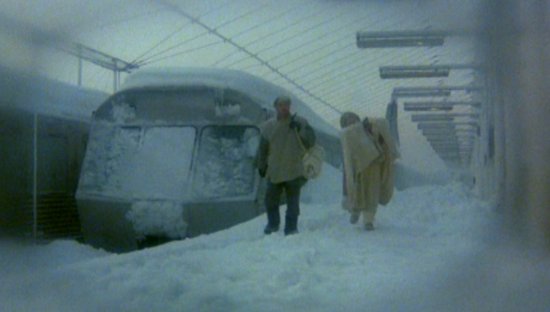
A scene near the begining of Quintet. Don't think I blurred the edges of the frame for artistic effect - I didn't. The whole movie looks like that. They must have used a gallon of vaseline on the lenses.

Back then I used to love to read the movie reviews in Time magazine. I think I enjoyed reading the reviews more than seeing the movies. Remember, this was long before the Internet – information was scant then. You tended to believe what you read.

Now we know better.

So I read the reviews of Quintet. It was a big deal – Paul Newman, Robert Altman, all-star international cast. With all this going for it, with all this at stake, it couldn’t suck. But it did. They didn’t really come out and say that – but we all knew how to read between the lines.

I bought my first television cable in about 1980. That was when HBO was still called Home Box Office. Quintet was on, but I only saw a few minutes of it. It actually looked like something I might enjoy – odd, eccentric, but entertaining in a quirky sort of way.

I was wrong.

Now, all these decades later, we have Netflix – and I’m able to watch this old chestnut in the privacy of my own laptop.

1979 were pre-global warming days – when it was assumed the world would end in ice, not fire. In the film, ice has taken over and the world is about to freeze solid. Everyone has given up and is waiting around to die. Paul Newman arrives from the wilderness – the prototypical outsider of the dystopian tradition – with a young pregnant wife. This should be a big deal – but nobody cares about anything. They go on playing this game, Quintet, and the losers get slaughtered and literally fed to the dogs.

ext for the image, e.g. “The Mona Lisa”

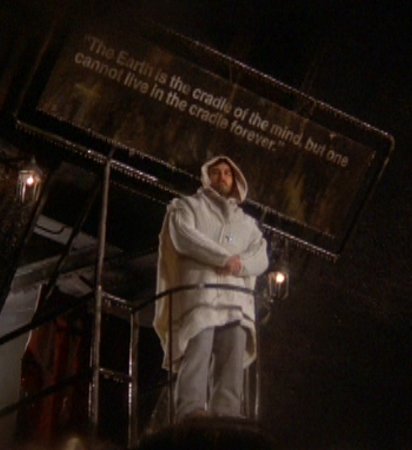
"The earth is the cradle of the mind, but one cannot live in the cradle forever." What the hell does that mean? I suspect very little.

The only interesting character is killed off thirty minutes in.

The move has a languid pace and an interesting frozen broken down look – but in the end, nobody gives a damn about anybody.

So why should we?

Another scene from Quintet

Paul Newman and Fernando Rey enjoying a hearty drink together. At least the beer is cold.